Starting with the 1860 election, Pennsylvania had an exceptionally long record of loyalty to the GOP, with Simon Cameron, a former Democrat, running the first Republican machine. This started a string of Republican state bosses and indeed the Philadelphia machine had quite a reputation for corruption. Pennsylvania did not even vote Democratic in the three-way 1912 election, rather Bull Moose Progressive Theodore Roosevelt won the state. Republicans were typically able to keep numerous working-class voters happy through tariff policies that benefited the prominent industries of state and served to raise wages but at the same time these policies raised costs of goods. Joseph Finch Guffey (1870-1959) was for many years in the minority in Pennsylvania as a Democrat. He hailed from a strongly Democratic family and made a key connection when he attended Princeton University and befriended Woodrow Wilson, whose political career he strongly supported. Guffey was both active in business and politics, being, rather unconventionally at least in the eyes of modern liberals, an oil executive, heading up the Guffey-Gillespie Oil Company beginning in 1918. He was instrumental in swaying the Pennsylvania Democratic delegation to supporting Wilson at the 1912 Democratic National Convention, much to the consternation of his party boss uncle, who was backing House Speaker Champ Clark (D-Mo.) (Hill).
Guffey in the Wilson Administration and Controversy
During World War I, President Wilson tapped Guffey to serve as Director of Sales for the Alien Property Custodian. In this position, he was responsible for managing billions. Because during the war 18,000 people had become millionaires and $20 billion had been spent on the war, Congressional Republicans reached the conclusion that there was some graft in war expenditures (Sanderlin, 465). After Attorney General Harry Daugherty dragged his feet on indictments (people who live in glass houses shouldn’t cast stones!), in 1922, Guffey was indicted on twelve counts of embezzlement by misappropriating funds he had managed. The case, however, stalled for years and in 1930 the government dropped the case as they did not believe they would be able to win a conviction. Guffey maintained his innocence for the rest of his life, and this matter, while haunting him, did not prove fatal to his political career.
The 1934 Election
Although Pennsylvania had remained loyal to Hoover in 1932 as had the black vote, FDR’s New Deal policies proved popular with both blacks and working-class voters. Republicans had been able to do well with both in the past, but the Great Depression and Roosevelt’s popularity politically taxed them, even in the Keystone State. Guffey ran for the Senate against Republican incumbent David A. Reed, who was one of the Senate’s standard-bearers of conservatism and had sponsored the Immigration Act of 1924. Governor Gifford Pinchot attacked Guffey on the basis of the 1922 indictment and declared “I can’t stand Guffey” while accusing him of obtaining a dismissal of the indictment through prominent New York State Republican Clarence H. Fay (Sanderlin, 466). The 1934 midterms proved a smashing success for the Democrats in the Keystone State as they cobbled together a coalition of working class and black voters, resulting in a net gain of eleven House seats in the state, Democrat George Earle winning the gubernatorial election to succeed Republican Gifford Pinchot, and Guffey defeating Reed by four points. Guffey’s election was the first time in sixty years that a Democrat was elected to the Senate from Pennsylvania.
Senator Guffey
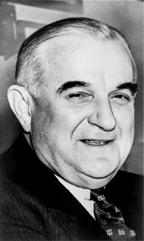
He quickly became the political boss of Pennsylvania given that as senator the Roosevelt Administration funneled patronage through him as well as New Deal money. Guffey made himself known as a “100 per cent Roosevelt man” and indeed his record almost entirely reflected that (Hill). In 1935, he sponsored the Guffey-Snyder Coal Act, establishing the National Bituminous Coal Commission setting minimum prices, establish fair labor practices, and guarantee collective bargaining rights. However, this measure was struck down by the Supreme Court in Carter v. Carter Coal Co. (1936), which resulted in Guffey quickly drafting and getting passed a new law, Guffey-Vinson, in 1937 that left out the labor provisions that had resulted in the Supreme Court striking the law down. Even on questions in which Roosevelt was not so popular he sided with the administration, such as his vote against the 1935 Patman Bonus bill, his vote against killing the “court-packing plan” in 1937, and his vote for Roosevelt’s executive reorganization plan in 1938, which would be defeated in the House. There was a rare exception or two, such as in 1939 when he voted against the legalization of TVA’s purchase of Commonwealth & Southern’s southern properties. He was also known as rather politically shrewd. For instance, early in his time in the Senate, Guffey attacked Bureau of Narcotics chief Harry Anslinger for his racism; Anslinger was married to Republican former Secretary of the Treasury Andrew Mellon’s niece and his criticizing a public official for racism certainly helped his standing with black voters (Hill). Unsurprisingly, he was also a supporter of civil rights legislation. In 1936, Guffey played a key role, despite being a senator, in determining the next House majority leader. After he hosted a fine luncheon for Pennsylvania’s Democrats they held an 18-6 vote for Texan Sam Rayburn over New York’s John J. O’Connor, and then he got all but one of the remaining to back Rayburn (Time Magazine). That year, Roosevelt won Pennsylvania by 16 points, the first time a Democrat had won the state in 80 years, a testament to the success of the New Deal coalition and to Guffey’s leadership of the state party. In 1940, a majority of Pennsylvanians proved pleased with Roosevelt and Guffey, reelecting them by seven and four points respectively. Pennsylvania’s Democratic organization was functioning well. In 1943, as a member of the Senate Foreign Relations Committee, he was profiled by Isaiah Berlin in a confidential analysis for the British Foreign Office as “a noisy Administration supporter who wraps himself in the Roosevelt flag and has been advocating for a fourth term for some time. A very typical Pennsylvania politician who has decided to throw his lot in with the President and has thus become an obedient party hack not of the purest integrity. Consistently votes in the opposite direction of his fellow Senator from Pennsylvania, James Davis” (Hachey, 146). Guffey was even more supportive of Roosevelt on foreign policy than his already staunch support of his domestic agenda.
During the 78th Congress, the pro-New Deal Union for Democratic Action found nothing amiss with Guffey’s voting record. In the prior UDA release, the only two votes he got “wrong” by them out of twenty were on a progressive “ability to pay” formula in 1939 and on tax-exempt securities in 1940. In 1944, President Roosevelt once again won reelection in Pennsylvania, this time by less than three points, and Republican Senator James Davis was finally defeated by Philadelphia Democratic Congressman Francis J. Myers by less than a point.
In 1946, the national environment proved far different from that of 1934 or 1940. The Great Depression was over, World War II was over, and people were chafing under price controls, particularly on meat, which resulted in meat shortages. Guffey’s record had remained staunchly liberal if not having even gotten more so. Worse yet for him was that Pennsylvania had a popular Republican governor in Edward Martin, who represented a return to the sort of politics of Guffey’s predecessor, David A. Reed. The environment of 1946 was so bad for Democrats in Pennsylvania that it resulted in Republicans picking up nine House seats, including all of Philadelphia’s seats, and Guffey lost reelection by a whopping twenty points. By this time a man of 76, his career was over. According to DW-Nominate, Guffey had been the most liberal senator at -0.656 throughout his 12 years in the Senate save for the 79th Congress, in which he was beaten by Idaho’s Glen H. Taylor. Guffey retired to Washington D.C., where he lived as an elder Democratic statesman until his death on March 6, 1959, at the age of 88.
References
Guffey, Joseph Finch. Voteview.
Retrieved from
https://www.voteview.com/person/3872/joseph-f-guffey
Hachey, T.E. (Winter, 1973-1974). American Profiles on Capitol Hill: A Confidential Study for the British Foreign Office in 1943. The Wisconsin Magazine of History, 57(2), 141-153.
Retrieved from
Hill, R. (2022, July 24). The Democratic Boss of Pennsylvania: Joseph F. Guffey. The Knoxville Focus.
Retrieved from
Sanderlin, W.R. (1963, October). The Indictment of Joseph F. Guffey. Pennsylvania History: A Journal for Mid-Atlantic Studies, 30(4).
Retrieved from
https://journals.psu.edu/phj/article/viewFile/22974/22743
The Congress: Leader Apparent. (1936, December 13). Time Magazine.
Retrieved from
https://time.com/archive/6756388/the-congress-leader-apparent

