New York is not a place particularly known for its conservatism, but in the time of the election of attorney and local Republican leader John Taber (1880-1965) to Congress in 1922 representing Auburn in the Finger Lakes region, there were many conservatives representing the state, notably Senator James W. Wadsworth Jr. Although the power of conservatism in New York would decline over time, especially with the rise of FDR, Taber’s old-school Republicanism would go mostly unchanged.
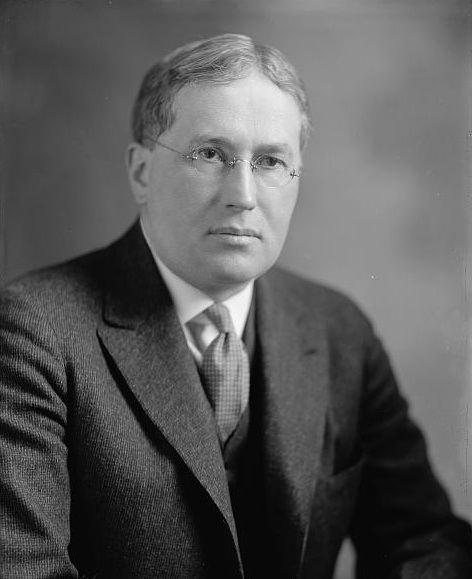
The 1920s were a time in which he was truly in his element and he stuck staunchly to the cost-conscious vetoes of President Calvin Coolidge. His orientation was strongly pro-business and lassiez-faire. However, Taber did interestingly vote for the Child Labor Amendment in 1924, which if enacted would have given Congress the power to regulate and abolish child labor. The upholding of the Fair Labor Standards Act (which Taber twice voted against) by the Supreme Court took the wind out of the sails of this amendment. Indeed, this amendment had quite a regional focus and the legislation that supporters of child labor legislation pushed was unlikely to change New York labor laws. After all, the Keating-Owen Act of 1916 for child labor, which was struck down by the Supreme Court, had no impact on New York’s labor laws.
Responding to Liberal Governance
Taber’s opposition to the New Deal was practically absolute, opposing all First 100 Days laws except the Economy Act, but his commitment to reduced spending on a couple occasions placed him on the same page as the Roosevelt Administration, such as him being one of eight Republicans to oppose the Steiwer-Cutting Amendment in 1933 for reviewing veterans benefit cuts. Republicans in general were in support of Steiwer-Cutting as they prioritized veterans benefits over New Deal spending. He also twice voted to sustain President Roosevelt’s vetoes of veterans’ bonus bills. In 1938, Taber stood out for his motion to to recommit that defeated FDR’s reorganization plan, an indicator that FDR couldn’t simply do whatever he wanted, even with the most strongly Democratic Congress. He also was one of 33 representatives to vote against Social Security. Taber warned, “Never in the history of the world has any measure been brought in here so insidiously designed so as to prevent business recovery, to enslave workers, and to prevent any possibility of the employers providing work for the people” (CBS) Although this was hyperbolic rhetoric, the Social Security tax that was imposed was one of the factors behind the Roosevelt Recession of 1937-1938 as the tax began in 1937 and benefits were not paid out on Social Security until 1940. Taber was also known as the “Watchdog of the Treasury” for his efforts to hold down expenditures and got the nickname “Meat Ax” for once declaring on the federal budget, “I’m going to cut it with a meat ax” (Cooke). His efforts got him criticism from the Truman Administration, but he also attracted admiration, even from opponents. One opponent stated, “No man has served Congress with greater distinction…Without his watchful eye the public debt would be $10 billion higher” (Cooke). His attitude towards spending was take-no-prisoners, “We’re not going to use a knife to cut down Federal appropriations, we’re going to use a sledgehammer” (The New York Times). Taber often worked to this end together with Appropriations Chairman Clarence Cannon (D-Mo.), who was often highly committed to budget cutting regardless of the wishes of president or party. This didn’t mean things were always peachy between them; in 1945 he and Cannon had an argument that escalated to Cannon punching Taber in the face (Henry).
Shouting to Cure Deafness
Among other things, Taber was known for his brassy, booming voice, and with this voice as well as a new amplification system in the House, resulted in a rather incredible event. On May 9, 1940, Taber, holding the microphone close to his mouth, was denouncing efforts to amend the Fair Labor Standards Act when Rep. Leonard Schuetz (D-Ill.) felt rather dizzy and had to leave the chamber to sit on a bench, and for the first time in his entire life was able to hear out of his left ear, and even better than in his right ear (The New York Times, 1940).
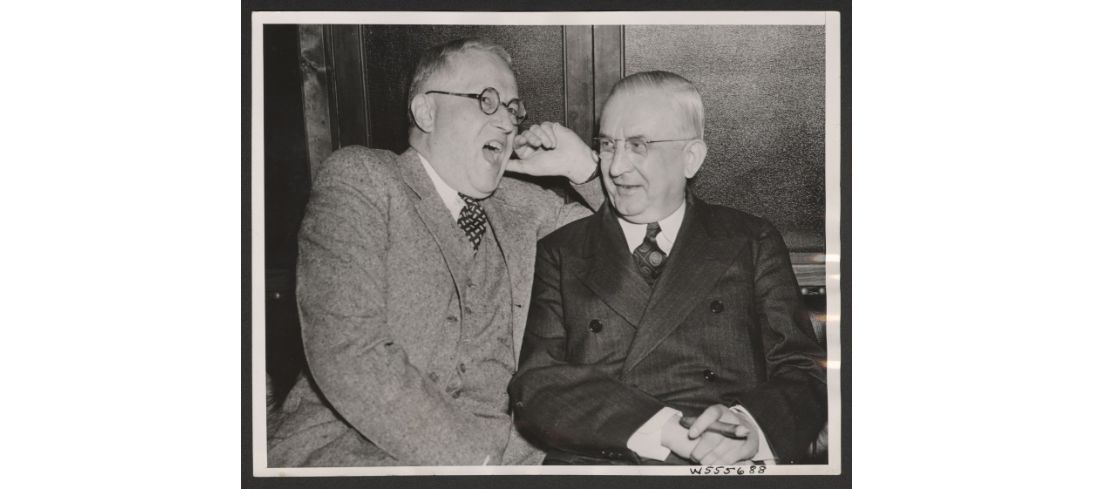
Taber and Schuetz “recreating” the incident for the press.
Foreign Policy
Although on domestic policy he was strongly to the right, he was open to foreign aid and could not be counted as among the die-hard non-interventionists before World War II. Indeed, in the postwar era, he supported aid to Greece and Turkey and the Marshall Plan. This support, however, was not without careful eye to spending, and he was well-positioned to keep a careful eye on spending given that for many years he was the leading Republican on the House Appropriations Committee. During the Republican 80th and 83rd Congresses, Taber was the chairman, and used his post to push forward strong domestic budget cuts and was considered among the top figures in the House GOP. During his time to cut budgets in a significant way was known as “Taberizing” (The New York Times).. However, even he could on occasion be persuaded that there was such a thing as too much “Taberizing”, which is what President Eisenhower accomplished in getting Taber to call for reversing foreign aid cuts in 1956. Indeed, during the Eisenhower Administration, he was backing Administration-sponsored increases in foreign aid. However, this enthusiasm didn’t carry over to President Kennedy’s foreign aid packages and he proved as much of a foe of the Kennedy Administration as he had the Truman Administration.
Civil Rights
Although John Taber supported anti-lynching legislation twice, he repeatedly voted against legislation to ban poll taxes. He also voted against the Civil Rights Acts of 1957 and 1960. However, Taber did vote for the 24th amendment in 1962, barring the poll tax in federal elections and primaries. He also multiple times voted for anti-segregation amendments.
The End
Although it was thought that Taber might retire in 1958 as he didn’t want to stick around too long, many legislators lean to staying in the game. However, by 1962, he was 82 years old, and he was redistricted into the same district as Democrat Sam Stratton. Given the redistricting and his age, Taber opted not to go for another term. His DW-Nominate score stands at 0.558, he agreed with the liberal Americans for Democratic Action 13% of the time from 1947 to 1962, and agreed 93% of the time with the conservative Americans for Constitutional Action from 1957 to 1962. He passed away in a nursing home on November 22, 1965 at the age of 85.
References
ADA Voting Records. Americans for Democratic Action.
Retrieved from
Cooke, J. (1965, November 22). John Taber Dead at 85. The Geneva Times, 1.
Retrieved from
www.newspapers.com/image/1187305413/
Ex. Rep. John Taber Dies at 85. (1965, November 23). The New York Times.
Retrieved from
Henry, C. (2018, July 12). The Man Who Brought Two Presidents to Town. Elsberry Historical.
Retrieved from
http://elsberryhistorical.org/items/show/163
Loud House Debate Restores Hearing of Congressman. U.S. House.
Retrieved from
Miracle in Congress. (1940, May 10). The New York Times.
Retrieved from
‘Pork’ Foe John Taber Succumbs. (1965, November 23). The Arizona Daily Star, 21.
Retrieved from
www.newspapers.com/image/162711177/
Taber, John. Voteview.
Retrieved from

