Forty years ago another two term Republican president faced a midterm election, and the results were not good for the Republicans in the Senate, with them losing a net of eight seats and thus the Senate, although the House results were far less punishing than 2026. This result wasn’t as bad for Republicans First, the Democratic Party of the time was less liberal than it is now. However, the results nonetheless were good enough for Democrats for retiring Speaker of the House Tip O’Neill (D-Mass.) to declare, “If there was a Reagan Revolution, it’s over” (Ryan-Hume). President Reagan himself had campaigned across the country in the hopes that the 1986 election would bear resemblance to the 1980 election, but it wasn’t so. However, unlike today, voters were not concerned about the economy, as in 1986 the economy was experiencing its third straight year of growth and Reagan himself was still popular with voters, polling at 66% unlike Trump today whose approval rating entering Election Day was around 38-39%. The drag on the Republican Party was the Republican brand being less popular than the Democratic brand rather than Reagan himself.
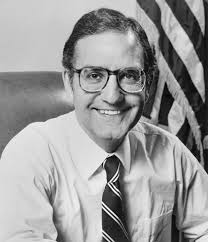
Sen. George Mitchell (D-Me.), chairman of the Democratic Senatorial Campaign Committee for 1986 and majority leader from 1989 to 1995.
Since Democrats already had the House, the Democrats only gained five seats, but credit nonetheless goes to Representative Tony Coelho (D-Calif.), chairman of the Democratic Congressional Campaign Committee, throughout the 1980s for maintaining a Democratic majority:
In Colorado, Republican Michael Strang of the 3rd district lost reelection to Democrat Ben Nighthorse Campbell, who would switch to the GOP as a senator in 1995.
In Hawaii, Democrats lost the 1st district when Republican Pat Saiki won the district after Neil Abercrombie left office.
In Indiana, the retirement of Republican Bud Hillis in the 5th district yielded the election of Democrat Jim Jontz. Incidentally, the one district Republicans held that they lost in Indiana this year was the 5th.
In Iowa, there was a mixed result. The retirement of Republican T. Cooper Evans in the 3rd district yielded the election of Democrat David Nagle while the retirement of Democrat Berkley Bedell in the 6th district yielded the election of Republican actor Fred Grandy.
In Louisiana, the retirement of Catherine Long, the widow of the late Gillis Long in the 8th district, yielded the election of Republican Clyde Holloway.
In Maine, Republican John McKernan of the 1st district retired to run for governor, yielding the election of Democrat Joseph Brennan.
In Maryland, the retirement of Republican Marjorie Holt of the 4th district resulted in the election of Democrat Tom McMillen, but the retirement of Democrat Michael Barnes in the 8th district yielded the election of Republican Connie Morella.
In Mississippi, Republican Webb Franklin of the 2nd district lost reelection to Democrat Mike Espy, the first black person elected to Congress from Mississippi since Reconstruction. That district has not again elected a Republican.
In Missouri, Democrat Robert Young of the 2nd district lost reelection to Republican Jack Buechner. This year, Republican incumbent Ann Wagner lost reelection in this district, which represents St. Louis suburbs.
In New York, the retirement of Republican William Carney in the 1st district produced the election of Democrat George Hochbrueckner. In the 30th district, Republican Fred Eckert lost reelection to Democrat Louise Slaughter. However, in the historically Republican 34th district, the retirement of Democrat Stan Lundine to run for lieutenant governor resulted in the election of Republican Amo Houghton.
In North Carolina, Republican Bill Cobey of the 4th district lost reelection to Democrat David Price and Republican Bill Hendon lost reelection to Democrat James M. Clarke in the 11th district. Clarke had lost reelection in 1984.
In Oklahoma, Democrat James R. Jones of the Tulsa-based 1st district retired to run for the Senate, and he was succeeded by Republican Jim Inhofe. Republicans have held the district since.
In Pennsylvania, Democrat Robert Edgar of the 7th district retired to run for the Senate, being succeeded by Republican Curt Weldon.
In South Carolina, Republican Carroll Campbell of the 4th district retired to run for governor, resulting in the election of Democrat Liz J. Patterson.
In Utah, Republican David S. Monson of the 2nd district lost reelection to Democrat Wayne Owens, who had previously served in Congress from 1973 to 1975.
In Virginia, Republican G. William Whitehurst of the 2nd district retired, and Democrat Tom Pickett succeeded him. Democrats also won the 2nd district from the Republicans this year.
In the Senate, six of the losers had rode in on the Reagan wave of 1980, and credit goes to George J. Mitchell (D-Me.), head of the Democratic Senatorial Campaign Committee. Political scientist Norman J. Ornstein (1986) had predicted a Republican loss in the Senate based on what he called the “curse of the six-year itch”. Furthermore, unlike 2026, Democrats were dealt a much better Senate map, making 2026 all the more devastating than 1986 given Democratic wins in territory previously regarded as unwinnable, even though 1986 was bad for Senate Republicans.
In Alabama, Republican Jeremiah Denton lost reelection to Congressman Richard Shelby, who would switch to Republican in 1995. Denton, who had been elected in 1980, was the first Republican elected to the Senate from Alabama since Reconstruction.
In Florida, Republican Paula Hawkins lost reelection to Democrat Bob Graham. Hawkins, who won in 1980, had been only the second Republican elected to the Senate from Florida since Reconstruction.
In Georgia, Republican Mack Mattingly, who won in 1980, lost reelection to Congressman Wyche Fowler. Mattingly was the first Republican senator from Georgia since Reconstruction.
In Maryland, the retirement of Republican Mac Mathias, one of the party’s most prominent liberals, resulted in the election of Congresswoman Barbara Mikulski.
In Missouri, the retirement of Democrat Thomas Eagleton resulted in the election of Republican Kit Bond, one of the few bright spots for the GOP in this midterm.
In Nevada, the retirement of Republican Paul Laxalt, a close friend and ally of President Reagan, resulted in the election of Democrat Harry Reid, who would lead the Senate Democrats from 2005 to 2017.
In North Carolina, interim Republican Senator James Broyhill, who had been appointed to succeed the late John Porter East, lost the election for a full term to Democrat Terry Sanford, who had previously served as governor from 1961 to 1965.
In North Dakota, Republican Mark Andrews, first elected to the Senate in 1980, lost reelection to Democrat Kent Conrad.
In South Dakota, Republican James Abdnor, first elected to the Senate in 1980, lost reelection to Congressman Tom Daschle, who would later serve as the Senate leader for the Democrats from 1995 to 2005.
In Washington, Republican Slade Gorton, first elected to the Senate in 1980, lost reelection to Brock Adams, who had served in Congress and been Secretary of Transportation under President Carter. Rare for a defeated senator, Gorton made a comeback in 1988 and served two more terms.
The Aftermath
Although this was a solid win for the Democrats, an issue was noted right after the election from Robert Shogan (1986) of the Los Angeles Times, writing, “As the focus shifts to the 1988 presidential campaign, both parties have failed to develop the compelling national messages they need to help win the White House and govern the country afterward. Party leaders themselves conceded that such overall themes, which distinguish parties and candidates in voters’ minds and enlist their loyalties, were starkly absent this year.” The 1988 elections resulted in the victory of Vice President George H.W. Bush, and easily at that, but the House and Senate remained Democratic. However, although comebacks do happen in politics, I will say the national environment today is different; Donald Trump is no Ronald Reagan and J.D. Vance no George H.W. Bush. Yet, what we will see in 2028 will not likely bear much similarity to 2026 as people might think today. After all, the new Democratic Congress will have a record that Republicans can point to, and who knows what will happen with President Trump in the next two years.
References
Ornstein, N.J. (1986, March). The Curse of the Six-Year Itch. The Atlantic.
Retrieved from
https://www.theatlantic.com/past/politics/polibig/ornstein.htm
Ryan-Hume, J. (2023, June 7). The 1986 Midterms: The End of the Reagan Revolution? Cambridge University Press.
Retrieved from
Shogan, R. (1986, November 5). 1986: A Year of Missed Opportunity: Both Parties Fail to Present National Themes for 1988. The Los Angeles Times.
Retrieved from
https://www.latimes.com/archives/la-xpm-1986-11-05-mn-15193-story.html

