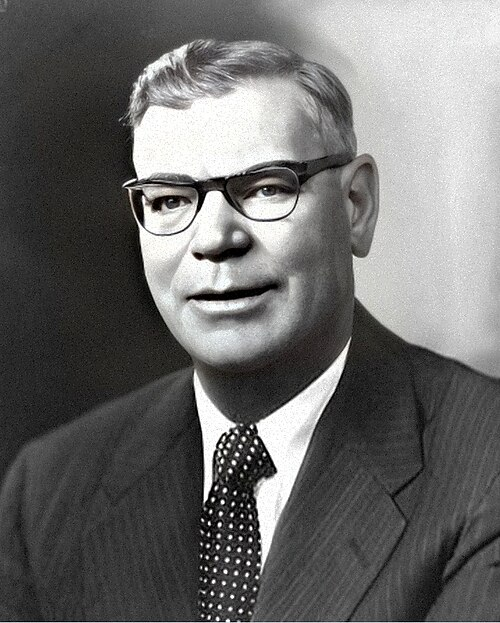
Delegate, and later Senator Bob Bartlett of Alaska
In 1956, Alaska was still a US territory, but there was an issue in the treatment of mentally ill Alaskans: Alaskans had to be sent to Morningside Hospital all the way in Portland, Oregon to get mental healthcare, thousands of miles away from their families. Thus, a bill was sponsored by Representative Edith Green (D-Ore.), who represented Portland, and Delegate Bob Bartlett (D-Alaska), who was also the author, to grant 1 million acres of land to the territory for the generation of revenue for mental health facilities and for federal funds for the establishment of local mental health facilities and to transfer patients from Morningside back to Alaska. This measure was a reform intended to repair a broken system that often brought harm to patients. Green said of the existing system, “…a person can be accused of the crime of being insane in Alaska. He is arrested as a common criminal and is thrown in jail. Then if he is found guilty he is transported to Portland, Ore.” (CQ Almanac). Theoretically, this bill should have been appealing to the political right; more sovereignty for people on the local level. However, a fear arose that no one who supported this bill anticipated, and it rippled throughout the American public: “Siberia USA”. Due to the wording of the bill that opened it up for misguided interpretations, a fear arose that this measure was going to result in a gulag and that Americans could be sent off there for political reasons.
The conservative American Public Relations Forum warned of this bill’s impact in 1956:
“Bill HR 6376 has the effect of preserving a vast tract of arctic wilderness to which any citizen of the United States may be sent. Once in Alaska, the ‘patient’ may be detained incommunicado, indefinitely. Soviet Russia, as we understand, has vast areas in Siberia to which, on the whim of the right bureaucrat, any person may be sent. The machinery for this brand of exile is contained in Mrs. Green’s bill” (University of Oregon).
The notorious Gerald L.K. Smith, writing in The Cross and the Flag, “the one-worlders, the object of UNESCO and the Mental Health Organization have embarked upon a program to root out all ideas opposed to their own…. So we have the Alaska Mental Health Act” (CQ Almanac).
Dan Smoot, a former FBI agent turned extremely conservative commentator, stated, “…the Alaska Mental Health Act…fits into a sinister pattern which has been forming ever since the United Nations was organized” (CQ Almanac).
Per Williams Intelligence Summary, run by the ultra-conservative and anti-Semitic Robert H. Williams, “…in view of the fact that so many psychiatrists are of alien origin and are Marxist fanatics and generally are trying to classify ‘super patriots,’ anti-Communists, anti-Zionists and other political opponents as mental cases, extreme caution should be used by the legislators….” (CQ Almanac).
L. Ron Hubbard played a role in this as well, as his black propaganda manual from the Church of Scientology, 1955’s “Brain-Washing”, got increased distribution and editing from Kenneth Goff, who distributed his version to members of Congress and other politicians (Boller & George). Goff was a former Gerald L.K. Smith acolyte who claimed to have once been a communist, Christian Identity minister, and fringe rightist who the FBI once described in a report as a “borderline psychopath”. “Brain-Washing” was falsely claimed to be a compilation of manuals from the USSR on brainwashing people but its most likely original author was Hubbard.
Members of Congress reported that the mail they received on this subject had not been at this level since the debate on the Lend-Lease bill in 1941, and many were bewildered by this development. Senator Scoop Jackson (D-Wash.) “Of all the bills which have come to my attention since I have been a Member of the Senate and of the House, the pending bill has been as widely misinterpreted as any piece of proposed legislation which has ever been presented to the Congress” (CQ Almanac). Senator Barry Goldwater (R-Ariz.), who had established himself as one of the most conservative people in the Senate by this time, decided to investigate the bill. He concluded that this “is intended to give to the territorial government a tax base and an income with which to finance the continued mental health program in Alaska and is not, as has been suggested by opponents to the bill, to be used as a vast concentration camp” (CQ Almanac). Nonetheless, to reassure the public and to enhance the sovereignty of Alaska residents, the bill was amended to prevent transfer of residents of other states to Alaska and to delete the section on commitment procedures adopted by the House, thus leaving commitment procedures up to the territorial government.
Although we look back and think the fear of the use of psychiatry to imprison people on political grounds was simply a scare, and indeed it was for the US, the fear did not arise from thin air; it was unfortunately all too real in the USSR. Nationalists, human rights and democracy advocates, the openly religious, and people trying to emigrate were targets of the abuse of psychiatry; from the 1940s to the 1980s at least 20,000 people were sent to asylums, many with the politically invented diagnosis of “sluggish schizophrenia”. The logic here was that it was not rational to oppose the Soviet system. Soviet dissident Alexander Solzhenitsyn wrote on this practice, “The incarceration of free thinking healthy people in madhouses is spiritual murder, it is a variation of the gas chamber, even more cruel; the torture of the people being killed is more malicious and more prolonged. Like the gas chambers, these crimes will never be forgotten and those involved in them will be condemned for all time during their life and after their death” (Sagan & Jonsen).
References
Alaska Mental Health. CQ Almanac.
Retrieved from
https://library.cqpress.com/cqalmanac/document.php?id=cqal56-1350077
Boller, P. & George, J. (1989). They never said it: a book of fake quotes, misquotes, and misleading attributions. New York, NY: Oxford University Press, 5-6.
Sagan, L. & Jonsen, A. (1976, June). Medical Ethics and Torture. The New England Journal of Medicine. 294(26): 1427-1430.
Siberia U.S.A.: Anatomy of a Conspiracy Theory. University of Oregon.
Retrieved from

