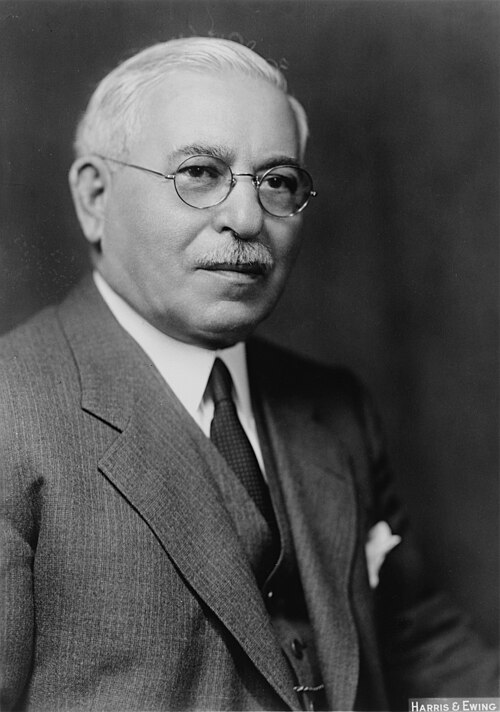
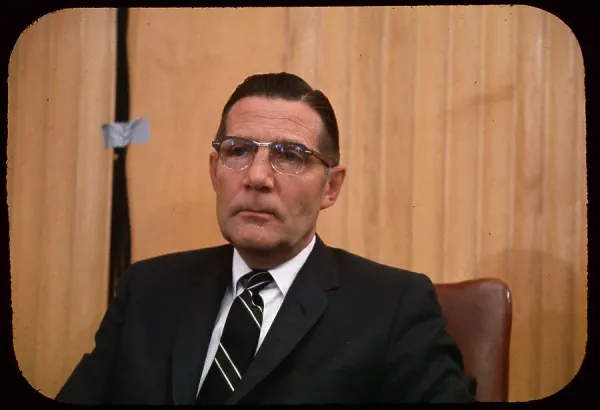
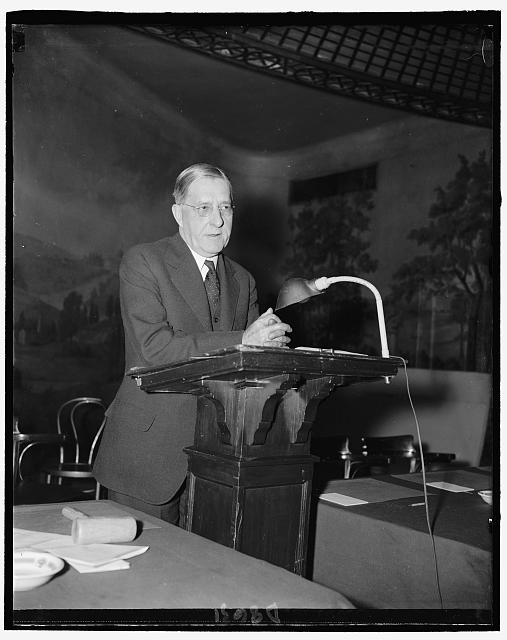
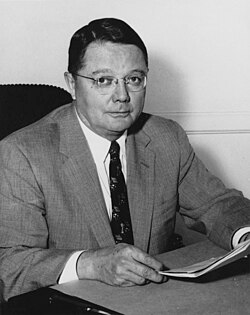
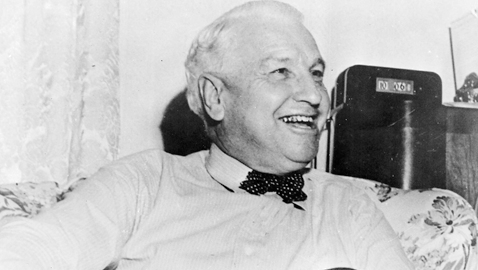
Adolph J. Sabath (D-Ill.), who served in Congress from 1907 until his death in 1952.
The subject of political ideology throughout American history and its changes has been of boundless interest to me. And in the course of this, there’s a lot of oversimplifications, a lot of misunderstandings, and misconceptions. In the course of research, I find a useful exercise to be to look at legislators who served over long periods of time and how they voted. Looking at their records at the start of their career and the end of their career can be illuminating, and most useful to looking at the latter end of careers in this case are the ratings of the liberal Americans for Democratic Action. I am in particular interested in comparing records of this longstanding liberal group to legislators who served before 1933, when FDR came into office and really shaped the liberalism that we understand today. ADA’s ratings go back to 1947, and the longest serving legislator at its start was Democrat Adolph Sabath of Chicago, who had been serving since 1907. Sabath, by the way, was a staunch New Deal defender and proved very liberal in the final years of his career. Another notable long-term figure when we look at change is Alabama’s J. Lister Hill. Hill first started serving in Congress in 1923, and during the Truman Administration he proves one of the South’s big liberals, but later on his record is soured by ADA standards as they come to focus more on civil rights issues and other social issues, and it is true that Hill also moved a bit to the right in his later career as Alabama was moving to the right.
Sam Rayburn of Texas also presents an interesting case study, for this is a legislator who sticks loyally to President Truman’s agenda for domestic liberalism and internationalism even though you would by some aspects of his earlier record not think him a champion of liberalism. Indeed, although Rayburn supported a lot of Woodrow Wilson’s agenda, he voted against the Keating-Owen Act in 1916 to regulate and restrict child labor, repeatedly voted against women’s suffrage, and voted against the Child Labor Amendment in 1924. By contrast, you have Daniel Reed of New York, who was considered a massive champion of traditional Republicanism. He voted for women’s suffrage in 1919 and voted for the Child Labor Amendment in 1924. However, Reed was one of the most down-the-line foes of the New Deal and anything that smacked of it, as well as stood as a staunch opponent of foreign aid programs, and his record remained to the right until his death in 1959. Yet another figure of interest is Roy Woodruff, who you would not tell by him having four “zeroes” by ADA that his first term was as a member of Theodore Roosevelt’s Progressive Party.
I have created a document that lists legislators, their party affiliation, their state, the year they started serving in Congress prior to 1933, and their rates of agreement with ADA by year. The last year listed is 1975, the last in which Congressman Wright Patman (D-Tex.), who started serving in 1929, served a full year. This should be illuminating as to ideology and what’s more how ADA was seeing the South.
* – Sam Rayburn’s (D-Tex.) is listed as 73 for 1953 and not 82 as presented in ADA’s records because Rayburn actually voted against, not for, Hawaii statehood in 1953.
References
ADA Voting Records. Americans for Democratic Action.
William S. Vare (R-Penn.), whose right to serve in the Senate was successfully contested.
When the U.S. Constitution was adopted, it set three requirements for being a senator, they are as follows:
“No Person shall be a Senator who shall not have attained to the Age of thirty Years, and been nine Years a Citizen of the United States, and who shall not, when elected, be an Inhabitant of that State for which he shall be chosen” (U.S. Constitution, Article I, section 3, clause 3).
After the War of the Rebellion, requirements were added that senators not have engaged in rebellion or treason. For conservatives on this issue, these were all that were required for seating. The circumstances of state elections were a state matter, whether widespread voting irregularities or violations of campaign finance law had occurred or not, and that any investigations should occur after, not before seating. For the ever-reform minded progressives, this would simply not do, and the 1920s in particular was a time for challenging elections. In that decade, there were seven contests of Senate elections. These were of Truman Newberry of Michigan, Earle Mayfield of Texas, Thomas Schall of Minnesota, Sam Bratton of New Mexico, Smith Brookhart of Iowa, William Vare of Pennsylvania, and Frank Smith of Illinois.
Truman Newberry: The Price of Crossing Henry Ford
Although the election happened in 1918, the case of Truman Newberry dragged into the 1920s. President Wilson had recruited Ford to run for the Senate to advance his message for peace and the League of Nations. He ran for both the Democratic and Republican nominations, believing that the Michigan public would overwhelmingly embrace him, the esteemed automaker. However, only the Democrats nominated him, with another wealthy individual, Truman Newberry, winning the Republican nomination. Ford was peeved that the Republicans didn’t nominate him, and although the race was close, Newberry won. He had spent a lot of money financing attacks against Ford’s pacifism, his anti-Semitism, and having allegedly engaged in extraordinary efforts to prevent his son Edsel from being drafted (U.S. Senate, Newberry). Newberry proved to be a staunch conservative who proved a thorn in Wilson’s side, including on the League of Nations. However, Newberry’s campaign had received and spent over $175,000, far above the $3,750 limit imposed by Michigan state law as well as the Federal Corrupt Practices Act on primary spending (U.S. Senate, Newberry). Although Newberry claimed ignorance of illegal campaign contributions and spending, that is not what the evidence indicated. He was indicted on November 29, 1919 along with 134 associates and convicted of violating the Federal Corrupt Practices Act on March 20, 1920, but he appealed to the Supreme Court, which ruled 5-4 in Newberry v. United States that the section of the Corrupt Practices Act that covered state primaries was unconstitutional and 9-0 that the judge in the case had given erroneous jury instructions (U.S. Senate, Newberry). Republicans in the 67th Congress managed to block an effort to unseat Newberry and
voted 46-41 that he was the elected senator from Michigan. Republicans asserted that his Navy service in New York City at the time of the primary precluded extensive knowledge about campaign spending, the Democratic minority disagreed, asserting that he knew full well (U.S. Senate, Newberry). the 1922 midterms promised a much more difficult Senate and progressive Republicans were keen on joining with Democrats to oust Newberry. Thus, he opted to resign instead of facing a grueling battle.
In the end, Ford did get his way. Newberry was out, and his successor was James Couzens. Although Couzens was a Republican, he was on the party’s progressive wing and was formerly vice president of Ford Motors, thus far more palatable to Henry Ford. Newberry would never run for public office again and Couzens would remain in the Senate until his death in 1936.
Schall vs. Johnson: Bull Moose v. Farmer-Labor
On April 28, 1923, Minnesota’s longtime Republican senator, Knute Nelson, died at the age of 80. Nelson had been a moderate conservative, but the Minnesota GOP was getting a challenge from the state’s Farmer-Labor Party, which was an economically progressive break-away from the GOP, and they succeeded in electing Magnus Johnson. However, Republicans picked a strong candidate for a full term in Thomas D. Schall, who had a history as a Bull Moose Republican, and he defeated Johnson by less than 8,000 votes in the 1924 election. Johnson challenged the election, claiming excessive campaign spending, scurrilous allegations against him, . The testimony of eight pro-Johnson witnesses did not produce any evidence connecting Schall to wrongdoing, and the investigating committee unanimously recommended that he be seated, and the Senate agreed (U.S. Senate, Schall). Schall would serve in the Senate until he was killed when a motorist accidentally struck him in 1935, and Magnus Johnson served a term in the House from 1933 to 1935, dying in 1936.
Mayfield vs. Peddy: A Quixotic Challenge
In 1922, the Senate election in Texas was Democrat Earle B. Mayfield against George E.B. Peddy, who was running both as a Republican and an Independent. Once the primaries were over, the winner was not in doubt as at the time statewide races (and indeed most other races in Texas) the winner was going to be a Democrat. On Election Day, Mayfield was elected, with strong support from the Ku Klux Klan, with 2/3’s of the vote. What was Peddy’s case for challenging the election? He challenged the procedures of the Democratic primary, excessive expenditures, voter fraud, and cited KKK involvement (U.S. Senate, Mayfield). However, Mayfield’s lead was insurmountably strong, even if there were shady practices he was going to be the winner in the general election given that the state was still part of the “Solid South” at the time. The Senate dismissed the challenge. Mayfield’s electoral fortunes had risen with the Klan, and they fell with the Klan too. He was defeated for renomination in 1928 by Congressman Tom Connally, who ran against him on an anti-Klan platform.
Brookhart vs. Steck: Progressive Republican vs. Moderate Democrat
In this case, the Senate outright rejected the election result and seated Democrat Daniel Steck. This was in part the product of Democratic partisanship but also in part the product of infighting between the conservative and progressive factions of the Republican Party. The controversy began when Brookhart, who had been elected in a special election to succeed William S. Kenyon, was running for a full term as a Republican. However, instead of endorsing Republican nominee Calvin Coolidge, he endorsed Progressive Robert La Follette of Wisconsin and campaigned for him after his nomination. This enraged many rank-and-file Iowa Republicans, who considered this trickery. The election reflected Republican faction tensions in this historically Republican state, with Brookhart only winning in official returns by around 800 votes to Democrat Daniel Steck, who was running as a moderate. Some conservatives in the GOP preferred reducing their majority by one because they found Steck ideologically preferable. In this case, despite the voters having voted for Brookhart, the full Senate voted to seat Steck. This was interestingly not a party-line vote, and there were seven Democrats who voted for Brookhart, including Mississippi’s Hubert Stephens, who wrote in defense of Brookhart’s election. A majority of Republicans voted for Brookhart, even a number of dyed-in-the-wool conservatives, although this was not out of sympathy for the views of Brookhart, rather because they did not believe the Senate should be rejecting winners of the state’s vote. In 1926, Brookhart successfully rebuked the Senate’s ruling on him when he defeated incumbent Albert B. Cummins for renomination and was elected. There is no better revenge than success, and there was no challenge that time.
The Republican establishment would ultimately oust Brookhart in the 1932 nomination contest, but the seat would be won by Democrat Louis Murphy, with Brookhart running as an independent Progressive candidate. Whether Brookhart would have won as a Republican in 1932 we can only speculate.
Bratton vs. Bursum: A Nothing-burger Challenge
Although New Mexico had been a Republican state when it was first admitted, by the 1920s Democrats were starting to gain power, and 1924 promised to be a close election between incumbent Holm O. Bursum, a high-tariff conservative Republican, and Judge Sam G. Bratton, a progressive Democrat. On Election Day, although New Mexico easily voted for President Coolidge, they did not do likewise for Bursum, with Bratton winning by 2.5%. Bursum challenged the election, claiming voter fraud. He claimed that eligible Indians were denied the vote while aliens, minors, college students voting from outside of their homes, and ex-cons were illegally allowed to vote (U.S. Senate). Although the Senate pushed Burusm to produce his evidence of such wrongdoing, he delayed for weeks and when he finally presented his evidence, although it reduced Bratton’s margin of victory, it fell far short of the irregularities alleged and Bratton kept his seat. Bursum would not seek public office again while Bratton would resign from the Senate in 1933 to accept a presidential appointment to the U.S. Court of Appeals. Democratic dominance of New Mexico would follow, with Republicans only making consistent gains starting in the late 1960s.
The Senate Contends with Big City Political Machinery: The Cases of Vare and Smith
Big city politics have had a reputation for corruption, and this was certainly the case with the Republican machines existing in Philadelphia and Chicago in the 1920s. In 1926, Congressman William S. Vare, the head of the Philadelphia machine, had defeated incumbent George W. Pepper for renomination. Pennsylvania was a very Republican state at that time and had not voted for a Democrat since 1856. The Democratic challenger was former Secretary of Labor William B. Wilson. The official results put Vare over the top with 54.6% of the vote as opposed to Wilson’s 43.1%, which was a respectable result for a Democrat at the time. It should also be noted that Wilson was leading until Philadelphia was counted (Hill). There was considerable doubt in the outcome and many did not want Philadelphia’s boss to be senator. The doubt in the Senate election in Pennsylvania was such that the state’s progressive Republican governor, Gifford Pinchot, refused to certify the election, instead stating that Vare “appears” to have been elected (Hill). However, Pinchot was finishing his term, and his successor, John Fisher, certified Vare.
The other highly contested race was Republican Frank L. Smith’s win with 46.9% of the vote, with Democrat George E. Brennan netting 43.1% of the vote. Smith had defeated incumbent William B. McKinley, who died shortly after his loss, on the issue of the U.S. joining the World Court. He received considerable campaign contributions from the controversial Samuel Insull, the holding company baron who played a major role in setting up America’s electrical grid. The problem? Smith chaired the Illinois Commerce Commission, which regulated utilities. This led to allegations of corruption by Smith, that he was giving Insull an easy ride in exchange for campaign financing. Senator Thaddeus Caraway (D-Ark.) took up the mantle against him. Obtaining information about spending on the Illinois race was not so cut-and-dry for the Senate, as the case of Newberry v. United States put primary campaigns out of the reach of regulation by the Senate and Illinois had no law capping campaign expenditures (U.S. Senate, Smith).
Vare and Smith were elected with strong support of corrupt political machines and extensive evidence was presented of illicit voting practices and excessive campaign financing. Conservatives held that because Vare and Smith met Constitutional requirements that they should be seated and then investigations into their elections proceed, but the fiercely independent William Borah (R-Idaho) was not having it, stating that the Senate had the right to deny them seating and considered doing so acting in the Senate’s preservation (Hill). Although the Senate concluded that despite voting irregularities that Vare had won the election, but that such widespread irregularities and excessive campaign spending had tainted his victory. Vare spoke in his defense, “How unfair and unjust my accusers have been in attempting to twist mere clerical irregularities and technicalities into acts of political fraud and conspiracy!” (Hill) Both were denied seating, although neither Wilson nor Brennan were ruled the winners. Ultimately Pennsylvania Republican Joseph Grundy, a prominent and staunchly conservative industrialist and lobbyist, was appointed interim senator while in Illinois, Republican Otis Glenn won the special election against future Chicago mayor Anton Cermak. The stress of the investigation broke Vare’s health, and he suffered a stroke on August 2, 1928, from which he never fully recovered. Although Vare tried to get back in as a Republican in 1930, the Republican organization turned on him and selected James J. Davis, Secretary of Labor under Harding, Coolidge, and Hoover, instead. Curiously, Vare would attempt a comeback by running for the Democratic nomination for the Senate in 1932, but he suffered another stroke, ending any prospects of return. He died of a heart attack on August 7, 1934.
References
Expulsion Case of Truman Newberry of Michigan. U.S. Senate.
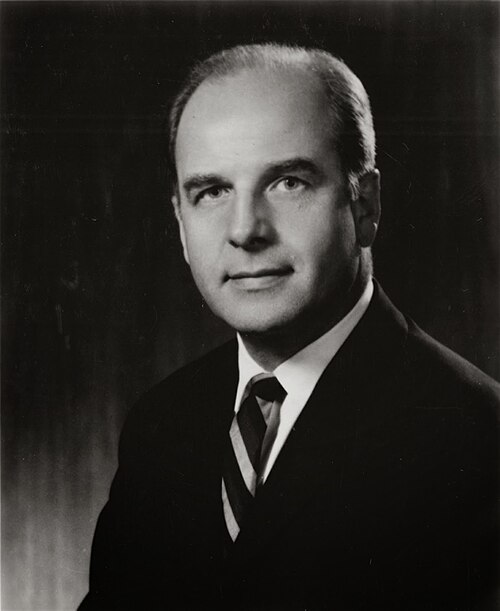
We have come to that time of year again, Earth Day. This day was the brainchild of a prominent liberal senator from Wisconsin, Gaylord Anton Nelson (1916-2005). 1958 proved, as I have written in the past, a massive boon for liberals. One of the victors was State Senator Gaylord Nelson, who was elected Wisconsin’s governor. As a state, Wisconsin had not been historically strong for Democrats. Indeed, it was considered shocking when Grover Cleveland won the state in 1892, and the liberal lane for decades was occupied by the progressive wing of the Republican Party, which came to prominence with the rise of Robert La Follette. Indeed, Democrats would not be able to make sustainable gains in the state until the 1950s, and Nelson’s victory was only the second time in the 20th century that a Democrat was elected governor. He had been in the State Senate since 1948, and had a reputation as a staunch liberal, and indeed he won on a strongly liberal platform. As governor, he along with Senator William Proxmire and future Governor Patrick Lucey were the fathers of the modern Democratic Party in the Badger State. He established a state Youth Conservation Corps, based off of the Civilian Conservation Corps during the Great Depression, and the Outdoor Recreation Acquisition Project, which resulted in the purchase of 1 million acres for public parks. Nelson was not overwhelmingly popular at this time, and he was limited in what he could do because both houses of the legislature still had a Republican majority. In 1960, he clinched reelection by three points. Nelson’s second term would serve as a platform for the next office he wanted: Senator.
Winning Against Wiley
By 1962, Wisconsin’s longtime senior senator, Alexander Wiley, was 78 years old and past his prime. Nelson took advantage both of the age difference and Wiley’s increasing irritability by energetically campaigning across the state and attacking the conservative aspects of his voting record. On Election Day, Nelson won by 5 points. The Democratic class of ‘62, which included George McGovern, was quite a liberal one indeed, and Nelson proved one of the most liberal senators. A staunch supporter of civil rights legislation, he was present at the August 28, 1963 March on Washington in which King delivered his “I Have a Dream” speech at the Lincoln Memorial. He backed the Great Society to a hilt, and although he voted for the Gulf of Tonkin Resolution he was an early critic of the Vietnam War. Nelson could at times vote a conservative position on foreign policy, such as voting to cut foreign aid in 1965. After a resounding reelection by 23 points in 1968, Nelson proved among the staunchest foes of the Nixon Administration. In 1973, he was one of only three senators to vote against the confirmation of Gerald Ford as vice president. However, Nelson’s foremost legacy was on the environment. In September 1969, he delivered a speech in Seattle in which he proposed the creation of Earth Day as a grassroots demonstration in response to the January and February 1969 Santa Barbara oil spill which was the worst spill in US history at the time, with the first Earth Day happening on April 22, 1970. Nelson recalled the idea came to him after reading about nationwide teach-ins against the Vietnam War, “It suddenly dawned on me, why not a nationwide teach-in on the environment?” (Thulin) Unsurprisingly, he was one of the strongest champions of environmental regulations. Nelson dismissed the notion that economic development should take precedence over environmental protection, stating, “The economy is a wholly owned subsidiary of the environment, not the other way around” (Nelson).
In 1970, Nelson held hearings on the safety of birth control pills, with many witnesses testifying their concerns that the pill could be causing cancer. The result of the hearings was a new law that warnings of potential side effects now had to be included on the labels. Although a staunch liberal like Senator George McGovern (D-S.D.) and a supporter, he declined an offer to be his running mate. In 1974, for many Wisconsinites, his opposition to Nixon was looking pretty good, and he was reelected by his largest margin yet, 26 points, against future Congressman Tom Petri.
The 1980 Election
Nelson’s rise to high political office came in the excellent liberal year of 1958, but 1980 was for Republicans what 1958 had been for Democrats. The political climate had substantially changed since his landslide reelection in 1974, and Nelson was swept away in the Reagan wave, losing by two points to former Congressman Bob Kasten. His ultra-liberalism was shown in multiple measures; he sided with the liberal Americans for Democratic Action 94% of the time, the conservative Americans for Constitutional Action 8% of the time, and has a -0.567 from DW-Nominate, making him one of the most liberal senators of his day. In 1995, President Clinton awarded him the Presidential Medal of Freedom for his service and efforts for environmental protection, and the proclamation for the award read, “As the father of Earth Day, he is the grandfather of all that grew out of that event: the Environmental Protection Act, the Clean Air Act, the Clean Water Act, the Safe Water Drinking Act’ (The New York Times). And it wasn’t just Democrats who praised him. Republican Melvin Laird, who as a conservative representative from Wisconsin had frequently disagreed with him, praised his service, “Gaylord’s contributions in the fields of conservation reform and environmental improvement are a living memorial to him” (The New York Times).
References
ADA Voting Records. Americans for Democratic Action.
In response to the Great Depression, the Roosevelt Administration sought unprecedented long-term uses of federal power, and although this would prove controversial, one of the longest lasting has been in regulation of agriculture. Although the Supreme Court hindered such measures significantly in his first term, the truth was at the time FDR easily won a popularity contest against the Supreme Court and those who cautioned excessive uses of federal power; the nation was in depression and as some of the time said, “You can’t eat the Constitution”. Although President Roosevelt didn’t win his battle for court-packing, another truth was that he had already won his battle against the Supreme Court with his landslide reelection in 1936. After his win, the Supreme Court began upholding his laws regularly, and as more justices were picked by Roosevelt, the more the Supreme Court moved in the direction of his theories of government, and this was most clear when it came to interstate commerce cases.
The Background
Roscoe Filburn was a small Ohio farmer who was growing wheat and some of it was for feeding his animals, but this meant that his harvest was 12 acres more than permitted under the 1938 Agricultural Adjustment Act, and he was fined. Restrictions like this were why critics considered such policies to be “regimentation”. Filburn sued the Secretary of Agriculture, Claude Wickard, and argued that because this surplus wheat was only for feeding his animals that it never entered interstate commerce and thus his activity did not fall under the Commerce Clause. The defendant in the suit was Secretary of Agriculture Claude Wickard.
In a previous court, Filburn would have gotten a more sympathetic hearing, and he might have even won. However, the court’s composition had changed significantly since 1933. By 1942, all of the justices who were of the ‘Four Horsemen” who had voted against most of FDR’s challenged laws had either died or retired, and the only two justices who remained from before FDR’s election were Chief Justice Harlan Fiske Stone and Justice Owen Roberts. The former had been of the “Three Musketeers” who frequently voted to uphold the Roosevelt Administration’s laws while Roberts was a swing vote.
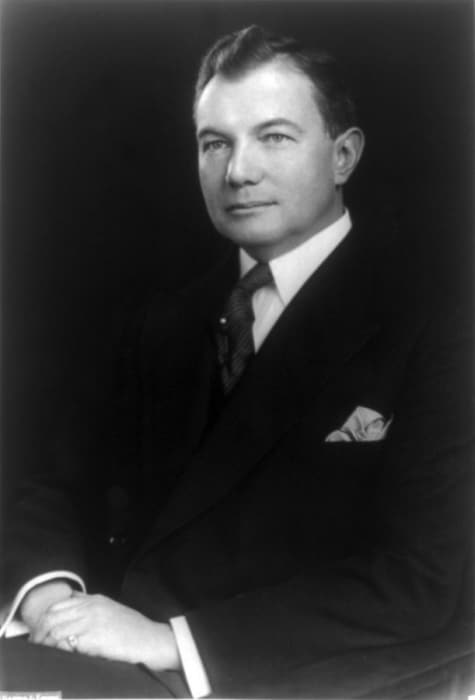
Justice Robert H. Jackson, author of the Wickard opinion.
On November 9, 1942, the court ruled for Wickard 9-0. Justice Robert H. Jackson wrote the court’s unanimous opinion, “The maintenance by government regulation of a price for wheat undoubtedly can be accomplished as effectively by sustaining or increasing the demand as by limiting the supply. The effect of the statute before us is to restrict the amount which may be produced for market and the extent as well to which one may forestall resort to the market by producing to meet his own needs. That [Filburn’s] own contribution to the demand for wheat may be trivial by itself is not enough to remove him from the scope of federal regulation where, as here, his contribution, taken together with that of many others similarly situated, is far from trivial”. In other words, non-participation in interstate commerce has an impact on interstate commerce.
This decision has become despised by conservatives, who see this decision as allowing pretty much any economic action to fall under interstate commerce. George Leef (2024) writing in the conservative publication National Review held, “The ruling shredded the concept of interstate commerce. It was as if the Founders had written the Constitution to say, “The government may impose controls of any kind on Americans who produce anything.””. Indeed, there is currently a case being heard by the Sixth Circuit of Appeals, Ream v. U.S. Department of the Treasury, by a man who wants to be able to distill bourbon in his home for personal and family consumption, which could potentially overturn Wickard.
After this decision, the Supreme Court issued no decisions that restricted Commerce Clause reach until United States v. Lopez (1995), which was a 5-4 decision on federal gun-free zone laws. Should Wickard be overturned, it will be Christmas Day for conservatives but a dire repudiation of the New Deal conception of regulatory powers.
References
Leef, G. (2024, November 20). One of the Worst Court Decisions of All Time. National Review.
Not everyone gets his or her historical due. Sometimes this failure to get one’s due is because the person was a polarizing figure in their time and the people who wrote the bulk of history on them were opponents. Sometimes it is because another figure in that time and place overshadowed them. The latter case was certainly true, and on more than one count, of Vermont’s Winston Lewis Prouty (1906-1971). Prouty was a Republican in a state that had always elected Republicans to the Senate since the foundation of the party at the time of his life and career, and did not appear to stand out as a liberal maverick nor as a staunch conservative. Indeed, he seemed entirely a man of his time and place; moderate in a state becoming increasingly liberal but still at the time wed by tradition to the GOP. I hope with this post to translate the forgettable into the memorable.
Prouty came from a political family that had a lumber and construction material business, and his uncle, George Prouty, had been one of Vermont’s governors. In 1923, at the age of 16 when working at his family’s lumber firm, he lost his right thumb in an accident with a buzzsaw (Express and Standard). This was said to have contributed to his overall cautious and reserved demeanor. In Vermont politics at the time of his rise, this demeanor was not a disability. After all, the famously reticent Calvin Coolidge had been a Vermonter. In 1932, Prouty began his gradual rise through Vermont politics as he was elected to the Newport City Council and served until 1937, and then was Mayor from 1938 to 1941. In 1940, Prouty was elected to the Vermont House, and served until 1949, serving as speaker in the last two years. In 1948, he ran for lieutenant governor but lost the nomination to the conservative Harold J. Arthur, instead getting to chair the state’s Water Conservation Board.
In 1950, Congressman Charles Plumley decided to retire after a House career consisting mostly of opposition to the New Deal and support for internationalist foreign policy. Prouty won the nomination to succeed him and was a shoo-in given that electing Republicans was not in doubt at the time in the Green Mountain State, and he won with 73.5% of the vote. As a representative, his overall moderate approach was a winner with Vermonters, and he always won reelection to the House with over 60% of the vote. He prevailed even though he cast a politically difficult vote for the St. Lawrence Seaway in 1954. Many New Englanders opposed the St. Lawrence Seaway for diverting shipping traffic. In 1958, Senator Ralph Flanders, by this time 78 years old, decided to retire. The most natural successor was Prouty. However, 1958 was a difficult year for the GOP, particularly so in New England where the recession was hitting hard. For the first time since the foundation of the Republican Party, a Democrat won Prouty’s House seat. Prouty himself prevailed, but by just shy of 5 points. This was certainly alarming for Republicans one of the two states that had never voted for Franklin D. Roosevelt.
Senator Prouty
The New York Times (1971) profiled Prouty as senator, “Serious, quiet, intense, hard to classify as liberal or conservative, Senator Prouty presented an enigma even to some of his friends. He rarely made campaign trips home to Vermont, and he seemed to have no visible political organization, but “he always wins and no one knows how,” as one Vermont politician put it”. Unfortunately for him, he was consistently overshadowed by his colleague, George Aiken, who was senior both in time in the Senate and age. Aiken was also much more popular with Vermonters.
Prouty unsurprisingly had a mixed response to the Kennedy Administration. While he was in support of a significant minimum wage increase and federal aid to education, he was opposed to Area Redevelopment legislation and the Housing Act of 1961 which expanded public housing. Prouty seemed to have some fundamental level of fiscal conservatism but was strongly supportive of furthering federal aid to education, something his successor, Robert Stafford, would champion. However, in one area, Prouty would lead opposition, and this was on the Youth Employment Act in 1963.
On April 10, 1963, Prouty led the charge to strike the Youth Conservation Corps, the central controversial feature, from the Youth Employment bill, which was defeated 41-47. Prouty would vote against the Youth Employment bill, which although it passed the Senate, it died in the House Rules Committee. Prouty’s continued moderation had certainly won over some people since the 1958 election, as he won another tough reelection in 1964 with a higher margin. Vermonters clearly differentiated the Republicanism of Prouty from the Republicanism of presidential nominee Barry Goldwater, who had won only 33.7% of the vote in the Green Mountain State. Prouty thrice voted to kill Medicare before supporting it in 1965.
While Prouty had led the charge in a conservative way against the Youth Employment Act in 1963, he led the charge in a liberal way on an expanded emergency job program, which failed on October 4, 1967 at 42-47. That year, he had also voted to lower the minimum age to receive Social Security benefits, albeit on a reduced basis, from 62 to 60. On civil rights, Prouty was strongly supportive. He voted for all the major laws of the 1960s and during the Nixon Administration he embraced the Philadelphia Plan and a busing compromise endorsed by President Nixon. Although a moderate, Prouty once in a while could surprise liberal colleagues, such as his support for guaranteed minimum income in 1968. However, it was another surprise that got his name in the papers for a time, and that was on the issue of the Anti-Ballistic Missile System. In 1968, Prouty had announced his opposition to this idea, but President Nixon succeeded in swaying his critical vote to the ABM system. The ABM system was passed by one vote. He split the difference in his votes for President Nixon’s unsuccessful Supreme Court nominations; he voted for the confirmation of Clement Haynsworth but against G. Harrold Carswell. He said his reason for voting against the latter was that a motion to recommit failed and Carswell didn’t have time to explain himself, “I thought we would be doing the Administration a favor by recommitting, giving Carswell a chance to dispel some of the doubts about him…It was a difficult decision—one of the most difficult I have ever had to make” (Time Magazine, April 19, 1970). Although George Aiken was typically thought of as the more liberal senator than Prouty, on this occasion, like his support for lowering the age for Social Security benefits, he voted to Aiken’s left. However, any disappointment Nixon had over his vote on Carswell was outweighed by his support for his polices on Vietnam. Prouty voted against both the Cooper-Church Amendment to stop funding for U.S. forces in Cambodia and Laos and against the McGovern-Hatfield “End the War” Amendment, and Nixon enthusiastically endorsed him for reelection.
The achievement that Prouty should be most known for, and one I’m surprised isn’t emphasized more on what I’ve read about him, is his crafting of the National Passenger Rail Service Act of 1970, which founded Amtrak. This law was passed to retain passenger rail service as private rail companies, most notably Penn Central, were going bankrupt due to the proliferation of automobiles after World War II as well as a toxic combination of subsidization and inflexible regulations from the Interstate Commerce Commission and state governments (Shedd). Thus, a figure obscure and seemingly without note continues to have impact on the lives of millions of Americans. That year, he had a spirited challenge from former Governor Phillip H. Hoff, a staunch anti-Vietnam War liberal, and polling a little over a week out from Election Day indicated that Prouty would lose (Time Magazine, October 25, 1970). However, the polling of this election seemed to be a bit off, as he not only won but won by 19 points, his biggest victory yet. The New York Times attributed Prouty’s victory to numerous late defections from conservative Democrats in Burlington and Winooski (Reinhold). Sadly, Prouty didn’t get to enjoy his victory long; he was subsequently diagnosed with stomach cancer and died on September 10, 1971. His DW-Nominate score is a pretty sedate 0.17 and he agreed with the conservative Americans for Constitutional Action 54% of the time and the liberal Americans for Democratic Action 44% of the time. It is unfortunate that Prouty is considered forgettable but he had a hard act to be alongside (Vermont’s longtime popular politician George Aiken) and following (Ralph Flanders had led the Republican side of the charge against Joseph McCarthy). I thought of writing about Prouty as a bit of a challenge to try and make an obscure and seemingly mundane figure interesting, and he is precisely the opposite of everything we have come to expect from modern politics. Did I succeed in my effort to make him interesting? Let me know!
References
ADA Voting Records. Americans for Democratic Action.
By 1930, Senator Furnifold M. Simmons had long been a powerful presence in North Carolina. He had been a senator since 1901 and had led the “white supremacy” campaign of 1898 that resulted in the Democrats coming back to power in the long run which also came with it the insurrection that overthrew the multiracial government of Wilmington, which had been the largest city in the state at the time. Although ideologically he could be thought of as a Wilsonian progressive, Simmons resolutely supported Prohibition. Thus, a problem arose for him when the Democratic Party nominated New York Governor Al Smith. Smith was against Prohibition and he had also risen in politics through New York City’s notorious Tammany Hall machine. Both were reason enough for Simmons to endorse Herbert Hoover over Smith. Simmons’ endorsement carried a lot of weight in the state and Hoover won both election and North Carolina. The last time a Republican had won North Carolina was in 1872. However, by 1930 the Great Depression had started and Hoover was very unpopular. This and that Simmons had not cultivated younger politicians made him vulnerable, and stepping in to challenge him was Josiah William Bailey (1873-1946).
Bailey had strong religious convictions as a Baptist, and after his father’s death in 1895 served as the editor of the North Carolina Baptist Convention’s newspaper the Biblical Recorder, and from 1903 to 1907, he headed the state’s Anti-Saloon League, but resigned when the organization started pushing for prohibition rather than temperance, not believing that the former would work (Moore). In 1913, President Woodrow Wilson tapped Bailey to be collector of revenue for the eastern district of North Carolina, and it was there that he gained practical experience on government efficiency, and managed to reduce the cost of collections by 65% (Moore). He served in this role until 1921 In 1914, Bailey pushed with Clarence Poe of the Progressive Farmer a platform for the Democratic Party Convention which included among its planks state primaries, increased assistance to public health and education, stronger regulation of freight and insurance rates, and strengthening child labor laws (Moore). This platform was not adopted, but it established Bailey’s reputation at the time as a progressive. By the early 1920s, Bailey became independent of the Simmons political machine and in 1924 he ran a reformist campaign in the Democratic primary for governor. Although he lost, he was now a known and credible political quantity in the state.
Bailey, who as editor of the Biblical Recorder had backed Simmons’ white supremacy campaign of 1898, hammered him for party disloyalty and this approach worked, with Bailey winning the nomination. Simmons gracefully accepted defeat and had no regrets about his decision to oppose Smith. Although Bailey had campaigned against Simmons on party disloyalty, he would ironically prove far more at odds with his party’s philosophy than Simmons had ever been. Indeed, Bailey had very distinct ideas about right and wrong. As the left-wing publication The Nation noted about him, he was a “diligent scholar whose devotion to abstract principles of right and wrong, and specifically to righteousness in civil and political affairs, borders on fanaticism…He is a brilliant but painstaking student whose mind quickly cuts through to the heart of a thing, with a logic that is irrefutable, and a command of language probably unequalled by any other living North Carolinian” (Tucker). While he campaigned for FDR in 1932, during the first 100 days of the New Deal, Bailey voted against the Agricultural Adjustment Act, being the only North Carolinian to do so. His stance was in contrast to his history of having been a progressive reformer in the 1910s and 1920s. Bailey did support some measures such as the National Industrial Recovery Act, the Tennessee Valley Authority, FDR’s gold measures, and Social Security. In FDR’s first term, Bailey served as a sometimes supporter and sometimes opponent of the New Deal. In 1935, Bailey was one of five Democratic senators to oppose the Wagner Act, commonly regarded as the Magna Carta of labor rights. He would consistently oppose legislation to increase the power of organized labor and support legislation to reduce it. Although Bailey was not blind to social problems and wasn’t necessarily opposing every measure to address them, he had his limitations which he saw as consistent with Jeffersonianism, stating, “Being a Baptist, I am liberal, and believe in liberty. Being a Democrat, I am a liberal and believe in liberty. Once we abandon the voluntary principles, we run squarely into Communism. . . . There can be no half-way control” (Tucker). Bailey was not willing, however, to go strong in opposition until after the 1936 election, but the next year he really went after the philosophy of the New Deal. In 1937, Bailey joined Burton K. Wheeler (D-Mont.) and Vice President John Nance Garner in leading the opposition to FDR’s “court packing plan” and delivered a powerful speech against on the Senate floor. In 1937, he and a group of conservative Democrats and Republicans crafted the “Conservative Manifesto”, with he and Arthur Vandenberg (R-Mich.) being the primary authors. This was a ten point document that outlined conservative alternatives to New Deal programs. This document, however, was prematurely leaked to The New York Times and when inquiries were made about who authored it, Bailey stepped up and admitted it while other Democrats were silent. Vandenberg and Warren Austin (R-Vt.) also stepped up and admitted themselves as participating in the drafting. The reason others were shying away from their involvement was because the ten point plan bore resemblance to what the American Liberty League had been calling for, and President Roosevelt had successfully painted the organization to the public as simply a vehicle for economic privilege. Indeed, Senate Minority Leader Charles McNary (R-Ore.), who had leaked the Manifesto, did so as he was concerned that this would overshadow a planned Republican platform and stated, “Anyone who signs that thing is going to have a Liberty League tag put on him” (Moore, 31-32). Bailey’s record on domestic issues after Roosevelt’s reelection was considerably more conservative on domestic issues, and he sought a program that involved lower spending, more emphasis on state’s rights, and more emphasis on free enterprise to help recovery. He stated, stated, “We do not have a Government at Washington. It is a gift enterprise and the gifts are at the expense of those who work and earn and save. Our President is not actuated by principle, but by fears. He will try to head off anything in order that he may stay at the head. I expect him to run for a third term, and if I am living, I expect to fight a good and last fight” (Moore, 26). Bailey’s leading role in the Conservative Manifesto presaged an overall shift in the state’s politics to the right, and one could consider him as an agent of change in the state who served the role that Republican George Aiken served for his state. Both men believed that in their views they were upholding their party’s traditional values but were often differing with their own parties. Bailey led the shift of North Carolina away from the national party, while Aiken led the shift of Vermont’s Republican party away from the Coolidge-style conservatism that characterized it during the 1930s. The collaboration of Bailey and Republican Vandenberg as central authors also could be marked as the start of the bipartisan Conservative Coalition which started to have pull after the 1938 midterms.
While Bailey was at odds with President Roosevelt on domestic policy, he was strongly supportive on foreign policy, backing all his major initiatives. Indeed, he contrasted considerably with his colleague, Robert Rice Reynolds, who had been much more supportive of New Deal programs but had voted against all of the president’s prewar initiatives save for the peacetime draft. Bailey was again back to the status of moderate opposition to President Roosevelt’s agenda. He was also an internationalist, and opposed the unsuccessful Revercomb (R-W.V.) amendment to require participation in international organizations be by treaty only. Although he had supported much of the president’s war policies, he was against a postwar direction of more government spending and emphasis on the public sector. However, Bailey’s role in the postwar world would be limited; in 1945, his health began to decline and on December 15, 1946, he died in office of a cerebral hemorrhage. Bailey’s DW-Nominate score is a -0.118, which although seems rather low given his domestic conservatism, party-line and procedural votes also get counted. By Democratic standards, he does fit on the party’s conservative wing. Indeed, as noted before, Bailey was the start of North Carolina’s shift to the right and away from the national Democratic Party politics. Although he is largely a forgotten figure, he got some recognition as one of the people profiled in Garland S. Tucker III’s 2015 book, Conservative Heroes: Fourteen Leaders Who Shaped America, From Jefferson to Reagan.
Bipartisanship is a less common commodity than it used to be, but there was a time in which postwar foreign policy was a bipartisan creation, and one of its champions was South Dakota Republican John Chandler “Chan” Gurney (1896-1985). Although Republicans historically had an advantage in South Dakota, the Great Depression depressed their prospects everywhere, even if said Republicans were progressive. In 1930, progressive Republican Senator William McMaster lost reelection to Democrat William J. Bulow. However, given the state’s usual Republican orientation, perhaps Bulow’s election was a fluke. This was a proposition that Chan Gurney tested in 1936. Gurney was a solid pick as he had a voice that was known across South Dakota as a radio announcer for radio station KNAX in Yankton. However, that year would be FDR’s greatest election, with him winning all states except Maine and Vermont. Only one Democratic seat flipped to the GOP that year, and South Dakota’s wasn’t it. Although Gurney lost, he had only lost by two points, running ahead of Republican presidential nominee Alf Landon by ten points. An opportunity would arise less than two months after the election, as on December 20, 1936, Republican Senator Peter Norbeck died of cancer, thus was gone the power of incumbency for that seat. Although Democratic Governor Tom Berry tapped Herbert Hitchcock to serve the remainder of the term. Berry intended to run himself, and defeated Hitchcock for running for the full term. Since Gurney had a good performance considering the environment of 1936, he was able to win the GOP nomination again, and this time he won by five points. As Drew Pearson and Robert Allen (1938) reported in the Washington Merry-Go Round, “In 1936, radio announcer Chandler Gurney had the displeasure of reporting to his listeners that he had been defeated in the race for the United States senate. Last month, announcer Gurney had the pleasure of reporting that he had won his race for the senate” (32).
As a new senator, Gurney proved antagonistic to the New Deal, supported curbing the growing power of organized labor, and stressed fiscal restraint on domestic spending. However, he also supported priorities for South Dakotans, such as rural electrification projects for the state and developing the Missouri River. However, he surprised political observers by supporting an interventionist position. Of South Dakota’s federally elected officials, he was the only one to vote for all of FDR’s major interventionist measures. Gurney, who had served in World War I, believed in national service and there would be no hypocrisy in the coming war as his sons also served. Ironically, his colleague Bulow, who had shifted to the right after FDR’s first term, would be the most opposed of all of South Dakota’s federally elected officials to interventionist foreign policy. In multiple ways, Gurney was contrary to his Republican predecessor, Norbeck, who was largely supportive of the New Deal and had opposed U.S. entry into the World Court. However, he was also staunchly anti-communist, and although he voted for Lend-Lease he had voted for an amendment to prevent Lend-Lease aid going to the USSR. In October 1941, Gurney joined Senators Styles Bridges (R-N.H.) and Warren Austin (R-Vt.) in calling for outright repealing the Neutrality Act, going further than many of their colleagues wanted (Time Magazine, 1942). He was also a strong supporter of the development of aviation and opposed a 1940 effort to cut spending for the Civil Aeronautics Board. In 1942, Gurney sponsored the law reducing the draft age to 18 and increasing the upper limit to 37 and argued that “the American people want to win the war in the shortest possible fashion and will do what it takes to accomplish that” and that drafting of 18 and 19-year-olds was required to do so (Time Magazine, 1942). During World War II, Gurney supported efforts at a new postwar international order, and opposed Senator Revercomb’s (R-W.V.) unsuccessful amendment requiring membership in international organizations to be done by treaty only. In 1944, he won reelection by 28 points, winning all but two counties.
Although Gurney was a senator who was willing to side with the Roosevelt Administration on foreign policy and on certain war measures for the home front, he was adamantly against long-term government involvement in the economy, voting to restrict the emphasis on the public sector in securing full employment in the Full Employment Act of 1946. In 1946, the Republicans won majorities in both houses of Congress, which meant that Gurney was now the chairman of the Armed Services Committee. As chairman, he introduced and led the push for the National Security Act of 1947 and the Selective Service Act of 1948, the latter reinstating the draft. For his work on defense issues, he was a trusted figure with the military brass. Gurney’s anti-communism was expressed both in his support for President Truman’s foreign policies of aid to Greece and Turkey and the Marshall Plan but also in his support for a loan for Francoist Spain, a policy Truman opposed.
Gurney and Civil Rights
Gurney had a record on civil rights that was mixed, more on the side of supporting in his first term and more to opposition in his next term. In 1940, he voted for the Wagner (D-N.Y.) Amendment to the Selective Service Act of 1940, which prohibited racial discrimination in enlistments and in 1943 he voted for an anti-discrimination rider to an education bill. However, in 1944 he voted to delete funding for the Fair Employment Practices Committee (FEPC) and voted against ending debate on establishing a permanent FEPC in 1946 and 1950. However, Gurney did vote for a short-term appropriation for the FEPC in 1945. As chairman of the Armed Services Committee in the 80th Congress, he opposed Senator Langer’s (R-N.D.) efforts to add civil rights riders to the Selective Service Act of 1948, not wishing to complicate passage of the legislation with such riders. Gurney also was one of four Republican senators to support Senator Richard Russell’s (D-Ga.) unsuccessful 1950 amendment to allow soldiers to choose whether they want to serve in racially integrated units or not.
The 1950 Election
Gurney had reason to believe that he was safe in his seat. After all, he had been a highly productive legislator, especially as chairman of the Armed Services Committee. His record on domestic issues surely had been conservative enough for the Republican base, and his seniority and expertise were of value. Thus, when Representative Francis Case (R-S.D.), who had been a pre-war non-interventionist and voted against the Marshall Plan ran against him, neither Gurney nor many observers took the run seriously. However, Case barnstormed the state making his case if you will for his nomination and that economy in government was important, including on matters of foreign aid spending. Gurney had dismissed campaigning back in his home state and declined to debate Case, stating that he was “busy” (Time Magazine, 1950). He changed his mind on campaigning in South Dakota two weeks before the primary when it was abundantly clear that Case was gaining traction. His campaign stressed the benefits to South Dakota of his seniority, opposition to deficit financing, opposition to big domestic government, and his stances on foreign policy (Argus-Leader). However, it was too late and he lost renomination by 15,000 votes. Senator George Aiken (R-Vt.) commented, “It made some of those who are up for re-election realize they had better go back home to do some politicking” (Time Magazine, 1950). Gurney’s DW-Nominate score is a 0.217, certainly being depressed by his foreign policy votes, and he agreed with the liberal Americans for Democratic Action 16% of the time from 1947 to 1950.
Gurney was out of elective politics, but President Truman had a job for him: to serve as a member of the Civil Aeronautics Board. He was appointed chairman in 1954, serving in this role until 1957, when he became vice chair until retirement in 1964. Gurney was subsequently on the board of directors for North Central Airlines. He died on March 9, 1985 at the age of 88, far outliving his South Dakota Republican colleagues. Gurney is remembered in South Dakota as Yankton’s municipal airport is named after him for his contributions to aviation policy.
References
ADA Voting Records. Americans for Democratic Action.
Today Iowa seems to only be getting further cemented as a Republican state, and indeed historically Iowa was a very Republican state, even if its Republicans didn’t always neatly fit the conservative mold. From the 1856 elections up to the Great Depression, Iowa had only had one Democratic senator in Daniel Steck and the circumstances of his election made it a fluke, and its only Democratic governor since the Republican Party’s foundation was Horace Boies, who served from 1890 to 1894. However, the Great Depression taxed the popularity of Republicans so much that it even hit major offices in Iowa. Democrat Richard Murphy won a Senate seat in 1932, Clyde Herring was elected governor, and Guy Gillette (1879-1973) won a Congressional seat in a typically Republican Iowa district. However, even in this early stage of his career, he proved independent from FDR and the New Deal; he voted against the Agricultural Adjustment Act and the National Industrial Recovery Act in 1933. However, Gillette backed other New Deal laws including the Tennessee Valley Authority, FDR’s gold policies, the Securities and Exchange Act, and Social Security. His margin of reelection only increased in 1934. His career was undoubtedly helped by his senatorial looks and geniality, with author Allen Drury writing in A Senate Journal that he was, “a nice fellow … impressively handsome with a friendly twinkle in his eye” (U.S. Senate). Although Gillette had won renomination for reelection to the House in 1936, fate had a different idea. On July 16, 1936, Senator Richard Murphy was killed in a car accident, and Gillette ran for his seat. This was yet another excellent year for the Democrats, he was elected to serve the remainder of the late Senator Murphy’s term.
Murphy had been a staunch New Dealer, but Gillette soon proved he would continue his independence by his opposition to FDR’s court packing plan as well as that year’s proposed Fair Labor Standards Act. A different version of the latter would be passed the following year. However, he did support his controversial proposed 1938 reorganization plan, which critics had dubbed the “dictator bill” for its centralizing of power. Not enthused about Gillette’s record, FDR backed Democratic Congressman Otha Wearin against him. Although strongly with the president now, Wearin had ironically also voted against the Agricultural Adjustment Act and the National Industrial Recovery Act in 1933. However, Iowa Democrats were sufficiently appreciative of Gillette’s independence as well as in opposition to FDR’s putting his thumb on the scale of state primaries. It was a different time back then. Although Roosevelt did not like Gillette being the nominee again, he undoubtedly preferred him to Republican candidate Lester J. Dickinson, who had been in the Senate from 1931 to 1937 and was a staunch foe of President Roosevelt. It was a tough campaign, with Gillette winning reelection by less than 3,000 votes. Had Wearin won the nomination, it seems likely that Dickinson would have returned, thus having an outright opponent rather than someone whose vote was not always certain. This win, by the way, was historic, as this was the first time a Democrat had won reelection to the Senate from Iowa since 1852.
In his second term, Gillette more often supported Roosevelt on domestic issues than not, but he also stood as one of the Senate’s opponents of FDR’s foreign policy. Although he had voted for the repeal of the arms embargo in 1939, he opposed the peacetime draft, Lend-Lease, and the permitting of merchant ships to enter belligerent ports. Writing confidentially for the British Foreign Office, Isaiah Berlin assessed Gillette thusly,
“[He] resembles Van Nuys in that he is a typical Mid-Western Senator with a moderately steady Isolationist voting record, although he is not an articulate opponent of the Administration’s policy. Unlike Van Nuys, he is a supporter of reciprocal trade pacts but shares his suspicion of the President. A simple, confused, but very honest Presbyterian of considerable character, he views the corn interest, which he represents, with an almost religious devotion. He leads the Senate Lobby interested in producing synthetic rubber out of corn, and coming from the Republican corn belt, is virtually a Republican in sentiment and conduct. He is not at all anti-British, but as isolationist as his general environment. His speeches in Congress take the form of thinking aloud. On foreign policy he is not a bigoted anti-Rooseveltite but is exceedingly uncertain” (Hachey, 146).
During World War II, Gillette strongly pushed for active efforts to save European Jews from the Holocaust. As a devout Christian, he sympathized with the historical plight of the Jews and sought to help them. He also shifted his foreign policy views from moderate non-interventionism to support for internationalism, most notably in evidence in his vote against Senator Revercomb’s (R-W.V.) unsuccessful 1943 amendment to require participation in international organizations be established by treaty only.
Although 1944 was a considerably better year for Democrats than expected, this didn’t apply enough in Gillette’s case to save him from the candidacy of Governor Bourke B. Hickenlooper in 1944, who won with 51% of the vote. By this time, differences between Gillette and the president appeared to be patched up, and he was appointed chairman of the Surplus Property Board. However, he did not care much for his role, and he often found himself outvoted by the board’s two other members. After his resignation in May 1945, Gillette was offered a judgeship by President Truman, but he turned it down as he believed himself unqualified as he had been too long out of the practice of law, a demonstration of his personal honesty (Hill). Gillette, a committed supporter of Zionism, was president of the American League for a Free Palestine, which was disbanded after the establishment of Israel in 1948. That year, Gillette sought a political comeback. President Truman and Gillette heavily appealed to farmers in this campaign, Truman campaigned for Gillette, and told Iowans that if they didn’t elect him to the Senate again there was something wrong with them (Hill). On Election Day, Gillette pulled a stunning victory by 162,448 votes against incumbent George A. Wilson, who had previously been popular.
Gillette’s Next Round
This time around, Gillette was a bit more supportive of the Democratic Administration and unlike his previous term in the Senate, he was solidly internationalist. He supported the Point Four program in 1950, and opposed most proposals to cut foreign aid. On domestic issues, Gillette had a hodgepodge of positions; he supported a “local option” amendment for rent control in 1949, but supported extending rent control in 1950, supported a conservative substitute for minimum wage legislation in 1949, opposed a 1950 proposal making housing credit more available to co-ops and non-profit housing projects, opposed the Knowland Amendment restricting the authority of the Social Security Administrator to enforce federal standards for unemployment compensation, and opposed the Tidelands Act in 1953. Gillette supported civil rights, opposing Senator Russell’s (D-Ga.) effort to undermine army desegregation and backed ending debate on a Fair Employment Practices bill. In 1952, Gillette voted against overriding President Truman’s veto of the McCarran-Walter Immigration Act. Curiously, during the Eisenhower Administration, Gillette’s foreign policy record seemed to take a turn to the right, with him backing a significant foreign aid cut in 1953 and supporting the Bricker Amendment the following year. In 1954, Gillette went for another term, but was defeated by Congressman Thomas E. Martin, who netted 52% of the vote in an otherwise good election year for Democrats, once again placing Gillette on the low end of a good Democratic year and was a reaffirmation of Iowa’s traditional Republicanism. This was a major upset as polling had put Gillette in the lead and on Election Night he believed he would be winning another term. He had sided with the liberal Americans for Democratic Action 66% of the time during his final term and his DW-Nominate score is a -0.076, the latter indicating that he was a moderate. Gillette got a cameo appearance in the 1962 film Advise and Consent, fittingly as a senator along with octogenarian former Senator Henry Ashurst (D-Ariz.) and sitting Senator Henry “Scoop” Jackson (D-Wash.). While retired, Gillette suffered a stroke which paralyzed his right side, but he succeeded in learning how to write with his left hand. On March 3, 1973, he died in a nursing home at the age of 94.
References
ADA Voting Records. Americans for Democratic Action.
Hachey, T.E. (1974). American Profiles on Capitol Hill: A Confidential Study for the British Foreign Office in 1943. The Wisconsin Magazine of History, 57(2), 141-153.
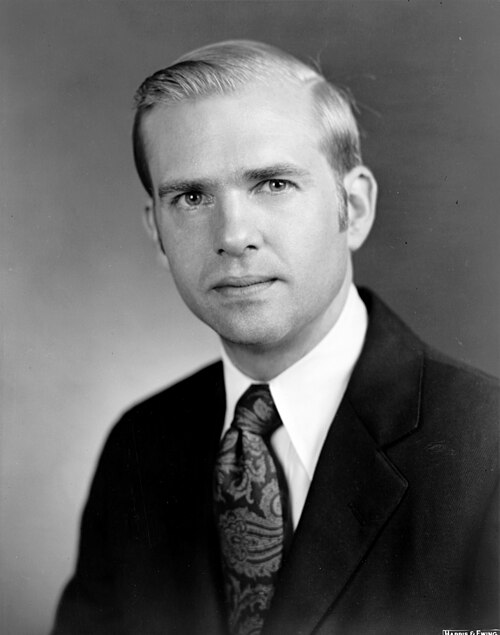
The 1966 election was a comeback for the GOP, which had taken a licking in the 1964 election, and one of their achievements was winning back Wisconsin’s 6th district with Oshkosh’s William Albert Steiger (1938-1978). From the start, Steiger was a go-getter who pursued his dreams. He dreamed of a career in public office, and at the mere age of 22 as a young graduate of his local state representative resigned, and he ran for the seat and won. Steiger’s young age fooled some people into thinking that he was a page. Once, a legislator ordered him to run an errand, and he humorously did so, later observing that he became chairman of the same committee the legislator served on (Miller).
As a member of Congress, Steiger proved to be considerably more moderate, especially on social issues, than his staunchly conservative Republican predecessor William K. Van Pelt, who had voted against the Civil Rights Act of 1964. On civil rights, he was even more liberal than his Democratic predecessor, Abner Race, who had voted against the proposed Civil Rights Act of 1966 for its inclusion of a fair housing provision; Steiger supported fair housing. He believed that there was some need for anti-poverty measures and thus opposed some efforts to curb the Office of Economic Opportunity and food stamps, opposed most anti-busing amendments, voted against a school prayer amendment to the Constitution, was an internationalist, and strongly supported the creation of the Legal Services Corporation. However, Steiger was also conservative on issues of taxes and economic regulation, consistently supported the Nixon Administration on the Vietnam War, and proved strongly opposed to campaign finance legislation, being one of 48 representatives to vote against the Federal Election Campaign Act Amendments in 1974. In 1970, Steiger was the House sponsor of the law creating the Occupational Safety and Health Administration and would oppose subsequent efforts to curb its enforcement on small businesses. He also sponsored legislation providing for environmental protection of the Great Lakes.
In 1978, Steiger called for reducing the capital gains tax from 49% to its pre-1969 level of 25%, arguing that this reduction would stimulate the economy by encouraging investment in the stock market and boosting capital investment, resulting in more jobs (Time Magazine). Through his debating skills and staunch advocacy as well as existing economic concerns, he persuaded the Democratic Congress to pass a capital gains tax cut from 49% to 28%, despite the Carter Administration’s opposition. Carter himself stated in opposition, “I will not tolerate a plan that provides huge windfalls for millionaires and two bits for the average American” (Time Magazine). That year, Steiger won reelection. On December 1st, he announced his plan to introduce legislation for tax-free capital gains accounts, but only three days later died in his sleep of a heart attack at the age of 40. Although Steiger was a diabetic, he was not previously known to have had heart problems and had been good on managing it. The ideological assessments of him differ somewhat. He sided with the conservative Americans for Constitutional Action 62% of the time, the liberal Americans for Democratic Action 31% of the time, and his DW-Nominate score is a 0.336. The latter is interesting because he gets a higher score than people who had stronger conservative reputations and stronger assessments from ACA and weaker assessments from ADA. His fate and the lost potential of it is both sad and reminiscent of Alabama’s Senator James B. Allen, who had died of a heart attack earlier that year. Both men had potential to play significant roles in the Reagan era; Steiger would likely have figured prominently in House debates and crafting of tax reduction legislation. On tax cutting, he was just ahead of his political times. Also, like James B. Allen mentoring Jesse Helms, he mentored a notable man in Dick Cheney, who worked for him as a staffer. Steiger referred him to his colleague, Donald Rumsfeld, who would tap him to work for him in the Office of Economic Opportunity under President Nixon and his roles in government would rise up until he was elected vice president.
References
ADA Voting Records. Americans for Democratic Action.