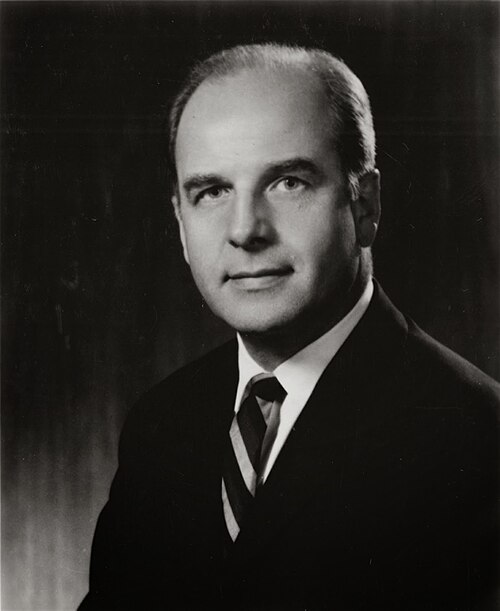
We have come to that time of year again, Earth Day. This day was the brainchild of a prominent liberal senator from Wisconsin, Gaylord Anton Nelson (1916-2005). 1958 proved, as I have written in the past, a massive boon for liberals. One of the victors was State Senator Gaylord Nelson, who was elected Wisconsin’s governor. As a state, Wisconsin had not been historically strong for Democrats. Indeed, it was considered shocking when Grover Cleveland won the state in 1892, and the liberal lane for decades was occupied by the progressive wing of the Republican Party, which came to prominence with the rise of Robert La Follette. Indeed, Democrats would not be able to make sustainable gains in the state until the 1950s, and Nelson’s victory was only the second time in the 20th century that a Democrat was elected governor. He had been in the State Senate since 1948, and had a reputation as a staunch liberal, and indeed he won on a strongly liberal platform. As governor, he along with Senator William Proxmire and future Governor Patrick Lucey were the fathers of the modern Democratic Party in the Badger State. He established a state Youth Conservation Corps, based off of the Civilian Conservation Corps during the Great Depression, and the Outdoor Recreation Acquisition Project, which resulted in the purchase of 1 million acres for public parks. Nelson was not overwhelmingly popular at this time, and he was limited in what he could do because both houses of the legislature still had a Republican majority. In 1960, he clinched reelection by three points. Nelson’s second term would serve as a platform for the next office he wanted: Senator.
Winning Against Wiley
By 1962, Wisconsin’s longtime senior senator, Alexander Wiley, was 78 years old and past his prime. Nelson took advantage both of the age difference and Wiley’s increasing irritability by energetically campaigning across the state and attacking the conservative aspects of his voting record. On Election Day, Nelson won by 5 points. The Democratic class of ‘62, which included George McGovern, was quite a liberal one indeed, and Nelson proved one of the most liberal senators. A staunch supporter of civil rights legislation, he was present at the August 28, 1963 March on Washington in which King delivered his “I Have a Dream” speech at the Lincoln Memorial. He backed the Great Society to a hilt, and although he voted for the Gulf of Tonkin Resolution he was an early critic of the Vietnam War. Nelson could at times vote a conservative position on foreign policy, such as voting to cut foreign aid in 1965. After a resounding reelection by 23 points in 1968, Nelson proved among the staunchest foes of the Nixon Administration. In 1973, he was one of only three senators to vote against the confirmation of Gerald Ford as vice president. However, Nelson’s foremost legacy was on the environment. In September 1969, he delivered a speech in Seattle in which he proposed the creation of Earth Day as a grassroots demonstration in response to the January and February 1969 Santa Barbara oil spill which was the worst spill in US history at the time, with the first Earth Day happening on April 22, 1970. Nelson recalled the idea came to him after reading about nationwide teach-ins against the Vietnam War, “It suddenly dawned on me, why not a nationwide teach-in on the environment?” (Thulin) Unsurprisingly, he was one of the strongest champions of environmental regulations. Nelson dismissed the notion that economic development should take precedence over environmental protection, stating, “The economy is a wholly owned subsidiary of the environment, not the other way around” (Nelson).
In 1970, Nelson held hearings on the safety of birth control pills, with many witnesses testifying their concerns that the pill could be causing cancer. The result of the hearings was a new law that warnings of potential side effects now had to be included on the labels. Although a staunch liberal like Senator George McGovern (D-S.D.) and a supporter, he declined an offer to be his running mate. In 1974, for many Wisconsinites, his opposition to Nixon was looking pretty good, and he was reelected by his largest margin yet, 26 points, against future Congressman Tom Petri.
The 1980 Election
Nelson’s rise to high political office came in the excellent liberal year of 1958, but 1980 was for Republicans what 1958 had been for Democrats. The political climate had substantially changed since his landslide reelection in 1974, and Nelson was swept away in the Reagan wave, losing by two points to former Congressman Bob Kasten. His ultra-liberalism was shown in multiple measures; he sided with the liberal Americans for Democratic Action 94% of the time, the conservative Americans for Constitutional Action 8% of the time, and has a -0.567 from DW-Nominate, making him one of the most liberal senators of his day. In 1995, President Clinton awarded him the Presidential Medal of Freedom for his service and efforts for environmental protection, and the proclamation for the award read, “As the father of Earth Day, he is the grandfather of all that grew out of that event: the Environmental Protection Act, the Clean Air Act, the Clean Water Act, the Safe Water Drinking Act’ (The New York Times). And it wasn’t just Democrats who praised him. Republican Melvin Laird, who as a conservative representative from Wisconsin had frequently disagreed with him, praised his service, “Gaylord’s contributions in the fields of conservation reform and environmental improvement are a living memorial to him” (The New York Times).
References
ADA Voting Records. Americans for Democratic Action.
Retrieved from
Gaylord Nelson, Former Senator Who Founded Earth Day, Dies at 89. (2005, July 3). The New York Times.
Retrieved from
Medicine: The Pill on Trial. (1970, January 25). Time Magazine.
Retrieved from
https://time.com/archive/6816452/medicine-the-pill-on-trial/
Nelson, G. (2002). Beyond Earth Day, fulfilling the promise. Madison, WI.: University of Wisconsin Press.
Nelson, Gaylord Anton. Voteview.
Retrieved from
https://voteview.com/person/10816/gaylord-anton-nelson
Thulin, L. (2019, April 22). Earth Day. Smithsonian Magazine.
Retrieved from

