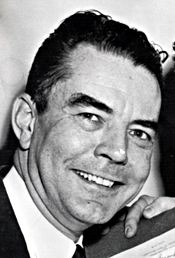
1944 was a disappointing year for the GOP. Although it was believed FDR was going to win reelection, it was believed for a time that Republicans would win control of the House, but instead the Democrats made gains. One of the places in which Republicans made gains, however, was in Wisconsin’s 8th district, centered in Green Bay, with Democrat LaVern Dilweg, who had played for the Green Bay Packers, losing reelection to John William Byrnes (1913-1985). He proved strongly fiscally conservative, siding wholesale with the domestic agenda of the Republican 80th Congress but willing to accept the bipartisan foreign policy that came with the postwar era, including voting for aid to Greece and Turkey and the Marshall Plan. However, he did not support foreign aid for poor nations through Point IV aid and voted for some foreign aid cuts. Byrnes also stood strongly for free market policies, supporting significant efforts to limit and end controls on prices and rents. In 1949, he was among the World War II veterans who spoke out against Rep. John Rankin’s (D-Miss.) pension bill for World War I and World War II veterans, which was intended to make the Social Security expansion proposed by President Truman fiscally impossible. Byrnes stated, “This legislation is dishonest…In ten years, our veterans will be shouldering half the nation’s tax burden…I am unalterably opposed to this bill. It is no hot potato as far as this member is concerned” (Time Magazine, 1949). In 1952 and 1953, he differed with the Conservative Coalition in its support for creating a committee to investigate tax-exempt institutions, which became known respectively as the Cox and Reece Committees. Byrnes continued his record of domestic conservatism during the Eisenhower Administration but supported increased foreign aid.
Byrnes Moves Into Leadership
In 1959, Byrnes was recognized as a strong voice on policy within the GOP with him being tapped to head up the House Republican Policy Committee. He stood as a staunch opponent of the Kennedy Administration’s domestic agenda while supporting foreign aid measures. In 1963, he rose to the position of ranking Republican on the powerful House Ways and Means Committee. An inflation hawk, he was the chief opponent in the House of the Kennedy tax reduction bill and pushed an unsuccessful proposal to cancel the tax cuts unless spending was not expected to exceed $98 billion in fiscal 1964. Byrnes also supported reducing spending to reduce the debt, being a confirmed opponent of the Keynesian approach that the Kennedy and Johnson Administrations were taking. That year, he made a risky admission; that in 1960 that after helping the Mortgage Guaranty Insurance Corporation get a favorable ruling from the IRS that he had purchased stock in the company and done so without knowing it was discounted, and subsequently moved the money to a scholarship fund (Fein). However, honesty paid off and he survived. Although he and Chairman Wilbur Mills (D-Ark.) disagreed on numerous issues regarding taxes and revenue, they had an effective working relationship and were able to produce compromises. Byrnes also opposed special loopholes and privileges in the tax code, and pushed to reduce them in his chief legislative accomplishment, the Tax Reform Act of 1969. In 1965, Byrnes would have to resign his post as head of the Republican Policy Committee due to a change in Republican rules that barred Republicans from holding both ranking positions and party leadership positions.
Byrnes and Civil Rights
Interestingly, Byrnes’ greatest difference with the civil rights position was on taxation; he was an opponent of repealing the poll tax by legislative means, and voted against doing so in 1945, 1947, and 1949. He thought this should be done by amending the Constitution, and true to this view he voted for the 24th Amendment in 1962. He would otherwise support the major civil rights laws, including the Civil Rights Act of 1964, the Voting Rights Act of 1965, and the Civil Rights Act of 1968. In 1971, Byrnes was one of 24 representatives to vote against the Equal Rights Amendment.
Byrnes and the Great Society
In 1965, Byrnes opposed Medicare being mandatory, but the Democratic majority was too great for a Conservative Coalition victory on the matter. Indeed, he was by and large an opponent of LBJ’s Great Society, opposing the Economic Opportunity Act, federal aid to education, rent subsidies, and mass transit aid. Byrnes voted against the initial version of the Social Security Act Amendments that included Medicare but voted for the conference report.
Byrnes and Nixon and the End
In 1969, Byrnes was the point man on the Revenue Act of 1969, and in some ways bent his traditional ways for President Nixon. For instance, he voted for the Family Assistance Plan in 1970 for guaranteed minimum income for families, a considerable departure from what Republicans had stood for in Democratic administrations. However, Byrnes was not simply a nodding head for Nixon. Both he and Ways and Means Committee chairman Wilbur Mills (D-Ark.) were staunchly opposed to revenue sharing, which was championed by Nixon, and Byrnes voted against. He said of the matter, “Maybe I’m old fashioned, but I believe most sincerely that with the pleasure of spending public funds there should also be the odium of collecting them” (Time Magazine, 1971). However, the objections of Byrnes and Mills weren’t enough against the pressures of the Nixon Administration and numerous governors who were wanting fiscal relief for their states. Byrnes also stood with Nixon on Vietnam War policy, opposing efforts to set timetables for troop withdrawals and opposing the Cooper-Church Amendment to pull troops from Cambodia and Laos. He opted not to run again in 1972. The interpretations of Byrnes’ record are consistent; he sided with the conservative Americans for Constitutional Action 84% of the time, the liberal Americans for Democratic Action 15% of the time, and his DW-Nominate score stands at 0.328. On January 8, 1985, Byrnes suffered a massive stroke at Central Wisconsin Airport on the way to a medical check-up and was reported to be in critical condition. He did not recover, dying four days later at the age of 71 at St. Joseph’s Hospital. The year after his death, President Ronald Reagan, who shared Byrnes’ opposition to revenue sharing, completed the program’s repeal.
References
ADA Voting Records. Americans for Democratic Action.
Retrieved from
Byrnes, John William. Voteview.
Retrieved from
https://voteview.com/person/1371/john-william-byrnes
Fein, E.B. (1985, January 14). Ex-Rep. John W. Byrnes Is Dead; Republican Was Tax Law Expert. The New York Times.
Retrieved from
John W. Byrnes, Former Representative, Dies. (1985, January 17). The Los Angeles Times.
Retrieved from
https://www.latimes.com/archives/la-xpm-1985-01-17-me-7747-story.html
The Congress: Rankin’s Revenge. (1949, February 28). Time Magazine.
Retrieved from
https://time.com/archive/6602178/the-congress-rankins-revenge/
The Nation: Pros and Cons of Revenue Sharing. (1971, January 31). Time Magazine.
Retrieved from
https://time.com/archive/6843587/the-nation-the-pros-and-cons-of-revenue-sharing/

