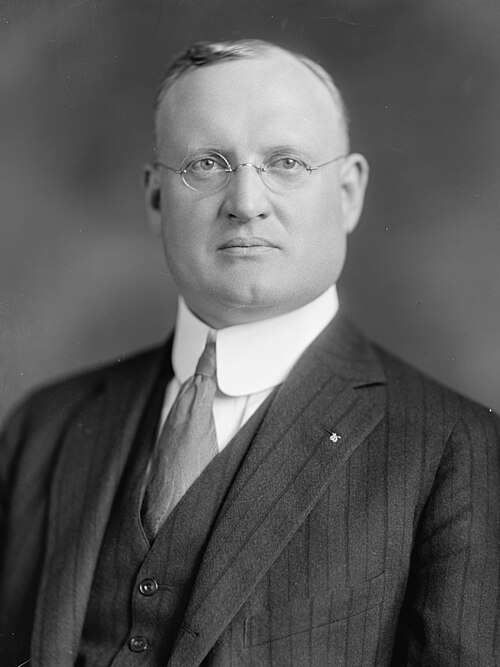
I have written before about the concept of politicians being bridges from one era of American politics to another due to the longevity of their service. They are the ones who can best answer questions about what people back then would have thought of politics that resemble ours. One such case is Daniel Alden Reed (1875-1959) of New York.
Reed was a number of things as a person; teetotaler, college football coach, and attorney for New York State. As an attorney, he went after violators of liquor laws and was supportive of Prohibition. In 1918, Reed was elected to Congress representing upstate New York, with his district being centered in Dunkirk. He was a strong supporter of income tax reduction and of high tariffs. Indeed, he represented the strong conservatism of his region. Reed even looked the part, per the New York Times (1959), “Mr. Reed even looked like an Old Guard Republican. His tall, erect frame carried a stern visage topped by pure-white hair. His dress was strictly conservative.”
As a strong supporter of the pro-business conservative Republicanism of the 1920s, Reed was naturally one of the most dogged opponents of the New Deal. He opposed all of the major First 100 Days legislation and he was one of the minority of legislators who voted against Social Security, darkly warning that because of this law “the lash of the dictator will be felt, and 25 million free American citizens will for the first time submit themselves to a fingerprint test.”(Kapur). In 1938, Reed voted against the Fair Labor Standards Act. He did have a softer spot for veterans as although he voted against the Patman Bonus Bill in 1935, he eventually gave in and voted to override President Roosevelt’s veto in 1936. Despite FDR being highly popular in the 1930s, Reed still won by over 10 points even in the tough 1936 election in which he carried all states save Maine and Vermont and House Republican numbers were reduced to 88.
On foreign policy, Reed remained consistent in his non-interventionist beliefs. He voted against all of the major pre-Pearl Harbor measures, and after World War II voted against aid to Greece and Turkey and the Marshall Plan. Reed even went as far as to oppose U.S. entry in to the United Nations. He was also an unrelenting opponent of price, rent, and wage controls and supported all efforts to curb the power of organized labor, which had substantially grown after the passage of the Wagner Act of 1935.
Reed, Civil Rights, and Federal vs. State Authority
One of Reed’s first votes in Congress was in support of women’s suffrage, but on civil rights for blacks, his record was more mixed.
In 1922 and 1937, he voted for anti-lynching legislation, but he proved one of the most consistent Republican opponents of anti-poll tax legislation, including being one of only four House Republicans to vote against the 1942 bill which only covered general elections and not primaries. Reed also voted against a compromise Fair Employment Practices bill in 1950, but also voted against a establishing a segregated VA hospital the following year and supported the 1956 civil rights bill as well as the Civil Rights Act of 1957. This included opposing a weakening jury trial amendment to the latter. On other issues surrounding state and federal issues, he sided with the states in his support for a local option to rent control in 1949, the Knowland Amendment to the 1950 Social Security bill, the Tidelands bill in 1953, the Anti-Preemption bill in 1958,
Chairman of the House Ways and Means Committee
With Dwight Eisenhower’s 1952 victory followed a Republican Congress, and this elevated Reed to the chairmanship of the Ways and Means Committee. Reed was not a “modern Republican” touted by Eisenhower, and was keen on ending the excess profits tax and cutting income taxes. He called the excess profits tax “iniquitous, unfair, unjust, destructive; a cancer on the economy of the country” (Hill). President Eisenhower’s allies then tried to bypass his committee to extend the excess profits tax for six months as the president wanted, much to his consternation, as he wanted it to expire on June 30, 1953, as originally scheduled. Reed agreed to hold hearings and he was outvoted in committee. The billl passed 325-77 on July 10th, retroactively extending it, with Reed being among the nays. Despite their differences on what sort of Republicanism ought to be practiced and on excess profits, Reed shepherded major tax reform signed into law by President Eisenhower in the form of the Revenue Act of 1954 as well as the Social Security Act Amendments of 1954. Despite his working with Eisenhower, he continued supporting the traditional high tariff line of the Old Guard Republicans, continued opposing foreign aid legislation, and opposed federal aid to education. Indeed, he led efforts to rein in presidential authority on tariffs, and on February 18, 1955 his effort failed 199-206 to make the president follow U.S. Tariff Commission recommendations. On June 11, 1958, Reed tried to kill an extension of the Reciprocal Trade Act outright, but this failed 146-268. However, he dissented from his fellow conservatives in opposing the creations of the Cox and Reece Committees to investigate tax-exempt institutions.
In 1958, Reed backed his friend Minority Leader Joe Martin (R-Mass.) for another term as Republican leader but he was narrowly defeated by Charles Halleck (R-Ind.) due to big losses in the 1958 midterms as well as President Eisenhower not putting his thumb on the scale. Reed would not live long in the next Congress; although he had taken doctor’s orders seriously in addressing his 1956 heart attack, he did not address a pain in his foot until he could no longer walk. It turned out that Reed had developed a serious infection, and it was serious enough to require amputation (Hill). He agreed to the amputation but died of a heart attack on February 19, 1959 before it could occur. Former Speaker of the House Joe Martin (R-Mass.) praised him, “He was a man of great courage, like a mighty oak never yielding to the tempest” (Hill). The ideological assessments of Reed are consistent; he sided with the conservative Americans for Constitutional Action 90% of the time, the liberal Americans for Democratic Action (ADA) 6% of the time, and his DW-Nominate score stands at 0.547. Indeed, in seven of the twelve years he was assessed by ADA he scored a 0%.
References
ADA Voting Records. Americans for Democratic Action.
Retrieved from
Hill, R. (2023). Daniel A. Reed of New York. The Knoxville Focus.
Retrieved from
Kapur, S. (2014, April 4). Remember When Republicans Said Social Security And Medicare Would Destroy Freedom Too? Talking Points Memo.
Retrieved from
https://talkingpointsmemo.com/dc/gop-social-security-medicare-freedom
Reed, Daniel Alden. Voteview.
Retrieved from
https://voteview.com/person/7781/daniel-alden-reed
Rep. Daniel Reed, 83, Dies in Capital. (1959, February 20). The New York Times.
Retrieved from

