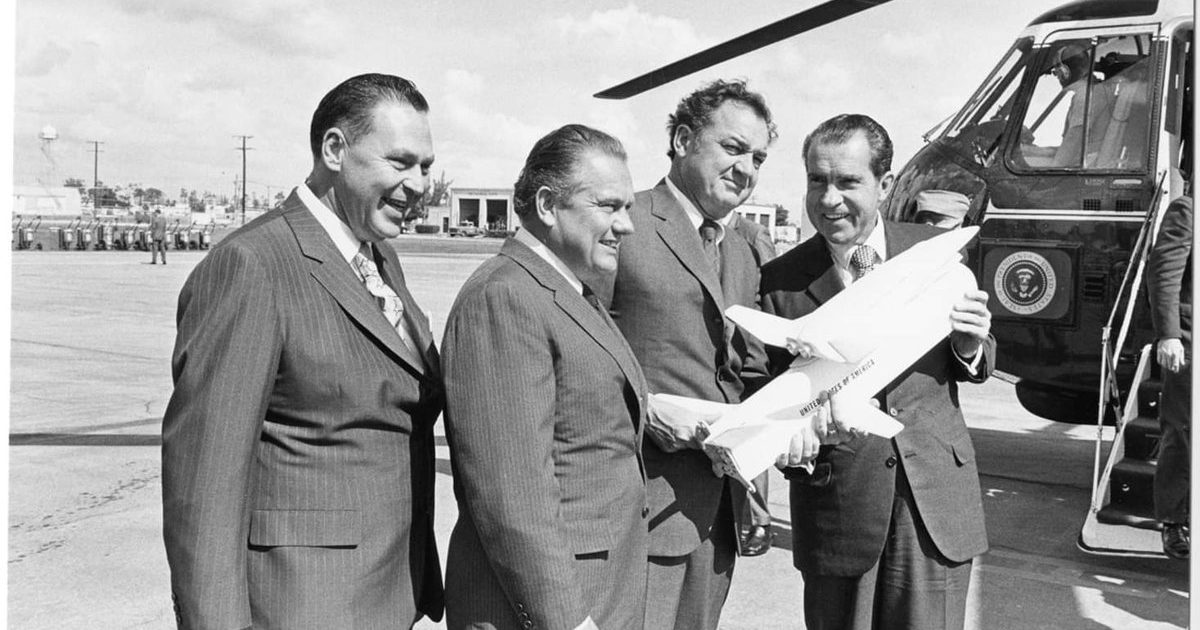
Richard Nixon campaigning in Florida, 1970.
Although the Democrats were still considerably ahead in the House, Nixon had hopes that he could defy the trend of midterms against the president’s party. He campaigned aggressively on social issues and stumped for Republican candidates across the country. Notably, the President’s Commission on Obscenity and Pornography concluded that pornography did no societal or individual harm and called for abolishing anti-obscenity laws for adults, a conclusion that the Nixon Administration as well the U.S. Senate disagreed on, with the chamber voting 60-5 (notably, future presidential candidates Walter Mondale and George McGovern were among the dissenters) to disagree with the report. President Nixon railed against obscenity numerous times in 1970 and tried to connect Democrats to anti-war protesters and obscenity. Nixon stated, “So long as I am in the White House, there will be no relaxation of the national effort to control and eliminate smut from our national life” (Weaver). Vice President Spiro Agnew also went on the attack. He put the election in stark ideological terms, “One issue dominates this election: Will the radical-liberalism that controls the Senate of the United States prevail in the nation? Or will America be led into the future by the moderates, centrists and conservatives who stand behind the President of the United States?” (Time Magazine) He accused Democrats of appeasing anti-war protesters, if not being like them. Although Nixon had successfully and quietly completed school desegregation in 1970, he actively campaigned against the use of busing to achieve desegregation, an issue that had more national impact than pushing against the South’s Jim Crow system. Democrats ran against the Republicans for the increasing inflation and unemployment occurring and on the Vietnam War. The Democrats critiqued what they dubbed “Nixonomics” (Apple).
Predictions for the Senate in September from The New York Times were that Democrats would gain Senate seats in Illinois and New York, and that Republicans would gain in Florida, Ohio, and Tennessee. California, Indiana, and Vermont were considered toss-ups. Democrats were expected to hold in Maryland and Texas, although an outside risk to Maryland’s Tydings was not discounted. Time Magazine (1970), which reported closer to the election, considered Maryland and Wyoming reasonably certain holds, that Ohio and Tennessee looked like Republican pickups, and that Florida and Texas looked like Democratic holds. Time Magazine also reported that Democrats were ahead in Connecticut and Vermont with the Republican slightly ahead in Indiana.
The Results
The direction of the midterms followed historical norms in the House in 1970, although Republicans lost less than the usual seats at 12.
Nick Begich (D-Alaska) won the open seat vacated by Republican Howard W. Pollock against future Senator Frank Murkowski. Begich along with House Majority Whip Hale Boggs (D-La.) would die in an air crash in Alaska in 1972 that was never recovered.
Jeffery Cohelan (D-Calif.), who represented Berkeley, lost renomination to staunch anti-Vietnam War socialist Ron Dellums, who won the election.
The seat vacated by John Tunney (D-Calif.) in his successful run for the Senate was won by Republican Victor Veysey.
In Colorado, Denver’s longtime Democratic representative Byron Rogers lost renomination to Craig Barnes, producing a divide among Democrats sufficient to give Republican Mike McKevitt a victory.
In Connecticut, Republican Robert Steele won the election to succeed the late Democrat William St. Onge in the 2nd district. However, this was counterbalanced by the victory of Democrat Ella Grasso in succeeding Republican Thomas Meskill in the 6th district, who left office for his successful gubernatorial run.
E. Ross Adair (R-Ind.), ranking Republican on the House Foreign Affairs Committee and one of the House’s leading critics of foreign aid, was defeated by Democrat J. Edward Roush. He had been in office for 20 years.
In Kansas, Republican Chester Mize of the 2nd district lost reelection to Democrat William R. Roy. Roy would come close to unseating Senator Bob Dole in the 1974 election.
William Cowger (R-Ky.) was defeated in the Louisville-based 3rd district by Democrat Romano Mazzoli, who would sponsor with Senator Alan Simpson (R-Wyo.) the Simpson-Mazzoli law on immigration in 1986. Cowger would die of a heart attack less than a year after his defeat at the age of 49.
In Maryland, Democrat George Fallon of the 4th district (Baltimore), who had served since 1945, lost renomination to Paul Sarbanes, who would later have a long career in the Senate. Democrat Goodloe Byron succeeded Republican J. Glenn Beall, Jr. in the 6th district, who had vacated his seat to successfully run for the Senate. This wasn’t much of a victory for Democrats, as Byron was a conservative. In the 7th district, Samuel Friedel, who had served since 1953, lost renomination to Parren J. Mitchell. Friedel was Jewish while Mitchell was black, reflecting a shift in preferences among the district’s Democrats. Mitchell won the election.
Philip J. Philbin (D-Mass.) was denied renomination by Father Robert Drinan, and lost a bid to retain his seat running as an Independent. Philbin, who had served in office since 1943, was considered insufficiently liberal and his support for the Vietnam War, despite his vote for the Cooper-Church Amendment, had cost him among young Democrats. Drinan would be one of only two Catholic priests to serve in Congress.
In Minnesota, Republican Odin Langen of the 7th district lost reelection to Democrat Robert Bergland.
In Montana, Democrat Arnold G. Olsen of the 1st district lost reelection to Republican Richard Shoup.
In Nebraska, Omaha’s Republican Glenn Cunningham lost renomination to John Y. McCollister, a more conservative figure, who won the election.
In New Mexico, Republican Ed Foreman of the 2nd district lost reelection to Democrat Harold Runnels. This wasn’t much of a victory for Democrats as Runnels was a conservative.
Allard Lowenstein (D-N.Y.), noted anti-Vietnam War activist who famously succeeded in making a big enough impact to influence Preisdent Johnson’s decision not to run for reelection, was defeated by Republican Norman F. Lent. Tragically, Lowenstein would be murdered in 1980 by a former protege.
Adam Clayton Powell (D-N.Y.) was defeated for renomination by Charles Rangel. Having served since 1945, voters had grown tired of his absenteeism and ethics issues.
Leonard Farbstein (D-N.Y.) was defeated for renomination by Bella Abzug, a loud feminist radical, who won the election.
Richard Ottinger (D-N.Y.), who vacated his seat to run for the Senate, was succeeded by Republican Peter Peyser. A moderate, Peyser would grow more liberal with time and eventually switched to the Democratic Party.
Martin B. McKneally (R-N.Y.), facing corruption charges, was defeated for reelection by John G. Dow, who he had defeated in 1968.
Daniel Button (R-N.Y.), the last Republican to have represented Albany in Congress, was defeated for reelection by Samuel Stratton, whose district had been merged with his.
Jack Kemp (R-N.Y.) won an open seat vacated by Democrat Richard McCarthy, who sought the Democratic Senate nomination. He would be known as a prominent supporter of individual tax cuts and would be Bob Dole’s running mate in the 1996 presidential election.
In North Dakota’s 2nd district, Republican Thomas Kleppe retired to run for the Senate and was succeeded by Democrat Arthur Link.
William H. Ayres (R-Ohio), a moderate who was the ranking Republican on the House Veterans Affairs Committee and the House Education and Labor Committee and had represented Akron for 20 years despite it being heavily unionized, was defeated for reelection by Democrat John Seiberling, who ran on an explicitly liberal and anti-Vietnam War platform. The Kent State shooting played a significant part in boosting Seiberling’s campaign against Ayres. As of 2026, Ayres is the last Republican to represent Akron.
Michael Feighan (D-Ohio), who had served in Congress since 1943, was defeated for renomination by Charles Carney, who won the election.
South Dakota was a notable surprise, with both Republican incumbents retiring and being succeeded by Democrats Frank Denholm and James Abourezk, the latter being of the George McGovern type.
In Utah, Democrat K. Gunn McKay won the election to succeed Republican Laurence J. Burton, who ran for the Senate unsuccessfully against incumbent Ted Moss.
In Virginia, retiring Democrat John O. Marsh of the 7th district was succeeded by Republican J. Kenneth Robinson. This wasn’t much of a loss for Democrats, as Marsh had been a conservative and would later switch to the GOP, serving as President Reagan’s Secretary of the Army.
In Washington, Republican Catherine May lost reelection to Democrat Mike McCormack in the 4th district. Today, Washington’s 4th, based in the east, is one of the state’s two safe Republican districts.
Henry C. Schadeberg (R-Wis.), a staunch conservative from the 1st district (which would later be represented by Paul Ryan), was defeated for reelection by over 20 points by Democrat Les Aspin, who would become known as a skeptic of military spending and would serve as President Clinton’s first Secretary of Defense.
In Wyoming, Republican John S. Wold vacated his seat to run unsuccessfully for the Senate, and was succeeded by Democrat Teno Roncalio, who had previously served during the Great Society Congress.
The Senate
Although Republicans didn’t win the Senate, they did have a net gain of two seats.
In California, Republican Senator George Murphy was defeated for reelection by Democratic Congressman John Tunney, son of pro boxer Gene Tunney. Murphy was compromised because although an operation to remove part of his larynx saved his life from throat cancer, he was rendered unable to speak above a whisper for the rest of his life, a serious disability for a U.S. senator and a sad fate for a man once renowned for his singing voice.
In Connecticut, Democrat Thomas J. Dodd was severely compromised because of his 1967 censure by the Senate for using campaign funds for personal expenses. He was defeated for renomination but tried for reelection as an Independent, which resulted in the victory of Republican Congressman Lowell P. Weicker Jr., at the time a moderate.
In Illinois, Republican Ralph Tyler Smith, seeking to finish the term of the late Senator Everett Dirksen, lost the election to Democrat Adlai Stevenson III.
In Maryland, liberal Democrat Joseph Tydings lost reelection to moderate Republican Congressman J. Glenn Beall, Jr., in a major upset. Tydings had defeated Beall’s father for reelection in 1964.
In New York, Republican Charles Goodell, who had been appointed to the Senate by Governor Nelson Rockefeller after the assassination of Robert F. Kennedy, had faced considerable headwinds in his own party. Although as a representative, Goodell had a moderately conservative record, as a senator he rivaled his fellow senator Jacob Javits in liberalism. The election was a three-way-race between Goodell, Democratic Congressman Richard Ottinger, and Conservative James L. Buckley. The Nixon Administration surreptitiously supported the election of Buckley, the only one of the candidates who supported Nixon on the Vietnam War. Because the liberal vote split between Goodell and Ottinger, Buckley was elected.
In Ohio, Republican Congressman Robert Taft Jr., grandson of President William Howard Taft, won an open Democratic seat, defeating Democrat Howard Metzenbaum. Metzenbaum would win in a rematch in 1976.
In Tennessee, Republican Congressman Bill Brock defeated Democrat Albert Gore Sr. for reelection. This was one of the major victories for the Nixon Administration given Gore’s Southern liberalism and his support for the Cooper-Church Amendment. Brock had labeled Gore “the third Senator from Massachusetts” for fundraising at a Kennedy event in Virginia (Time Magazine).
Although not a change in party for the seat, a notable election nonetheless was the Texas Senate election, which saw Democrat Lloyd Bentsen defeat Republican Congressman George H.W. Bush. In 1988, Bush would win the presidency and Bentsen would be the Democratic nominee for vice president. Democrat Vance Hartke would hold in Indiana as would Republican Winston Prouty in Vermont, and Democrat Lawton Chiles kept the Florida seat.
Notable Lasts
The election of Mike McKevitt to represent Denver would be the last time the city would elect a Republican to Congress.
The election of J. Glenn Beall, Jr. in 1970 was the last time a Republican defeated a Democratic Senate incumbent for reelection in Maryland.
This was the last election in which Utah would elect a Democrat to the Senate, reelecting Ted Moss.
In this election Wyoming would return Democrat Teno Roncalio to the House. To this day, he is the last Democrat to have represented the Bighorn State in the House and was succeeded by Dick Cheney in the 1978 midterms. This was also the last time that Wyoming’s voters would elect a Democrat to the Senate in their vote to reelect Gale W. McGee.
Overall, President Nixon and the Republicans did considerably better than average on this midterm, and shows that indeed the best defense can be a good offense. As the midterms approach, I can easily see Republicans campaigning against radicalism and trying to tie Democrats to far leftists like Hasan Piker.
References
Apple, R.W. (1970, September 13). Two Parties Pick Definitive Issues for Senate Race. The New York Times.
Retrieved from
Nation: The Republican Assault on the Senate. (1970, October 25). Time Magazine.
Retrieved from
https://time.com/archive/6838217/nation-the-republican-assault-on-the-senate
Weaver, W. (1970, October 25). Nixon Repudiates Obscenity Report as Morally Void. The New York Times.
Retrieved from

