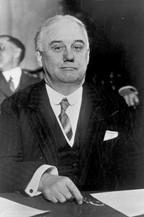
William S. Vare (R-Penn.), whose right to serve in the Senate was successfully contested.
When the U.S. Constitution was adopted, it set three requirements for being a senator, they are as follows:
“No Person shall be a Senator who shall not have attained to the Age of thirty Years, and been nine Years a Citizen of the United States, and who shall not, when elected, be an Inhabitant of that State for which he shall be chosen” (U.S. Constitution, Article I, section 3, clause 3).
After the War of the Rebellion, requirements were added that senators not have engaged in rebellion or treason. For conservatives on this issue, these were all that were required for seating. The circumstances of state elections were a state matter, whether widespread voting irregularities or violations of campaign finance law had occurred or not, and that any investigations should occur after, not before seating. For the ever-reform minded progressives, this would simply not do, and the 1920s in particular was a time for challenging elections. In that decade, there were seven contests of Senate elections. These were of Truman Newberry of Michigan, Earle Mayfield of Texas, Thomas Schall of Minnesota, Sam Bratton of New Mexico, Smith Brookhart of Iowa, William Vare of Pennsylvania, and Frank Smith of Illinois.
Truman Newberry: The Price of Crossing Henry Ford
Although the election happened in 1918, the case of Truman Newberry dragged into the 1920s. President Wilson had recruited Ford to run for the Senate to advance his message for peace and the League of Nations. He ran for both the Democratic and Republican nominations, believing that the Michigan public would overwhelmingly embrace him, the esteemed automaker. However, only the Democrats nominated him, with another wealthy individual, Truman Newberry, winning the Republican nomination. Ford was peeved that the Republicans didn’t nominate him, and although the race was close, Newberry won. He had spent a lot of money financing attacks against Ford’s pacifism, his anti-Semitism, and having allegedly engaged in extraordinary efforts to prevent his son Edsel from being drafted (U.S. Senate, Newberry). Newberry proved to be a staunch conservative who proved a thorn in Wilson’s side, including on the League of Nations. However, Newberry’s campaign had received and spent over $175,000, far above the $3,750 limit imposed by Michigan state law as well as the Federal Corrupt Practices Act on primary spending (U.S. Senate, Newberry). Although Newberry claimed ignorance of illegal campaign contributions and spending, that is not what the evidence indicated. He was indicted on November 29, 1919 along with 134 associates and convicted of violating the Federal Corrupt Practices Act on March 20, 1920, but he appealed to the Supreme Court, which ruled 5-4 in Newberry v. United States that the section of the Corrupt Practices Act that covered state primaries was unconstitutional and 9-0 that the judge in the case had given erroneous jury instructions (U.S. Senate, Newberry). Republicans in the 67th Congress managed to block an effort to unseat Newberry and
voted 46-41 that he was the elected senator from Michigan. Republicans asserted that his Navy service in New York City at the time of the primary precluded extensive knowledge about campaign spending, the Democratic minority disagreed, asserting that he knew full well (U.S. Senate, Newberry). the 1922 midterms promised a much more difficult Senate and progressive Republicans were keen on joining with Democrats to oust Newberry. Thus, he opted to resign instead of facing a grueling battle.
In the end, Ford did get his way. Newberry was out, and his successor was James Couzens. Although Couzens was a Republican, he was on the party’s progressive wing and was formerly vice president of Ford Motors, thus far more palatable to Henry Ford. Newberry would never run for public office again and Couzens would remain in the Senate until his death in 1936.
Schall vs. Johnson: Bull Moose v. Farmer-Labor
On April 28, 1923, Minnesota’s longtime Republican senator, Knute Nelson, died at the age of 80. Nelson had been a moderate conservative, but the Minnesota GOP was getting a challenge from the state’s Farmer-Labor Party, which was an economically progressive break-away from the GOP, and they succeeded in electing Magnus Johnson. However, Republicans picked a strong candidate for a full term in Thomas D. Schall, who had a history as a Bull Moose Republican, and he defeated Johnson by less than 8,000 votes in the 1924 election. Johnson challenged the election, claiming excessive campaign spending, scurrilous allegations against him, . The testimony of eight pro-Johnson witnesses did not produce any evidence connecting Schall to wrongdoing, and the investigating committee unanimously recommended that he be seated, and the Senate agreed (U.S. Senate, Schall). Schall would serve in the Senate until he was killed when a motorist accidentally struck him in 1935, and Magnus Johnson served a term in the House from 1933 to 1935, dying in 1936.
Mayfield vs. Peddy: A Quixotic Challenge
In 1922, the Senate election in Texas was Democrat Earle B. Mayfield against George E.B. Peddy, who was running both as a Republican and an Independent. Once the primaries were over, the winner was not in doubt as at the time statewide races (and indeed most other races in Texas) the winner was going to be a Democrat. On Election Day, Mayfield was elected, with strong support from the Ku Klux Klan, with 2/3’s of the vote. What was Peddy’s case for challenging the election? He challenged the procedures of the Democratic primary, excessive expenditures, voter fraud, and cited KKK involvement (U.S. Senate, Mayfield). However, Mayfield’s lead was insurmountably strong, even if there were shady practices he was going to be the winner in the general election given that the state was still part of the “Solid South” at the time. The Senate dismissed the challenge. Mayfield’s electoral fortunes had risen with the Klan, and they fell with the Klan too. He was defeated for renomination in 1928 by Congressman Tom Connally, who ran against him on an anti-Klan platform.
Brookhart vs. Steck: Progressive Republican vs. Moderate Democrat
In this case, the Senate outright rejected the election result and seated Democrat Daniel Steck. This was in part the product of Democratic partisanship but also in part the product of infighting between the conservative and progressive factions of the Republican Party. The controversy began when Brookhart, who had been elected in a special election to succeed William S. Kenyon, was running for a full term as a Republican. However, instead of endorsing Republican nominee Calvin Coolidge, he endorsed Progressive Robert La Follette of Wisconsin and campaigned for him after his nomination. This enraged many rank-and-file Iowa Republicans, who considered this trickery. The election reflected Republican faction tensions in this historically Republican state, with Brookhart only winning in official returns by around 800 votes to Democrat Daniel Steck, who was running as a moderate. Some conservatives in the GOP preferred reducing their majority by one because they found Steck ideologically preferable. In this case, despite the voters having voted for Brookhart, the full Senate voted to seat Steck. This was interestingly not a party-line vote, and there were seven Democrats who voted for Brookhart, including Mississippi’s Hubert Stephens, who wrote in defense of Brookhart’s election. A majority of Republicans voted for Brookhart, even a number of dyed-in-the-wool conservatives, although this was not out of sympathy for the views of Brookhart, rather because they did not believe the Senate should be rejecting winners of the state’s vote. In 1926, Brookhart successfully rebuked the Senate’s ruling on him when he defeated incumbent Albert B. Cummins for renomination and was elected. There is no better revenge than success, and there was no challenge that time.
The Republican establishment would ultimately oust Brookhart in the 1932 nomination contest, but the seat would be won by Democrat Louis Murphy, with Brookhart running as an independent Progressive candidate. Whether Brookhart would have won as a Republican in 1932 we can only speculate.
Bratton vs. Bursum: A Nothing-burger Challenge
Although New Mexico had been a Republican state when it was first admitted, by the 1920s Democrats were starting to gain power, and 1924 promised to be a close election between incumbent Holm O. Bursum, a high-tariff conservative Republican, and Judge Sam G. Bratton, a progressive Democrat. On Election Day, although New Mexico easily voted for President Coolidge, they did not do likewise for Bursum, with Bratton winning by 2.5%. Bursum challenged the election, claiming voter fraud. He claimed that eligible Indians were denied the vote while aliens, minors, college students voting from outside of their homes, and ex-cons were illegally allowed to vote (U.S. Senate). Although the Senate pushed Burusm to produce his evidence of such wrongdoing, he delayed for weeks and when he finally presented his evidence, although it reduced Bratton’s margin of victory, it fell far short of the irregularities alleged and Bratton kept his seat. Bursum would not seek public office again while Bratton would resign from the Senate in 1933 to accept a presidential appointment to the U.S. Court of Appeals. Democratic dominance of New Mexico would follow, with Republicans only making consistent gains starting in the late 1960s.
The Senate Contends with Big City Political Machinery: The Cases of Vare and Smith
Big city politics have had a reputation for corruption, and this was certainly the case with the Republican machines existing in Philadelphia and Chicago in the 1920s. In 1926, Congressman William S. Vare, the head of the Philadelphia machine, had defeated incumbent George W. Pepper for renomination. Pennsylvania was a very Republican state at that time and had not voted for a Democrat since 1856. The Democratic challenger was former Secretary of Labor William B. Wilson. The official results put Vare over the top with 54.6% of the vote as opposed to Wilson’s 43.1%, which was a respectable result for a Democrat at the time. It should also be noted that Wilson was leading until Philadelphia was counted (Hill). There was considerable doubt in the outcome and many did not want Philadelphia’s boss to be senator. The doubt in the Senate election in Pennsylvania was such that the state’s progressive Republican governor, Gifford Pinchot, refused to certify the election, instead stating that Vare “appears” to have been elected (Hill). However, Pinchot was finishing his term, and his successor, John Fisher, certified Vare.
The other highly contested race was Republican Frank L. Smith’s win with 46.9% of the vote, with Democrat George E. Brennan netting 43.1% of the vote. Smith had defeated incumbent William B. McKinley, who died shortly after his loss, on the issue of the U.S. joining the World Court. He received considerable campaign contributions from the controversial Samuel Insull, the holding company baron who played a major role in setting up America’s electrical grid. The problem? Smith chaired the Illinois Commerce Commission, which regulated utilities. This led to allegations of corruption by Smith, that he was giving Insull an easy ride in exchange for campaign financing. Senator Thaddeus Caraway (D-Ark.) took up the mantle against him. Obtaining information about spending on the Illinois race was not so cut-and-dry for the Senate, as the case of Newberry v. United States put primary campaigns out of the reach of regulation by the Senate and Illinois had no law capping campaign expenditures (U.S. Senate, Smith).
Vare and Smith were elected with strong support of corrupt political machines and extensive evidence was presented of illicit voting practices and excessive campaign financing. Conservatives held that because Vare and Smith met Constitutional requirements that they should be seated and then investigations into their elections proceed, but the fiercely independent William Borah (R-Idaho) was not having it, stating that the Senate had the right to deny them seating and considered doing so acting in the Senate’s preservation (Hill). Although the Senate concluded that despite voting irregularities that Vare had won the election, but that such widespread irregularities and excessive campaign spending had tainted his victory. Vare spoke in his defense, “How unfair and unjust my accusers have been in attempting to twist mere clerical irregularities and technicalities into acts of political fraud and conspiracy!” (Hill) Both were denied seating, although neither Wilson nor Brennan were ruled the winners. Ultimately Pennsylvania Republican Joseph Grundy, a prominent and staunchly conservative industrialist and lobbyist, was appointed interim senator while in Illinois, Republican Otis Glenn won the special election against future Chicago mayor Anton Cermak. The stress of the investigation broke Vare’s health, and he suffered a stroke on August 2, 1928, from which he never fully recovered. Although Vare tried to get back in as a Republican in 1930, the Republican organization turned on him and selected James J. Davis, Secretary of Labor under Harding, Coolidge, and Hoover, instead. Curiously, Vare would attempt a comeback by running for the Democratic nomination for the Senate in 1932, but he suffered another stroke, ending any prospects of return. He died of a heart attack on August 7, 1934.
References
Expulsion Case of Truman Newberry of Michigan. U.S. Senate.
Retrieved from
https://www.senate.gov/about/powers-procedures/expulsion/102TrumanNewberry_expulsion.htm
Hill, R. (2026, March 15). The Boss of Philadelphia: William S. Vare of Pennsylvania. The Knoxville Focus.
Retrieved from
The Election Case of Daniel F. Steck v. Smith W. Brookhart. U.S. Senate.
Retrieved from
The Election Case of Frank L. Smith of Illinois. U.S. Senate.
Retrieved from
The Election Case of George E.B. Peddy v. Earle Mayfield. U.S. Senate.
Retrieved from
The Election Case of Holm O. Bursum v. Sam G. Bratton of New Mexico. U.S. Senate.
Retrieved from
The Election Case of Magnus Johnson v. Thomas D. Schall. U.S. Senate.
Retrieved from
The Election Case of William B. Wilson v. William S. Vare of Pennsylvania. U.S. Senate.
Retrieved from

