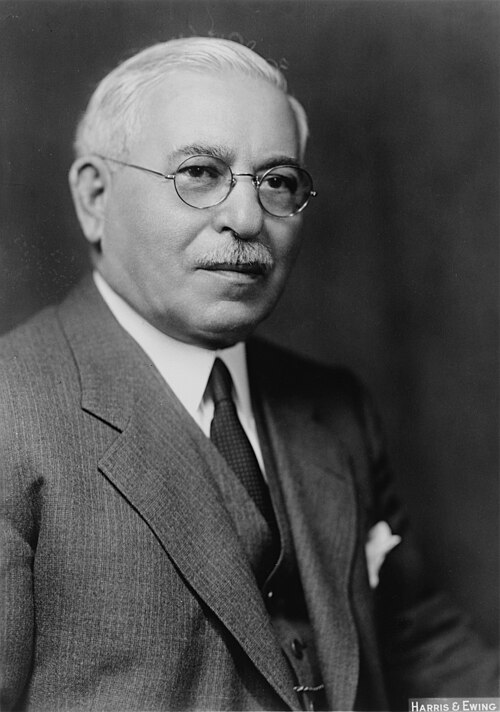
Adolph J. Sabath (D-Ill.), who served in Congress from 1907 until his death in 1952.
The subject of political ideology throughout American history and its changes has been of boundless interest to me. And in the course of this, there’s a lot of oversimplifications, a lot of misunderstandings, and misconceptions. In the course of research, I find a useful exercise to be to look at legislators who served over long periods of time and how they voted. Looking at their records at the start of their career and the end of their career can be illuminating, and most useful to looking at the latter end of careers in this case are the ratings of the liberal Americans for Democratic Action. I am in particular interested in comparing records of this longstanding liberal group to legislators who served before 1933, when FDR came into office and really shaped the liberalism that we understand today. ADA’s ratings go back to 1947, and the longest serving legislator at its start was Democrat Adolph Sabath of Chicago, who had been serving since 1907. Sabath, by the way, was a staunch New Deal defender and proved very liberal in the final years of his career. Another notable long-term figure when we look at change is Alabama’s J. Lister Hill. Hill first started serving in Congress in 1923, and during the Truman Administration he proves one of the South’s big liberals, but later on his record is soured by ADA standards as they come to focus more on civil rights issues and other social issues, and it is true that Hill also moved a bit to the right in his later career as Alabama was moving to the right.
Sam Rayburn of Texas also presents an interesting case study, for this is a legislator who sticks loyally to President Truman’s agenda for domestic liberalism and internationalism even though you would by some aspects of his earlier record not think him a champion of liberalism. Indeed, although Rayburn supported a lot of Woodrow Wilson’s agenda, he voted against the Keating-Owen Act in 1916 to regulate and restrict child labor, repeatedly voted against women’s suffrage, and voted against the Child Labor Amendment in 1924. By contrast, you have Daniel Reed of New York, who was considered a massive champion of traditional Republicanism. He voted for women’s suffrage in 1919 and voted for the Child Labor Amendment in 1924. However, Reed was one of the most down-the-line foes of the New Deal and anything that smacked of it, as well as stood as a staunch opponent of foreign aid programs, and his record remained to the right until his death in 1959. Yet another figure of interest is Roy Woodruff, who you would not tell by him having four “zeroes” by ADA that his first term was as a member of Theodore Roosevelt’s Progressive Party.
I have created a document that lists legislators, their party affiliation, their state, the year they started serving in Congress prior to 1933, and their rates of agreement with ADA by year. The last year listed is 1975, the last in which Congressman Wright Patman (D-Tex.), who started serving in 1929, served a full year. This should be illuminating as to ideology and what’s more how ADA was seeing the South.
* – Sam Rayburn’s (D-Tex.) is listed as 73 for 1953 and not 82 as presented in ADA’s records because Rayburn actually voted against, not for, Hawaii statehood in 1953.
References
ADA Voting Records. Americans for Democratic Action.
Retrieved from
Rayburn, Samuel Taliaferro. Voteview.
Retrieved from
https://voteview.com/person/7753/samuel-taliaferro-rayburn
Reed, Daniel Alden. Voteview.
Retrieved from
 Mad Politics: The Bizarre, Fascinating, and Unknown of American Political History