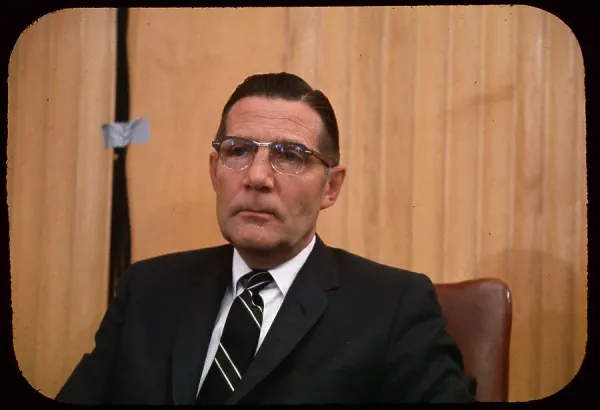
Not everyone gets his or her historical due. Sometimes this failure to get one’s due is because the person was a polarizing figure in their time and the people who wrote the bulk of history on them were opponents. Sometimes it is because another figure in that time and place overshadowed them. The latter case was certainly true, and on more than one count, of Vermont’s Winston Lewis Prouty (1906-1971). Prouty was a Republican in a state that had always elected Republicans to the Senate since the foundation of the party at the time of his life and career, and did not appear to stand out as a liberal maverick nor as a staunch conservative. Indeed, he seemed entirely a man of his time and place; moderate in a state becoming increasingly liberal but still at the time wed by tradition to the GOP. I hope with this post to translate the forgettable into the memorable.
Prouty came from a political family that had a lumber and construction material business, and his uncle, George Prouty, had been one of Vermont’s governors. In 1923, at the age of 16 when working at his family’s lumber firm, he lost his right thumb in an accident with a buzzsaw (Express and Standard). This was said to have contributed to his overall cautious and reserved demeanor. In Vermont politics at the time of his rise, this demeanor was not a disability. After all, the famously reticent Calvin Coolidge had been a Vermonter. In 1932, Prouty began his gradual rise through Vermont politics as he was elected to the Newport City Council and served until 1937, and then was Mayor from 1938 to 1941. In 1940, Prouty was elected to the Vermont House, and served until 1949, serving as speaker in the last two years. In 1948, he ran for lieutenant governor but lost the nomination to the conservative Harold J. Arthur, instead getting to chair the state’s Water Conservation Board.
In 1950, Congressman Charles Plumley decided to retire after a House career consisting mostly of opposition to the New Deal and support for internationalist foreign policy. Prouty won the nomination to succeed him and was a shoo-in given that electing Republicans was not in doubt at the time in the Green Mountain State, and he won with 73.5% of the vote. As a representative, his overall moderate approach was a winner with Vermonters, and he always won reelection to the House with over 60% of the vote. He prevailed even though he cast a politically difficult vote for the St. Lawrence Seaway in 1954. Many New Englanders opposed the St. Lawrence Seaway for diverting shipping traffic. In 1958, Senator Ralph Flanders, by this time 78 years old, decided to retire. The most natural successor was Prouty. However, 1958 was a difficult year for the GOP, particularly so in New England where the recession was hitting hard. For the first time since the foundation of the Republican Party, a Democrat won Prouty’s House seat. Prouty himself prevailed, but by just shy of 5 points. This was certainly alarming for Republicans one of the two states that had never voted for Franklin D. Roosevelt.
Senator Prouty
The New York Times (1971) profiled Prouty as senator, “Serious, quiet, intense, hard to classify as liberal or conservative, Senator Prouty presented an enigma even to some of his friends. He rarely made campaign trips home to Vermont, and he seemed to have no visible political organization, but “he always wins and no one knows how,” as one Vermont politician put it”. Unfortunately for him, he was consistently overshadowed by his colleague, George Aiken, who was senior both in time in the Senate and age. Aiken was also much more popular with Vermonters.
Prouty unsurprisingly had a mixed response to the Kennedy Administration. While he was in support of a significant minimum wage increase and federal aid to education, he was opposed to Area Redevelopment legislation and the Housing Act of 1961 which expanded public housing. Prouty seemed to have some fundamental level of fiscal conservatism but was strongly supportive of furthering federal aid to education, something his successor, Robert Stafford, would champion. However, in one area, Prouty would lead opposition, and this was on the Youth Employment Act in 1963.
On April 10, 1963, Prouty led the charge to strike the Youth Conservation Corps, the central controversial feature, from the Youth Employment bill, which was defeated 41-47. Prouty would vote against the Youth Employment bill, which although it passed the Senate, it died in the House Rules Committee. Prouty’s continued moderation had certainly won over some people since the 1958 election, as he won another tough reelection in 1964 with a higher margin. Vermonters clearly differentiated the Republicanism of Prouty from the Republicanism of presidential nominee Barry Goldwater, who had won only 33.7% of the vote in the Green Mountain State. Prouty thrice voted to kill Medicare before supporting it in 1965.
While Prouty had led the charge in a conservative way against the Youth Employment Act in 1963, he led the charge in a liberal way on an expanded emergency job program, which failed on October 4, 1967 at 42-47. That year, he had also voted to lower the minimum age to receive Social Security benefits, albeit on a reduced basis, from 62 to 60. On civil rights, Prouty was strongly supportive. He voted for all the major laws of the 1960s and during the Nixon Administration he embraced the Philadelphia Plan and a busing compromise endorsed by President Nixon. Although a moderate, Prouty once in a while could surprise liberal colleagues, such as his support for guaranteed minimum income in 1968. However, it was another surprise that got his name in the papers for a time, and that was on the issue of the Anti-Ballistic Missile System. In 1968, Prouty had announced his opposition to this idea, but President Nixon succeeded in swaying his critical vote to the ABM system. The ABM system was passed by one vote. He split the difference in his votes for President Nixon’s unsuccessful Supreme Court nominations; he voted for the confirmation of Clement Haynsworth but against G. Harrold Carswell. He said his reason for voting against the latter was that a motion to recommit failed and Carswell didn’t have time to explain himself, “I thought we would be doing the Administration a favor by recommitting, giving Carswell a chance to dispel some of the doubts about him…It was a difficult decision—one of the most difficult I have ever had to make” (Time Magazine, April 19, 1970). Although George Aiken was typically thought of as the more liberal senator than Prouty, on this occasion, like his support for lowering the age for Social Security benefits, he voted to Aiken’s left. However, any disappointment Nixon had over his vote on Carswell was outweighed by his support for his polices on Vietnam. Prouty voted against both the Cooper-Church Amendment to stop funding for U.S. forces in Cambodia and Laos and against the McGovern-Hatfield “End the War” Amendment, and Nixon enthusiastically endorsed him for reelection.
The achievement that Prouty should be most known for, and one I’m surprised isn’t emphasized more on what I’ve read about him, is his crafting of the National Passenger Rail Service Act of 1970, which founded Amtrak. This law was passed to retain passenger rail service as private rail companies, most notably Penn Central, were going bankrupt due to the proliferation of automobiles after World War II as well as a toxic combination of subsidization and inflexible regulations from the Interstate Commerce Commission and state governments (Shedd). Thus, a figure obscure and seemingly without note continues to have impact on the lives of millions of Americans. That year, he had a spirited challenge from former Governor Phillip H. Hoff, a staunch anti-Vietnam War liberal, and polling a little over a week out from Election Day indicated that Prouty would lose (Time Magazine, October 25, 1970). However, the polling of this election seemed to be a bit off, as he not only won but won by 19 points, his biggest victory yet. The New York Times attributed Prouty’s victory to numerous late defections from conservative Democrats in Burlington and Winooski (Reinhold). Sadly, Prouty didn’t get to enjoy his victory long; he was subsequently diagnosed with stomach cancer and died on September 10, 1971. His DW-Nominate score is a pretty sedate 0.17 and he agreed with the conservative Americans for Constitutional Action 54% of the time and the liberal Americans for Democratic Action 44% of the time. It is unfortunate that Prouty is considered forgettable but he had a hard act to be alongside (Vermont’s longtime popular politician George Aiken) and following (Ralph Flanders had led the Republican side of the charge against Joseph McCarthy). I thought of writing about Prouty as a bit of a challenge to try and make an obscure and seemingly mundane figure interesting, and he is precisely the opposite of everything we have come to expect from modern politics. Did I succeed in my effort to make him interesting? Let me know!
References
ADA Voting Records. Americans for Democratic Action.
Retrieved from
Hard-Bitten Republican. (1971, September 11). Hard-Bitten Republican. The New York Times.
Retrieved from
Nation: Four Crucial Nays: Why They Did It. (1970, April 19). Time Magazine.
Retrieved from
https://time.com/archive/6877106/nation-four-crucial-nays-why-they-did-it/
Nation: The Republican Assault on the Senate. (1970, October 25). Time Magazine.
Retrieved from
https://time.com/archive/6838217/nation-the-republican-assault-on-the-senate/
Prouty, Winston Lewis. Voteview.
Retrieved from
https://voteview.com/person/7637/winston-lewis-prouty
Reinhold, R. (1970, November 4). Prouty Defeats Hoff in Vermont. The New York Times.
Retrieved from
Senator Prouty of Vermont Dies, Cast Major Vote for the ABM. The New York Times.
Retrieved from
Shedd, J. (1981, May). Amtrak: Congress’s Toy Trains. Reason Magazine.
Retrieved from
https://reason.com/1981/05/01/amtrak/
Winston Prouty Slips and Loses His Thumb on Butting Saw. (1923, August 10). Express and Standard (Newport, Vt.).
Retrieved from
https://www.newspapers.com/article/express-and-standard-prouty-thumb/71187290/
 Mad Politics: The Bizarre, Fascinating, and Unknown of American Political History