The year 1966 constituted a backlash against the policies of the Johnson Administration, and some incumbents went down who were thought to be in good shape in their districts. Republican attorney and mayor of El Monte Charles Edward Wiggins (1927-2000) challenged incumbent Democrat Ronald B. Cameron in the 25th district in Orange County. Cameron had previously defeated Republican John Rousselot in 1962, as he had attracted great controversy for being a prominent member of the John Birch Society. However, Wiggins could not be painted in the same light, and on Election Day 1966 he ousted Cameron by 5 points. This would be Wiggins’ toughest election as he would prove popular in his district.
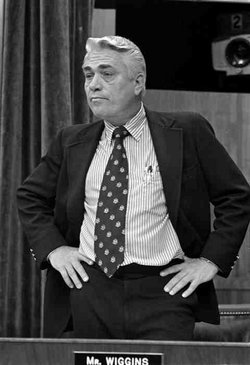
Wiggins on Policy
At first, it may have seemed like Wiggins was going to be an extreme conservative; in 1967 the liberal Americans for Democratic Action found him in agreement on none of the 15 votes they had tallied as most important, and this included a civil rights bill that had the support of all but 25 Republicans. However, he would prove that he had more layers than just ultra-conservative; as a member of the House Judiciary Committee he was involved in the consideration of Constitutional amendments, and he was regularly against further amendments; in 1971, he was one of 19 representatives to vote against the 18-year-old vote and one of 24 to vote against the Equal Rights Amendment, but in the same year he also voted against the School Prayer Amendment. In 1978, Wiggins voted against an amendment letting Washington D.C. elect representatives. However, this didn’t mean he was against autonomy for D.C., as in 1973 he voted for the law permitting D.C. to elect its own mayor and city council. He also wasn’t opposed to all efforts to amend the Constitution; in 1969 he voted in favor of an amendment scrapping the Electoral College. His political stances had some variance; although in 1969 he supported killing the Philadelphia Plan (affirmative action precursor) he also supported expanding the government’s ability to enforce anti-discrimination laws in 1971. Wiggins was a staunch supporter of President Nixon’s policy on Vietnam and although he was in opposition to most anti-poverty programs, he did support the creation of the Legal Services Corporation to help provide legal assistance to the poor. In 1974, he was one of 48 representatives to vote against the Federal Election Campaign Act Amendments in 1974, which provided for federal funding of presidential campaigns, limitations on campaign contributions, and the establishment of the Federal Election Commission. On economics, Wiggins supported free market approaches to policy and was in opposition to price control on gas. He was also fiscally conservative, voting to sustain the vetoes of Presidents Nixon and Ford on spending. However, Wiggins backed a few hot-button positions unpopular with rank and file conservatives, such as voting for the New York City bailout in 1975, against the Hyde Amendment in 1976, and his support for the Panama Canal Treaties. He also went against President Ford on voting to override his veto of the bill providing for national standards for strip mining in 1975. Wiggins opposed the 1975 Voting Rights Act extension and led the push for an alternative formula for coverage under the act, one more lenient than what existed, namely he called for a standard of coverage based on minority turnout rates.
Wiggins and Watergate
Wiggins was one of the three leaders of the defense of the Nixon Administration during the Watergate hearings. Their strategy, per The New York Times (2000) was “…to construe the evidence as narrowly as possible, require ironclad proof and propose benign explanations of information damaging to the president” (Pace). However, upon the release of the Watergate tapes, he changed his mind and supported impeachment, but wanted the president to resign to avoid dragging things out. Wiggins lamented where he had to stand, stating, “Such a conclusion was a sad and personally wrenching one for me to reach, because I regarded–and still do regard–myself as a friend of the president and his family and one still willing, proudly, to claim his achievements” (Nelson & Weinstein). Although Wiggins’ defense of Nixon certainly harmed his political prospects, he nonetheless prevailed in reelection in 1974, winning by 15 points. In 1978, Wiggins opted to retire to private legal practice, and he was succeeded by the much more conservative William Dannemeyer. His DW-Nominate score is a 0.359, he was in agreement with the conservative Americans for Constitutional Action 79% of the time, and in agreement with the liberal Americans for Democratic Action 15% of the time. However, he was not out of government for good.
Judge Wiggins
In 1984, President Reagan tapped Wiggins to the 9th Circuit Court of Appeals, and he issued some substantive rulings. In 1994, he upheld the military’s “Don’t Ask, Don’t Tell” policy in Holmes v. California National Guard, finding that it was not in violation of the 1st and 5th Amendments (Nelson & Weinstein) In 1996, Wiggins assumed senior status (semi-retirement for judges). In 1998, he testified before Congress during the Clinton impeachment hearings and urged a “nay” vote as he found the charges too vague (Pace). He was in poor health in his last years, suffering from diabetes and heart disease, dying on March 2, 2000 at the age of 72.
Conclusion
The inclusion of Wiggins may seem odd, but in truth on most matters he was conservative and was a man who thought for himself, unafraid to take unpopular positions, whether in opposition to consensus or his party’s preferences. I tremendously value the latter, which is why the current era of politics is disturbing to me. Pardon the late aside, but I see two political cults present in American politics: the Cult of Trump and the Cult of Social Justice, the latter which seems to be increasingly going mask off in its favorability to communism, and the former which tries very very hard to form a greater ideological philosophy from whatever President Trump wishes. The truth about President Trump is that although yes he is a man of the right, he is also temperamental and often acts based on his whims, whether for good or ill. Seeing people twist like pretzels in justification for some of the things he does (such as imposing tariffs so broad and slipshod that they included islands with penguins rather than humans as residents) is simultaneously amusing and disheartening. Choose systems and philosophies, not men, and don’t insist on 100% agreement with you as it is not realistic, and there is also a non-zero chance that you are wrong (GASP!). President Reagan was right when he said that someone who is 80% your friend and ally in politics is not 20% your enemy. Use your own brains, people! Don’t merely be a mouthpiece for others.
Bonus:
Wiggins’ press conference explaining his position on Watergate after the release of the Watergate tapes:
References
ADA Voting Records. Americans for Democratic Action.
Retrieved from
Nelson, S.S. & Weinstein,H. (2000, March 4). U.S. Judge Charles E. Wiggins; Backed Nixon During Watergate. The Los Angeles Times.
Retrieved from
https://www.latimes.com/archives/la-xpm-2000-mar-04-mn-5189-story.html
Pace, E. (2000, March 8). Charles Wiggins, 72, Dies; Led Nixon’s Defense in Hearings. The New York Times.
Retrieved from
Wiggins, Charles Edward. Voteview.
Retrieved from

