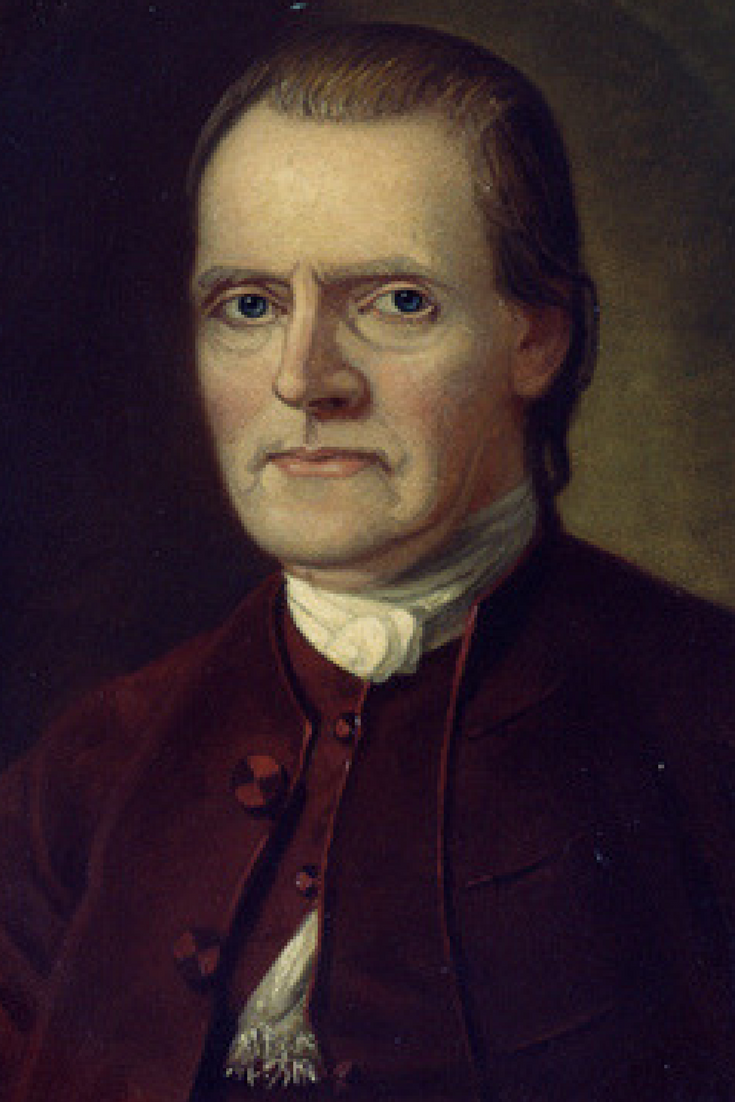
Thirty years ago, I was nine years old and spent the Fourth of July in Connecticut, where I was visiting my great grandma. I remember there were no real fireworks to speak of but the beach was nice and warm to swim. I remember A&P market, being taught to shoot a BB gun, and riding a motorboat. Those are my memories of Connecticut, and on this, our 250 year anniversary as a nation, I think it best to honor the state’s foremost Founding Father, Roger Sherman (1721-1793).
Although Sherman largely lacked a formal education, he committed himself to the study of law and became highly involved in the colony’s politics, serving in Connecticut’s House of Representatives and serving as a justice of Connecticut’s Superior Court from 1766 to 1789. During this time, Sherman was involved in the crafting of four critical documents to America: the Continental Association, the Declaration of Independence, the Articles of Confederation, and the Constitution. He is the only person to have signed all four. Although Sherman was reluctant for the colonies to split from Britain, he believed that the British were not being true to the rights of the colonists and came to accept revolution as the answer.
Although Thomas Jefferson was the central author of the Declaration of Independence and often gets sole credit in the minds of the public, Sherman was among the five who drafted it (the others were John Adams, Benjamin Franklin, and Robert Livingston). He also supported the creation of the original government under the Articles of Confederation, but the Articles of Confederation proved too limited in governing a nation, and given Revolutionary War debts, there needed to be a more effective way of collecting taxes.
The Constitution
Roger Sherman agreed with other Founding Fathers on the need to expand the power of the national government, particularly to establish interstate commerce and to tax. However, he differed with others in his belief that this objective could be achieved without scrapping the Articles of Confederation. Of course, we all know Sherman did not prevail on this. His crowning achievement to the Constitution was his role in forming the legislative branch.
The Creation of the House and the Senate
In the debate on setting up a legislative branch, a major issue arose in what would constitute a fair balance between big and small states. Big states wanted a population basis while small states sought an equality basis for how the legislature was to be apportioned. James Madison proposed the “Virginia Plan”, which called for three branches of government with the legislative branch being bicameral and
based on population. This alarmed small states, which responded with the New Jersey Plan, proposed by William Paterson, which would have established a unicameral legislature with all states having equal representation. Sherman, representing a small state, initially backed the New Jersey Plan, but it was voted down. Thus, he proposed the Connecticut Compromise, which embraced the bicameral legislature but had the Senate be based on political equality while the House remained based on population size. Sherman also unsuccessfully pushed for each state to have only one senator. The finalized plan was sufficient to assuage fears of states of smaller states that they would be dominated by states with big populations…after all, the Founding Fathers feared the rise of two tyrannies: the tyranny of the majority and the tyranny of the minority. Indeed, this was one of numerous compromises that needed to be crafted to create an effective Constitution.
Dissenting on the Bill of Rights
Sherman’s belief was that the Bill of Rights was an unnecessary add-on to the Constitution, as he believed such rights were assumed to be protected by the states as such powers were not granted to the federal government. Indeed, he feared that the Bill of Rights could serve to limit rights. However, this dissent was initial, and he ended up raising no objection to the proposing of ten amendments. Madison’s original draft of the Bill of the Rights would have had these amendments throughout the Constitution, but Sherman argued against this, stating, “we cannot incorporate these amendments in the body of the Constitution. It would be mixing brass, iron, and clay” (Hall). This argument won the day, and a separate Bill of Rights section was created. He was also responsible for making the Vice President the president of the Senate with authority to vote in cases of a tie with Article 1, Section 3, Clause 4, stating that otherwise “he would be without employment” (Schmitt). This once again highlights the utter ridiculousness of the argument that a vice president can reject electors.
Although Sherman supported an expanded government from that of the Articles of Confederation, his views of government were nonetheless limited. Farrand’s Records summarizes one of Sherman’s speeches, “The objects of the Union, he thought were few. 1. defence agst. foreign danger. 2. agst. internal disputes & a resort to force. 3. Treaties with foreign nations 4. regulating foreign commerce, & drawing revenue from it … All other matters civil & criminal would be much better in the hands of the States” (Gutzman).
In 1788, the voters of Connecticut sent Sherman to the House. He was not there long, since in 1790 he was elected to the Senate. While a member of Congress, he staunchly supported George Washington, backed the federal assumption of state debts, the creation of a national bank, tariffs, and internal improvements to expand commerce. Sherman was also an early foe of slavery, and had been the key figure in getting the state to adopt a law that gradually ended slavery. Again, he was not in the Senate long as in May 1793 he contracted typhoid fever. The 72-year-old Sherman lost his battle on July 23rd. Although his views were not always adopted, he was highly regarded, even by those who often disagreed with him. Thomas Jefferson praised him as “a man who never said a foolish thing in his life”. Recorded history has yet to contradict Jefferson on Sherman. Fisher Ames, a man far more in line with Sherman’s philosophy of governance and another “Great Conservative”, praised him thusly, “If I am absent during the discussion of a subject, and consequently know not on which side to vote, I always look at [him], for I am sure if I vote with him I shall vote right” (Werther). By the standards of DW-Nominate, Sherman ranks as strongly conservative, with his DW-Nominate score at 0.589.
Sherman also had numerous descendants, including Roger Sherman Baldwin (his grandson), a prominent Connecticut politician who successfully defended the slaves of the Amistad, General William Tecumseh Sherman, Senator John Sherman, Senator William M. Evarts, and Senator George Frisbie Hoar, the latter particularly concerned with preserving his constitutional legacy in his opposition to the direct election of senators and abolishing the Electoral College. Sherman stands as among the more conservative of the Founding Fathers, as he had a distrust in pure democracy and his views aligned with the Federalist Party. Interestingly, all of these descendants died as Republicans.
Sherman’s statue sits in the National Statuary Hall Collection, where all states contribute two statues to honor key figures in their histories.
References
Gutzman, K. (2013, August 1). Roger Sherman: Constitutional Calvinist. The Imaginative Conservative.
Retrieved from
Roger Sherman. Encyclopedia Britannica.
Retrieved from
https://www.britannica.com/biography/Roger-Sherman
Roger Sherman. National Constitution Center.
Retrieved from
https://constitutioncenter.org/signers/roger-sherman
Hall, M.D. (2017, January 26). Roger Sherman: An Old Puritan in a New Republic. Law & Liberty.
Retrieved from
Roger Sherman was born 300 years ago. Find out why he still matters. (2021, April 6). New Haven Register.
Retrieved from
https://www.nhregister.com/news/article/Free-virtual-lecture-to-mark-Roger-Sherman-s-16080647.php
Schmitt, G.J. (2022, November 18). Misunderstanding the Vice President’s Constitutional Role. American Enterprise Institute.
Retrieved from
Werther, R.J. (2017, September 28). Roger Sherman: The Only Man Who Signed All Four Founding Documents. Journal of the American Revolution.
Retrieved from

