In 2022, Washington Republicans thought they just might have a shot in winning a Senate seat from Washington with Tiffany Smiley, but she was defeated by 15 points. Indeed, Republicans have not won a Senate seat from the state since 1994. However, at one time, Republicans were the status quo of Washington, and the foremost representative of this status quo was Wesley Livsey Jones (1863-1932).
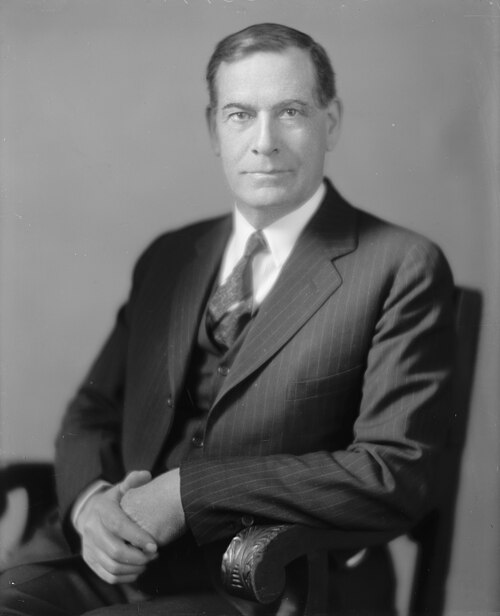
An Illinoisan by birth, Jones found his way to the Republican Party before he found his way to Washington. He studied law and with this came an an enthusiasm for politics. In 1884, he energetically campaigned for James G. Blaine and did likewise for Benjamin Harrison in 1888 (Forth, 3). The following year, Washington was admitted, and he moved to North Yakima to establish his law practice. Jones continued to be active in the Republican Party, and although Republicans had a bit of a hiccup with Democrat William Jennings Bryan winning the state in 1896 over the currency issue, the 1898 midterms proved to be better for them, and Jones went head to head against Congressman J. Hamilton Lewis, who would do the opposite of Jones by moving to Illinois for his later political career. Dubbing him “Yakima Jones”, he was described in the press as “a plain solid looking sort of man…of medium height, broad shouldered and strong, he looks what he is, a man of intelligence” (Papavizas). Although a debate between him and Lewis was reported by some sources as a disaster for him, others thought that Jones had trounced Lewis, and Jones ultimately benefited from the US victory in the Spanish-American War and was elected. This was the start of a long, successful career in Washington. Lewis would serve as a senator from Illinois from 1913 to 1919 and again from 1931 to 1939.
Congressman Jones
Jones regarded himself as a “conservative progressive”, meaning that he supported reform pushes he considered to be moderate while rejecting radicalism, thus he was seen as a moderate during the Progressive Era (Papavizas). This was pretty safe for Washington’s politics, which although they were inclined towards Republicans at the time, Washingtonians were strongly supportive of certain progressive era pushes, such as for Prohibition and women’s suffrage, as was Jones. In an age in which hypocrisy was rife on Prohibition, he was certainly the ideal figure to push for it. One historian described Jones as “…a tall, sincere, devout former lawyer from Yakima. He did not drink, gamble, smoke, or swear. He was dedicated to middle-class American values and to the Republican party, both of which he in many ways personified” (Papavizas). On women’s suffrage, he expressed his support for it early. In 1914, he asked his colleagues rhetorically, “What peculiar sexual difference is there that entitles man to vote and prevents woman? Can anyone point out any such peculiarity? No one has ever done so” (Papavizas). In 1909, the state legislature sent Jones to the Senate.
Senator Jones
Jones was supportive of the Taft Administration on a number of issues, but he did embrace some progressive Constitutional pushes, such as for direct election of senators and for abolishing the Electoral College. During the Wilson Administration, Jones flew the Lincoln flag in his opposition to the institution of segregation in numerous departments of the federal government. However, he in truth was sometimes in support and sometimes in opposition to Wilson’s agenda. Jones kept up protectionism with his vote against the Underwood Tariff and strongly supported expanded naval construction. However, he also supported the creation of the Federal Reserve and during World War I he was one of a minority of Republican senators to strongly support the Sedition Act, including opposing the France Amendment for free speech protections for telling the truth with good motives. As William Forth (1962) writes in his dissertation, “Until after the World War he supported liberal legislation as often as he opposed it although alarmed at the divisive nature of the emotions such actions had on his party” (v). Although Jones was supportive of the advancement of blacks, he was also strongly supportive of blocking Japanese immigration, consistent with the views of many laboring white men of Western states at the time. Neither he nor them wanted Asian labor competition and subscribed to the belief that they could not assimilate in society. Jones had initially opposed American involvement in World War I, stating in 1916 that an American who “persists in travelling for pleasure or profit in the danger zone and in a belligerent ship shows that he is utterly lacking in patriotism” (Papavizas). The following year, he attempted to find a middle ground on arming merchant vessels, but this met with great criticism. The Seattle Star went as far as to condemn him for having “failed pathetically on the one big thing in his generation” (Papavizas).
In 1920, Jones sponsored the Jones Act, which was designed to revitalize the shipbuilding industry in the US by requiring that all ships moving from US port to US port be built by Americans, owned by American citizens, and crewed by Americans. Jones was considered a diligent and hard worker, and he worked incredibly hard to win passage of this legislation, including holding 37 hearings in 51 days, hearing testimony from over 100 witnesses (Papavizas). This was in keeping with the protectionist stance of the GOP of his day.
From 1924 to 1929, Jones served as Majority Whip. He was a good figure for this role as he could appeal to both the conservative and progressive wings of the GOP. Jones supported basic conservative policies on taxes and tariffs in the 1920s while still sometimes siding with the progressive wing. His colleague, Democrat Clarence Dill, commented, “Senator Jones never knocks any flies. He bunts and always plays low ball. That is why he is always safe” (Papavizas). Although he played it safe, Jones did have a bit of a close race in 1926, winning reelection by 5 points.
In the later part of his career, became foremost known for what was called the “five and ten law” in 1929, which made certain Prohibition violations felonies to curb professional bootleggers and provided for five years’ imprisonment or a $10,000 fine (or both) for first-time violations. He did not author this law, rather introduced it on behalf of the Coolidge Administration. This was in keeping with his fundamental moral stances as well as state voter preferences, as Prohibition had come into effect in the state before the nation adopted it. However, this also hurt him as Prohibition’s popularity began to decline not long after this law’s adoption.
In 1932, the Great Depression was severely impacting the nation and killing the confidence of the nation in President Hoover and the Republican Party. Washington was no exception, and radicalism dramatically increased in the state and support for Prohibition had declined. The Democrats selected Homer T. Bone, a former member of the Socialist Party, to run against Jones. Not only did the national environment harm Jones, his poor health following abdominal operations in 1928 and 1929 precluded his campaigning effectively. While in the past he had consistently been able to win, this time around he lost reelection by a whopping 28 points and lost all counties. The ailing senator did not have much time to mourn his loss, as the day after he entered a sanitarium in grave condition and died a mere eleven days after the election of heart failure at 69. His time, and the time of his brand of Republicanism having appeal in the state, was over. Jones’ DW-Nominate score stands at 0.319, making him moderately conservative. No Republican would be elected to Congress from Washington until 1942, and the Commonwealth Federation of Washington, a communist-dominated faction of the Democratic Party, would have substantial sway for years on the state’s politics. In all, Jones was an honest figure in the GOP who struck a careful balance in his positions, and that worked for him up until his final days.
References
Forth, W.S. (1962). Wesley L. Jones: A Political Biography [Doctoral Dissertation, University of Washington]. ProQuest.
Retrieved from
Jones, Wesley. Voteview.
Retrieved from
https://voteview.com/person/5065/wesley-livsey-jones
Papavizas, C. (2024). The Man Behind the Jones Act. Marine News.
Retrieved from
https://www.maritimemagazines.com/marine-news/202401/the-man-behind-the-jones-act
Senator Jones Dies. (1932, November 20). The New York Times.
Retrieved from

