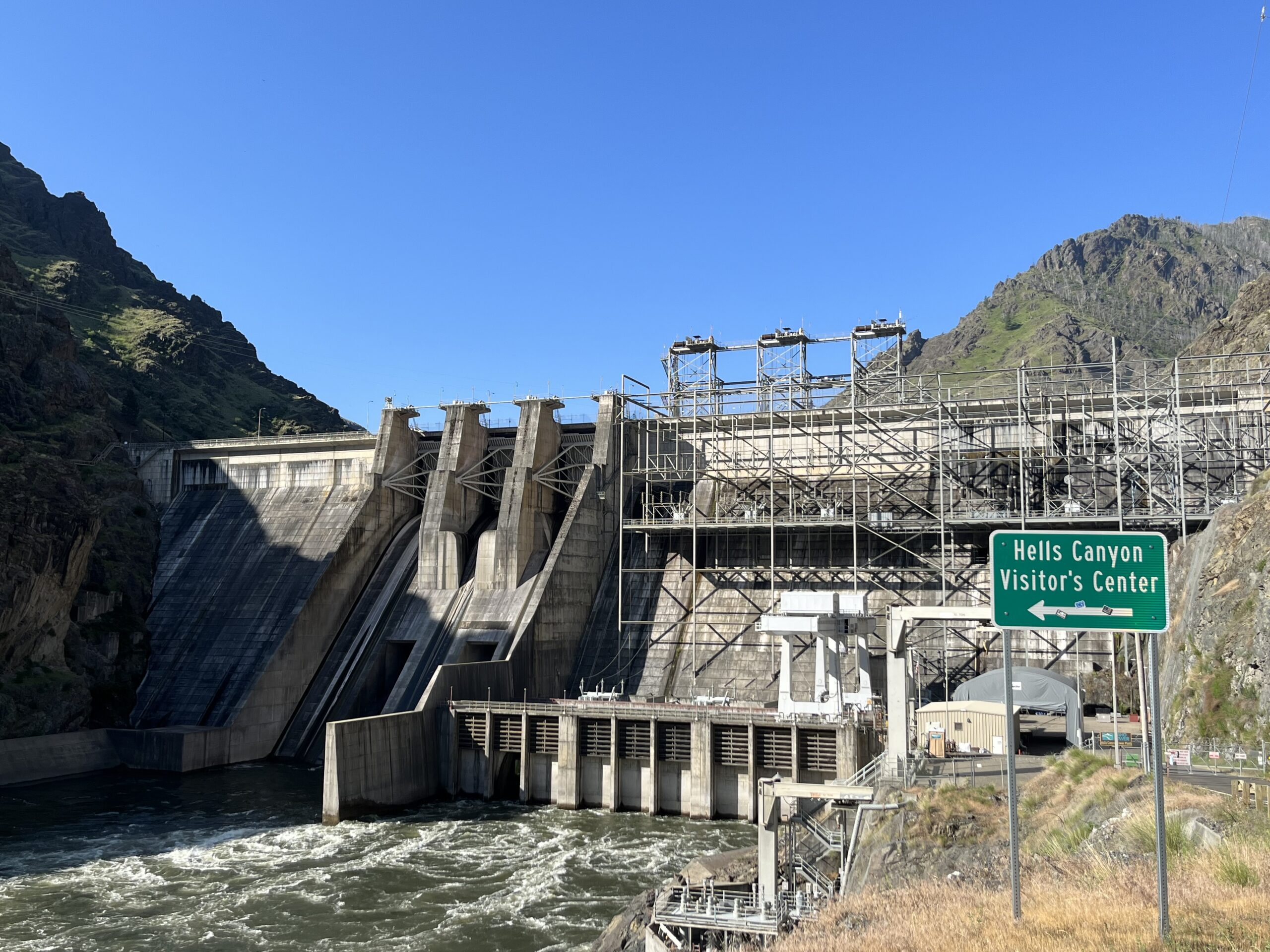
The 1952 election brought Dwight Eisenhower to the presidency as well as Republicans to a majority in Congress. One of Eisenhower’s policies was instead of public construction of dams, as had been the norm with the Roosevelt and Truman Administrations, that there would be a partnership between government and private companies, with government using private companies to construct and own the dams generating power. This proved highly controversial in the West, and the proposal for constructing the Hells Canyon Dam was at the center of this controversy.
Hells Canyon is a deep canyon between Idaho, Oregon, and a small portion of Washington, and has the snake river, and was seen as a rich source of hydroelectric power. The Eisenhower Administration favored the Idaho Power Company constructing three dams to generate power, but this met strong opposition from Democrats. Unfortunately for the Republicans, there was more opposition than that among the public. In 1954, Oregon Republican Senator Guy Cordon, the last conservative to represent the state in the Senate, narrowly lost reelection to Democrat Richard Neuberger despite President Eisenhower coming to Oregon to campaign with him, and one of the key issues Neuberger pushed was opposition to private power as opposed to public power, painting it as a giveaway of public rights (LaLande). After the 1954 election, Oregon had two Democratic senators for the first time since the Wilson Administration.
Votes on Hells Canyon Dam and an Alleged Deal
In 1956, the Senate voted down public construction of Hells Canyon Dam 41-51 on July 19th. Most Republicans voted against it along with several Southern Democrats. The 1956 election didn’t produce a different party makeup of the Senate, as Republicans and Democrats both gained and lost different seats. Yet, on June 21, 1957, the Senate approved public construction of Hells Canyon Dam 45-38. The senators who had voted against in 1956 but voted for this time were George Smathers (D-Fla.), Richard Russell (D-Ga.), Russell Long (D-La.), Margaret Chase Smith (R-Me.), James Eastland (D-Miss.), Sam Ervin (D-N.C.), and George Aiken (R-Vt.). The flip of five Southern Democrats was key to securing this victory, and Senator Charles Potter (R-Mich.), a supporter of a strong civil rights bill and opponent of public ownership of Hells Canyon Dam, alleged right after the vote that this flip was done in exchange for the support of Western Democrats for watering down the pending civil rights bill (The New York Times). Senator Wayne Morse (D-Ore.), a supporter of strong civil rights legislation and a co-sponsor of the Hells Canyon Dam denied the charge. Senator Frank Church (D-Idaho), who had voted for both of the key amendments weakening the Civil Rights Act of 1957 and had co-sponsored the Jury Trial Amendment as well as the Hells Canyon Dam bill, denied that a deal had occurred. He stated, “There was never any understanding between Lyndon Johnson and me that I would take a role in the Civil Rights Bill or I would join in the sponsorship of the Jury Trial Amendment in exchange for his help on Hells Canyon. That’s pure fiction utterly without any basis in fact” (Gellman). Although this flip of the Southern senators is suggestive of a deal, there was a public explanation for the flip from the de facto leader of the Southern Democrats. Senator Richard Russell (D-Ga.) stated as to his own reason, “I happen to be one of the five Democrats who changed his vote on Hells Canyon. I did it because of the tax amortization feature which made it very apparent that the Federal Government was going to pay for the dam in any event. If we were going to pay for it, I thought we ought to have title to it” (Bill Downs, War Correspondent). Several senators who were alleged to be participants in this deal denied that a deal occurred, but historian Robert Caro gave this allegation credence as he reported that Majority Leader Lyndon B. Johnson (D-Tex.) masterminded this deal. However, historian Irving Gellman (2015) contests this, holding that Hells Canyon Dam had been killed in a House subcommittee before the vote on the Jury Trial Amendment. However, this counter-argument might be off as well, as the exchange, according to Time Magazine, was over the vote to send the Civil Rights Act of 1957 to the Judiciary Committee, chaired by segregationist James Eastland (D-Miss.), to undo Minority Leader William Knowland’s (R-Calif.) maneuver bypassing it. Indeed, the vote on sending the bill to the Judiciary Committee was held the day before the Hells Canyon Dam vote and numerous Western senators voted with the South on this one, with the five Southern senators voting for the dam allegedly in gratitude for the support of Western senators. Interestingly, Frank Church was not among the senators to vote to bring it back to committee, pointing to his denial being accurate that he didn’t make a deal. Although Wayne Morse voted to send it back, his record was consistent as a stickler for legislative procedure and he voted against efforts to weaken the bill, making his denial credible as well. Although several senators had denied there was a deal, Russell Long (D-La.) would give credence to the notion of an informal deal, stating, “Johnson put together sort of a gentleman’s agreement where about four of us would vote for the high dam at Hells Canyon and about four on the other side would vote with us (…) on a completely unrelated subject: civil rights” (Lange, 69).
Political Consequences of Support for Private Power
There were significant political consequences for those in the Pacific Northwest who supported private construction and ownership of the Hells Canyon Dam; although President Eisenhower easily won reelection in Oregon, Oregon Republicans got hit hard; Oregon Republican Congressmen Sam Coon and Harris Ellsworth lost reelection in districts that had been held by Republicans since the 1942 election. Coon’s loss was directly attributed to his opponent Al Ullman’s opposition to private construction of dams in Hells Canyon (Foss). Indeed, the 1956 election had bad results for Oregon Republicans by and large. That year, Republican Governor Elmo Smith lost reelection to Democrat Robert Holmes and Democrats won control of the state legislature for the first time since 1878 (Swarthout). In Idaho, Democrat Frank Church, a supporter of public ownership of dams at Hells Canyon, defeated Republican incumbent Herman Welker, a supporter of private ownership, in the last election in which a Democrat would defeat a Republican Senate incumbent in Idaho. Although in this case, Welker’s loss was attributable to more than that as his behavior was increasingly volatile and erratic, with him being prone to temper tantrums and bouts of depression as well as appearing to have poor balance, which included a public incident of stumbling and falling down airplane stairs (Hill). At the time his critics alleged that this was the product of heavy drinking, but the truth was worse: it turned out Welker had a brain tumor, and it would kill him on October 30, 1957. Welker’s strong support of Joseph McCarthy also proved a hindrance rather than a help by 1956.
Despite these political consequences, the Hells Canyon legislation being killed in the House subcommittee proved to be the final word on it, as the Idaho Power Company would later construct three dams on the Snake River.
References
Foss, C. Albert Conrad “Al” Ullman. Oregon Encyclopedia.
Retrieved from
https://www.oregonencyclopedia.org/articles/ullman_al/
Gellman, I.F. (2015, November 9). Robert Caro Gives LBJ More Credit than He Deserves for the Passage of the Civil Rights Act of 1957. History News Network.
Retrieved from
https://www.historynewsnetwork.org/article/robert-caro-gives-lbj-more-credit-than-he-deserves
Hill, R. Idaho’s Conservative: Herman Welker. The Knoxville Focus.
Retrieved from
https://www.knoxfocus.com/archives/this-weeks-focus/idahos-conservative-herman-welker/rom
HR. 6127. Civil Rights Act of 1957. Point of Order Against Objection by Knowland to Referral of Bill to Judiciary Committee. Rejected. (Bill Thus Bypassed the Judiciary Committee). Govtrack.
Retrieved from
https://www.govtrack.us/congress/votes/85-1957/s57
LaLand, J. (2022, September 16). Guy Cordon. Oregon Encyclopedia.
Retrieved from
https://www.oregonencyclopedia.org/articles/cordon_guy_1890_1969_/
Lange, O.M. (2017). “The Miracle of 1957”: Southern senators and the making of the 1957 Civil Rights Act (Master’s thesis). University of Oslo.
Retrieved from
National Affairs: Balance Tipped. (1957, July 1). Time Magazine.
Retrieved from
https://time.com/archive/6611890/national-affairs-balance-tipped/
Potter Charges Dam – Rights Deal. (1957, June 22). The New York Times.
Retrieved from
Russell Rejects Criticism of South on Civil Rights. (2024, February 13). Bill Downs, War Correspondent.
Retrieved from
https://www.billdownscbs.com/2024/02/1957-senator-richard-b-russell-rejects.html
S. 1333. Authorize Construction, Operation, and Maintenance of Hells Canyon Dam. Govtrack.
https://www.govtrack.us/congress/votes/84-1956/s200
S. 555. Authorize Federal Construction of Hells Canyon Dam. Govtrack.
Retrieved from
https://www.govtrack.us/congress/votes/85-1957/s59
Swarthout, J.M. (1957). The 1956 Election in Oregon. The Western Political Quarterly, 10(1).
Retrieved from

