Part of my research involves an interest in how legislators are perceived, and a significant perception difference between liberals and conservatives exists with those who represented the states of the former Confederacy. An interesting article from 1943 from a Southern perspective argued that the liberal Americans for Democratic Action’s (ADA) predecessor organization, Union for Democratic Action, was anti-Southern in its tabulation of key votes. This would prove increasingly true after 1964 with ADA taking on a bit more of a new left perspective, in which certain lopsided votes were counted against legislators, most notably a 1967 proposal to withdraw troops from Vietnam, which only got 18 votes from representatives.
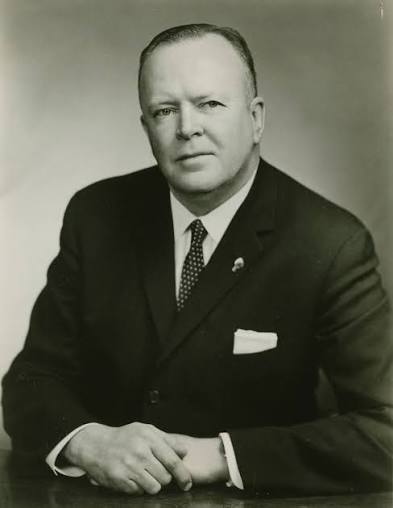
Robert W. Hemphill (D-S.C.), one of the legislators most disagreed on by conservatives and liberals.
Conservatives were significantly less impressed with the conservatism of Southern Democrats that liberals saw. Indeed, some differences in evaluation are of magnitudes in difference. Take Thomas S. Gettys of South Carolina for instance; he served entirely within in a period that both the conservative Americans for Constitutional Action (ACA) and ADA were grading, and Gettys only sides with ACA 63% of the time and ADA 7% of the time. This is an astounding 30 point difference: by ACA standards he fits within what I consider the moderate range of 35-65%, while by ADA he’s an ultra-conservative. DW-Nominate places him at -0.122 by contrast, closer to the conservative assessment. Same goes for Robert Hemphill of South Carolina, who was the most favorable of South Carolina’s Democrats in the early 1960s to national Democratic programs and represented a district in the poorer northern portion of the state that was more favorable towards New Deal liberalism than the ; ADA only finds him 34% liberal while ACA finds him only 33% conservative, this is a 33 point differential in how these organizations seem him. Hemphill’s DW-Nominate score is -0.129, which fits closer with the conservative conception of Hemphill. Americans for Democratic Action regarded Southern Democrats as 17 points more conservative than Americans for Constitutional Action, with the discrepancy with Southern Republicans being considerably less at 6.6 points. Interestingly, among politicians who fall completely within the range ACA was scoring, the discrepancy is even higher, with Southern Democrats being 20.6 points more conservative by ADA than ACA with Republicans only at 7.4 points discrepancy. There are a few outside cases in which legislators from the South who are considered ultra-conservative by ACA are considered just slightly less so by ADA, such as Texas’s Bruce Alger and Virginia’s William Scott, but the differential is a mere two points. ACA and ADA being far more in agreement on where Southern Republicans stand vs. where Southern Democrats stand indicates that ACA places stronger emphasis on certain old New Deal issues; they count more agricultural votes and in particular their 1959 scoring stands out for counting votes in the House that hardly any Democrats voted their position on; these include a motion to delete a direct housing loan program for veterans, overriding President Eisenhower’s veto of a public works bill, and an increased permissible interest rate for government bonds. ADA counted more positions that strengthen the Southern Democratic claim to conservatism, such as a 1959 vote on Hawaii statehood and a 1960 vote on the strengthening McCulloch-Celler Amendment to the Civil Rights Act of 1960. Indeed, civil rights votes being counted more by ADA than ACA further emphasizes Southern conservatism, while ACA’s greater focus on spending and programs that brought more unity between Northern and Southern Democrats. Also, Southern Democrats really suffer under liberal scoring because of ADA’s much stronger emphasis on defense and Vietnam votes than ACA’s. The details of legislator scores of agreement with ADA and ACA are below…legislators in BOLD served entirely within the period that ACA was assessing politicians.`
References
Gettys, Thomas Smithwick. Voteview.
Retrieved from
https://voteview.com/person/10728/thomas-smithwick-gettys
Hemphill, Robert Witherspoon. Voteview.
Retrieved from
https://voteview.com/person/4299/robert-witherspoon-hemphill
The South Isn’t Anti-New Deal — The New Deal Is Anti-Southern. (1943, August 21). The Southern Watchman, p. 2.
Retrieved from
https://fascinatingpolitics.com/wp-content/uploads/2025/04/southern_watchman_1943_08_21_2.pdf

