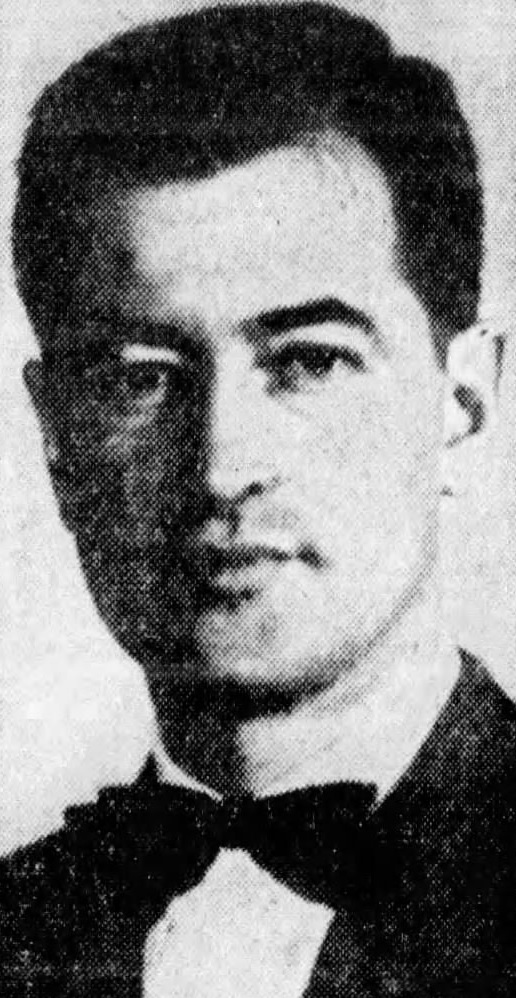
Willis Carto, the radical right founder, treasurer, and de facto head of Liberty Lobby.
Last week, an article from conservative columnist Erick Erickson covered a troubling phenomenon brewing among the right that has taken a stand against liberty, most notably in the figure of Charles Haywood in the article, “The Midwestern Fuehrerbunker Driving the Right Off the Cliff”. Indeed, the trending towards authoritarianism in the name of traditionalism places excessive emphasis on order. The efforts of Haywood and others in infiltrating the conservative movement and its organizations remind me of a figure who like Haywood was from Indiana that the conservative movement figuratively expelled from its ranks: Willis Carto, who would eventually be the subject of multiple exposes as pro-Nazi and peddled antisemitism and racism through means covert and overt in his long life. This organization he formed to get on the map and to serve as a springboard for a right-wing dictatorship when the time was right. Liberty Lobby attracted some conservatives but also some radical right cranks and bigots on to its Board of Policy. I had known that this organization issued ratings but I was and still am far more interested in Americans for Constitutional Action (ACA) as a good way to judge right and left from a conservative perspective in the past, and examining these ratings has certainly not changed my mind. However, this alternative take is of interest too, especially since I found the criterion by which the first two years of the Kennedy Administration was judged. I am going to interchangeably refer to the makers of the criterion as Liberty Lobby and Carto as they were by and large one and the same.
Liberty Lobby’s ratings of Congress are rather limited and simplistic; only 10 votes are counted for the entirety of the Congress in both legislative bodies; by contrast the liberal Americans for Democratic Action counted 10 votes for 1961 and 8 votes for 1962 in the House while ACA counted 12 votes in 1961 and 11 votes in 1962 for the House. Carto was strict in grading but also simultaneously leaves out numerous issues that were considered both by ADA and ACA as salient for determining ideology:
. The Ayres-Kitchin conservative substitute for minimum wage legislation in 1961.
. The 1961 Area Redevelopment Act.
. Rep. Cannon’s (D-Mo.) 1961 effort to restore funding for power generation at the Hanford plutonium reactor.
. The failed effort in 1961 to get President Kennedy’s federal aid to education bill considered in the House.
. The Housing Act of 1961.
Rather than these measures, Carto sees fit to include the vote for a Constitutional amendment banning the poll tax and the bill establishing the Arms Control and Disarmament Agency. Liberty Lobby’s analysis is quite limited given the exclusion of numerous issues that I would consider highly ideologically salient and his emphasis seems strong on the nationalistic; 4 of 10 issues connect in some way to nationalism. Also, instead of counting the Mason (R-Ill.) substitute in the House like ADA and ACA do, Liberty Lobby counts the final vote on the Trade Expansion Act, which dings a lot of rural representatives.
The following votes in the House were considered to be of greatest importance by Carto:
1. Expand the Rules Committee
Speaker Sam Rayburn’s (D-Tex.) resolution to expand the House Rules Committee from 12 to 15 members for the 87th Congress, adding two Democrats and one Republican. This was intended to counter its chairman, Howard W. Smith (D-Va.), a staunch opponent of liberal legislation.
Adopted 217-212: D 195-64; R 22-148, 1/31/61.
Yea = -, Nay = +
2. Establish Arms Control and Disarmament Agency
Passage of the bill establishing the Arms Control and Disarmament Agency in the State Department to implement arms control and to manage international negotiations for arms limitations.
Passed 290-54: D 194-16; R 96-38, 9/19/61.
Yea = -, Nay = +
3. Disapprove Creation of Department of Urban Affairs
Resolution disapproving of President Kennedy’s executive order creating the Department of Urban Affairs. Conservatives in the Republican Party objected to the growth of government but there was an additional incentive for Southern Democrats to vote against as the proposed cabinet head would be Robert Weaver, who was black.
Disapproved 264-150: D 111-137; R 153-13, 2/21/62.
Yea = +, Nay = –
4. Raise National Debt to $308 Billion.
Passed 211-192: D 202-39; R 9-153, 6/14/62.
Yea = -, Nay = +
5. Defeat Food and Agriculture Bill
Rep. Paul Findley (R-Ill.) motion to recommit and thus kill the Food and Agriculture Act of 1962, which provided for supply management controls for wheat, corn, and other feed grains.
Passed 215-205: D 48-204; R 167-1, 6/21/62.
6. Trade Expansion Act
Passage of the bill granting the president expanded authority to negotiate trade agreements and provides for adjustment assistance to employers and workers harmed by trade agreements.
Passed 298-125: D 218-35; R 80-90, 6/28/62.
Yea = -, Nay = +
7. Foreign Aid Authorization
Passage of the bill basically granting President Kennedy’s request for foreign aid funds for fiscal year 1963.
Passed 250-164, 7/12/62.
Yea = -, Nay = +
8. Poll Tax Ban Amendment
Adoption of the resolution proposing a Constitutional amendment banning the poll tax as a requirement to vote in federal elections.
Adopted 295-86: D 163-71; R 132-15, 8/27/62.
Yea = -, Nay = +
9. Kill Public Works Program
Rep. William Cramer (R-Fla.) motion to recommit, and thus kill, the bill establishing an accelerated public works program.
Defeated 192-221: D 44-202; R 148-19, 8/29/62.
Yea = +, Nay = –
10. United Nations Bond Bill
Passage of the bill providing for up to $100 million in loans to the United Nations.
Passed 257-134: D 191-46; R 66-88, 9/14/62.
Yea = -, Nay = +
I have not found out what issues Liberty Lobby graded for the Senate yet, but I have learned that only Senators Strom Thurmond (D-S.C.) and John Tower (R-Tex.) got 100%. The representatives that got 100% by Liberty Lobby were:
Republicans
Edgar Hiestand, Calif.
John Rousselot, Calif.
James B. Utt, Calif.
Noah Mason, Ill.
Earl Wilson, Ind.
August Johansen, Mich.
Clare Hoffman, Mich.
James Battin, Mont.
Ralph Beermann, Neb.
John H. Ray, N.Y.
Gordon Scherer, Ohio
Samuel Devine, Ohio
Ellis Y. Berry, S.D.
Bruce Alger, Tex.
William K. Van Pelt, Wis.
Democrats
Joe Waggonner, La.
Otto Passman, La.
Jamie Whitten, Miss.
John Bell Williams, Miss.
W. Arthur Winstead, Miss.
William Colmer, Miss.
John Dowdy, Tex.
Omar Burleson, Tex.
I should note that scoring a 100% on this does not necessarily mean alignment with Carto’s noxious views on race and religion. For instance, Samuel Devine of Ohio would later vote for the Civil Rights Act of 1964 and some others, such as Gordon Scherer of Ohio and William K. Van Pelt of Wisconsin, had voted for previous civil rights measures. As for the scorecard, it is below:

