One of the most memorable politicians in America’s history who never became president was Huey Pierce Long (1893-1935). He even has fans on the internet today who hail from both the right and left. Yet, his time of prominence was relatively short and he was only 42 at the time of his death. Although his philosophy is often seen as to the left of FDR, he in truth is something of an enigma. There were some ways in which Long was indeed to his left, but there were other ways in which Long was to Roosevelt’s right. Huey Long had his own views on himself when asked:
“Oh, hell, say that I’m sui generis [unique] and let it go at that” (Huey Long).
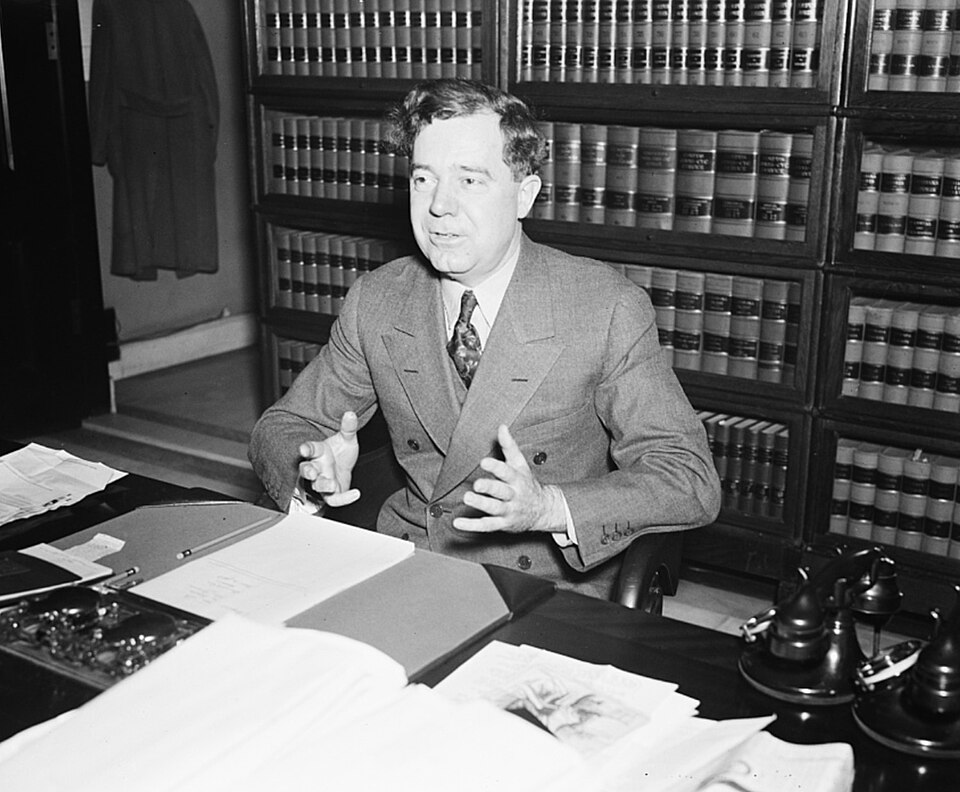
To determine Long’s place on the political spectrum we must look both at his record in the state of Louisiana and in the Senate. Long was elected governor in 1928 on a populist platform against Standard Oil and other large companies. Unlike many politicians in Louisiana, when Long made grand promises, he kept them. During his administration, extensive infrastructure was built, including over 9700 miles of new roads. He also had numerous bridges and natural gas pipelines created, and did so efficiently by bypassing local bosses and machines. Long funded these improvements by raising taxes on Standard Oil and other large corporations while reducing the tax burden on the common people. One of the ways he did so was reducing the personal property tax. He also eliminated the poll tax and provided relief for debt and foreclosures during the Great Depression. All of Long’s programs dd cost money, and the state’s debt dramatically increased. However, many states were spending money back then to fight the Great Depression, and the state’s operating expenses during Long’s time was $41.97 per capita, the third lowest of the 25 states that tracked such data and taxes rose an average of 2.2% as opposed to the average of 4.7% among states (Huey Long). He also proposed national minimum and maximum levels of income with every family getting an estate and a guaranteed minimum income, funded by increases in income and inheritance taxes with his “Share Our Wealth” plan. When asked if his Share Our Wealth plan was communist, he responded, “Communism? Hell no! … This plan is the only defense this country’s got against communism” (Huey Long). Long and others were willing to consider some significant alternative ideas to try and bat back a potential communist revolt. In 1930, he engineered his election to the Senate, and although once a senator he was officially no longer governor, his successor, Oscar K. Allen, was a figurehead. Thus, Long was in all but name still governor of Louisiana.
The Senate
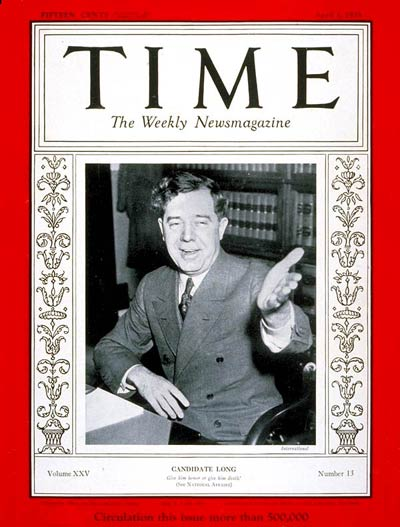
Long described his own record during the Roosevelt Administration thus, “Whenever this administration has gone to the left I have voted for it, and whenever it has gone to the right I have voted against it” (Huey Long). However, his record is actually a bit more complicated than that. Long did vote for a lot of the Roosevelt Administration’s First 100 Days legislation, such as the Agricultural Adjustment Act and the Tennessee Valley Authority. He also voted for FDR’s currency legislation and work relief. In 1935, Long supported extending the Tennessee Valley Authority, the Public Utilities Holding Company Act, and the Bituminous Coal Act. There were certainly some ways in which Long went to FDR’s left, for example, he strongly supported veterans bonus legislation while Roosevelt was in opposition due to its budgetary impact and was supportive of Frazier-Lemke farm mortgage relief legislation. However, there are reasons to see Long as both right and left. He took a stance that was long associated with the right while in the Senate; he consistently opposed tariff reduction. Part of this was that Louisiana’s sugar industry had interest in keeping sugar tariffs high. However, he was one of the few Southerners to vote against the Reciprocal Trade Act in 1934, and the only other Louisianan to follow his lead on this was Congressman Numa Montet of the 3rd district. This was a law that all Republicans of the party’s conservative wing voted against. In 1935, Long opposed US entry into the World Court (which suggests non-interventionist politics come World War II) including sponsoring a reservation that the Monroe Doctrine would apply, supported the Clark Amendment to the Social Security bill that would permit exemption from the program by companies that either had pension plans that met or exceeded Social Security or agreed to adopt such plans, Although this amendment passed the Senate, it was deleted in conference. Long also opposed the final version of the National Industrial Recovery Act and voted against its extension in 1935. Long also opposed and voted to recommit legislation to create a Farmers Home Corporation, a motion that among Republicans was only opposed by George Norris of Nebraska and Lynn Frazier of North Dakota, among the most liberal of Republicans. Also something strange to note about Long is that he has one of the highest DW-Nominate scores of anyone who has ever served in Congress as a Democrat at 0.251. Some of Long’s opposition to the Roosevelt Administration, however, was based on self-interest. He held one of the longest solo filibusters in Senate history at 15 hours and 35 minutes, which was the second longest at the time, to retain a provision in the extension of the National Industrial Recovery Act that mandated Senate confirmation of senior officials of the National Recovery Administration. This was to prevent Roosevelt from appointing political rivals to these positions. However, this proved unsuccessful and the proposal, backed primarily by New Deal critics, failed in a roll call vote. Another interesting matter to examine when assessing Long’s ideology is that of those people who strongly supported him and how their records turned out after Long’s death.
Two key people in support of Long who went to the Senate were John H. Overton and Allen J. Ellender. The former was Long’s attorney who defended him during impeachment proceedings and joined Long in the Senate in 1932 while Ellender was floor leader for Long in the state House and succeeded him. Overton’s DW-Nominate score is a -0.053 and Ellender’s DW-Nominate score is -0.089, so not generally considered to be strongly ideologically left although it should be noted that the latter started as a firm supporter of the New Deal who backed FDR’s court packing plan. The predecessor to the liberal Americans for Democratic Action, Union for Democratic Action, released ratings in 1944 and 1945, and cumulatively, Ellender sided with them on counted votes 64% of the time while Overton only did so 25% of the time. The latter would side with ADA during the 80th Congress 59% of the time. These are not indicative of strong left-wing politics. Later on, Ellender would be quite a bit less liberal; he sided with the conservative Americans for Constitutional Action 57% of the time and the liberal Americans for Democratic Action 26% of the time. Although of course it is true that Ellender and Overton are different people than Long, they were among his closest and most powerful allies thus it stands to reason that they are much more alike than different. He also had a brother, George Long, with a Congressional record in the 1950s and also his son, Russell, who served in the Senate from 1949 to 1987. Neither were considered leading lights of left-wing politics, although Russell was more supportive of the Great Society than many of his fellow Southern Democrats. Yet, Russell Long also endorsed the Reagan tax cuts and was considered one of the more conservative Democrats by the 1980s. Had Huey Long simply remained a senator and lived a long life, it is absolutely conceivable to see him in postwar be in opposition to foreign aid, supportive of domestic anti-communist measures, and opposed to civil rights legislation (his son, Russell, opposed all of the major civil rights laws of the 1960s except the 24th Amendment).
Something also to bear in mind is that Long’s anti-corporate stance certainly rhymes with the left, but being anti-corporate isn’t always inherently left. Senator Josh Hawley (R-Mo.), a man no one considers a left-winger, is also by attitude anti-corporate. Furthermore, most socialists opposed Long as he opposed organized labor in Louisiana and also used state government to crack down on communist groups. He did nonetheless vote for the Wagner Act as senator. It is true that Long’s politics do not fit cleanly with conservatism given his support for many significant New Deal programs as well as using extensive deficit spending as governor but it is also true that they do not fit cleanly with liberalism. His reduction of property taxes I don’t think translates well on that front and nor do his opposition to the World Court, his opposition to Reciprocal Trade Agreements, and his opposition to the National Industrial Recovery Act. Although he often is categorized as populist left, I think he is populist but a bit more syncretic in philosophy than commonly thought. We may just have to accept Long saying that he was “sui generis”.
References
A Congress to Win the War and the Peace. (1944, May 5). The New Republic, 110 (19), 643-58.
Retrieved from
https://www.newspapers.com/image/1143419115
ADA Voting Records. Americans for Democratic Action.
Retrieved from
Ellender, Allen Joseph. Voteview.
Retrieved from
https://voteview.com/person/2901/allen-joseph-ellender
Huey Long As Louisiana Governor. HueyLong.com.
Retrieved from
https://www.hueylong.com/life-times/governor
Huey Long Quotes. HueyLong.com.
Retrieved from
https://www.hueylong.com/perspectives/huey-long-quotes
Huey Long Filibusters New Deal Legislation. U.S. Senate.
Retrieved from
https://www.senate.gov/about/powers-procedures/filibusters-cloture/huey-long-filibusters.htm
Long, Huey Pierce. Voteview.
Retrieved from
https://voteview.com/person/5758/huey-pierce-long
Overton, John Holmes. Voteview.
Retrieved from
https://voteview.com/person/7126/john-holmes-overton
Patton, J.G. & Loeb, J. (1945, February 5). Challenge to Progressives. The New Republic, 112 (6), 21-42.
Retrieved from

