Right now, Arizona is a purple state although before the rise of Donald Trump it was known as reliably Republican, which started in 1952 with the election of Barry Goldwater to the Senate and the popularity of his brand of conservatism in the state. Republican primary voters as of late have made a few poor and out-of-touch decisions in their nominations (Blake Masters and Kari Lake come to mind), and it has cost them greatly. Arizona itself used to be a solidly Democratic state; indeed in its first forty years only one federally elected politician was a Republican, and that was Senator Ralph Cameron in the landslide 1920 election. In 1940, Senator Henry F. Ashurst, one of the state’s first two senators, was originally thought to be a shoo-in for renomination, but he did little campaigning due to depression from the passing of his wife. Enter Pinal County Superior Court Judge Ernest William “Mac” McFarland (1894-1984), who challenged Ashurst. In contrast to the senator, McFarland ran an energetic campaign, and he prevailed with over 56% of the vote.
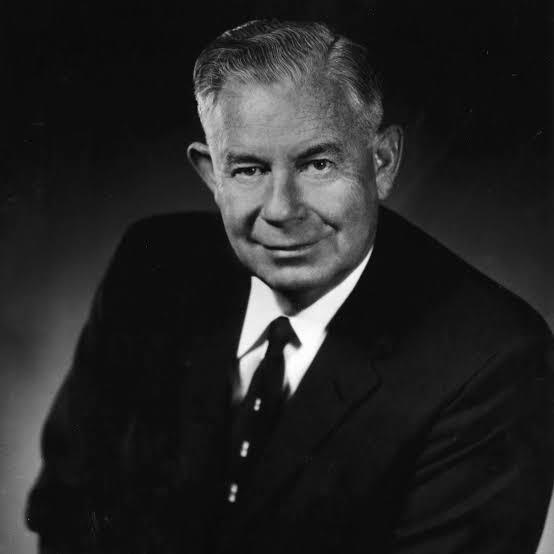
McFarland came from humble circumstances, literally being born in a log cabin at his family’s farm in the at-the-time territory of Oklahoma. As a young man he was an educator and although he signed up for the navy during World War I, he spent the war on duty at Lake Michigan, but was admitted to a naval hospital with pneumonia on March 3, 1918, which became so serious that he required life-saving surgery to drain fluid from his lungs. He struggled with other illnesses that resulted from his pneumonia and he was not well enough to be discharged from the navy until January 31, 1919, and subsequently moved to Arizona for the dry climate. McFarland subsequently attended Stanford University Law School, earning a J.D. as well as a Master’s in political science. He practiced law but also participated in politics, assisting George W.P. Hunt in his first successful campaign for governor, resulting in McFarland becoming assistant attorney general. In 1924, McFarland was elected Pinal County attorney, and served six years in that position. In his role, he represented the state in the appeal of Eva Dugan, who had been convicted of murdering her elderly employer. The appeal failed, and she was executed. McFarland subsequently ran for a post on the Superior Court of Pinal County, but narrowly lost the primary, and instead formed the Office of McFarland and Fulbright, which primarily dealt in water law, of which he was an expert, but also successfully won an appeal for convicted murderer Winnie Ruth Judd on grounds of insanity. In 1934, he again tried for the Superior Court of Pinal County, and won, serving for the next six years. On the bench, McFarland gained a sterling reputation. Indeed, his rulings were only overturned on appeal thrice (McMillan, 49).
In his personal life, McFarland had more than his share of tragedy, as he and his first wife, Clare, lost their first child at two years old and the second dying two days after birth. In 1930, she was pregnant again but the child was stillborn, and she died from postpartum complications. In 1933, McFarland remarried widow Edna Eveland Smith and adopted his new wife’s daughter, Jewell.
Senator McFarland
Although new senators are typically learning the ropes and thus not prone to making a splash, McFarland was an exception. He was placed on a committee to investigate alleged pro-war propaganda in Hollywood films spearheaded by Senator Gerald Nye (R-N.D.), one of the Senate’s leading opponents of US intervention in World War II as the only defender of the Roosevelt Administration’s foreign policy. However, McFarland quickly got attention when he criticized the committee’s practices, accusing witnesses against movies characterized as pro-war of having not seen the films they condemned (Kroman, 102). McFarland’s push-back against this committee was regarded favorably by much of the public and most of the press. He was overall supportive of the Roosevelt Administration although not a rubber stamp supporter. In 1943, although McFarland voted for the Smith-Connally Act to address labor disputes, he subsequently voted to sustain President Roosevelt’s veto, and his record would be friendly to organized labor from then on. In 1944, he was the Senate sponsor of the G.I. Bill, providing educational and other assistance to returning soldiers, which got him further approval with his constituents. Although 1946 was a wave year for the GOP, McFarland won reelection by 39 points and won all counties against Republican Ward Powers.
In the GOP-led 80th Congress, McFarland voted against much of the prominent measures pushed by the GOP leadership, including tax reduction, the Taft-Hartley Act, and the Bulwinkle-Reed bill to loosen anti-trust enforcement on railroads. He also supported retention of New Deal fundamentals such as support for public power generation and distribution and funds for soil conservation. On foreign policy, McFarland supported aid to Greece and Turkey and the Marshall Plan. However, on certain ideologically salient amendments McFarland proved more conservative; he supported Senator Cain’s (R-Wash.) amendment to kill public housing in 1948, supported two amendments to hinder rent control in 1948, opposed loosening restrictions on the admittance of displaced persons, and backed cutting funds for the Marshall Plan. McFarland also voted with regional preference in his support of wool tariffs in 1947.
In 1950, Senate Majority Leader Scott Lucas (D-Ill.) lost reelection, and the Democrats decided that McFarland, a popular figure among his colleagues, would replace him. After all, he was not considered a staunch liberal, had voted independently often enough to possibly shield him from charges of being a rubber stamp, and had won reelection overwhelmingly in 1946. As majority leader, he backed public housing funds, opposed using the injunction provision of the Taft-Hartley Act during the 1952 steel mill strikes, and opposed foreign aid cuts, but voted to override President Truman’s veto of the McCarran-Walter Act, which strengthened the national origins quota for immigration.
As majority leader, McFarland was nonetheless allied and identified with the Truman Administration for the Senate. However, the Truman Administration was unpopular at the time and Senators Richard Russell (D-Ga.) and Robert Taft (R-Ohio) carried more influence overall. He was an active critic of the methods of Senator Joseph McCarthy (R-Wis.), stating, “When the name of any member of the Senate becomes an adjective for mudslinging, we have come a far way from the tradition of those great men who preceded us here” (U.S. Senate).
The 1952 Election
A lot changed in six years in Arizona, and a warning sign for Arizona Democrats was the 1950 victory of J. Howard Pyle in the gubernatorial election. Pyle had been the first Republican to be elected governor since 1928 and only the third in the state’s history. In 1952, McFarland was challenged by Phoenix City Councilman Barry Goldwater, who had managed Pyle’s 1950 campaign. As Senate Majority Leader, McFarland was closely tied to the Truman Administration, which by this point was highly unpopular, and Goldwater capitalized on this, running as a dyed-in-the-wool conservative. He ran with the campaign slogan, “Mac is for Harry, Harry’s all through, You be for Barry, ‘Cause Barry’s for you” (Time Magazine, 7). Dwight Eisenhower carried the state by around 42,000 votes in 1952, and Goldwater prevailed by 6,725 votes.
Goldwater subsequently wrote to Senator Joseph McCarthy (R-Wis.) on the result, “The election victory was not entirely a surprise, because we knew that McFarland, carrying the weight of Truman’s mistakes around his neck, would have a difficult time winning, particularly in view of the fact that I had spent nearly all my life campaigning for this job, whether I realized it or not” (Dean & Goldwater, 72). McFarland had sided with the liberal Americans for Democratic Action 64% of the time and his DW-Nominate score stands at -0.252, indicating a moderate to moderately liberal record. In 1953, McFarland, highly interested in the growing medium of television, established the Arizona Television Company, which established the station KTVK in 1955, and was an ABC affiliate for decades.
Comeback
By 1954, Governor Pyle was increasingly vulnerable in part due to the Short Creek Raid he had ordered in enforcing anti-polygamy laws on the Mormon enclave of Colorado City, an event in which over 200 children were separated from their parents after the arrest of 24 fathers, and reporters snapped pictures of crying children being separated from their parents (Hill). He also had trouble dealing with the Arizona legislature, which at the time remained strongly Democratic, providing a grand opening for McFarland’s return. He ran for governor against Pyle on a campaign of getting things done and won with 52.5% of the vote. McFarland won reelection in 1956 by 19 points and winning all counties.
Although 1958 looked like a good opportunity to get back into the Senate as many Republicans lost reelection, Goldwater managed to fend off his challenge, winning reelection with 56% of the vote. The Flagstaff Arizona Daily Sun wrote of the defeat of the Democrats in Arizona, “With a preponderantly heavy Democratic registration, with surveys and pre-election polls favoring Gov. Ernest McFarland and Robert Morrison, the Arizona Democrats forgot about issues and contented themselves with presenting these two party wheel-horses on a ballyhoo campaign background that was in style around the turn of the century” (Hill). In 1964, at the age of 70, McFarland won a seat on the state Supreme Court, and served as chief justice in 1968. He retired from elective office with his departure from the court in 1971, and subsequently served as the director of the Federal Home Loan Bank of San Francisco as well as president of the Arizona Television Company. After years of declining health, McFarland died in Phoenix on June 8, 1984 at the age of 89. To this day, McFarland is the only Arizonan to have served as Senate Majority Leader, Governor, and Chief Justice of the state Supreme Court.
References
ADA Voting Records. Americans for Democratic Action.
Retrieved from
Dean, J.W. & Goldwater, B.M. Jr. (2008). Pure Goldwater. New York, NY: Palgrave Macmillan.
Ernest McFarland: “Father of the GI Bill”. U.S. Senate.
Retrieved from
https://www.senate.gov/about/parties-leadership/mcfarland-ernest.htm
Hill, R. (2021, July 11). Ernest McFarland of Arizona. The Knoxville Focus.
Retrieved from
Kroman, K.K. (1989). Ernest W. McFarland. The Arizona governors, 1912-1990. Phoenix, AZ: Heritage Publishers, 99-108.
McFarland, Ernest William. Voteview.
Retrieved from
https://voteview.com/person/6242/ernest-william-mcfarland
McMillan, J.E. (2006). Ernest W. McFarland: majority leader of the United States Senate and governor and chief justice of the state of Arizona. Prescott, AZ: Sharlot Hall Museum Press.
Republicans: Salesman for a Cause. (1961, June 23). Time Magazine.
Retrieved from
https://content.time.com/time/subscriber/article/0,33009,894485-7,00.html

