
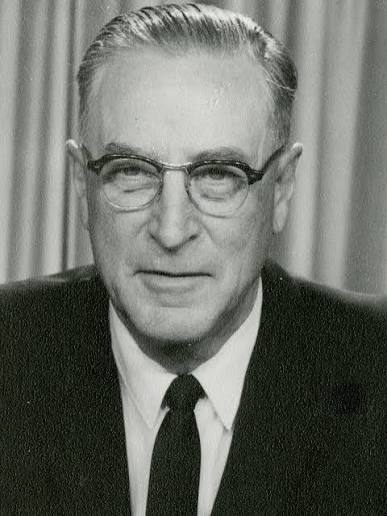
Milton Young in his early years in the Senate.
Although for much of its history, like today, North Dakota was dominated by the Republican Party, what it meant to be a Republican varied. This variation first came to pass with the establishment of the Non-Partisan League in 1915 by Arthur C. Townley, a man who had previously run for public office as a member of the Socialist Party. The Non-Partisan League constituted the progressive wing of the state’s Republican Party, while its conservative counterpart, established in 1918, was the Independent Voters’ Association. For a while, the Non-Partisan League had a major impact on the state’s GOP, indeed, progressive Republicanism had representation up until the late 1950s, concluding with the death of Senator William Langer in 1959. Milton Ruben Young (1897-1983) was among the leaders of the movement against the Non-Partisan League, which dominated the GOP during the Great Depression. Young would in retrospect describe the Non-Partisan League as “too far out. They had some socialists in there. That’s what turned me the other way” (Jacobs). Young, who was a farmer like many in his state, had held public office since 1924 and in 1932 was elected to the state House, followed by the state Senate in 1934, where he would serve as majority leader from 1943 to 1945 and co-founded the Republican Organizing Committee. He successfully managed the campaign to elect Fred Aandahl governor in 1944, taking control of the state Republican Party from the Non-Partisan League. Aandahl represented a conservative change in the Republican leadership of the state, and Young would soon himself politically benefit from this success. That year, non-interventionist Senator Gerald Nye lost reelection to Democrat John Moses. There were several things going on here. First, conservative critics of the New Deal had not forgotten Nye’s earlier votes in favor. Second, Moses was considered a conservative Democrat. And third, a third party candidate, Lynn Stambaugh, had entered the race. Third party candidates tend to harm the incumbent more often than harm the challenger. However, John Moses only lived two months in office; rumors of his ill health had plagued his campaign and they had turned out to be true. A special election was held to determine who would serve the rest of the term. Governor Aandahl tapped Young to serve, and he won the June 25, 1946 special election to serve the rest of the term, in part by forming a temporary alliance with his old rival, Langer.
Unlike Langer, Young was not a die-hard non-interventionist and supported aid to Greece and Turkey as well as the Marshall Plan. He supported tax reduction and the Taft-Hartley Act during the 80th Congress, and he considered himself to be “slight to the right of center” (Jacobs). On major, attention-grabbing issues, Young’s record was more conservative, but on certain more under-the-surface issues, he proved one of the less conservative Republicans; if Republicans opposed a policy he considered beneficial to his state, he’d vote for the policy. Indeed, Young regarded himself as a farmer first and a Republican second. Although not flamboyant like Langer and not a skilled speaker, he was no less of a skilled politician. One cause he took up that was non-ideological was the restoration of Ford’s Theatre.
Restoring Ford’s Theatre
Soon after joining the Senate, Young visited Ford’s Theatre, the site of the Lincoln assassination, and noted its dire state of disrepair. He thus championed the cause of restoring and preserving Ford’s Theatre. In 1955, Young sponsored legislation signed into law to study its restoration, and funding for its restoration came in 1964. In 1981, Young was awarded the first Ford’s Theatre Lincoln Medal for his efforts.
The 1950s and 1960s
In 1952, Young caused a minor controversy within his party when he announced that if Senator Richard Russell (D-Ga.) won his party’s nomination that he would support him for president. Russell did not win his party’s nomination, thus Young supported Eisenhower and this little entertaining of voting for a Democrat for president never harmed Young’s career in North Dakota. Indeed, Russell was a conservative Democrat and North Dakota farmers knew that Young was a foremost advocate for them, to the degree that he was known as “Mr. Wheat” for his commitment to making sure that federal policy on wheat, the state’s leading crop, was favorable to the state’s farmers. Indeed, Young himself revealed the secret to his success, “I have always tried to stay close to the people. In North Dakota to be elected and to stay on, you have to know the farmers and stay close to them. They are loyal to a fault” (Hill). This being said, he had some differences with President Dwight Eisenhower. He opposed Ike’s agricultural policy, which was free-market oriented, and he opposed his increases in foreign aid. Young also voted against the censure of Joseph McCarthy, something the White House had been supporting behind the scenes. On anti-communism, Young supported domestic measures, including keeping the student loyalty oath and state anti-subversive laws.
Young’s exceptions in conservatism for agriculture, although not registering much in how the liberal Americans for Democratic Action viewed him, they did harm his standing with the conservative Americans for Constitutional Action, which in this author’s opinion, was correct in not exempting economic controls on agriculture from evaluating political ideology. Young differing from his party was especially clear on the subject of agriculture. In 1962, he was the only Senate Republican to support the initial version of the Food and Agriculture Act which contained supply management controls and was defeated in the House. Young also opposed Republican efforts to block sales of wheat to the USSR and Hungary facilitated by the Export-Import Bank in 1963. His dissents from conservative positions made him a target of invective from members of a new organization: the John Birch Society.
In 1961, the North Dakota House voted to ratify a Constitutional amendment known as the “Liberty Amendment” backed by the Committee for Economic Freedom, which was endorsed by the John Birch Society and if enacted would have repealed the 16th Amendment (income tax) and ended the Federal Reserve as well as numerous federal agencies, including some that helped North Dakota farmers and veterans (Baker). Young, alarmed by this amendment, wrote to several state senators advising against this amendment, and it was defeated. He did not know it then, but he had crossed the John Birch Society and its members and he started receiving a stream of hostile letters. After researching the John Birch Society, in March 1961 Young read a report on the John Birch Society on the floor of the Senate and denounced them as well as Robert Welch’s assertion that former President Eisenhower was a “dedicated conscious agent of the Communist conspiracy” (Baker). Responses were militant. One voter from Blue Grass wrote him, “I will take it up with our Liberty League board, and see if we will circulate petitions to have you recalled from office, impeached or indicted for treason” (Baker). However, Young was both renominated and reelected in 1962. The John Birch Society was also opposed to civil rights legislation, but was Young as well?
Young and Civil Rights
Milton Young’s record on civil rights was a bit mixed; while he was one of only two Senate Republicans on record against the 24th Amendment banning the poll tax in federal elections, he voted for the Civil Rights Act of 1964 and the Voting Rights Act of 1965. On the former, he supported retention of the provision against discrimination in public accommodations but voted to strike the employment discrimination section. While he voted for the Civil Rights Act of 1957, Young also supported two key limiting amendments; the Kefauver-Church-O’Mahoney Jury Trial Amendment and the Anderson-Aiken-Case Amendment to bar federal initiation of 14th Amendment lawsuits. He was less favorable to the Great Society.
The Great Society
Milton Young was opposed to most Great Society legislation, including the Economic Opportunity Act, Medicare, and federal aid to education. He also supported Constitutional amendments to counter Supreme Court decisions on school prayer and legislative reapportionment. However, he did support the Demonstration Cities and Metropolitan Development Act in 1966 and supported lowering the minimum age to receive Social Security in 1967. However, during the Johnson Administration his primary dissents from conservatism were as they had been before, on agricultural policy.
Other Issues
On social issues, Milton Young was the usual conservative in supporting school prayer and the death penalty while opposing busing and abortion. On treaties, although he supported a reservation to the Partial Nuclear Test Ban Treaty in 1963, he did vote for the treaty, but also opposed the 1967 Consular Treaty. Young was also supportive of conservative policies regarding oil, including development of the Alaska Pipeline in 1973 and lifting price controls on oil. On organized labor, Young was not reflexively opposed to their positions; although he voted against the proposed repeal of the “right to work” clause of the Taft-Hartley Act in 1965 and against the Common Site Picketing bill in the 1970s, he had voted against all major anti-organized labor amendments in the 1958 debates on labor reform but had supported most of the major ones in 1959, with the exception of requiring unions to hold secret ballots before agreeing to a strike.
Young and Nixon
In 1968, it was speculated that liberal broadcaster Eric Sevareid might return home to North Dakota to run against Young. When asked about this possibility, Young responded, “What does Eric Sevareid know about wheat?” (UPI). He won easily his biggest reelection that year. In 1972, Young strongly supported wheat sales to Russia to reduce wheat surplus and to increase the price of wheat. He was also strongly supportive of Nixon Administration efforts to curb crime as well as his Supreme Court nominations. He stood in support of President Nixon’s policies on the Vietnam War up until 1973, when he voted to bar further funds for military action in or over Cambodia and Laos. Young also was consistently supportive of increasing military spending. Contrary to President Nixon’s position, he supported public funding of presidential campaigns in 1974.
Final Term
In 1974, Young faced a difficult reelection; he was 77 years old and had refrained from retiring as he didn’t like his most likely successor, Congressman Mark Andrews. His reelection was also difficult due to Watergate and his competitor being the popular Democratic Governor William L. Guy, but to dispel the age issue he had an ad filmed of him karate chopping a wooden board, and he was reelected, albeit by only 186 votes.
In his final term, Young contended with the Ford and Carter presidencies, where he continued his moderate conservatism. In 1977, he accommodated the Carter Administration in his vote to confirm Paul Warnke as the chief negotiator for the SALT II talks. However, Young also voted against the Panama Canal Treaties the next year. Despite that, he supported legislation implementing the treaties the following year. Young also supported Carter’s sales of military aircraft to Middle Eastern nations in 1978.
In 1979, Young announced that he would not be running for another term. To honor him, in 1980 he was allowed by the lame duck Democratic Senate to serve for one day as President Pro Tem. Young had been around so long that he was the last person born in the 19th century to serve in Washington D.C. Despite his dislike of Mark Andrews, he succeeded him in the Senate. Ideologically, differing perceptions of Milton Young are primarily dependent on the focus on agriculture. Young was willing to go rather liberal on the subject. While Young only sided with ADA 16% of the time from 1947 to 1980, ACA only found him in agreement with their positions 67% of the time from 1955 to 1980. Young’s DW-Nominate score of 0.172 is more in alignment with the view of ACA than ADA. Indeed, Young’s own self-assessment throughout his career, as well as him saying “I’m kind of a middle-of-the-roader myself”, lend credence to ACA and DW-Nominate’s interpretations of his record (Jacobs) Young subsequently retired to Sun City, Arizona, where he died of prostate cancer on May 31, 1983, at the age of 85. To this day, Young is the longest serving senator from North Dakota and at the time of his death was the longest serving Republican senator in history.
References
ADA Voting Records. Americans for Democratic Action.
Retrieved from
Baker, R. (1961, April 18). Senator Who Brought Birch Unit To Public Notice Fears Reprisal. The New York Times.
Retrieved from
Former Sen. Milton R. Young of North Dakota. (1983, June 1). UPI.
Retrieved from
https://www.upi.com/Archives/1983/06/01/Former-Sen-Milton-R-Young-of-North-Dakota-who/6524423288000
Hill, R. (2021, July 5). Milton R. Young of North Dakota. The Knoxville Focus.
Retrieved from
Jacobs, M. (1983, June 1). Sen. Milton Young dies in Arizona at 85. Grand Forks Herald, 1.
Retrieved from
https://www.newspapers.com/image/1134134962
Young, Milton Ruben. Voteview.
Retrieved from

