Today Florida seems like blood red Republican territory. However, it used to be even more solidly Democratic, and this was how it was when the state’s longest serving representative in history was elected to Congress. This man, who served 44 years in the House, was Charles Edward Bennett (1910-2003).
A lawyer by profession, Bennett gained prominence in his home of Jacksonville and was elected to the Florida House in 1941. However, the following year he resigned to serve in World War II, and in the process contracted polio, which paralyzed his legs for the rest of his life. He managed to walk with the assistance of canes, crutches, or leg braces. In 1948, Bennett challenged incumbent Emory Price of the 2nd Congressional district, based in Jacksonville, for renomination and won. This was tantamount to election in Florida at the time. Bennett was a moderate during the Truman Administration, sometimes going with and sometimes going against it. His record varied over his long time in Congress, at times being quite conservative and at other times being accommodating to the national Democrats.
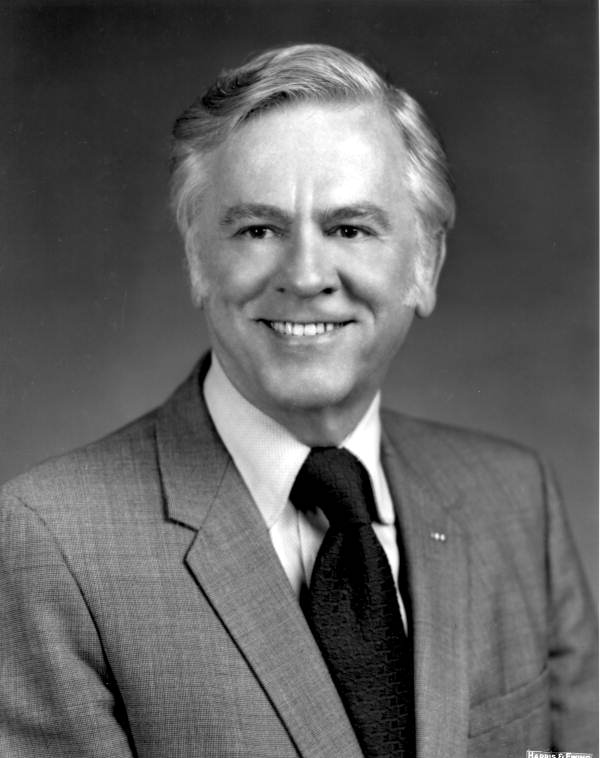
In 1955, Bennett sponsored the legislation that impacts what we see every day: adding “In God We Trust” on all currency, which was passed unanimously. He said of the legislation, ”In these days when imperialistic and materialistic communism seeks to attack and destroy freedom, we should continuously look for ways to strengthen the foundations of our freedom. At the base of our freedom is our faith in God and the desire of Americans to live by his will and his guidance. As long as this country trusts in God, it will prevail” (The New York Times).
Bennett’s record on civil rights was, save for his vote for the 24th Amendment in 1962 (banning poll taxes in federal elections), entirely one of opposition until his vote for the Voting Rights Act of 1965. His vote against the Civil Rights Act of 1964 and the Gulf of Tonkin Resolution he would later say were the two votes he regretted (Cirincione). For the duration of the Johnson presidency, Bennett was with the conservative wing of his party; he voted against key Great Society programs including the Economic Opportunity Act, Medicare, a permanent food stamp program, and federal aid to education.
In 1967, Bennett sponsored legislation creating the House Ethics Committee. However, he would be denied its chairmanship multiple times, and would only serve a term as its chair in the 96th (1979-1981) Congress. He was known as “Mr. Clean”, and his reputation for ethics went untarnished in his long career. Bennett would not take contributions or private gifts from defense contractors. Although certainly his clean reputation was appreciated by many, some fellow legislators thought he was a bit uptight. As the 1980 edition of The Almanac of American Politics described him, “He opposes unofficial office accounts, outside income for members and congressional pay raises, which led one colleague to call him ‘a bit too pious.'” (The Jacksonville Times-Union) Indeed, his reputation for ethics also came with a reputation for diligence and hard work. Late in his career, he described himself thus, ”I’m not a brilliant person. I do produce some good legislation. But I’ve never been accused of being a genius. But I feel that being there and making the vote is my duty and responsibility” (The New York Times). And indeed, Bennett was sure to be there…for his entire career, he never missed a roll call vote.
Although Bennett’s district overtime started voting for Republican candidates for president, he was sufficiently popular to continue to handily win reelection, and often did support the positions of President Richard Nixon. However, Bennett did dissent from Nixon on some issues; in 1971 he began differing with the Nixon Administration on Vietnam, supporting proposals for a timetable for withdrawal. Bennett also could vote the liberal position on environmental issues, siding with environmentalists against the construction of the Alaska pipeline in 1973. Indeed, Bennett prized conservation and his efforts resulted in the creation of several environmental reserves. On social issues, he was broadly conservative, opposing busing to achieve desegregation, supporting the death penalty, and a school prayer amendment. In 1977, Bennett suffered a tragedy when one of his sons, Charles Jr., died of a drug overdose, which got his focus on combating illegal drugs. However, he softened up a bit on his opposition to some social programs; in 1971 he supported the creation of a national childcare system, but this was ultimately vetoed by President Nixon. Bennett also supported the creation of the Legal Services Corporation in 1974. On foreign policy, Bennett was often skeptical of foreign aid and in 1979 opposed implementing the Panama Canal Treaties.
During the 1980s, he was a prominent skeptic of President Reagan’s military buildup, and opposed the Strategic Defense Initiative, the B-2 Bomber, and the MX Missile. Bennett had previously supported certain military expenditures, such as the B-1 Bomber and the Neutron Bomb. Despite this, Bennett was passed up for chairmanship of the House Armed Services Committee in 1985, the post going to Les Aspin (D-Wis.),who had a strong record as a skeptic of high defense spending. Defense policy was not his only difference with Reagan; he also voted against his tax reduction proposal in 1981. However, Bennett could justify this on his personal sense of fiscal conservatism, and in 1982 he sided with the Administration in support of a Balanced Budget Amendment to the Constitution. His record, particularly in the second half of the Reagan presidency got more liberal, more in accord with national Democrats but on social issues he largely remained conservative. In 1990, Bennett was one of the champions of the Americans with Disabilities Act. In 1992, although he initially sought to run for another term, he opted to retire after his wife suffered a stroke. Bennett’s lifetime scores by the conservative Americans for Constitutional Action and the liberal Americans for Democratic Action are almost the inverse of each other; 62% and 39% respectively. His DW-Nominate score is a -0.088, which is high for a Democrat.In 2002, his health deteriorated due to a heart attack and stroke and he died on September 6, 2003 at the age of 92. Bennett is without doubt among the most honorable of the politicians that the public has sent to Washington.
References
ADA Voting Records. Americans for Democratic Action.
Retrieved from
Charles E. Bennett: A noble life. (2003, September 9). The Jacksonville Times-Union.
Retrieved from
Bennett, Charles Edward. Voteview.
Retrieved from
https://voteview.com/person/633/charles-edward-bennett
Cirincione, J. (2003, November 6). An American Patriot. Carnegie Russia Eurasia Center.
Retrieved from
https://carnegieendowment.org/russia-eurasia/research/2003/11/an-american-patriot
Files, J. (2003, September 10). Charles E. Bennett Dies at 92; Put ‘In God We Trust’ on Bills. The New York Times.
Retrieved from

