There was a sort of progressivism that in many ways would be alien to modern people who identify themselves as “progressive”, and this was the early 20th century progressivism, especially that of the South. Despite the South’s current reputation for conservatism, progressive politics far from skipped the region, and one of the region’s foremost advocates was Georgia’s Michael (Hoke) Smith (1855-1931).
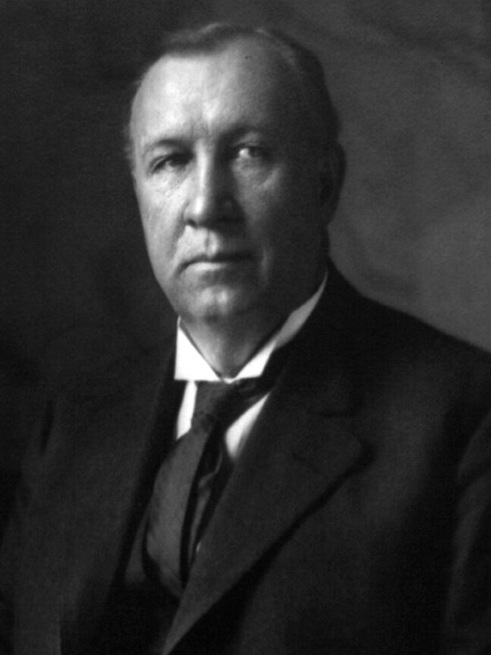
An attorney by profession, Hoke Smith’s lucrative injury law practice in which he represented clients against railroad companies got him money and influence, and in 1887, he purchased The Atlanta Journal, and grew the paper into an influential publication. His successful running of the paper as well as the paper’s advocacy for Grover Cleveland and his tariff reform proposals in 1888 elevated his national profile. Smith also played a major role in lining up the Georgia delegation to the Democratic National Convention behind Cleveland in 1892, and after his victory he awarded Smith with the post of Secretary of the Interior in 1893. In this role, he was placed in charge of reforming the pension system for Union veterans, which had grown bloated. In 1896, Smith, who was supportive of gold like Cleveland, opposed William Jennings Bryan’s candidacy for the Democratic nomination, but after his win he supported his candidacy out of a sense of duty to support the Democratic candidate.
Smith continued to use The Atlanta Journal to advance his beliefs, and among other causes he pushed for railroad regulation, countering trusts, ending the convict leasing system, and white supremacy. In 1904, he condemned the Roosevelt Administration and the GOP on race, stating,
“The attitude of the Republican Party and its candidate for President threatens the peace and tranquility of a great section of the United States known as the South. This section was already confronted with a serious problem, the presence of 8,000,000 negroes, the large majority of whom need direction in their daily walks of life from their white neighbors. This daily aid is required on account of the superior qualities of the white race. Any effort to force equality will necessarily injure the negroes as well as disorganize the relations under which the agricultural and commercial growth of the South must take place.
Under the wise Administrations of Cleveland, Harrison, and McKinley each day brought new evidence that the problem of two different races living side by side was being handled wisely and justly by the stronger race freed from outside interference. As one of the proofs of this fact it may be mentioned that the white people of the South have paid by voluntary taxes on their property over $100,000,000 for the education of negro children. The harm already accomplished by Roosevelt and the Republicans is serious. The South is contributing a full part of the commercial growth of the country. A blow against our section injures all sections. We should especially ask those interested in Southern investments to reflect upon this situation before they give approval to the present course of the Republican Party and its candidate for President” (The New York Times).
In 1906, Smith ran for governor of Georgia, and secured the support of the Populist leader Tom Watson by running a white supremacy campaign and promising to disenfranchise blacks, although it is true that Clark Howell, his main opponent in the Democratic primary, was also running a white supremacy campaign. His rhetoric as well as that of others, numerous publicized allegations of black men sexually assaulting white women, and the generally heated racial atmosphere set the stage for the 1906 Atlanta Race Massacre, in which thousands of whites attacked black residents, homes, and businesses for three days, resulting in the killings of dozens of blacks and injuries of scores more. The entrance of state troops to counter the massacre as well as heavy rainfall resulted in its end.
As governor, Smith abolished the convict leasing system and took the lead in trust-busting, becoming known as the “trust-busting Georgian” (The New York Times, 1931). Although the end of the convict leasing system was a good development for blacks, it was replaced with the state-run chain-gang system of forced prison labor which also was ripe for abuse and brutality. He also formally instituted the disenfranchisement of blacks and instituted the “grandfather clause” exemption to literacy tests. However, the latter would be struck down by the Supreme Court as unconstitutional. The Southern form of progressivism practiced by Smith and others at the time was put best by historian C. Vann Woodward, “progressivism for whites only” (Lerda, 72). In 1908, Smith had a setback when Watson switched his political support to Joseph M. Brown, who had been removed from the State Railroad Commission by Smith after he voted against his passenger railroad rate cut, over Smith’s refusal to commute a death sentence of one of his supporters. Brown won the primary but in 1910, Smith defeated Brown and once again was governor. However, Senator Alexander Clay’s death in 1910 resulted in the elevation of former Governor Joseph M. Terrell, however, Terrell was badly compromised in his effort to serve out the remainder of Clay’s term after having suffered a paralyzing stroke, and the state legislature chose Smith to serve. Smith decided not to immediately take the office of senator, choosing to finish his agenda before doing so, which included creating the Department of Commerce and Labor and the state Board of Education, a lobbying curb, and placing a maximum work week of 60 hours for textile workers (Maysilles).
As senator, Smith had several accomplishments, including the Smith-Lever Act in 1914 and the Smith-Hughes Act in 1917 and backed much of Wilson’s New Freedom agenda. He was also one of the most racist senators; he, Mississippi’s James K. Vardaman, and South Carolina’s Ben Tillman refused to support nominations of any blacks except for Ambassador to Liberia, which helped sink the nomination of Adam Patterson for the Register of the Treasury, a position that was reserved for blacks under previous post-War of the Rebellion administrations. However, he had an independent streak and proved a bit more conservative than you might expect given his time as governor. For instance, Smith supported Senator Lodge’s (R-Mass.) reservations to the Versailles Treaty and defended civil liberties during World War I, most notably with his vote for the France Amendment in 1918 to protect telling the truth with good motives from government censorship. In 1920, Smith faced a strong challenge in the primary from Tom Watson, who interestingly was running on a platform critical of the Wilson Administration and in opposition to the League of Nations. He also pushed anti-Catholicism, and won the primary, tantamount to election in the uniformly Democratic Georgia. Although Tom Watson was not a preferable replacement for Smith on racial issues for blacks, they nonetheless were pleased to see Smith defeated. Smith’s DW-Nominate score stands at -0.234.
Smith died on November 27, 1931 at 76, being the last survivor of President Cleveland’s cabinet. Governor Franklin D. Roosevelt of New York, closely connected to Georgia by his Warm Springs residence, later known during his presidency as the “Little White House”, stated on his death, “I am deeply distressed to hear of the passing of my old and close friend, Hoke Smith. I first knew him when I was a very small boy, when he was in President Cleveland’s Cabinet. His was a distinguished career and Georgia loses a great citizen” (The New York Times, 1931). Indeed assessments of him were good on the time of his death, but his leading role in the disenfranchisement of black voters and his capitalizing on racism to win public office mar his legacy and have only aged worse over time.
References
Hoke Smith is Dead. (1931, November 28). The New York Times.
Retrieved from
Hoke Smith on Race Issue. (1904, October 4). The New York Times.
Retrieved from
Lerda, V.G. (2000). Southern Progressivism in Historical Perspective: the 1890s and the 1990s. RSA Journal, 11.
Retrieved from
Maysilles, D. Hoke Smith. New Georgia Encyclopedia.
Retrieved from
Smith, Hoke. Voteview.
Retrieved from

