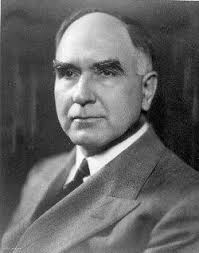
Rural Ohio is not generally known as a friendly place for liberalism, but during the New Deal, it certainly was, and Roosevelt was popular in many rural places in his first term, Marion, Ohio, included. However, Roosevelt’s popularity was taxed by the Roosevelt recession and the perception that he was trying to become a dictator through certain power-grabbing pushes as the “court packing plan” and his 1938 executive reorganization that got defeated by Congress. In this political context, Republicans came back in the North, and Frederick Cleveland Smith (1884-1956) of Marion was among them. Smith had served as mayor of Marion from 1935 to 1939 and had been a practicing osteopathic physician since 1908. Although Marion’s history was largely Republican, it was possible for Democrats to win there for a while, and the Democrat he defeated for reelection by nine points, Thomas B. Fletcher, had in total represented the district for ten years, from 1923 to 1927 and from 1933 to 1939.
Smith vs. The New Deal
Smith was a dedicated, uncompromising opponent of the New Deal and its works. So known he was for this that the press dubbed him “No No Smith”, which he enthusiastically embraced (The Marion Star). Had he served in the future, he would have definitely been nicknamed “Dr. No”. The liberal Union for Democratic Action identified Smith as among the obstructionists they wanted defeated in the 1942 election, profiling him thusly, “His isolationist position extends back to the last war, and his anti-New Deal position extends back to its beginning. Smith thinks of himself in the old Ohio Republican tradition of McKinley and the rest and holds what might be called a McKinley gold bias. He votes regularly in the interest of the private-power companies and thus to the benefit of his friends in the Marion Reserve Power Company. He operates the Smith Clinic for male diseases, which is not looked upon without criticism by other members of the Ohio medical profession. He finds time in the Congress to introduce numerous measures for the benefit of Dr. Tucker’s Asthma Specific, a patent medicine made in his district which has had difficulties because of the pure-food-and-drug laws” (The New Republic, 710). In 1939, Smith introduced a bill to exempt a Mount Gilead, Ohio, laboratory from an incoming pure food and drug law against mail prescribing. He spoke on behalf of the medicine’s effectiveness as did numerous other members of Congress, stating, “A Food and Drugs Act passed last year would compel firms of this sort to cease prescribing by making a diagnosis through the mails….I have practiced medicine for a good many years and have myself prescribed this remedy many times….I know physicians who use it themselves. Just before I left for Washington one of my colleagues told me he hoped they would not take this remedy away from the people. This colleague of mine has since died. He used this remedy himself [laughter]—not from the remedy” (Time Magazine). Smith was such a pain for Union for Democratic Action that they found absolutely nothing to like about his record from 1939 to 1945. However, its successor organization, Americans for Democratic Action, would find him siding with their positions 13% of the time from 1947 to 1950, although this is due to him objecting to certain measures not being strong enough from a conservative standpoint. On civil rights, you might think that Smith was also simply also a no-man, but this wasn’t necessarily so; he voted for the 1940 anti-lynching bill and for the 1946 anti-segregation Powell Amendment to that year’s school lunch bill. However, he also paired against the 1949 bill banning the poll tax.
Smith vs. Internationalism
Smith compromised no more, and arguably even less, with the Roosevelt Administration on foreign policy than he did on domestic policy. Not only did he join the majority of Republicans in opposing Lend-Lease in 1941, he was also one of 55 representatives to vote against the first appropriation, which had attracted a lot more Republican support as it was a vote on simply aiding Britain rather than granting new powers to the Roosevelt Administration. During World War II, Smith voted against Lend Lease appropriations despite them getting near unanimous support. In 1943, he was one of 29 representatives to vote against the Fulbright Resolution, an official statement of the House in favor of the formation of a United Nations. Smith argued against it thusly, “I am impelled to vote against the Fulbright resolution that Congress favor the setting up of international machinery with power to establish and maintain peace among the nations of the world. It seems to me the lower House is attempting here to perform a function which does not properly belong to it. The subject matter of this resolution deals specifically with treaties. The Constitution definitely vests in the President the “power to make treaties,” but only “by and with the advice and consent of the Senate, provided two-thirds of the Senators present concur.” I think this is sufficient reason for voting against this resolution” (Congressional Record, 7708). Smith would not change with the end of World War II, and voted against aid to Greece and Turkey in 1947 and the Marshall Plan in 1948.
Smith vs. The Majority
If there were a small minority of conservatives taking a position, chances are really good Smith was among them, and on occasion voted against major GOP legislation as he thought it too accommodating to the New Deal, such as with the House version of the Taft-Hartley Act (he had previously voted for other bills curbing organized labor). Some examples of his dissents include:
On March 10, 1943, Smith was one of 6 representatives to oppose extending Lend-Lease for one year.
On May 21, 1943, Smith paired against Lend-Lease funding, a measure that 4 representatives voted against.
On April 19, 1944, Smith was one of 21 representatives to vote against extending Lend-Lease for one year.
On December 18, 1945, Smith was one of 15 representatives to vote against appointing representatives to the UN and its organizations.
On March 7, 1946, Smith was one of 24 representatives to vote against a housing bill that was considerably compromised in its liberalism by conservative limiting amendments, including his own to limit the power of the housing expediter.
On April 2, 1946, Smith was the only representative to vote against a bill for temporary additional compensation for postmasters and employees of the postal service.
On April 18, 1946, Smith was one of 20 representatives to support a motion to recommit the price control bill to immediately end all controls.
On August 7, 1948, he was one of 9 representatives to vote against the resolution considering accepting the Senate amendment to that year’s housing bill.
On August 11, 1949, he paired against a compromised increasing of the minimum wage, which 35 representatives voted against.
On December 5, 1950, he paired against extending the excess profits tax, which 20 representatives voted against.
Congressman Smith did on a few occasions vote against nearly all Republicans in the 80th Congress, but this was out of a refusal to accept compromise, such as his vote against the Wolcott Housing Bill in 1948, which did not include any public housing and a vote for was considered by the liberal Americans for Democratic Action against their position.
In 1947, Smith’s health began to decline, which resulted in frequent absences that year and in 1949 and 1950. Reading the writing on the wall by 1950, he opted to retire. In his retirement announcement, he stated, “I wish to announce that I shall not seek the nomination for re-election to Congress at the coming primary, and want to take this opportunity to than the citizens of this Congressional District, the 8th Ohio, for the splendid cooperation and loyal support they have given me throughout all the years of my service in striving to stop the growth of political power, which I have always regarded as Communism, or dictatorship by another name. To the extent that my health permits I shall, during the remainder of my term, continue to pursue the same course as I have in the past, perhaps stressing more than I have heretofore, if that be possible, the gravity of the situation that now menaces the way of life our fathers bequeathed us” (The Marion Star). He was among the representatives that anarcho-capitalist theorist Murray Rothbard (1950) was sad to see leave and his DW-Nominate score was a whopping 0.92, making him the most conservative individual to serve during the Roosevelt Administration per that measurement. His health continued to decline after his retirement and he died on July 16, 1956, at the age of 71 at Marion General Hospital.
References
A Congress to Win The War. (1942, May 18). The New Republic.
Retrieved from
https://archive.org/details/cainmnh_000157/mode/2up
A Congress to Win the War and the Peace. (1944, May 5). The New Republic, 110 (19), 643-58.
Retrieved from
https://www.newspapers.com/image/1143419115
ADA Voting Records. Americans for Democratic Action.
Retrieved from
Cong. Smith Not to Seek Re-Election. (1950, January 5). The Marion Star, 1.
Retrieved from
https://www.newspapers.com/image/293277002/
Medicine: Balm of Gilead. (1939, April 30). Time Magazine.
Retrieved from
https://time.com/archive/6760484/medicine-balm-of-gilead
Participation in World Peace. (1943, September 21). Congressional Record, 7705-7729. Washington, D.C.: Government Printing Office.
Retrieved from
https://www.congress.gov/bound-congressional-record/1943/09/21/house-section
Patton, J.G. & Loeb, J. (1945, February 5). Challenge to Progressives. The New Republic, 112 (6), 21-42.
Retrieved from
https://www.newspapers.com/image/1143339882
Rothbard, M. (1950, November 15). Rothbard on the Elections. LewRockwell.
Retrieved from
Smith, Frederick Cleveland. Voteview.
Retrieved from

