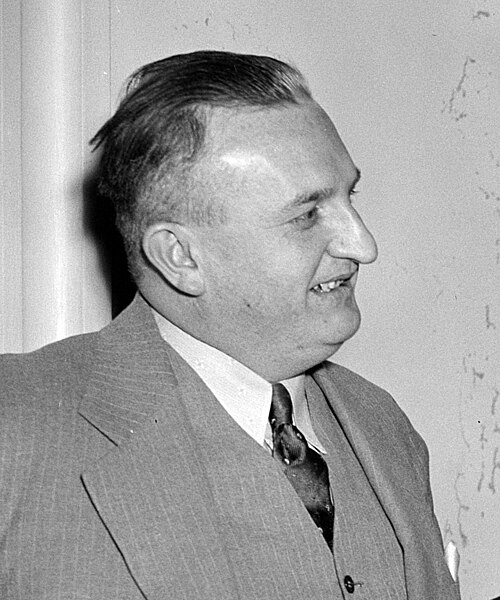
Today, Washington is regarded as among the most liberal states in the nation. Indeed, according to the most recent Cook Partisan Voting Index, the state is the 6th most Democratic in the nation. The last time the state voted for a Republican governor was in 1980, the last time for a Republican for president was in 1984, and the last time its people voted for a Republican senator was 1994. The election of Katie Wilson as Seattle’s mayor has far from lessened its reputation and However, is this the most liberal period in the state’s history? Perhaps not…and one of the foremost representatives of the state’s strongly liberal politics during the Roosevelt Administration was John Main Coffee (1897-1983).
Coffee’s involvement in politics began when he came to work on the campaign of Democrat Clarence Dill in 1922, who was running against progressive-turned-conservative Republican Miles Poindexter. 1922 was a good year for Democrats and Poindexter’s pronounced shift to the right was not appreciated by voters, thus Dill won. He subsequently worked as Dill’s chief of staff. He ultimately decided to return to Tacoma to pursue a legal career. Although Republicans dominated Washington’s politics during the 1920s, the Great Depression brought about a massive change of fortune for Democrats, and Coffee was active in the implementation of the New Deal in Washington, serving as secretary for the Advisory Board of the National Recovery Administration and served as the appraiser for the Pierce County State Inheritance Tax & Escheat Division (Hill). A greater opportunity would come for him by 1936.
On January 10, 1936, Congressman Wesley Lloyd of Tacoma died suddenly of a heart attack. In his place, Coffee was elected to Congress as a staunch supporter of the New Deal. Roosevelt sailed to a landslide victory as did Coffee. As a member of Congress, Coffee was firmly in support of organized labor, more New Deal programs, the Fair Labor Standards Act, and civil rights legislation. Believe it or not, the latter was not a guarantee for Washington Democrats to support at the time; Charles Leavy of the 5th district twice voted against anti-lynching legislation and Knute Hill of the 4th supported the 1937 bill but opposed the 1940 bill. The only area on domestic legislation in which he dissented from the liberal line occasionally was in regard to agriculture. Although much of the nation shifted to the right in the 1938 midterms, Coffee and other Washington Democrats sailed to reelection. He represented a district in which unions were strong and his constituents loved the New Deal. Coffee was unfailing in his defense of the power of organized labor that had been established with the Wagner Act and stood as a strong opponent of the Dies Committee, which was primarily investigating communism and communists in the United States. For a time, the most significant organization within Washington’s Democratic Party, and one that was backing Coffee, was the Washington Commonwealth Federation (WCF), which had become increasingly communist-dominated after 1938 when numerous non-communist members departed in opposition to communist influence. Some leaders of the group included Hugh De Lacy, a secret communist who would serve in the House during the 79th Congress (1945-1947) and executive Secretary Howard Costigan, who had secretly joined the Communist Party after the WCF lifted the ban on membership. Such men pushed to align WCF’s stances with those of the Communist Party, and by extension with Moscow. Coffee would have a long record of opposing domestic anti-communist measures, and although he was not among the four representatives to vote against the Smith Act (Alien Registration Act) on final passage, he was one of 48 to vote to recommit the bill without instructions (thus killing it) on July 29, 1939.
Non-Interventionist
Although left-wing domestic policies were popular in Washington during the Roosevelt Administration, Washingtonians were not as pro-Administration on foreign policy. Although Coffee voted for repealing the arms embargo in 1939, he voted against the peacetime draft in 1940, against Lend-Lease in 1941, against extending the peacetime draft, and against the repeal of the bar on U.S. ships entering belligerent ports. Something to bear in mind is that the WCF had been following the Soviet line on foreign policy, thus after the 1939 Molotov-Ribbentrop Pact, they were pushing messaging that FDR was a warmonger for trying to get involved. This messaging promptly changed after Operation Barbarossa, in line with Moscow. After Pearl Harbor, Coffee was once again in near full accord with liberal opinion. In the 78th Congress, Coffee did not differ from the position of Union for Democratic Action at all, and the only dissents he had had with them before were on foreign policy.
In 1944, Coffee read excerpts on the floor of the House from love letters Connecticut businesswoman and tax protestor Vivien Kellems had written to Count Friedrich Carl von Zedlitz in Argentina, who was on a British blacklist and suspected of being a Nazi agent. He charged, “Miss Kellems poses as a patriotic citizen and yet has consistently played the Nazi game. She is today giving aid and comfort to the enemy and is a tool of the Goebbels propaganda machine. ” (McLaughlin). Ultimately no charges came out of the allegation that her correspondence amounted to treason. That year, he won reelection resoundingly against Republican Thor Tollefson, prosecutor of Pierce County, by 23 points. However, the next two years would be rough on Coffee.
Charges of Radicalism and Corruption
Tollefson ran again, and during his campaign he accused Coffee of being a member of 28 communist front groups. To rebut the charge, Coffee claimed that former chairman of the House Committee on Un-American Activities, Martin Dies (D-Tex.), told him that he would go up to Washington to campaign for him. However, a Republican operative called Dies, and he stated that he strongly disagreed with his philosophy of government and would not campaign on his behalf (Hill). He also along with Congressmen Hugh De Lacy and Charles Savage had signed a letter in to Henry Wallace in praise of his pro-Soviet foreign policy views and urged him to come and speak in Washington, to which the conservative Spokesman-Review condemned them as the “three faithful who don’t deviate in their loyalty to Russia” (Hill). Maybe he could have survived this alone, but he was also dogged on ethics.
In 1945, Coffee came to the attention of the Mead Committee investigating wartime contract expenditures when contractor Eivind Anderson testified that he had received a no-bid war contract after making a contribution to Coffee’s campaign in 1941 that amounted to $50,000 when adjusting for inflation. Chairman Mead (D-N.Y.) publicly regarded this relationship as immoral, but clarified that no money had been lost towards the war effort (Hill). The statute of limitations on any charges that could have been brought against Coffee had expired, which although it kept him out of legal jeopardy, it also blocked him from having a shot at legally clearing his name. The mood of the nation, Coffee’s ethics baggage, and the nation turning increasingly against the USSR resulted in him netting 46% of the vote against Tollefson. Coffee’s DW-Nominate score is a -0.48, or strongly liberal.
Although Coffee attempted a comeback in 1950, Tollefson was now a popular representative who had a pro-union voting record and was of the moderate to liberal wing of the Republican Party, and he netted only 38.9% of the vote. He tried one more time to beat Tollefson, in 1958. This was an excellent year for Democrats and liberals in general, thus if there was a time for him to return, it would be now. However, he only netted 46% of the vote. Coffee’s political career was now undoubtedly over. Reporter Jack Pyle of Tacoma News Tribune summed up his situation after the 1958 election thusly, he was “unbeatable up to 1946, and unelectable after that” (Hill). Coffee would continue the practice of law until his death on June 2, 1983 at the age of 86.
References
Black, G., Salter, D., and Gregory, J. (2005). Who’s Who in the Communist Party of Washington. Communism in Washington State History and Memory Project.
Retrieved from
https://depts.washington.edu/labhist/cpproject/whos_who.shtml#
Coffee, John Main. Voteview.
Retrieved from
https://voteview.com/person/1899/john-main-coffee
Hill, R. (2025, May 4). John M. Coffee of Washington State. The Knoxville Focus.
Retrieved from
McLaughlin, K. (1944, April 1). Urges U.S. Study of Vivien Kellems; Coffee Says Tax Recalcitrant for Years Has Written to Nazi Agent in Argentina. The New York Times.
Retrieved from

