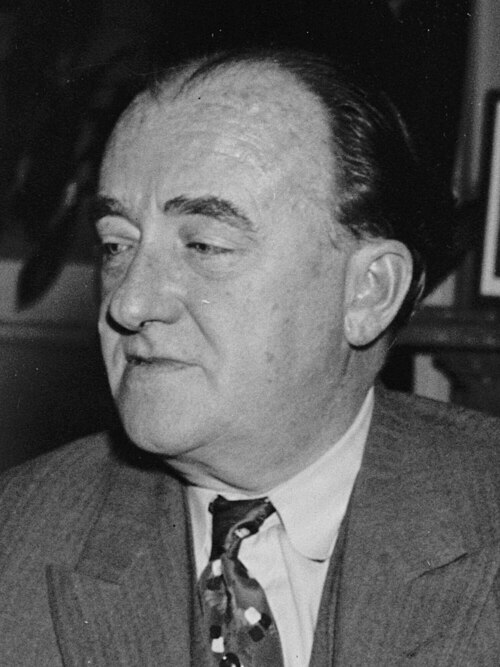
In 1934, Speaker of the House Henry T. Rainey of Illinois died, and taking his place was Rules Committee Chairman Jo Byrns of Tennessee. Because since 1910 the Speaker of the House was not allowed to simultaneously chair committees, this post went to John Joseph O’Connor (1885-1960) of New York City.
A lawyer by profession, O’Connor’s first public office was as State Assemblyman from 1921 to 1923, and he was then elected to Congress to fill the vacancy left by the death of William Bourke Cockran, who had been Winston Churchill’s American mentor who I’ve already covered. During the 1920s, there wasn’t much in O’Connor’s voting record that would indicate that he would give FDR problems, indeed he differed little from other New York Democrats in his voting behavior. O’Connor was a strong supporter of Al Smith for the 1928 election, and likewise backed Smith in 1932.
O’Connor backed all of the First 100 Days legislation, but a warning sign of difficulties ahead may have been his vote against the tax-raising Revenue Act of 1934. One of the issues O’Connor could have been considered conservative on was ironically one in which he was in accord with President Roosevelt; his votes against veterans bonus bills in 1934 and 1935.
The 74th Congress provided a lot of work for O’Connor, as not only was he the chairman of the Rules Committee, he also had to perform the duties of Majority Leader William B. Bankhead of Alabama for weeks at a time as he was in ill health. It turns out Speaker Jo Byrns of Tennessee was in poor health too, and he died in 1936. O’Connor was a major contender for majority leader, but two things went against him despite him being the brother of his former law partner and his insistence that he was a New Dealer: 1. O’Connor had fought against the “death sentence” clause of the Public Utilities Holding Company Act as too punitive, and 2. He was a Tammany Hall man. Sam Rayburn of Texas, by contrast, was not a Tammany Hall man and he sponsored the Public Utilities Holding Company Act. Rayburn won the post. The key to Rayburn’s victory was the votes of the Pennsylvania Democratic delegation, whose direction in this matter was determined by Senator Joseph Guffey, a staunch supporter of the New Deal. O’Connor was initially sour in defeat, remarking, “The country got along pretty well when there were no Democrats from Pennsylvania” (Time Magazine, 1936).
In 1937, O’Connor again irked FDR with his vocal opposition to the court-packing plan and in the following year he opposed his executive reorganization plan, which was killed in the House. These two issues, as well as the “Death Sentence” clause, were seen as part of the litmus test for loyalty to the New Deal program, and O’Connor was thus targeted for defeat. However, O’Connor had voted for most of the New Deal, and the highly esteemed Senator Robert F. Wagner, known as a New Dealer, had voted to kill the court packing plan and voted against the 1938 reorganization plan. Indeed, O’Connor’s record in most respects matched that of Wagner. One way he certainly stood out negatively for New Dealers was his lone stand among New York Democrats in his vote for an investigation into sit-down strikes in 1937. Although he was reported as in opposition to the Fair Labor Standards Act, none of his votes reflect this, including him voting against the successful motion to recommit the first version of the bill, which was stronger than the version that reached the president’s desk in 1938. In 1937, O’Connor called for a special session of Congress in the wake of the “Roosevelt Recession” for tax relief to restore business confidence and curb their fear of government. He stated, “We are picking on them, abusing them and snooping on them. Yet the only place anybody can get a job is from a private employer. The employers won’t do anything while living under the fear of the Government, with taxes, snooping and so on to harass them” (Pittsburgh Post Gazette). In 1938, he voted to strike a proposed excess profits tax from that year’s Revenue Act, but more Democrats than not voted to strike it too.
Roosevelt stated of him that he was “one of the most effective obstructionists in the lower house. Week in and week out O’Connor labors to tear down New Deal strength, pickle New Deal legislation” (The American Presidency Project). O’Connor protested that he had been a New Dealer and that the only vote he had cast against a major New Deal proposal was the executive reorganization bill (the court-packing plan didn’t come to a vote in the House). This protestation didn’t stop the Democratic base from heeding Roosevelt; he was the one major scalp that FDR got from his effort to purge his party of dissidents, getting his preferred man of James H. Fay, a World War I veteran who had lost his leg. O’Connor then switched parties and ran for reelection as a Republican but lost by five points…the party label mattered more than the man in 1938. Ironically, O’Connor’s insistence that he was a New Dealer had mostly been on point. He had supported all of the “First 100 Days” legislation, had voted for pretty much everything except the Revenue Act of 1934 and FDR’s 1938 reorganization plan. O’Connor even backed the final version of the Public Utilities Holding Company Act despite it containing the “Death Sentence” clause. Indeed, O’Connor’s obituary noted that he “had had a major hand in promoting much of the landmark legislation of the New Deal” (Daily Press). His ouster reminds me in some way of Liz Cheney’s 2022 ouster; she had voted most of the time with Republicans, its just that she crossed the head honcho, like O’Connor crossed the head honcho of his day. Indeed, although FDR identified O’Connor as one of the most effective “obstructionists”, his DW-Nominate score is a -0.466.
After his time in Congress, he resumed his legal career. O’Connor also supported America First causes and represented Rep. Hamilton Fish’s (R-N.Y.) aide, George Hill, when he was being prosecuted for perjury for claiming under oath that he didn’t have a role in a franking scheme with German propaganda agents George Sylvester Viereck and Prescott Dennett and that he didn’t know Viereck. O’Connor died while hospitalized on January 26, 1960. Of all FDR’s targets in the 1938 purge, O’Connor was easily the most ideologically loyal, but that he wouldn’t do everything FDR wanted was enough to get him the boot.
References
Democratic Leader Urges Quick Tax Cut as Job Aid. (1937, November 13). Pittsburgh Post-Gazette, 1.
Retrieved from
www.newspapers.com/image/88828479/
Excerpts from the Press Conference. (1938, August 16). The American Presidency Project.
Retrieved from
https://www.presidency.ucsb.edu/documents/excerpts-from-the-press-conference-104
Jury is Selected for Trial of Hill. (1942, January 8). The New York Times.
Retrieved from
O’Connor, John Joseph. Voteview.
Retrieved from
https://voteview.com/person/7018/john-joseph-o-connor
O’Connor, N.Y. Democrat Purged By FDR, Succumbs. (1960, January 27). Daily Press (Newport News, Va.), 20.
Retrieved from
http://www.newspapers.com/image/232265456/
The Congress: Differential Differences. (1938, May 8). Time Magazine.
Retrieved from
https://time.com/archive/6758874/the-congress-differential-differences
The Congress: Leader Apparent. (1936,December 13). Time Magazine.
Retrieved from
https://time.com/archive/6756388/the-congress-leader-apparent

