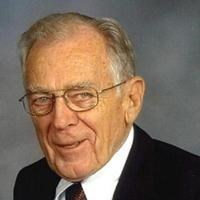
Dr. Lloyd W. Bailey (1928-2020), the Nixon elector who prompted the first Congressional vote to disapprove of an electoral vote cast.
Ever since the Electoral College was created, there have been numerous criticisms and real or possible pitfalls pointed out. Indeed, in my area, there are quite a few critics. One of the potential pitfalls are the electors themselves, and whether their votes will be in comport with the will of the people. I say for this one that it is a “potential” pitfall as no elector’s independent decision has changed the outcome of a presidential election. There have been a few famous instances of faithless electors as well as efforts to curb the phenomenon.
The 1968 election was a three-way race between Republican Richard Nixon, Democrat Hubert Humphrey, and American Independent George Wallace. Wallace had no realistic chance of winning the election, but he did have a chance of serving as kingmaker, and that is what his campaign was shooting for. Had Wallace been able to serve as a kingmaker, he could have extracted a pledge from the winning candidate that would have hindered the progression of civil rights in the South. The Wallace campaign got just a little closer to this potential outcome when Dr. Lloyd W. Bailey, an elector pledged to Nixon, cast his vote for Wallace. This had no chance of changing the election, and Bailey said that if his vote would have changed the election, he would have stuck with Nixon. This was a big news story at the time, and created the best political environment in history for the repeal of the Electoral College. At the start of 1969, Rep. James G. O’Hara (D-Mich.) filed the first ever objection to an electoral vote in history. Sen. Edmund Muskie (D-Me.) did likewise for the Senate. Their hope in this matter was to discourage future faithless electors by invalidating this vote and to uphold “the integrity of this election under the present system and to effectively dramatize the dangers of continuing to operate under this outmoded, haphazard and undemocratic method of electing a President” ( They had the backing of the chairman of the House Judiciary Committee, Emanuel Celler (D-N.Y.). He spoke in favor of the objection, stating, “Whether or not electors are pledged, whether or not they are named, whether or not their names appear on the ballot, whether or not the law provides sanctions if they should fail to vote in accordance with the electorate’s wishes, the universal – and I say “universal” – understanding in the United States today and in the 20th century particularly is that the electoral college exercises a ministerial, an agency function and effectuates the expressed wishes of the people. Indeed most electors consider themselves irrevocably committed to support the presidential candidate on whose ticket they were elected or on which they were elected” and concluded, “…I intend to support the proposed challenge to the vote cast by the elector from North Carolina. I do so recognizing that the disposition of this challenged vote will not affect the result of the presidential election. However, I believe it most appropriate and essential that the Congress give effect to the view now held by the overwhelming majority of our people that when the vote of an electorate is cast for President, it shall not be nullified or abrogated by any elector” (Congressional Record, 149). However, the ranking Republican on the House Judiciary Committee, William McCulloch of Ohio, was in opposition. He argued, “Today, the objectors ask us to circumvent the [constitutional] amending process. They ask us to do what we have criticized so often before—to read into the Constitution what we wish the law to be. . . . They ask us to adopt a view which not only differs from but which is diametrically opposed to the way the Constitution was written” and held that Congress should only engage in objections in instances in which two returns were received, such as in the 1876 election (U.S. House).
Congress voted on both the O’Hara and Muskie resolutions, but both failed, the O’Hara objection 169-229 and the Muskie objection 33-58. Interestingly, House Minority Leader Gerald Ford (R-Mich.) supported O’Hara’s objection, as did many Michiganders. Maine’s delegation joined Muskie in support as well.
The Ideology of the Vote
Nearly all of the most conservative members of Congress agreed with McCulloch’s objection and voted against. There were also, even more interestingly, some very liberal legislators who voted against the objection, such as California’s Philip Burton. However, the liberal Americans for Democratic Action considered voting for the objections to be the liberal position. All black politicians save for Senator Edward Brooke (R-Mass.), who happened to be the only black Republican legislator at the time, voted for the objection.
The vote is detailed here, with lifetime ACA agreement rates for legislators:
8/21/26 Correction: There were a few errors on the ACA scores in the O’Hara Elector Objection, which I have fixed.
References
Congress and the Case of the Faithless Elector. (2020, November 17). U.S. House of Representatives.
Retrieved from
https://history.house.gov/Blog/2020/November/11-17-Faithless-Electors
Counting Electoral Votes – Joint Session of the House and Senate Held Pursuant to the Provisions of Senate Concurrent Resolution 1. (1969, January 6). Congressional Record, 145-172.
Retrieved from
https://www.congress.gov/bound-congressional-record/1969/01/06/house-section
Counting of the Electoral Vote. (1969, January 6). Congressional Record, 197-246.
Retrieved from
https://www.congress.gov/bound-congressional-record/1969/01/06/senate-section

