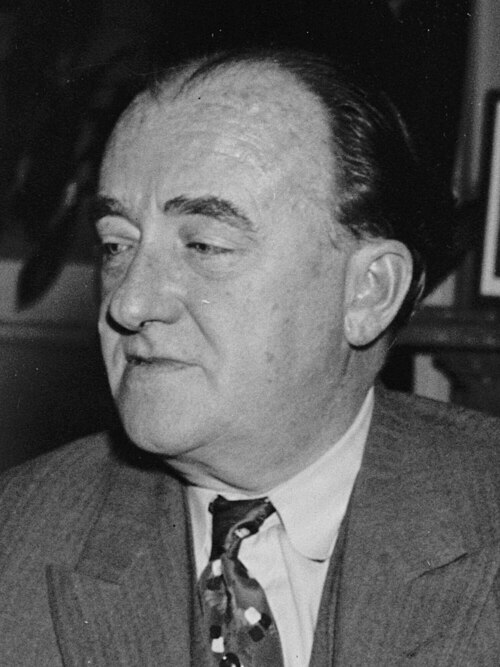
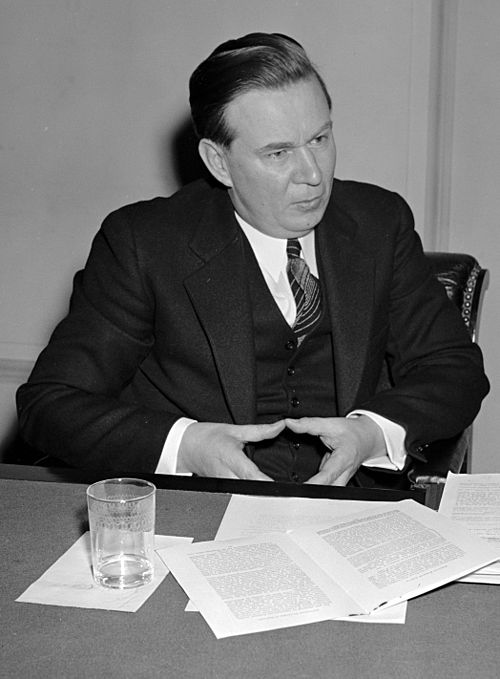
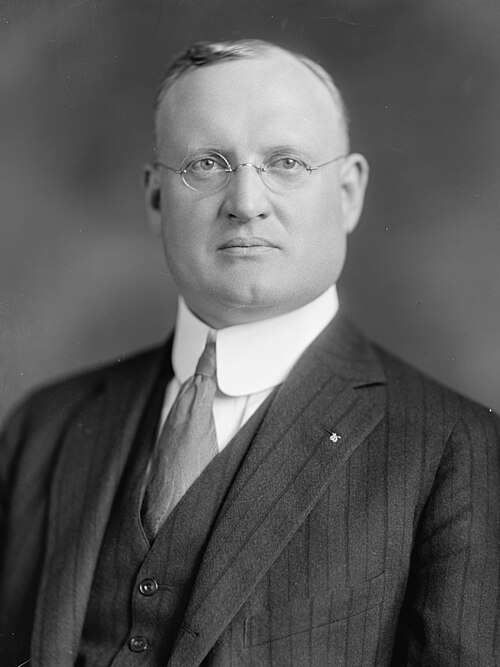
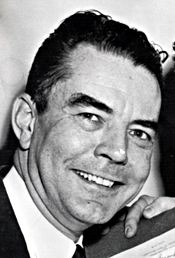
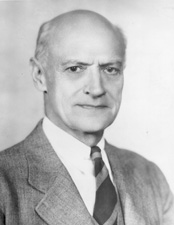
In 1934, Speaker of the House Henry T. Rainey of Illinois died, and taking his place was Rules Committee Chairman Jo Byrns of Tennessee. Because since 1910 the Speaker of the House was not allowed to simultaneously chair committees, this post went to John Joseph O’Connor (1885-1960) of New York City.
A lawyer by profession, O’Connor’s first public office was as State Assemblyman from 1921 to 1923, and he was then elected to Congress to fill the vacancy left by the death of William Bourke Cockran, who had been Winston Churchill’s American mentor who I’ve already covered. During the 1920s, there wasn’t much in O’Connor’s voting record that would indicate that he would give FDR problems, indeed he differed little from other New York Democrats in his voting behavior. O’Connor was a strong supporter of Al Smith for the 1928 election, and likewise backed Smith in 1932.
O’Connor backed all of the First 100 Days legislation, but a warning sign of difficulties ahead may have been his vote against the tax-raising Revenue Act of 1934. One of the issues O’Connor could have been considered conservative on was ironically one in which he was in accord with President Roosevelt; his votes against veterans bonus bills in 1934 and 1935.
The 74th Congress provided a lot of work for O’Connor, as not only was he the chairman of the Rules Committee, he also had to perform the duties of Majority Leader William B. Bankhead of Alabama for weeks at a time as he was in ill health. It turns out Speaker Jo Byrns of Tennessee was in poor health too, and he died in 1936. O’Connor was a major contender for majority leader, but two things went against him despite him being the brother of his former law partner and his insistence that he was a New Dealer: 1. O’Connor had fought against the “death sentence” clause of the Public Utilities Holding Company Act as too punitive, and 2. He was a Tammany Hall man. Sam Rayburn of Texas, by contrast, was not a Tammany Hall man and he sponsored the Public Utilities Holding Company Act. Rayburn won the post. The key to Rayburn’s victory was the votes of the Pennsylvania Democratic delegation, whose direction in this matter was determined by Senator Joseph Guffey, a staunch supporter of the New Deal. O’Connor was initially sour in defeat, remarking, “The country got along pretty well when there were no Democrats from Pennsylvania” (Time Magazine, 1936).
In 1937, O’Connor again irked FDR with his vocal opposition to the court-packing plan and in the following year he opposed his executive reorganization plan, which was killed in the House. These two issues, as well as the “Death Sentence” clause, were seen as part of the litmus test for loyalty to the New Deal program, and O’Connor was thus targeted for defeat. However, O’Connor had voted for most of the New Deal, and the highly esteemed Senator Robert F. Wagner, known as a New Dealer, had voted to kill the court packing plan and voted against the 1938 reorganization plan. Indeed, O’Connor’s record in most respects matched that of Wagner. One way he certainly stood out negatively for New Dealers was his lone stand among New York Democrats in his vote for an investigation into sit-down strikes in 1937. Although he was reported as in opposition to the Fair Labor Standards Act, none of his votes reflect this, including him voting against the successful motion to recommit the first version of the bill, which was stronger than the version that reached the president’s desk in 1938. In 1937, O’Connor called for a special session of Congress in the wake of the “Roosevelt Recession” for tax relief to restore business confidence and curb their fear of government. He stated, “We are picking on them, abusing them and snooping on them. Yet the only place anybody can get a job is from a private employer. The employers won’t do anything while living under the fear of the Government, with taxes, snooping and so on to harass them” (Pittsburgh Post Gazette). In 1938, he voted to strike a proposed excess profits tax from that year’s Revenue Act, but more Democrats than not voted to strike it too.
Roosevelt stated of him that he was “one of the most effective obstructionists in the lower house. Week in and week out O’Connor labors to tear down New Deal strength, pickle New Deal legislation” (The American Presidency Project). O’Connor protested that he had been a New Dealer and that the only vote he had cast against a major New Deal proposal was the executive reorganization bill (the court-packing plan didn’t come to a vote in the House). This protestation didn’t stop the Democratic base from heeding Roosevelt; he was the one major scalp that FDR got from his effort to purge his party of dissidents, getting his preferred man of James H. Fay, a World War I veteran who had lost his leg. O’Connor then switched parties and ran for reelection as a Republican but lost by five points…the party label mattered more than the man in 1938. Ironically, O’Connor’s insistence that he was a New Dealer had mostly been on point. He had supported all of the “First 100 Days” legislation, had voted for pretty much everything except the Revenue Act of 1934 and FDR’s 1938 reorganization plan. O’Connor even backed the final version of the Public Utilities Holding Company Act despite it containing the “Death Sentence” clause. Indeed, O’Connor’s obituary noted that he “had had a major hand in promoting much of the landmark legislation of the New Deal” (Daily Press). His ouster reminds me in some way of Liz Cheney’s 2022 ouster; she had voted most of the time with Republicans, its just that she crossed the head honcho, like O’Connor crossed the head honcho of his day. Indeed, although FDR identified O’Connor as one of the most effective “obstructionists”, his DW-Nominate score is a -0.466.
After his time in Congress, he resumed his legal career. O’Connor also supported America First causes and represented Rep. Hamilton Fish’s (R-N.Y.) aide, George Hill, when he was being prosecuted for perjury for claiming under oath that he didn’t have a role in a franking scheme with German propaganda agents George Sylvester Viereck and Prescott Dennett and that he didn’t know Viereck. O’Connor died while hospitalized on January 26, 1960. Of all FDR’s targets in the 1938 purge, O’Connor was easily the most ideologically loyal, but that he wouldn’t do everything FDR wanted was enough to get him the boot.
References
Democratic Leader Urges Quick Tax Cut as Job Aid. (1937, November 13). Pittsburgh Post-Gazette, 1.
I’d already written a post earlier about UDA-New Republic ratings from 1943, but I have found through a search of newspapers.com more information on the organization, the first vote guide they put out.
In 1942, Union for Democratic Action published through the left-wing The New Republic a pamphlet for voters led in crafting by former Representative Thomas Amlie of Wisconsin, who I already covered as a major example of a genuine RINO (Republican in Name Only), which he was during his first term. In the House and Senate he and his team tabulated 20 votes, 10 domestic, and 10 foreign by which to judge them. On its back, the upcoming 1942 election was proclaimed to be the most important in the nation’s history. Gee, how many have times have we heard that one before?
The House criterion for votes presents an issue as one of the twenty is not a roll call vote, rather a teller vote on whether to adopt FDR’s proposed $875 million WPA bill, which the House rejected 137-226 on January 13, 1939. They count the vote based on a reconstruction based on witness accounts as well as how legislators said they voted. This reconstruction was done by labor leader John L. Lewis’s Labor’s Non-Partisan League, but most troubling for my analysis, however, is that because they are so focused on making this relevant for 1942, they don’t tabulate the vote for representatives who left office in 1940. Thus, in order to reconstruct the vote myself I must find more sources…if I do reconstruct it I’ll update this post. It is rather compelling that there’s a vote so relevant but only done by voice vote that a labor group reconstructed it. There was, incidentally, a recorded Senate vote in which the $875 million bill was rejected by one vote. This, as well as reporting on the House vote indicates House GOP opposition to the $875 million bill to be overwhelming and one of the earliest victories of the Conservative Coalition.
The House roll call votes they count are, and I am going to put these in chronological order:
1. Fortification of Guam
Delete $5 million for fortification of Guam.
Adopted 205-168 (D 64-152; R 138-15; P 2-0; FL 1-0; AL 01), 2/39.
A “nay” is the liberal position.
2. Cut Military Plane Spending
Reducing funds for airplane construction by the military by $37 million.
Rejected 150-217 (D 3-207; R 145-8; P 2-0; FL 0-1; AL 0-1), 6/22/39.
A “nay” is the liberal position.
3. RFC Bond Authority
Motion to consider the bill providing the Reconstruction Finance Corporation authority to issue bonds.
Rejected 167-193: D 164-47; R 0-146; P 2-0; AL 1-0, 8/1/39.
A “yea” is the liberal position.
4. Continue Arms Embargo
Rep. James Shanley (D-Conn.) amendment to the Neutrality Act amendments, retaining the arms embargo.
Defeated 181-243, 11/2/39.
A “nay” is the liberal position.
5. Neutrality Revision
Passage of the bill repealing the arms embargo, a weakening of the Neutrality Acts.
Passed 244-171, 11/3/39.
A “yea” is the liberal position.
6. National Youth Administration
Amendment to the Department of Labor, Federal Security Administration, and related agencies, increasing funds for the National Youth Administration.
Adopted 218-159 (D 183-42; R 31-117; P 2-0; FL 1-0; AL 1-0), 3/28/40.
A “yea” is the liberal position.
7. Food Stamp Plan
Reduce funds for the food stamp plan, providing surplus food to the needy, from $85 million to $72.7 million.
Rejected 173-191 (D R 17-105), 5/9/40.
A “yea” is the liberal position.
8. Wagner Act Amendments
Passage of the Smith (D-Va.) amendments to the Wagner Act, which sought to limit the power of organized labor.
Passed 258-129 (D 116-112; R 142-14; P 0-1; FL 0-1; AL 0-1), 6/7/40.
A “nay” is the liberal position.
9. Conscription Bill
Passage of the bill instituting a peacetime draft for military preparedness.
Passed 263-149 (D 211-33; R 52-112; P 0-2; FL 0-1; AL 0-1), 9/7/40.
A “yea” is the liberal position.
10. Lend-Lease
Passage of the bill authorizing the U.S. to lend ships to Britain.
Passed 260-165 (D 236-25; R 24-135; P 0-3; FL 0-1; AL 0-1), 2/6/41.
A “yea” is the liberal position.
11. First Lend-Lease Appropriation
Passed 336-55 (D 231-6; R 104-45; P 0-3; FL 1-0; AL 0-1), 3/19/41.
A “yea” is the liberal position.
12. Property Seizure Bill
Passage of the bill authorizing the President to acquire property, with compensation, as needed for the national defense.
Passed 240-133 (D 215-11; R 25-122; P 0-3; AL 1-0), 08/05/41.
A “yea” is the liberal position.
13. Draft Extension
Passage of the bill extending the draft for an additional 18 months, the closest major vote of the session.
Passed 203-202 (D 182-65; R 21-133; P 0-3; AL 0-1), 8/12/41.
A “yea” is the liberal position.
14. Ban on Arming Ships Repeal
Adopted 259-138 (D 219-21; R 39-113; P 0-3; FL 0-1; AL 1-0), 10/17/41.
A “yea” is the liberal position.
15. Lifting Belligerent Port and Combat Zone Ban
Passed 212-194 (D 189-53; R 22-137; P 0-3; FL 0-1; AL 1-0) , 11/13/41.
A “yea” is the liberal position.
16. Vinson Anti-Strike Bill
Passage of the Vinson (D-Ga.) Anti-Strike bill, which includes the Smith (D-Va.) amendments placing numerous restrictions on organized labor activities.
Passed 252-136 (D 129-108; R 123-24; P 0-3; AL 0-1), 12/3/41.
A “nay”’ is the liberal position.
17. Price Control Limitation
Rep. Jesse Wolcott (R-Mich.) amendment, strike authorization for creation of the Office of Price Administration to issue and revoke licenses and provide for a board of review.
Rejected 189-210 (D 36-204; R 149-6; P 3-0; FL 1-0; , 1/6/42.
A “nay” is the liberal position.
18. Continue the Dies Committee
Adoption of the resolution extending the life of the investigative Dies Committee, which investigates communist and fascist, among other “un-American” activities.
Passed 331-46 (D 183-41; R 145-3; P 3-0; FL 0-1; AL 0-1), 3/11/42.
A “nay” is the liberal position.
19. Increase Funds for Public Power Projects
Adoption of the amendment providing $24 million in funds for the Table Rock and Bull Shoals public power projects.
Defeated 117-202 (D 110-76; R 3-126; P 3-0; AL 1-0), 3/27/42.
A “yea” is the liberal position.
Senate
Unlike the House, in which the votes go back to 1939, the Senate goes back to 1937 to account for a full term of senators up for reelection in 1942. This is the same thing that the conservative Americans for Constitutional Action did for their first set of ratings, which like UDA’s, were designed to influence voters for an upcoming election. Rather peculiarly, only foreign policy issues are counted for the 1941 Senate and the same goes for all but one of the House votes.
The following 29 legislators were singled out by Union for Democratic Action as obstructionists for defeat in the 1942 election, among them 18 Republicans and 11 Democrats.
1. Gilbertsville Dam
Adoption of the amendment appropriating funds for the Gilbertsville Dam as part of the Tennessee Valley Authority.
Adopted 46-29 (D 40-20; R 3-9; FL 1-0; P 1-0; I 1-0), 5/12/37.
A “yea” is the liberal position.
2. Recommit (Defeat) Court Packing Plan
Passed 70-20 (D 53-18; R 16-0; FL 1-1; I 0-1; P 0-1), 7/22/37.
A “nay” is the liberal position.
3. Housing Act Restriction
Sen. Harry Byrd (D-Va.) amendment limiting the housing bill’s costs to $4000 a unit.
Adopted 40-39 (D 26-37; R 13-0; FL 1-1; P 0-1), 8/4/37.
A “nay” is the liberal position.
4. Reorganization Plan
Adoption of FDR’s reorganization plan, which centralized more power in the executive. Although it passed here, it was defeated in the House.
Passed 49-42 (D 47-26; R 0-14; FL 0-2; P 1-0; I 1-0), 3/28/38.
A “yea” is the liberal position.
5. Roosevelt Administration WPA Measure
Sen. Kenneth McKellar (D-Tenn.) proposed to adopt the Roosevelt Administration figure of $875,000 for the Works Progress Administration.
Defeated 46-47 (D 41-26; R 2-20; FL 1-1; P 1-0; I 1-0), 1/27/39.
A “yea” is the liberal position.
6. Surtax on Incomes Starting at $3000 Instead of $4000
Sen. Robert La Follette Jr. (P-Wis.) amendment, providing for a more proportional tax system.
Defeated 38-38 (D 23-32; R 11-6; FL 2-0; P 1-0; I 1-0), 6/22/39.
A “yea” is the liberal position.
7. Delete RFC Loan for Railroads
Sen. Burton Wheeler (D-Mont.) amendment to the Public Works bill, deleting a Reconstruction Finance Corporation loan to railroads.
Adopted 45-32 (D 23-31; R 19-0; FL 2-0; P 0-1; I 1-0), 7/28/39.
A “nay” is the liberal position.
8. Resume Mandatory Arms Embargo
Rejected 33-60 (D 14-52; R 17-7; FL 2-0;P 1-0; I 0-1), 10/27/39.
A “nay” is the liberal position.
9. Passage of the Arms Embargo Repeal
Passed 63-30 (D 54-12; R 8-16; FL -1; P 0-1; I 1-0), 10/27/39.
A “yea” is the liberal position.
10. Cut Civilian Conservation Corps
Reduce funds for Civilian Conservation Corps camps by $25 million.
Defeated 14-43 (D 11-33; R 3-8; FL 0-1; P 0-1), 4/25/40.
A “nay” is the liberal position.
11. Labor Anti-Spy Bill
Passage of the bill stopping certain oppressive labor practices, such as employing spies within unions.
Passed 47-20 (D 37-14; R 7-6; FL 1-0; P 1-0; I-0), 5/27/40.
A “yea” is the liberal position.
12. Conscription Bill
Passage of the bill instituting a peacetime draft for military preparedness.
Passed 58-31 (D 50-17; R 8-10; FL 0-2;P 0-1; I 0-1), 8/28/40.
A “yea” is the liberal position.
13. Tax-Exempt Securities
Sen. Prentiss Brown (D-Mich.) amendment, stopping further issuing of tax-exempt securities.
Defeated 30-44 (D 19-34; R 8-10; FL 1-0; P 1-0; I 1-0), 9/19/40.
A “yea” is the liberal position.
14. Restrict Armed Forces to Western Hemisphere
Amendment to the Lend-Lease bill, restricting deployment of US forces to the Western Hemisphere.
Rejected 38-51 (D 12-48; R 25-2; P 1-0; I 0-1, 3/7/41.
A “nay” is the liberal position.
15. Substitute Loan for Lend-Lease
Amendment substituting Lend-Lease with a $2 billion loan to Britain.
Rejected 33-56 (D 13-48; R 19-7; P 1-0; I 0-1), 3/8/41.
A “nay” is the liberal position.
16. Lend-Lease Bill
Passed 60-31 (D 49-13; R 10-17; P 0-1; I 1-0), 3/8/41.
A “yea” is the liberal position.
17. No Transfer of Axis Ships to Great Britain
Amendment barring transfer of Axis ships to Great Britain.
Rejected 38-43 (D 15-39; R 22-3; P 1-0; I 0-1), 5/15/41.
A “nay” is the liberal position.
18. Extend Military Draft for 18 Months
Passed 45-30 (D 38-16; R 7-13; P 0-1), 8/7/41.
A “yea” is the liberal position.
19. Retain Belligerent Port and Combat Zone Bans
Defeated 38-49 (D 15-43; R 22-5; P 1-0; I 0-1), 11/7/41.
A “nay” is the liberal position.
20. Neutrality Act Revision
Passage of the bill repealing sections 3 and 6 of the Neutrality Act of 1939.
Passed 50-37 (D 43-15; R 6-21; P 0-1; I 1-0), 11/7/41.
A “yea” is the liberal position.
Not only was this offered as a guide for the voters, but UDA also highlighted three senators and twenty-six representatives who were up for reelection as key obstructionists of President Roosevelt’s agenda. These were:
Senate
C. Wayland “Curly” Brooks, R-Ill. – Staunch non-interventionist and domestic conservative.
Arthur Capper, R-Kan. – Longtime advocate for agriculture, his record was once supportive of the New Deal but had since moved to the right.
W. Lee “Pappy” O’Daniel, D-Tex.
House
Joe Starnes, D-Ala. – For his role on the House Committee on Un-American Activities.
Leland M. Ford, R-Calif. – Although Ford was an interventionist, he was one of the staunchest opponents of FDR on domestic issues.
Eugene Cox, D-Ga. – Cox was a prominent member of the House Rules Committee and a key figure in the Conservative Coalition.
Everett Dirksen, R-Ill. – Although considered an effective figure, that’s part of why he makes the list as a foe of FDR’s domestic and foreign policies. From 1959 to 1969 he would lead the Senate Republicans.
Stephen A. Day, R-Ill. – Prominent non-interventionist who published speeches through Flanders Hall, which was run by the Nazis’ top paid agent in the US, George Sylvester Viereck.
William P. Lambertson, R-Kan. – A rural progressive turned staunch conservative.
Thomas Winter, R-Kan. – A a strong opponent of the president on domestic and foreign policy.
Paul Shafer, R-Mich. – A representative taking after Clare Hoffman in his sheer opposition to the Roosevelt Administration.
Clare Hoffman, R-Mich. – A man whose record is described as almost 100% bad by UDA.
Harold Knutson, R-Minn. – Minnesota’s staunchest foe of President Roosevelt’s agenda.
John Rankin, D-Miss. – A staunch bigot who shifted right on numerous issues, but still was a strong supporter of public power.
Dewey Short, R-Mo., a staunch conservative known for his strong oratory against he Roosevelt Administration, in particular on the draft.
James F. O’Connor, D-Mont., for his allegiance to Senator Burton K. Wheeler and his non-interventionism.
Harry B. Coffee, D-Neb., who had been voting like a Republican.
J. Parnell Thomas, R-N.J., a prominent member of the House Committee on Un-American Activities.
William B. Barry, D-N.Y., for his status as a non-interventionist Democrat who spoke at America First events.
Hamilton Fish, R-N.Y., for his leading role in opposition to the Roosevelt Administration who had been careless in his connections.
Frederick C. Smith, R-Ohio, a conservative traditionalist in the mold of McKinley.
Martin Sweeney, D-Ohio, for his non-interventionism and having been the House’s leading supporter of Father Charles Coughlin.
James Van Zandt, backed by railroad interests and a consistent pusher of America First.
Charles Faddis, D-Penn. -For his increasingly rightist stances on domestic issues.
Karl Mundt, R-S.D., prominent non-interventionist.
Martin Dies, D-Tex. – For his leading the House Committee on Un-American Activities.
Howard W. Smith, D-Va. – Another Southern Democrat on the Rules Committee who pushed legislation to limit the power of organized labor.
Frank Keefe, R-Wis. – A staunch foe of the Roosevelt Administration on domestic and foreign policy.
Joshua L. Johns, R-Wis. – Another staunch Midwestern non-interventionist first elected by the splitting of the Democratic and Progressive votes.
Most of these people, including all of the senators, were returned to office in 1942. The successor organization, Americans for Democratic Action, would be a lot more successful in advancing liberal causes.
The approach of balancing out domestic and foreign votes met with criticism from another liberal, Morris H. Rubin of The Progressive magazine. He critiqued that Democrats with opposition records to the New Deal and organized labor were faring better than certain progressives because of foreign policy and that the release of this serves to divide real progressives. Although he opposes inclusion of foreign policy votes, which I don’t agree with, I largely concur with his criticism. I think UDA’s selection is over-weighted to the inclusion of foreign policy issues by making matters 50-50. Although a UDA representative in response held that the foreign policy records of a number of progressives served to cause division and denied that these scorecards were meant to be averaged out, I think the presentation of pluses and minuses gives ammo to this interpretation. This overall constitutes an early, flawed, and largely unsuccessful effort to bolster President Roosevelt. Yet, it is an interesting look at the issues the staunchly left among FDR’s backers found to be most important. There is more to say about UDA, but I will leave that for later.
References
A Congress to Win The War. (1942, May 18). The New Republic.
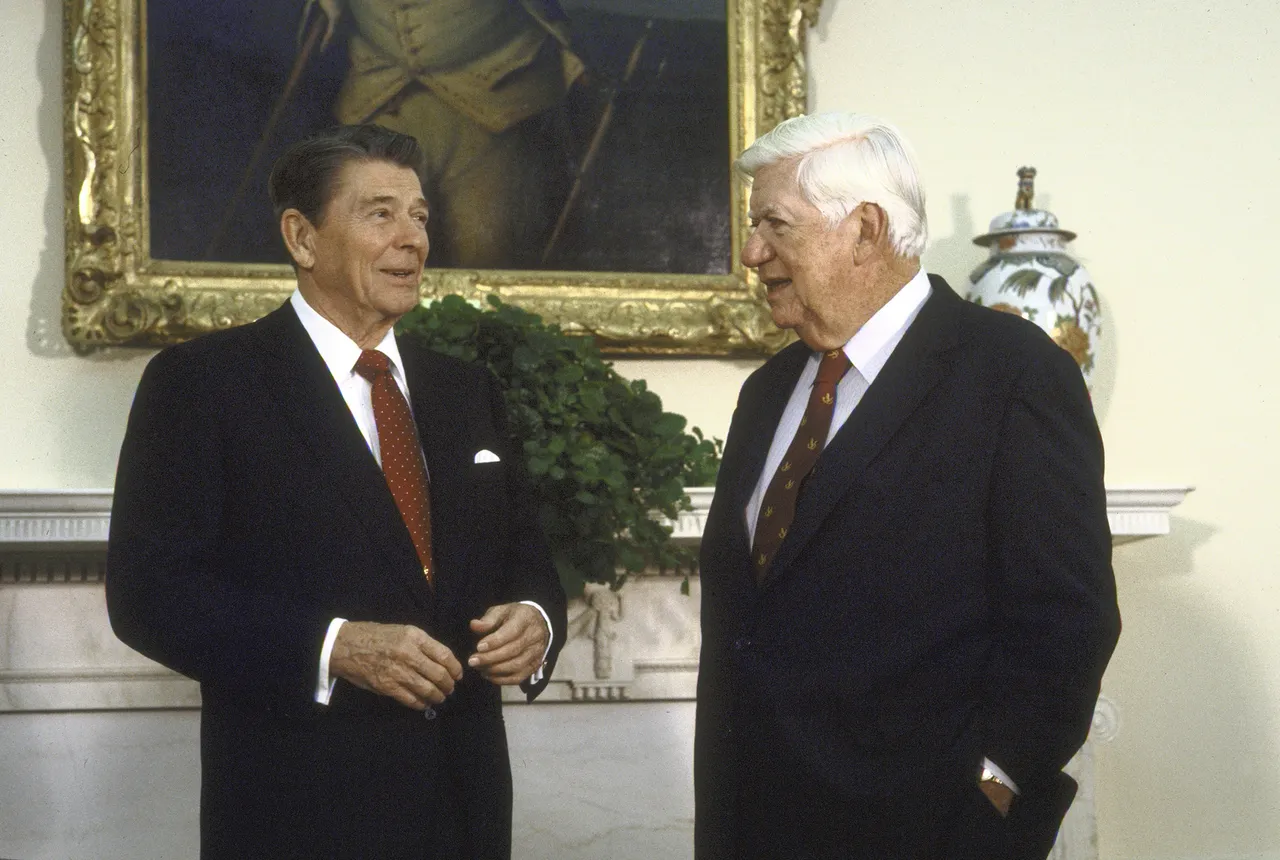
President Reagan and Speaker Tip O’Neill (D-Mass.).
As a year, 1982 served as the low point of the Reagan presidency. Much of the rhetoric of the left surrounding his legacy was also issued forth that year, as the economy was in recession with 10% unemployment due to interest rate hikes by the Federal Reserve to combat inflation, and this election was a referendum on his presidency thus far. The effect was felt in the House, with Democrats winning 26 seats, but the dynamics in the Senate did not change; Democrats reaffirmed their hold in New Jersey, with Democrat Frank Lautenberg succeeding interim Republican appointee Nicholas Brady after the resignation of Democrat Harrison Williams. The Democratic win with Jeff Bingaman defeating Republican Harrison Schmitt in New Mexico was balanced out by Republican Chic Hecht’s defeat of incumbent Howard Cannon in Nevada. In Virginia, Independent Harry Byrd Jr. was succeeded by Republican Congressman Paul Trible, but this didn’t really change anything as both Byrd and Trible were conservatives.
1982 House Losses
The 1982 midterms were successful for Democrats in the House and it was a testament to the efforts of Tony Coelho to get the Democrats back on track from their 1980 loss, which had exposed numerous ways in which the Democrats were behind in their approach on campaigning. Of the 26 Republicans who lost, 14 had first been elected in 1980.
Some notable victors this year included John McCain, who succeeded Republican House leader John Rhodes in Arizona’s 1st district, and John Kasich, who defeated Democrat Bob Shamansky for reelection. Indeed, Kasich was the only Republican to defeat a Democratic incumbent in the House that year. The current governor of Ohio, Mike DeWine, won his first term in Congress this year from Ohio’s 7th district, succeeding Bud Brown (who, just in a random bit of trivia is the father of actor Clancy Brown).
Redistricting strongly impacted this election, and it resulted in numerous incumbents having to fight within their own parties for renomination.
In Alabama, Republican incumbent Albert Lee Smith, who represented Birmingham, lost reelection to Democrat Ben Erdreich. As a former member of the John Birch Society, Smith was an increasingly poor fit for a district in which the black Democratic vote was becoming increasingly powerful. Republican Bill Dickinson of the 2nd district (Montgomery) came within a point of losing as well.
In Arizona, Democrats picked up a newly created seat with Jim McNulty. However, his Republican opponent, Jim Kolbe, would win the seat in 1984.
In California, Congressman Phil Burton succeeded in getting a redistricting scheme that benefited Democrats. This resulted in the loss of Republican Don Clausen of the 1st district, who had served since 1963, lost reelection to Democrat Douglas Bosco. His district was based in Napa Valley and Santa Rosa, which had increasingly been trending Democratic. The Democrats also gained a seat in Eastern California with Richard Lehman and a seat in Southern California with Howard Berman. Republicans lost two seats to redistricting as incumbents Bobbi Fiedler and Barry Goldwater Jr. had their districts merged; Goldwater ran unsuccessfully for the GOP Senate nomination, as well as Wayne Grisham and David Dreier’s districts merging with Dreier winning the primary. However, perhaps the most notable event was the turning out of office of the ultra-conservative John Rousselot, who had recruited a strong candidate to try to defeat Burton’s brother, John, for reelection in 1980. Rousselot had his district merged with Democrat Matthew Martinez, which resulted in him running in a majority Latino district. The famously fiery Congressman Robert “B-1 Bob” Dornan also had his district altered to make it a Democratic district, thus he made a run for the Senate. He would return to Congress in the 1984 election in another Orange County district.
In Colorado, Republicans gained the newly created 6th district. Although astronaut Jack Swigert won the election, he died less than two months later of cancer, thus Republican Daniel Schaefer ended up serving.
Connecticut was a mixed bag for the GOP. On one hand, Republican Lawrence DeNardis lost reelection in the 3rd district, but on the other, Republican Nancy Johnson won an open Democratic seat in the 6th district.
In Delaware, troubled incumbent Thomas B. Evans, alleged to have engaged in adultery, was defeated for reelection by Democrat Thomas Carper, who would eventually be the state’s governor as well as its four-term senator.
In Florida, the dynamics didn’t change as four districts were added but Democrats and Republicans won two each.
In Illinois, Paul Findley of the 20th district, who had served in office since 1961, narrowly lost reelection to Democrat Dick Durbin, who is currently in the Senate. Findley had become most known at this point as a strong critic of Israel and in his own words, “Arafat’s best friend in Congress”. Redistricting making his district more Democratic, the early 1980s recession, and AIPAC efforts to turn him out of office combined had resulted in the loss. In the 17th district, Republican Tom Railsback lost renomination for his political moderation, and was succeeded by Democrat Lane Evans. In the 4th district, Republican Ed Derwinski lost renomination to George O’Brien, whose districts had been merged. Another merging was of Republican Robert McClory’s district with that of Republican John Porter. McClory opted to retire rather than running against Porter.
In Indiana, Republican H. Joel Deckard lost reelection to Democrat Frank McCloskey, but Democrats lost a seat due to two of their districts being merged and Republicans gained a newly created seat with Danny Burton. Democrat Floyd Fithian retired from his district, which had merged with that of Republican John T. Myers, who won the election.
In Kansas, Republicans lost the seat of retiring James Jeffries, with Democrat Martha Keys winning the seat.
In Massachusetts, Republican representation was shaved down to Silvio Conte of the 1st district as Republican Margaret Heckler lost reelection by 19 points to Democrat Barney Frank; their districts had been merged. Heckler would after serve as Reagan’s Secretary of Health and Human Services. Republican representation in Massachusetts had gradually been declining since the 1940s.
In Michigan, freshman incumbent James Dunn of the 6th district lost reelection to Democrat Bob Carr, who he had defeated in 1980.
In Minnesota, Republicans Tom Hagedorn and Arlen Erdahl lost reelection to Democrats Tim Penny and Gerry Sikorski respectively.
In Mississippi, Republicans gained an open Democratic seat with the retirement of David Bowen with Webb Franklin. However, this district would not be a hold for them for that long, as the district had a high black population and by 1986 their political participation resulted in Franklin’s loss to Mike Espy. Democrats have held the district since.
In Missouri, Republicans lost a seat when Wendell Bailey’s district was merged with Democrat Ike Skelton’s, and the latter won the election.
In Nevada, the growing state added a Congressional district. With the retirement of Democrat Jim Santini, this resulted in the Las Vegas based district of the 1st, represented by Harry Reid, and the rest of the state, represented by Republican Barbara Vucanovich of the 2nd.
In New Mexico, Democrats gained the newly created 3rd district, based in Albuquerque with Bill Richardson.
In New Jersey, liberal Republican Harold Hollenbeck of the 9th district lost reelection to Democrat Robert Torricelli, who would later serve in the Senate.
In New York, the results were a wash. First-term Republican John LeBoutillier lost reelection against Democrat Robert J. Mrazek, whose districts had been merged. However, Democrat Leo Zeferetti’s district was merged with first-term Republican Guy Molinari’s, and Molinari won the election, as well as Democrat Peter Peyser’s district merging with Republican Ben Gilman’s, the latter winning the election.
In North Carolina, first term Republicans Gene Johnston of the 6th district and Bill Hendon of the 11th district lost reelection to Robin Britt and James M. Clarke respectively. Republicans would win both districts back in 1984, with Hendon returning for one more term.
In Ohio, first term Republican Ed Weber of the 9th district (Toledo) lost reelection to Democrat Marcy Kaptur, who as of writing is still in Congress!
In Oregon, Republicans gained a newly created seat with Bob Smith winning the election.
In Pennsylvania, Philadelphia’s Republican Charles Dougherty lost reelection to Democrat Robert Borski. To this day, he is the last Republican to have represented any portion of Philadelphia in Congress. Other losses for Republicans included Eugene Atkinson in the 5th district to Joe Kolter, James Coyne of the 8th district to Peter Kostmayer and James Nelligan of the 11th district to Democrat Frank Harrison. However, retiring Democrat Allen Ertel of the 17th district was succeeded by Republican George W. Gekas.
In South Carolina, Republican John Napier lost reelection to Democrat Robin Tallon.
In South Dakota, the two districts became one, and incumbent Democrat Tom Daschle defeated Republican incumbent Clint Roberts. Daschle would later lead the Democrats in the Senate.
In Texas, unlike modern population growth, Democrats gained three seats.
In Utah, a third district was added, which was won by Republican Howard C. Nielson.
In Virginia, Republican Robert Daniel of the 4th district lost reelection to Democrat Norm Sisisky. Republican William Wampler of the 9th district also lost reelection to Democrat Rick Boucher, who would serve until his loss in the Tea Party wave of 2010. The district is now the strongest Republican district in Virginia. In Virginia’s 6th district, one of the first to go Republican, retiring M. Caldwell Butler was succeeded by Democrat Jim Olin.
In Washington, Republicans gained a seat in the newly created 8th district with Rod Chandler.
In West Virginia, Democrats won all seats, with first term Republican incumbents Mick Staton turned out of office and Republican Cleve Benedict leaving to run for the Senate, which he lost easily to popular incumbent Robert Byrd. Republicans would be locked out of the West Virginia delegation until the 2000 election, which just goes to show how much states can change.
After this election, the Reagan Administration acknowledged the setback and estimated they lost 24 conservative supporters but still believed that they could secure victories sometimes in the House (Raines). Both parties though knew the ideological balance had shifted from conservatives, held up by a coalition of Republicans and Reagan Democrats, towards liberals. House Speaker Tip O’Neill (D-Mass.) summed up the House elections thusly, “It was a disastrous defeat for the President” (Raines).
References
1982 United States House of Representatives elections. Wikipedia.
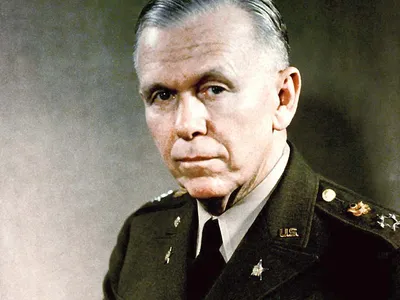
General George C. Marshall, the namesake of the Marshall Plan
The Marshall Plan, initially proposed by General George C. Marshall, was, along with the creation of the UN, the culmination of the postwar bipartisan foreign policy, which departed dramatically from the pre-World War II popular view that the US should stand independent of the international community. While the 80th Congress was dubbed the “Do-Nothing Congress” by President Truman, the truth was that they were “do nothing” in the sense that they didn’t do what he wanted on domestic issues and pushed what they wanted. On foreign policy, however, bipartisanship was going strong. Indeed, President Truman championed it and two Republicans were the primary sponsors in Senator Arthur Vandenberg (R-Mich.), chairman of the Senate Foreign Relations Committee, and Charles Eaton (R-N.J.), chairman of the House Committee on Foreign Affairs. The measure allocated $13.3 billion in aid in capital and materials (the equivalent of $130 billion today) to reconstruct 16 war-torn European nations. Despite the support of the Republican leadership, a lot of opposition remained among the conservative base. In the Senate, the most significant effort to reduce the scope of the bill was an amendment sponsored by Robert Taft (R-Ohio), to cut the first year of funding from $5.3 billion to $4 billion, which failed on March 12th on 31-56 (R 23-24, D 8-32). The Marshall Plan was approved the next day 69-17 (R 31-13, D 36-4). One of the “yeas” was Senator Taft, who reluctantly concluded the measure was needed. The House followed up with an easy approval of 329-74 (R 171-61, D 158-11, ALP 0-2) on March 31, 1948. The conference report was adopted by voice vote in the Senate while the House adopted on a similar margin on April 2nd.
The strongest support came from the East, with nearly all Democrats and Republicans in favor. The exceptions were Senators John J. Williams (R-Del.) and Albert W. Hawkes (R-N.J.) and Representatives T. Millet Hand (R-N.J.), black radical Adam Clayton Powell (D-N.Y.), Ralph W. Gwinn (R-N.Y.), Dan Reed (R-N.Y.), and Robert F. Rich (R-Penn.). Williams, Hawkes, Gwinn, Reed, and Rich were among the most conservative members of Congress while Powell was a black radical who was critical of Truman’s anti-communist focus on foreign policy. Also from New York who opposed were the two American Labor Party representatives, Vito Marcantonio and Leo Isacson, being sympathetic to the USSR. There were no opponents from New England.
The West Coast was all for it with the sole exception of John Phillips (R-Calif.), a staunch conservative who represented the Southeastern portion of the state. At the time, Republicans had the edge on numbers in the delegation, with only two of the six senators being Democrats, whereas today its all six who are Democrats.
Opposition mostly consisted of Midwestern Republicans, who were the strongest group in opposition to internationalism. 41% of Midwestern senators opposed the Marshall Plan, and in the 80th Congress Scott Lucas of Illinois stood as the lone Democrat. In the House, all Midwest Democrats except George Sadowski (D-Mich.), who opposed from the left, were for. 71% of Illinois Republicans, 63% of Indiana Republicans, 25% of Iowa Republicans, 33% of Kansas Republicans, 50% of Michigan Republicans, 43% of Minnesota Republicans, 100% of Nebraska Republicans, 50% of North Dakota Republicans, 32% of Ohio Republicans, 50% of South Dakota Republicans, and 25% of Wisconsin Republicans were opposed. The most odd example of opposition among the Midwestern Republicans was Senator Joseph Ball (R-Minn.), who had a record of supporting interventionist policies before Pearl Harbor and beforehand had an internationalist record. He balked at the cost and wanted a stronger anti-communist orientation to the measure.
The Mountain States
In the states between the Midwest and West Coast, there was mostly support for the Marshall Plan. The only representative who voted against was J. Edgar Chenoweth (R-Colo.) while three senators opposed; Henry Dworshak (R-Idaho), Glen Taylor (D-Idaho), and George Malone (R-Nev.). Dworshak and Malone opposed from the right, while Taylor, who was the running mate of Progressive Henry Wallace in 1948, was from the left, wanting more accommodation with the USSR.
The Border States
In the Border States (Kentucky, Maryland, Missouri, Oklahoma, and West Virginia), we see a lot of opposition from Republicans and only two dissents from Democrats. Kentucky is the most favorable state, with only the near-death John Robsion (R-Ky.) of the Appalachian region in opposition. All elected officials from Maryland are in support, but in Missouri 67% of Republican representatives are opposed while one of its two Republican senators, James P. Kem, stands opposed. In Oklahoma, Republican Senator Edward H. Moore is opposed, as are Representatives George Schwabe (R-Okla.) and Ross Rizley (R-Okla.). The two Democrats in opposition in the region were from Oklahoma in Glen Johnson of the 4th district and Toby Morris in the 6th district. In West Virginia, the Democrats favor while Republican Senator W. Chapman Revercomb is in opposition and the Republicans split in the House delegation.
The Dixie Opposition
Most Southern Democrats stayed true to their pre-World War II stances on interventionism in support of the Marshall Plan. However, there was a small pool of dissenters from Dixie.
Senators
Olin Johnston (D-S.C.), who while he was one of the more liberal Southerners who went to bat for organized labor, was a frequent critic of foreign aid.
W. Lee O’Daniel (D-Tex.), who was the only person in the Texas delegation to oppose the Marshall Plan. By this point he had become completely alienated from his own party and was voting in line with the most conservative of Republicans.
Harry F. Byrd (D-Va.), who was one of the staunchest fiscal hawks in the whole Democratic Party and voted almost entirely in line with conservative Republicans by this point.
Representatives
John S. Wood (D-Ga.), who would head up the House Committee on Un-American Activities from 1949 to 1953 and had been at the scene as a driver during the 1915 lynching of Leo Frank to transport his body to the morgue. He had also briefly been a member of the second KKK.
Henry Larcade (D-La.), who had one of the friendliest records to the domestic agenda of the 80th Congress among Democrats.
Otto Passman (D-La.)., a first-termer who would have a reputation as a leading critic of foreign aid in his 30 years in office.
John Rankin (D-Miss.), the House’s loudest bigot who had started his career on the political left but shifted to the right.
Graham Barden (D-N.C.), a conservative who would chair the House Education Committee.
Robert L. Doughton (D-N.C.), who was the ranking Democrat on the House Ways and Means Committee who had sponsored Social Security.
W.J. Bryan Dorn (D-S.C.), a man who in his career would be counted among the conservatives of his party but later move in a liberal direction on some issues, including anti-poverty program funding and busing as a means of school desegregation.
Burr P. Harrison (D-Va.), the only of the state’s crop of conservative Democrats to follow Senator Byrd.
References
Congressional Supplement. (1948, July). Americans for Democratic Action.
I have written before about the concept of politicians being bridges from one era of American politics to another due to the longevity of their service. They are the ones who can best answer questions about what people back then would have thought of politics that resemble ours. One such case is Daniel Alden Reed (1875-1959) of New York.
Reed was a number of things as a person; teetotaler, college football coach, and attorney for New York State. As an attorney, he went after violators of liquor laws and was supportive of Prohibition. In 1918, Reed was elected to Congress representing upstate New York, with his district being centered in Dunkirk. He was a strong supporter of income tax reduction and of high tariffs. Indeed, he represented the strong conservatism of his region. Reed even looked the part, per the New York Times (1959), “Mr. Reed even looked like an Old Guard Republican. His tall, erect frame carried a stern visage topped by pure-white hair. His dress was strictly conservative.”
As a strong supporter of the pro-business conservative Republicanism of the 1920s, Reed was naturally one of the most dogged opponents of the New Deal. He opposed all of the major First 100 Days legislation and he was one of the minority of legislators who voted against Social Security, darkly warning that because of this law “the lash of the dictator will be felt, and 25 million free American citizens will for the first time submit themselves to a fingerprint test.”(Kapur). In 1938, Reed voted against the Fair Labor Standards Act. He did have a softer spot for veterans as although he voted against the Patman Bonus Bill in 1935, he eventually gave in and voted to override President Roosevelt’s veto in 1936. Despite FDR being highly popular in the 1930s, Reed still won by over 10 points even in the tough 1936 election in which he carried all states save Maine and Vermont and House Republican numbers were reduced to 88.
On foreign policy, Reed remained consistent in his non-interventionist beliefs. He voted against all of the major pre-Pearl Harbor measures, and after World War II voted against aid to Greece and Turkey and the Marshall Plan. Reed even went as far as to oppose U.S. entry in to the United Nations. He was also an unrelenting opponent of price, rent, and wage controls and supported all efforts to curb the power of organized labor, which had substantially grown after the passage of the Wagner Act of 1935.
Reed, Civil Rights, and Federal vs. State Authority
One of Reed’s first votes in Congress was in support of women’s suffrage, but on civil rights for blacks, his record was more mixed.
In 1922 and 1937, he voted for anti-lynching legislation, but he proved one of the most consistent Republican opponents of anti-poll tax legislation, including being one of only four House Republicans to vote against the 1942 bill which only covered general elections and not primaries. Reed also voted against a compromise Fair Employment Practices bill in 1950, but also voted against a establishing a segregated VA hospital the following year and supported the 1956 civil rights bill as well as the Civil Rights Act of 1957. This included opposing a weakening jury trial amendment to the latter. On other issues surrounding state and federal issues, he sided with the states in his support for a local option to rent control in 1949, the Knowland Amendment to the 1950 Social Security bill, the Tidelands bill in 1953, the Anti-Preemption bill in 1958,
Chairman of the House Ways and Means Committee
With Dwight Eisenhower’s 1952 victory followed a Republican Congress, and this elevated Reed to the chairmanship of the Ways and Means Committee. Reed was not a “modern Republican” touted by Eisenhower, and was keen on ending the excess profits tax and cutting income taxes. He called the excess profits tax “iniquitous, unfair, unjust, destructive; a cancer on the economy of the country” (Hill). President Eisenhower’s allies then tried to bypass his committee to extend the excess profits tax for six months as the president wanted, much to his consternation, as he wanted it to expire on June 30, 1953, as originally scheduled. Reed agreed to hold hearings and he was outvoted in committee. The billl passed 325-77 on July 10th, retroactively extending it, with Reed being among the nays. Despite their differences on what sort of Republicanism ought to be practiced and on excess profits, Reed shepherded major tax reform signed into law by President Eisenhower in the form of the Revenue Act of 1954 as well as the Social Security Act Amendments of 1954. Despite his working with Eisenhower, he continued supporting the traditional high tariff line of the Old Guard Republicans, continued opposing foreign aid legislation, and opposed federal aid to education. Indeed, he led efforts to rein in presidential authority on tariffs, and on February 18, 1955 his effort failed 199-206 to make the president follow U.S. Tariff Commission recommendations. On June 11, 1958, Reed tried to kill an extension of the Reciprocal Trade Act outright, but this failed 146-268. However, he dissented from his fellow conservatives in opposing the creations of the Cox and Reece Committees to investigate tax-exempt institutions.
In 1958, Reed backed his friend Minority Leader Joe Martin (R-Mass.) for another term as Republican leader but he was narrowly defeated by Charles Halleck (R-Ind.) due to big losses in the 1958 midterms as well as President Eisenhower not putting his thumb on the scale. Reed would not live long in the next Congress; although he had taken doctor’s orders seriously in addressing his 1956 heart attack, he did not address a pain in his foot until he could no longer walk. It turned out that Reed had developed a serious infection, and it was serious enough to require amputation (Hill). He agreed to the amputation but died of a heart attack on February 19, 1959 before it could occur. Former Speaker of the House Joe Martin (R-Mass.) praised him, “He was a man of great courage, like a mighty oak never yielding to the tempest” (Hill). The ideological assessments of Reed are consistent; he sided with the conservative Americans for Constitutional Action 90% of the time, the liberal Americans for Democratic Action (ADA) 6% of the time, and his DW-Nominate score stands at 0.547. Indeed, in seven of the twelve years he was assessed by ADA he scored a 0%.
References
ADA Voting Records. Americans for Democratic Action.
Although the Democrats were still considerably ahead in the House, Nixon had hopes that he could defy the trend of midterms against the president’s party. He campaigned aggressively on social issues and stumped for Republican candidates across the country. Notably, the President’s Commission on Obscenity and Pornography concluded that pornography did no societal or individual harm and called for abolishing anti-obscenity laws for adults, a conclusion that the Nixon Administration as well the U.S. Senate disagreed on, with the chamber voting 60-5 (notably, future presidential candidates Walter Mondale and George McGovern were among the dissenters) to disagree with the report. President Nixon railed against obscenity numerous times in 1970 and tried to connect Democrats to anti-war protesters and obscenity. Nixon stated, “So long as I am in the White House, there will be no relaxation of the national effort to control and eliminate smut from our national life” (Weaver). Vice President Spiro Agnew also went on the attack. He put the election in stark ideological terms, “One issue dominates this election: Will the radical-liberalism that controls the Senate of the United States prevail in the nation? Or will America be led into the future by the moderates, centrists and conservatives who stand behind the President of the United States?” (Time Magazine) He accused Democrats of appeasing anti-war protesters, if not being like them. Although Nixon had successfully and quietly completed school desegregation in 1970, he actively campaigned against the use of busing to achieve desegregation, an issue that had more national impact than pushing against the South’s Jim Crow system. Democrats ran against the Republicans for the increasing inflation and unemployment occurring and on the Vietnam War. The Democrats critiqued what they dubbed “Nixonomics” (Apple).
Predictions for the Senate in September from The New York Times were that Democrats would gain Senate seats in Illinois and New York, and that Republicans would gain in Florida, Ohio, and Tennessee. California, Indiana, and Vermont were considered toss-ups. Democrats were expected to hold in Maryland and Texas, although an outside risk to Maryland’s Tydings was not discounted. Time Magazine (1970), which reported closer to the election, considered Maryland and Wyoming reasonably certain holds, that Ohio and Tennessee looked like Republican pickups, and that Florida and Texas looked like Democratic holds. Time Magazine also reported that Democrats were ahead in Connecticut and Vermont with the Republican slightly ahead in Indiana.
The Results
The direction of the midterms followed historical norms in the House in 1970, although Republicans lost less than the usual seats at 12.
Nick Begich (D-Alaska) won the open seat vacated by Republican Howard W. Pollock against future Senator Frank Murkowski. Begich along with House Majority Whip Hale Boggs (D-La.) would die in an air crash in Alaska in 1972 that was never recovered.
Jeffery Cohelan (D-Calif.), who represented Berkeley, lost renomination to staunch anti-Vietnam War socialist Ron Dellums, who won the election.
The seat vacated by John Tunney (D-Calif.) in his successful run for the Senate was won by Republican Victor Veysey.
In Colorado, Denver’s longtime Democratic representative Byron Rogers lost renomination to Craig Barnes, producing a divide among Democrats sufficient to give Republican Mike McKevitt a victory.
In Connecticut, Republican Robert Steele won the election to succeed the late Democrat William St. Onge in the 2nd district. However, this was counterbalanced by the victory of Democrat Ella Grasso in succeeding Republican Thomas Meskill in the 6th district, who left office for his successful gubernatorial run.
E. Ross Adair (R-Ind.), ranking Republican on the House Foreign Affairs Committee and one of the House’s leading critics of foreign aid, was defeated by Democrat J. Edward Roush. He had been in office for 20 years.
In Kansas, Republican Chester Mize of the 2nd district lost reelection to Democrat William R. Roy. Roy would come close to unseating Senator Bob Dole in the 1974 election.
William Cowger (R-Ky.) was defeated in the Louisville-based 3rd district by Democrat Romano Mazzoli, who would sponsor with Senator Alan Simpson (R-Wyo.) the Simpson-Mazzoli law on immigration in 1986. Cowger would die of a heart attack less than a year after his defeat at the age of 49.
In Maryland, Democrat George Fallon of the 4th district (Baltimore), who had served since 1945, lost renomination to Paul Sarbanes, who would later have a long career in the Senate. Democrat Goodloe Byron succeeded Republican J. Glenn Beall, Jr. in the 6th district, who had vacated his seat to successfully run for the Senate. This wasn’t much of a victory for Democrats, as Byron was a conservative. In the 7th district, Samuel Friedel, who had served since 1953, lost renomination to Parren J. Mitchell. Friedel was Jewish while Mitchell was black, reflecting a shift in preferences among the district’s Democrats. Mitchell won the election.
Philip J. Philbin (D-Mass.) was denied renomination by Father Robert Drinan, and lost a bid to retain his seat running as an Independent. Philbin, who had served in office since 1943, was considered insufficiently liberal and his support for the Vietnam War, despite his vote for the Cooper-Church Amendment, had cost him among young Democrats. Drinan would be one of only two Catholic priests to serve in Congress.
In Minnesota, Republican Odin Langen of the 7th district lost reelection to Democrat Robert Bergland.
In Montana, Democrat Arnold G. Olsen of the 1st district lost reelection to Republican Richard Shoup.
In Nebraska, Omaha’s Republican Glenn Cunningham lost renomination to John Y. McCollister, a more conservative figure, who won the election.
In New Mexico, Republican Ed Foreman of the 2nd district lost reelection to Democrat Harold Runnels. This wasn’t much of a victory for Democrats as Runnels was a conservative.
Allard Lowenstein (D-N.Y.), noted anti-Vietnam War activist who famously succeeded in making a big enough impact to influence Preisdent Johnson’s decision not to run for reelection, was defeated by Republican Norman F. Lent. Tragically, Lowenstein would be murdered in 1980 by a former protege.
Adam Clayton Powell (D-N.Y.) was defeated for renomination by Charles Rangel. Having served since 1945, voters had grown tired of his absenteeism and ethics issues.
Leonard Farbstein (D-N.Y.) was defeated for renomination by Bella Abzug, a loud feminist radical, who won the election.
Richard Ottinger (D-N.Y.), who vacated his seat to run for the Senate, was succeeded by Republican Peter Peyser. A moderate, Peyser would grow more liberal with time and eventually switched to the Democratic Party.
Martin B. McKneally (R-N.Y.), facing corruption charges, was defeated for reelection by John G. Dow, who he had defeated in 1968.
Daniel Button (R-N.Y.), the last Republican to have represented Albany in Congress, was defeated for reelection by Samuel Stratton, whose district had been merged with his.
Jack Kemp (R-N.Y.) won an open seat vacated by Democrat Richard McCarthy, who sought the Democratic Senate nomination. He would be known as a prominent supporter of individual tax cuts and would be Bob Dole’s running mate in the 1996 presidential election.
In North Dakota’s 2nd district, Republican Thomas Kleppe retired to run for the Senate and was succeeded by Democrat Arthur Link.
William H. Ayres (R-Ohio), a moderate who was the ranking Republican on the House Veterans Affairs Committee and the House Education and Labor Committee and had represented Akron for 20 years despite it being heavily unionized, was defeated for reelection by Democrat John Seiberling, who ran on an explicitly liberal and anti-Vietnam War platform. The Kent State shooting played a significant part in boosting Seiberling’s campaign against Ayres. As of 2026, Ayres is the last Republican to represent Akron.
Michael Feighan (D-Ohio), who had served in Congress since 1943, was defeated for renomination by Charles Carney, who won the election.
South Dakota was a notable surprise, with both Republican incumbents retiring and being succeeded by Democrats Frank Denholm and James Abourezk, the latter being of the George McGovern type.
In Utah, Democrat K. Gunn McKay won the election to succeed Republican Laurence J. Burton, who ran for the Senate unsuccessfully against incumbent Ted Moss.
In Virginia, retiring Democrat John O. Marsh of the 7th district was succeeded by Republican J. Kenneth Robinson. This wasn’t much of a loss for Democrats, as Marsh had been a conservative and would later switch to the GOP, serving as President Reagan’s Secretary of the Army.
In Washington, Republican Catherine May lost reelection to Democrat Mike McCormack in the 4th district. Today, Washington’s 4th, based in the east, is one of the state’s two safe Republican districts.
Henry C. Schadeberg (R-Wis.), a staunch conservative from the 1st district (which would later be represented by Paul Ryan), was defeated for reelection by over 20 points by Democrat Les Aspin, who would become known as a skeptic of military spending and would serve as President Clinton’s first Secretary of Defense.
In Wyoming, Republican John S. Wold vacated his seat to run unsuccessfully for the Senate, and was succeeded by Democrat Teno Roncalio, who had previously served during the Great Society Congress.
The Senate
Although Republicans didn’t win the Senate, they did have a net gain of two seats.
In California, Republican Senator George Murphy was defeated for reelection by Democratic Congressman John Tunney, son of pro boxer Gene Tunney. Murphy was compromised because although an operation to remove part of his larynx saved his life from throat cancer, he was rendered unable to speak above a whisper for the rest of his life, a serious disability for a U.S. senator and a sad fate for a man once renowned for his singing voice.
In Connecticut, Democrat Thomas J. Dodd was severely compromised because of his 1967 censure by the Senate for using campaign funds for personal expenses. He was defeated for renomination but tried for reelection as an Independent, which resulted in the victory of Republican Congressman Lowell P. Weicker Jr., at the time a moderate.
In Illinois, Republican Ralph Tyler Smith, seeking to finish the term of the late Senator Everett Dirksen, lost the election to Democrat Adlai Stevenson III.
In Maryland, liberal Democrat Joseph Tydings lost reelection to moderate Republican Congressman J. Glenn Beall, Jr., in a major upset. Tydings had defeated Beall’s father for reelection in 1964.
In New York, Republican Charles Goodell, who had been appointed to the Senate by Governor Nelson Rockefeller after the assassination of Robert F. Kennedy, had faced considerable headwinds in his own party. Although as a representative, Goodell had a moderately conservative record, as a senator he rivaled his fellow senator Jacob Javits in liberalism. The election was a three-way-race between Goodell, Democratic Congressman Richard Ottinger, and Conservative James L. Buckley. The Nixon Administration surreptitiously supported the election of Buckley, the only one of the candidates who supported Nixon on the Vietnam War. Because the liberal vote split between Goodell and Ottinger, Buckley was elected.
In Ohio, Republican Congressman Robert Taft Jr., grandson of President William Howard Taft, won an open Democratic seat, defeating Democrat Howard Metzenbaum. Metzenbaum would win in a rematch in 1976.
In Tennessee, Republican Congressman Bill Brock defeated Democrat Albert Gore Sr. for reelection. This was one of the major victories for the Nixon Administration given Gore’s Southern liberalism and his support for the Cooper-Church Amendment. Brock had labeled Gore “the third Senator from Massachusetts” for fundraising at a Kennedy event in Virginia (Time Magazine).
Although not a change in party for the seat, a notable election nonetheless was the Texas Senate election, which saw Democrat Lloyd Bentsen defeat Republican Congressman George H.W. Bush. In 1988, Bush would win the presidency and Bentsen would be the Democratic nominee for vice president. Democrat Vance Hartke would hold in Indiana as would Republican Winston Prouty in Vermont, and Democrat Lawton Chiles kept the Florida seat.
Notable Lasts
The election of Mike McKevitt to represent Denver would be the last time the city would elect a Republican to Congress.
The election of J. Glenn Beall, Jr. in 1970 was the last time a Republican defeated a Democratic Senate incumbent for reelection in Maryland.
This was the last election in which Utah would elect a Democrat to the Senate, reelecting Ted Moss.
In this election Wyoming would return Democrat Teno Roncalio to the House. To this day, he is the last Democrat to have represented the Bighorn State in the House and was succeeded by Dick Cheney in the 1978 midterms. This was also the last time that Wyoming’s voters would elect a Democrat to the Senate in their vote to reelect Gale W. McGee.
Overall, President Nixon and the Republicans did considerably better than average on this midterm, and shows that indeed the best defense can be a good offense. As the midterms approach, I can easily see Republicans campaigning against radicalism and trying to tie Democrats to far leftists like Hasan Piker.
References
Apple, R.W. (1970, September 13). Two Parties Pick Definitive Issues for Senate Race. The New York Times.
Retrieved from
Nation: The Republican Assault on the Senate. (1970, October 25). Time Magazine.
In the 1930s, the Progressive Party came to power in Wisconsin. They were a liberal offshoot of the Republican Party, breaking away because the Republicans didn’t want to support the New Deal. However, starting in 1938, Republicans were regaining power, and 1942 was another year of loss, with Progressive incumbent Bernard J. Gehrmann losing reelection to journalist and educator Alvin Edward O’Konski (1904-1987).
O’Konski was a Republican, but would prove to be his own man in office. He said of himself that “I’m a New Deal Democrat domestically and a rabid conservative internationally” (McConaughy, 130). His mix of politics constituted quite a balancing act for his primarily Scandinavian working class district in the state’s northwest. As part of his international conservatism, he was an in-demand speaker for anti-communist ethnic groups and this was one of the things he became most known for. O’Konski also had an early accomplishment as she was one of the coauthors of the G.I. Bill of Rights in 1944. Although independent, O’Konski largely got behind the conservative domestic agenda of the 80th Congress with his support for tax reduction, anti-communist domestic legislation, and the Taft-Hartley Act and, consistent with his stated stance on foreign policy, voted against aid to Greece and Turkey as well as the Marshall Plan. He would nonetheless be one of the more supportive Republicans of the Truman Administration’s domestic policy, voting for a mandatory Fair Employment Practices Committee, middle-income housing aid, upholding price and rent controls, and against removing the natural gas from the jurisdiction of the Federal Power Commission. However, he proved a reliable Republican vote for the classic issue of tariffs, opposed the Brannan Plan (guaranteed minimum income for farmers), and supported the Knowland Amendment restricting federal authority over state unemployment compensation. O’Konski’s record on organized labor was, despite his support of the Taft-Hartley Act in 1947, mostly favorable. He had opposed the Smith-Connally Act in 1943, opposed the Case bill in 1946, supported revising the Taft-Hartley Act in 1949, opposed the 1959 Landrum-Griffin substitute to labor reform legislation, and in 1965 he supported repealing the “right to work” provision of the Taft-Hartley Act. A change in administration to one of his party, if anything, boosted his independence.
O’Konski and Eisenhower
Congressman O’Konski was not known for towing the party line as previously noted, and this wouldn’t change under President Eisenhower. Indeed, he was to Eisenhower’s left on domestic policy but far to his right on foreign policy with his refusal to support foreign aid. Life Magazine profiled O’Konski as one of the Eisenhower Administration’s Republican dissenters, noting “O’Konski opposes Eisenhower on taxes (he wants to increase personal exemptions), is against foreign aid, against reciprocal trade, against raising postal rates, against the farm program, against increasing the debt limit. He favors the Bricker Amendment” (McConaughy, 130). Indeed, Eisenhower’s farm program sought to reduce price supports and thus make agriculture more oriented to the free market, which met with opposition from several Wisconsin politicians interested in propping up the dairy industry, including Senator Joseph McCarthy. When Agriculture Secretary Ezra Taft Benson cut dairy price supports, O’Konski demanded his resignation (McConaughy, 130). In 1957, he ran for the Republican nomination to succeed the late Joseph McCarthy, but lost.
Federal vs. State Authority
On the matter of federal vs. state authority, O’Konski frequently sided with federal. He voted against the 1953 Tidelands Bill, against the 1958 and 1959 anti-preemption bills, and against the 1964 bill restricting the jurisdiction of federal courts in state legislative apportionment cases. However, O’Konski also backed local option for rent control in 1949, as previously noted supported the 1950 Knowland Amendment, and supported block grants for anti-crime programs in 1967. Speaking of federal vs. state relations…
O’Konski on Civil Rights
By and large Congressman O’Konski supported civil rights legislation. A curious vote, however, was his vote against final passage of the Civil Rights Act of 1957, although in his case it was certainly on the grounds that it was not strong enough, as he had voted against weakening the bill with a jury trial amendment. He supported the Civil Rights Act of 1964 and the Voting Rights Act of 1965, including opposing a Republican substitute to the latter. He supported both the proposed Civil Rights Act of 1966 and the Civil Rights Act of 1968 but had voted to strike the fair housing section from the former. Consistent with what organized labor wanted, O’Konski voted to kill the Philadelphia Plan in 1969. He also drew the line at using busing as a means of school desegregation. This was a civil rights record that satisfied both the want of the north for civil rights legislation to end Jim Crow but also fit the views of socially conservative union members.
O’Konski and the Sixties
During the Kennedy and Johnson Administrations, O’Konski was one of the most favorable to their domestic agendas in the GOP. He supported expanding the House Rules Committee to ease passage of legislation, the accelerated public works program, supported a strong minimum wage increase, and was one of the few Republicans to support bringing the Administration’s education bill to the House floor for consideration. He would also support federal aid to mass transit, food stamps, and the Economic Opportunity Act of 1964. Although O’Konski supported Medicare, he also supported the Republican substitute. By contrast, on foreign policy, he could not be counted for the Democrats at all and opposed President Kennedy’s Trade Expansion Act.
Interestingly, O’Konski had a particularly loud voice on issues regarding the District of Columbia. He was one of the leading opponents of D.C. home rule, motioning to kill the home rule bill in 1965. He also opposed a mass transit system for the city on cost grounds, but he changed his mind. O’Konski’s combination of support for New Dealish domestic policies and his ultra-conservatism on foreign policy was a winning combo for his Fond du Lac based district, him often winning reelection by double digits, even in the difficult years of 1958 and 1964. However, he was not invincible, and the Nixon years would prove it.
Decline of Support for O’Konski
Although O’Konski had won yet another blowout election victory in 1968, his margin was cut massively for the 1970 election. He won reelection by less than three points, his worst performance so far. What made for the decline? After all, he had been keeping up with his record of anti-communism with his support for Nixon’s approach to the Vietnam War and his independence from the GOP on numerous domestic issues. The truth is as they say, politics is local, and O’Konski had fatefully backed the U.S. Navy’s Project Sanguine, that sought to install thousands of antenna in northern Wisconsin’s forests and furthermore President Nixon’s wheat deal with Russia had angered farmers (Time Magazine, 1972). Matters got worse for him when Wisconsin lost a district in the 1970 census, which resulted in his district being merged with that of Democrat Dave Obey, who was highly popular in his district. Making matters worse yet again, George McGovern was polling pretty well in this new district, him being even with Nixon, and even O’Konski himself said that “it’ll be the toughest race I have ever had. No question about that” (Time Magazine). And indeed it was, on Election Day 1972, Obey won by over 25 points, ending O’Konski’s 30-year career. Ideological assessments of him are pretty consistent: he sided with the liberal Americans for Democratic Action 45% of the time, the conservative Americans for Constitutional Action 53% of the time, and his DW-Nominate score stands at 0.067. All measures I employ thus place him, on average, in the center. O’Konski died of heart failure on July 8, 1987, at the age of 83.
References
ADA Voting Records. Americans for Democratic Action.
One of the more controversial figures to have worked in the federal government was Lewis Strauss. Strauss’s career in government began as a young man when he volunteered his services to Herbert Hoover in 1917 for the Belgian Relief Commission and then participated in Hoover’s efforts to feed Europe after World War I. His work under Hoover got him into working on Wall Street, where he made his fortune in the 1920s. Strauss was wedded on both a partisan and ideological basis to the Republican Party, and had been a strong opponent of the New Deal. During World War II, Strauss served in the U.S. Navy but in a desk position due to his poor eyesight, but his work was of enough merit to get him the rank of rear admiral the Distinguished Service Medal, Legion of Merit. During the Truman Administration, he was tapped to serve on the Atomic Energy Commission, where he was a frequent dissenter to the others, who were Democrats. One success that Time Magazine (1959) credits him with was pulling out all the stops to get the government to set up an atomic test detection system when other AEC commissioners would not support it, which resulted in us knowing that the Soviets had detonated an atomic bomb in 1949. He also successfully pushed, over the objections of physicist J. Robert Oppenheimer, the development of the H-Bomb, although he was far from the only person to push this. The U.S. did beat the Soviets by nine months in testing the H-Bomb (Time Magazine). However, his way of going about things got him a reputation for competence and intelligence but also arrogance and ruthlessness. Time Magazine (1959) described the contrast in perspectives between supporters and opponents, “In the eyes of friends, he is brilliant, devoted, courageous and, in his more relaxed moments, exceedingly charming. His enemies regard him as arrogant, evasive, suspicious-minded, pride-ridden, and an excessively rough battler.” Indeed, Oppenheimer would be on the receiving end of Strauss’s rough battling due to personal differences, political differences, and national security concerns with him being denied renewal of his security clearance in 1954 due to his ties to communists, which included Strauss successfully lobbying FBI director J. Edgar Hoover to conduct surveillance on him, which included illegal wiretapping. However, he was far from alone in the push against Oppenheimer. The Defense Department as well as President Eisenhower himself were working against him. Strauss also crossed western senators in his successful effort to block the Atomic Energy Commission from constructing nuclear power plants (leaving this to the private sector) and his efforts at pushing private over public power, but again this was not all Strauss; Eisenhower and his Budget Bureau were behind this push (Time Magazine). Strauss served as Eisenhower’s chairman of the Atomic Energy Commission and was initially going to bow out of public service in 1958. However…
In October 1958, Strauss was tapped to serve as acting Secretary of Commerce by President Eisenhower, after the resignation of Sinclair Weeks, and was sworn in on November 13th. He did have to be confirmed to serve as the actual Secretary of Commerce, and he had made enemies on Capitol Hill. One figure he had repeatedly crossed on policy was Senator Clinton Anderson (D-N.M.) on policy and had really done it when he implied in a speech that the senator and other critics of him not releasing research information on atomic energy research projects to them did not understand the relationship between atomic energy and national security. Anderson came up with a strategy on defeating his nomination to hold weeks of hearings, reasoning, “I thought if the committee members saw enough of him, he would begin to irritate them, just as he has me” (Time Magazine).
The source of Strauss’s defeat, although most commonly publicized based on the film Oppenheimer as his role in denying the renewal of his security clearance, there were more factors at play in his defeat. One was his pushing of private over public power, which displeased Democratic senators in the west as previously mentioned, but another was his highly defensive and condescending attitude. Indeed, it was a bad sign for him when his nomination was only narrowly favorably reported out of committee on a 9-8 vote. President Eisenhower was resolute in supporting Strauss’s nomination and would not back down even if Strauss offered to back out (Time Magazine). In the face of opposition led by Anderson and freshman Senator Gale W. McGee (D-Wyo.), Strauss refused to admit any errors on his part. Time Magazine (1959) observed that had he given even a little ground, he would likely have been confirmed. Another factor was that the Democrats, who had won a blowout victory in 1958, were repeatedly facing Eisenhower’s veto pen for their proposals, thus one way they could assert some authority was by denying his nomination.
Supporters of Strauss’s nomination spoke out:
Andrew Schoeppel (R-Kan.) said of him that he is “personifying a philosophy of government which some feel impelled to combat and destroy. Mr. Strauss quite simply is a conservative…He has always stubbornly resisted anything which seemed to him to be an undue encroachment by the Legislative Branch” (CQ Press).
Prescott Bush (R-Conn.) criticized the efforts against his nomination as “The campaign of character assassination” (CQ Press).
Hugh Scott (R-Penn.) condemned the campaign against him, stating, “In all my career I have never before witnessed such a well-planned attempt at legislative lynching….(Yet) in 16 days of hearings I saw no evidence to justify an adverse recommendation on this nomination. Lewis Strauss’ competence, patriotism and excellent background were never challenged” (CQ Press).
Some supporters, such as Rep. Steven Derounian (R-N.Y.) and Sen. Scott (R-Penn.), alleged anti-Semitism in the opposition to Strauss (Time Magazine).
Opponents of Strauss
Opponents of Strauss, who wrote the minority report on his confirmation, charged Strauss with “deception,” telling “unqualified falsehoods” and creating “myths” about his own achievements (Time Magazine). As noted before, Anderson and McGee were the chief foes, and they were helped by certain pro-Strauss industrialists who lobbied heavily for him and in a way that was seen as unseemly. Also a boon for opponents of his nomination was that Strauss insisted on cross-examining hostile witnesses and senators which fueled more opposition to him (U.S. Senate).
When the nomination looked like it was going to be close, Republican senators were desperately flown in to cast votes. However, it was to no avail; on June 19, 1959, Strauss was rejected 46-49. The Democratic vote on his nomination was 15-47 and the Republican vote was 31-2. His nomination President Eisenhower was deeply disappointed, calling his rejection the “second most shameful day in Senate history” (the first was the Andrew Johnson impeachment trial) (Drury). The two Republican dissenters were Maine’s highly independent-minded Margaret Chase Smith and aging populist maverick William Langer of North Dakota. The Democratic supporters of his nomination were Arkansas’ John McClellan, Connecticut’s Thomas Dodd, Florida’s Spessard Holland, Georgia’s Richard Russell, Louisiana’s Allen Ellender, Mississippi’s James Eastland and John C. Stennis, New Mexico’s Dennis Chavez, Ohio’s Frank Lausche, Oklahoma’s Robert S. Kerr, Rhode Island’s John O. Pastore, South Carolina’s Strom Thurmond, Tennessee’s Albert Gore, and Virginia’s Harry F. Byrd and Willis Robertson. To emphasize how rare confirmation rejections of cabinet nominees are, the last one to have been rejected was Charles B. Warren for Attorney General in 1925 and the next to be rejected would be John Tower for Defense Secretary in 1989. Strauss never served in another position in government and published his autobiography, Men and Decisions, in 1962. Strauss died on January 21, 1974, of cancer at the age of 77.
References
Drury, A. (1959, June 19). Senate Rejects Strauss, 49-46, at Night Session. The New York Times.
Retrieved from
Senate Rejects Lewis Strauss Confirmation. U.S. Senate.
1944 was a disappointing year for the GOP. Although it was believed FDR was going to win reelection, it was believed for a time that Republicans would win control of the House, but instead the Democrats made gains. One of the places in which Republicans made gains, however, was in Wisconsin’s 8th district, centered in Green Bay, with Democrat LaVern Dilweg, who had played for the Green Bay Packers, losing reelection to John William Byrnes (1913-1985). He proved strongly fiscally conservative, siding wholesale with the domestic agenda of the Republican 80th Congress but willing to accept the bipartisan foreign policy that came with the postwar era, including voting for aid to Greece and Turkey and the Marshall Plan. However, he did not support foreign aid for poor nations through Point IV aid and voted for some foreign aid cuts. Byrnes also stood strongly for free market policies, supporting significant efforts to limit and end controls on prices and rents. In 1949, he was among the World War II veterans who spoke out against Rep. John Rankin’s (D-Miss.) pension bill for World War I and World War II veterans, which was intended to make the Social Security expansion proposed by President Truman fiscally impossible. Byrnes stated, “This legislation is dishonest…In ten years, our veterans will be shouldering half the nation’s tax burden…I am unalterably opposed to this bill. It is no hot potato as far as this member is concerned” (Time Magazine, 1949). In 1952 and 1953, he differed with the Conservative Coalition in its support for creating a committee to investigate tax-exempt institutions, which became known respectively as the Cox and Reece Committees. Byrnes continued his record of domestic conservatism during the Eisenhower Administration but supported increased foreign aid.
Byrnes Moves Into Leadership
In 1959, Byrnes was recognized as a strong voice on policy within the GOP with him being tapped to head up the House Republican Policy Committee. He stood as a staunch opponent of the Kennedy Administration’s domestic agenda while supporting foreign aid measures. In 1963, he rose to the position of ranking Republican on the powerful House Ways and Means Committee. An inflation hawk, he was the chief opponent in the House of the Kennedy tax reduction bill and pushed an unsuccessful proposal to cancel the tax cuts unless spending was not expected to exceed $98 billion in fiscal 1964. Byrnes also supported reducing spending to reduce the debt, being a confirmed opponent of the Keynesian approach that the Kennedy and Johnson Administrations were taking. That year, he made a risky admission; that in 1960 that after helping the Mortgage Guaranty Insurance Corporation get a favorable ruling from the IRS that he had purchased stock in the company and done so without knowing it was discounted, and subsequently moved the money to a scholarship fund (Fein). However, honesty paid off and he survived. Although he and Chairman Wilbur Mills (D-Ark.) disagreed on numerous issues regarding taxes and revenue, they had an effective working relationship and were able to produce compromises. Byrnes also opposed special loopholes and privileges in the tax code, and pushed to reduce them in his chief legislative accomplishment, the Tax Reform Act of 1969. In 1965, Byrnes would have to resign his post as head of the Republican Policy Committee due to a change in Republican rules that barred Republicans from holding both ranking positions and party leadership positions.
Byrnes and Civil Rights
Interestingly, Byrnes’ greatest difference with the civil rights position was on taxation; he was an opponent of repealing the poll tax by legislative means, and voted against doing so in 1945, 1947, and 1949. He thought this should be done by amending the Constitution, and true to this view he voted for the 24th Amendment in 1962. He would otherwise support the major civil rights laws, including the Civil Rights Act of 1964, the Voting Rights Act of 1965, and the Civil Rights Act of 1968. In 1971, Byrnes was one of 24 representatives to vote against the Equal Rights Amendment.
Byrnes and the Great Society
In 1965, Byrnes opposed Medicare being mandatory, but the Democratic majority was too great for a Conservative Coalition victory on the matter. Indeed, he was by and large an opponent of LBJ’s Great Society, opposing the Economic Opportunity Act, federal aid to education, rent subsidies, and mass transit aid. Byrnes voted against the initial version of the Social Security Act Amendments that included Medicare but voted for the conference report.
Byrnes and Nixon and the End
In 1969, Byrnes was the point man on the Revenue Act of 1969, and in some ways bent his traditional ways for President Nixon. For instance, he voted for the Family Assistance Plan in 1970 for guaranteed minimum income for families, a considerable departure from what Republicans had stood for in Democratic administrations. However, Byrnes was not simply a nodding head for Nixon. Both he and Ways and Means Committee chairman Wilbur Mills (D-Ark.) were staunchly opposed to revenue sharing, which was championed by Nixon, and Byrnes voted against. He said of the matter, “Maybe I’m old fashioned, but I believe most sincerely that with the pleasure of spending public funds there should also be the odium of collecting them” (Time Magazine, 1971). However, the objections of Byrnes and Mills weren’t enough against the pressures of the Nixon Administration and numerous governors who were wanting fiscal relief for their states. Byrnes also stood with Nixon on Vietnam War policy, opposing efforts to set timetables for troop withdrawals and opposing the Cooper-Church Amendment to pull troops from Cambodia and Laos. He opted not to run again in 1972. The interpretations of Byrnes’ record are consistent; he sided with the conservative Americans for Constitutional Action 84% of the time, the liberal Americans for Democratic Action 15% of the time, and his DW-Nominate score stands at 0.328. On January 8, 1985, Byrnes suffered a massive stroke at Central Wisconsin Airport on the way to a medical check-up and was reported to be in critical condition. He did not recover, dying four days later at the age of 71 at St. Joseph’s Hospital. The year after his death, President Ronald Reagan, who shared Byrnes’ opposition to revenue sharing, completed the program’s repeal.
References
ADA Voting Records. Americans for Democratic Action.
After World War II, a new class of Republicans gained prominence; those who believed that the Republican Party needed to embrace internationalism and hold to Senator Vandenberg’s “politics stops at the water’s edge” line and tone down their opposition to New Deal policies. This sort of Republican, the sort that President Eisenhower called a “modern Republican”, fit New Jersey’s Howard Alexander Smith (1880-1966) to a tee.
As a young man, Smith attended Princeton University, where he was educated by none other than Woodrow Wilson, who he said was “the greatest teacher I ever had” and that he inspired him to enter public service (The New York Times). He subsequently attended Columbia University to earn his law degree. Smith was also in his early years influenced by progressive reformer Jacob Riis’ book, “How the Other Half Lives” on slum conditions, by the time he pursued a political career he had come to believe that increased domestic government was dangerous to individual freedom (The New York Times). Despite his view of Woodrow Wilson, Smith would not join his party. However, Wilson did impact his support for internationalism. Smith would have a long experience with foreign policy, with him working for Herbert Hoover under the United States Food Administration to feed the population of Europe after World War I. Although Smith made a lot of his money as a New York City attorney, he would move to New Jersey and served as executive secretary for Princeton University during the 1920s and be a lecturer from 1927 to 1930. His political career, however, did not start until he became active in the state’s GOP as treasurer of the New Jersey Republican State Committee. Smith would eventually serve as the head of New Jersey’s Republican Party and was a member of the Republican National Committee from 1942 to 1943.
During World War II, Smith’s chance at elected office came when Senator W. Warren Barbour died on November 22, 1943, and he ran to finish his term in 1944. He had a close race against Congressman Elmer Wene, but prevailed by under 2 points. As a senator, Smith quickly established himself as one of the chamber’s leading Republican internationalists on the Senate Foreign Relations Committee. In 1948, he sponsored with Rep. Karl Mundt (R-S.D.) the U.S. Information and Educational Exchange Act, permitting the State Department to make international broadcasts, one of these being the Voice of America. He broadly followed the conservative line on matters of taxes and organized labor. Smith was a staunchly religious man, praying every morning on matters from public policy to where he should vacation and maintaining a journal (Inboden).
In 1950, Smith led the fight against including foreign aid programs in budget cuts; he was successful in preventing a cut in Marshall Plan assistance but the Senate rejected his effort to exempt Point IV aid. Although Smith initially opposed a loan to Francoist Spain in 1949, the following year he voted along with most senators for a loan; the Korean War had since begun. In 1951, he figured prominently in the “Great Debate” over how many troops the U.S. could commit to Europe without Congressional authorization as part of NATO, and opposed the limitation adopted by the Senate. However, the following year Smith voted to limit presidential authority to participate in NATO military planning. He had a difficult vote when in 1951, he was the deciding vote on whether the Senate would proceed with the nomination of Philip Jessup as a delegate to the UN General Assembly. Jessup had been one of the State Department officials critical of Nationalist China and had bought the narrative pushed by the communists that they were democratic. Smith had strongly supported Nationalist China and his decision became more complex after Senator Joseph McCarthy had accused Jessup of being a conscious agent of the communist conspiracy. Smith reasoned in his decision, “I have known Philip Jessup for many years and I have absolute confidence in his integrity, ability and loyalty to his country. I am convinced that he has not and never had any connection with the Communist Party” but added, “the real issue raised by Dr. Jessup’s nomination in the light of past and present events is the approval or disapproval of our overall Far Eastern policy. Dr. Jessup has been identified with those forces in and outside the Administration which were responsible for the Far Eastern policy which has led to the present crisis. He was editor of the China white paper…He participated in the unfortunate events which led to the summary dismissal of General MacArthur. He is the symbol of a group attitude toward Asia which seems to have been proven completely unsound. This is not a case of mere difference of opinion. This is an issue that may well involve the future of Asia and the world” (Time Magazine). Therefore, despite pressures on him to rebut McCarthy’s accusations by voting to confirm, Smith voted to reject the nomination. Truman, however, gave him a recess appointment. However, Smith was far from a supporter of McCarthy’s style. He voted for the nomination of Charles Bohlen as Ambassador to the USSR in 1953, to which McCarthy led the opposition, and opposed McCarthy’s 1953 effort to cut foreign aid to nations that trade with Red China. He would unsurprisingly vote for McCarthy’s censure. Smith initially opposed the St. Lawrence Seaway and successfully motioned to kill its construction in 1948. However, President Eisenhower’s support for the Seaway may have moved him to vote for the 1954 Wiley-Dondero Act to construct it. That year, consistent with his internationalism, he opposed the Bricker Amendment to restrain what the president could do with executive orders, which failed Senate ratification by one vote.
Although Smith’s record was mostly supportive of civil rights measures, he was also cautious, believing that using force to achieve desegregation was unwise, stating, “you’ll never do it with paratroopers” (The New York Times). Although he voted against the jury trial amendment to the Civil Rights Act of 1957 he voted for Anderson-Aiken-Case Amendment, deleting the section permitting the Attorney General to enter into civil suits for preventative relief in civil rights cases, even if all remedies had not been exhausted. On revelations of union corruption, in 1958 Smith supported most proposals to curb the power of organized labor. By contrast, his considerably more liberal Republican colleague Clifford Case opposed the 1958 proposals. That year, Smiith sided with the Eisenhower Administration in its opposition to the Anti-Preemption bill to curb the Supreme Court’s authority to review state anti-subversive laws.
By 1957, Smith was 77 years old and conflicted on retirement. On one hand, he was cognizant of his aging but on the other he wanted his party to avoid a bruising primary, but ultimately his age as well as Congressman Robert Kean announcing his run motivated his dropping out. All three metrics I like to use paint a picture of a moderate: he sided with the conservative Americans for Constitutional Action 61% of the time, the liberal Americans for Democratic Action 40% of the time, and he has a DW-Nominate score of 0.159. Smith no doubt fit the mold of the “modern Republican” or the “country club Republican” His nephew, Peter H. Dominick, would serve in the House as a Republican from Colorado from 1961 to 1963 and then senator from 1963 to 1975. Sadly, Smith’s son, H. Alexander Jr., predeceased him in 1964. Smith died of a stroke on October 27, 1966 at the age of 86.
References
ADA Voting Records. Americans for Democratic Action.