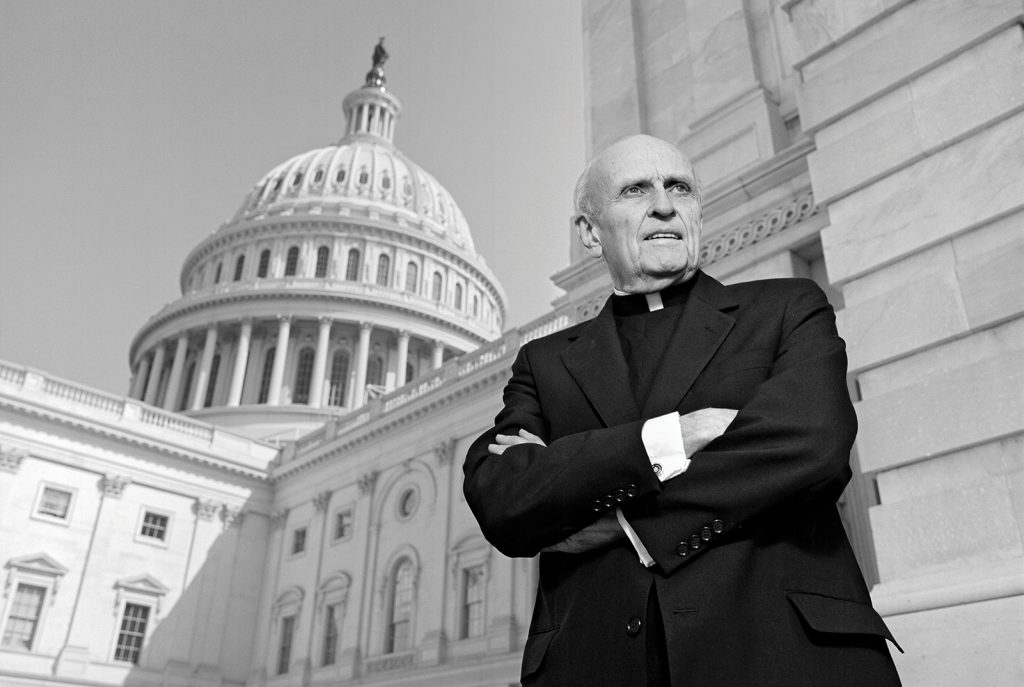
Robert Frederick Drinan’s (1920-2007) background in one way was rather unusual for a political career, but in another way it was all too usual. In 1942, he entered the Jesuit order and while in the order he earned his law degree from Georgetown in 1950. Drinan was ordained in 1953 and was admitted to the bar in 1956, but his primary work was as a law professor. He kept himself busy, serving as vice president of the Massachusetts Bar Association from 1961 to 1964 and on the Massachusetts Civil Rights Commission from 1962 to 1971. This legal background provided a basis for a political run, while his status as a Catholic priest added an aura of moral authority and interest in him as a candidate.
In 1970, Father Drinan ran for Congress, challenging incumbent Philip J. Philbin for renomination. Philbin had served in Congress since 1943 and was vice chairman of the House Armed Services Committee. His record, although in many ways liberal and included a vote for the Cooper-Church Amendment, did not meet the anti-Vietnam War litmus test of young liberals, and Drinan narrowly defeated him. Drinan’s campaign manager was none other than John Kerry. This run attracted great attention, with National Review’s William F. Buckley, Jr. dubbing him “the greatest threat to orderly thought since Eleanor Roosevelt left this vale of tears” (Feeney). Indeed, his win came on the heels of other ultra-left-wing victories in Democratic primaries, such as the ouster of Berkeley’s Jeffery Cohelan for Ron Dellums, and New York City’s Leonard Farbstein being tossed for Bella Abzug. While in Congress, Drinan wore his Jesuit priest outfit with a Congressional pin. When questioned about the propriety of wearing this instead of a regular suit, he responded, “It’s the only suit I own” (Glass).
Drinan filed the first impeachment against President Nixon in 1973, but this was not for Watergate, rather for his secret bombing of Cambodia. Tip O’Neill recalled this effort in his memoirs, “Morally, Drinan had a good case. But politically, he damn near blew it. For if Drinan’s resolution had come up for a vote at the time he filed it, it would have been overwhelmingly defeated — by something like 400 to 20. After that, with most of the members already on record as having voted once against impeachment, it would have been extremely difficult to get them to change their minds later on” (Feeney). Two years later, he would file impeachment charges for Ambassador to Iran Richard Helms for his activities as CIA director. Father Drinan was also a passionate advocate for imprisoned Soviet dissidents, and he was among the leaders of efforts to free Natan Sharansky, who eventually was freed after eight years in a Soviet gulag. As a Catholic priest in Congress, he stood out for his opposition to the Hyde Amendment barring Medicaid funding for abortions, a stance that attracted a lot of criticism from other prominent Catholics. In 1980, Pope John Paul II issued a papal order that all priests leave elected office. Drinan then announced that he would not run for reelection but was allowed to finish out his term, and when some of his staunch supporters suggested that he ignore the papal order, he responded, “That would be unthinkable” (Sprigg).
Although reported by Politico on his death that Drinan was the only Catholic priest elected to Congress, this is not true. While he was the only Jesuit priest, Robert John Cornell of Wisconsin, also a liberal Democrat, was also a Catholic priest. However, he lost reelection before the Pope’s order for all priests to depart elected office and unlike Drinan, opposed government funding for abortion. Drinan’s liberal status was most indicated by the fact that he sided with the liberal Americans for Democratic Action 100% of the time and never missed any of the votes they counted. He also sided with the conservative Americans for Constitutional Action only 8% of the time, and his DW-Nominate score stands at -0.422. He would become the chairman of Americans for Democratic Action after his time in office and for the rest of his life teach at Georgetown University Law Center. In 1996, Drinan spoke in support of President Clinton’s veto of the Partial Birth Abortion Ban Act. Upon his death on January 28, 2007 at the age of 86, Senator Ted Kennedy (D-Mass.) lauded him, “He was a profile in courage in every sense of the word, and the nation has lost one of the finest persons ever to serve in Congress” (Feeney).
References
ADA Voting Records. Americans for Democratic Action.
Retrieved from
Drinan, Robert Frederick. Voteview.
Retrieved from
https://voteview.com/person/13013/robert-frederick-drinan
Glass, A. (2007, January 29). Father Drinan Dies at 86; Only Catholic Priest Elected to Congress Backed Abortion Rights. Politico.
Feeney, M. (2007, January 29). Congressman-priest Drinan dies. Boston Globe.
Retrieved from
Sprigg, P. (2007, April 30). Robert Drinan, Infanticide, and the “Unthinkable”. First Things.
Retrieved from

