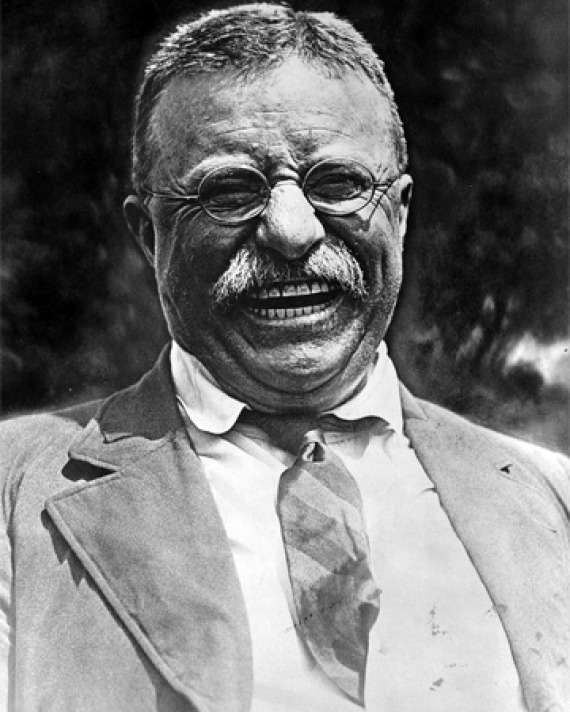
Theodore Roosevelt is a figure who can be cited for what I call the “party switch narrative”. After all, he is strongly associated with the Progressive movement that swept the Unted States in the early 20th century, and many Democrats as of late have preferred to use the label “progressive” as opposed to “liberal” and many of their opponents have gone along with this, myself admittedly included. However, this may give people the idea that the Democrats of now are the natural successors of Theodore Roosevelt. Oh, how we play with language! To be fair, the 1912 Progressive Party did have numerous figures associated with it who would later translate their support into support for New Deal liberalism. Perhaps the most prominent example is Harold Ickes, a Progressive who would later serve as FDR’s Interior Secretary and director of the Public Works Administration. I write this to point out that this narrative isn’t conjured out of thin air, but I find the notion that being part of the Progressive Party translates into New Dealism and modern-day liberalism to be deeply flawed.
The 1912 election was one of those that defied the typical two-party formulation we know of in American politics, and this was only possible because the leader of the third party himself had been a popular president: Theodore Roosevelt. His handpicked successor, William Howard Taft, had turned out to be more conservative than he expected. Tariff reform of the record-high Dingley Tariff under him had only produced a net 5% reduction on tariffs, as he had given in to conservative Republican leaders in getting a weak reduction bill through in the Aldrich-Payne Tariff. There was also the controversy Taft had gotten into when he had sided with his Interior Secretary Richard Ballinger over U.S. Forest Service chief Gifford Pinchot, an ardent conservationist. Pinchot had accused Ballinger of acting illegally to aid a former client of his, and although Ballinger was eventually exonerated of illegality, it was established that Ballinger was anti-conservation, and this contributed to the conservative-progressive split in the GOP in which the conservatives in the GOP sided with Taft and the progressives sided with Pinchot.
To know what to make of it, let’s use first a primary source, namely the Progressive Party platform! This platform was largely written by Progressive reformer Charles McCarthy. From here on out any quotes regarding the Democratic, Progressive, and Republican party platforms will be, unless otherwise specified, sourced from the respective platforms themselves, the links for which will be in References.
On Business:
The Progressive Party supported a “strong National regulation of inter-State corporations”. For the latter, the Progressive Party platform clarifies, “The concentration of modern business, in some degree, is both inevitable and necessary for national and international business efficiency. But the existing concentration of vast wealth under a corporate system, unguarded and uncontrolled by the Nation, has placed in the hands of a few men enormous, secret, irresponsible power over the daily life of the citizen — a power insufferable in a free Government and certain of abuse”.
. The Progressive Party stood for strong regulation of interstate corporations through a federal commission, namely creating a sort of Interstate Commerce Commission for them. This was, interestingly, a conservative substitute from Theodore Roosevelt, who had removed a strong provision for “trust busting”, which critics attributed to the influence of key financial backer George Walbridge Perkins, a director of U.S. Steel.
. Such “constructive regulation”, as the Progressive Party platform called it, “legitimate business” was intended to thrive as it would not be subject to “fruitless litigation”. The Progressive Party was seeking to, in its own way, to make doing business in the United States easier through curbing monopolies.
. Stood for strengthening the Sherman Anti-Trust Act of 1890.
. Stood for the federal government cooperating with business to help them expand their global reach, citing Germany as an example of the success of this approach. The GOP during the Harding and Coolidge Administrations sought to do this by giving favorable tax treatment to American businesses in China.
On Tariffs:
“We believe in a protective tariff which shall equalize conditions of competition between the United States and foreign countries, both for the farmer and the manufacturer, and which shall maintain for labor an adequate standard of living”.
“We condemn the Aldrich-Payne bill as unjust to the people.”
The Progressive Party on Labor
. Occupational safety laws, including “minimum safety and health standards”.
. Prohibiting child labor (a popular position with the regular GOP as well, a regional rather than a left-right one as evidenced by the vote on the Keating-Owen Act in 1916).
. Requiring one day off a week for wage workers.
. An eight-hour day in continuous 24-hour industries and for women and young people.
. A minimum wage for women.
. A “livable wage” in all industrial occupations.
. The abolition of the convict contract labor system (directed at the South).
. Worker’s compensation.
Interestingly, worker’s compensation was also a concept supported by GOP conservatives…it is a way to streamline injury claims that would otherwise be separate lawsuits. Thus, there were some Democrats who opposed this as they believed that a worker ought to be able to file their own suit for injury, with potentially greater damages for companies.
These explicit endorsements of labor laws were not present in the Republican or Democratic Party platforms. Both Democrats and Progressives, however, opposed how the courts were treating unions.
The Progressive Party on Healthcare
. The Progressive Party stood for consolidating all existing agencies addressing public health into a single national health service. This could be seen as an efficiency measure.
On Conservation
“The natural resources of the Nation must be promptly developed and generously used to supply the people’s needs, but we cannot safely allow them to be wasted, exploited, monopolized, or controlled against the general good. We heartily favor the policy of conservation, and we pledge our party to protect the National forests without hindering their legitimate use for the benefit of all the people.
Agricultural lands in the National forests are, and should remain, open to the genuine settler. Conservation will not regard legitimate development. The honest settler must receive his patent promptly, without hindrance, rules or delays.
We believe that the remaining forests, coal and oil lands, water powers and other natural resources still in State or National control (except agricultural lands) are more likely to be wisely conserved and utilized for the general welfare if held in the public hands”.
Their conservation stance seems rather moderate and nuanced compared to the environmentalism that ideologically developed in the 1960s and 1970s. The Progressive Party’s concerns revolve around lands being of use to people, or we might now say, they are anthropocentric. Old conservationism didn’t consist of rigid restrictions on development, rather emphasizing a wise use of resources. Whether this would translate to support for the Republican position of today of allowing oil drilling in the Arctic National Wildlife Refuge is unknowable, as the Progressive Party never contended with the modern environmentalism. If their anthropocentric perspective were to prove unmovable, then I suspect they would back the modern GOP position.
Currency
. Opposed the Aldrich currency bill on the grounds that “its provisions would place our currency and credit system in private hands, not subject to effective public control”.
On Taxation
The Progressive Party favored the adoption of a graduated inheritance tax as well as ratifying the income tax. The former stance is undoubtedly against modern GOP orthodoxy (which labels it the “death tax”) and the latter, although its adoption is bemoaned by hardliners, I think the reality is realized by most that the income tax is here to stay in some form.
On Immigration
“We denounce the fatal policy of indifference and neglect which has left our enormous immigrant population to become the prey of chance and cupidity.
We favor Governmental action to encourage the distribution of immigrants away from the congested cities, to rigidly supervise all private agencies dealing with them and to promote their assimilation, education and advancement”.
Although one cannot be precisely sure of where the Progressive Party would stand today on immigration, it is worth pointing out that their focus on assimilation is certainly against the identitarian mindsets that exist in the modern-day American left. What’s more, Progressive Party members of Congress were in favor of immigration restriction legislation, undoubtedly against the modern liberal position. However, it must be noted that immigration restriction was an issue that was backed by numerous labor unions at the time, including Samuel Gompers’ American Federation of Labor.
On Government Efficiency:
“We pledge our party to readjustment of the business methods of the National Government and a proper co-ordination of the Federal bureaus, which will increase the economy and efficiency of the Government service, prevent duplications, and secure better results to the taxpayer for every dollar expended”.
Interestingly, both the Republican and Democratic platforms also pledge to make the government more efficient. So, this platform is rather difficult to judge as “liberal” or “conservative”.
Direct Democracy:
The Progressive Party platform called for the adoption of Initiative, Referendum, and Recall. Some states adopted some of these direct democracy measures. 20 of 50 states have a form of recall. Neither the Democratic nor Republican platforms mention these direct democracy measures.
Some other notes:
. All parties state their opposition, at least in theory, to monopolies, thus this can’t really be considered a left-right issue, rather how to go about addressing monopolies is a left-right issue. The GOP platform asserts, to the disagreements of the Democratic and Progressive platforms, that it has “consistently and successfully enforced” the Interstate Commerce Act of 1887 (regulating railroads) and the Sherman Anti-Trust Act of 1890. The Democrats criticized the Republicans for embracing a “judicial construction” of anti-trust law, relying on courts to make rulings rather than setting hard and fast rules by the Federal government. Federal courts at the time, with many Republican appointees, had reputations of being favorable to business. Thus, management of trusts by courts is the “right” position. Ironically, Taft busted more trusts than Theodore Roosevelt through the judicial approach condemned by progressives.
. The Democratic and Progressive Party platforms endorse the income tax amendment while the GOP platform is silent on the matter.
. The Democratic and Progressive Party platforms condemn the Aldrich currency bill, which would in a modified form (namely partially private and partially public as opposed to entirely private) become the Federal Reserve under Wilson. while the GOP platform is again silent on the matter. The GOP platform’s framers may be aware of the unpopularity of specifics on Taft policy, and thus their platform language is vague.
. The clearest marker of polarization in this period is the tariff. The GOP enthusiastically embraces the protective tariff, the Democratic Party is opposed to the protective tariff, while the Progressive Party is, although supportive of the protective tariff, wanting to revise tariffs lower than the GOP. The GOP clearly regards the protective tariff as good for business, holding, “We condemn the Democratic tariff bills passed by the House of Representatives of the Sixty-second Congress as sectional, as injurious to the public credit, and as destructive to business enterprise”. However, the GOP platform doesn’t outright state support for the Payne-Aldrich bill, a measure that Taft himself had strongly defended. This was yet another example of vague platform language. The Democratic Party on the other hand asserts regarding the protective tariff that “the high Republican tariff is the principal cause of the unequal distribution of wealth; it is a system of taxation which makes the rich richer and the poor poorer [that aphorism in American politics actually goes back to Andrew Jackson]; under its operations the American farmer and laboring man are the chief sufferers; it raises the cost of the necessaries of life to them, but does not protect their product or wages.”
. The Progressive Party seems to be considerably more imaginative and innovative in policy proposals than the Republican and Democratic parties of the day, and some of its proposals will become part of FDR’s New Deal. Although not as to the left as the Democrats, the Progressive Party was more forward-thinking while the Democratic platform comes off as more focused on the issues of the present.
The Progressive Party won six states in the 1912 election: California, Michigan, Minnesota, Pennsylvania, South Dakota, and Washington. Roosevelt won more states and more votes than the Republican nominee, William Howard Taft, who only won Utah and Vermont. The Progressive split gives Taft the dreadful distinction for the flimsiest election performance of an incumbent president in American history. The Progressive Party also wasn’t just a Roosevelt vehicle, as it elected people to Congress too! In the 63rd and 64th Congresses, the following members were of the Progressive Party, and I have included their DW-Nominate scores:
. Charles Bell, Calif. – 0.32
. William Stephens, Calif. – 0.349
. James W. Bryan, Wash. – 0.189
. Jacob Falconer, Wash. – 0.213
. Ira Copley, Ill. – 0.329 – Ran for reelection in 1914 as a Progressive, but in 1916 was reelected as a Republican.
. William Hinebaugh, Ill. – 0.328
. Charles Thomson, Ill. – 0.285
. Whitmell Martin, La. – -0.132 – Served as a Progressive from 1915 to 1919, and as a Democrat from 1919 until his death in 1929. Martin was more favorable to tariffs than the usual Democrat, and part of this is him representing a Louisiana district, and Louisiana was one of the most favorable Democratic states to tariffs, as the sugar industry was powerful and favored high sugar tariffs. Martin is the only Progressive representative to switch to the Democratic Party.
. William J. MacDonald, Mich. – 0.212
. Roy Woodruff, Mich. – 0.348 – Woodruff served one term as a Progressive from 1913 to 1915, and then as a Republican from 1921 to 1953. In the latter period, he started as a moderate and backed numerous measures of the first New Deal. However, by FDR’s second term, he had firmly shifted to ultra-conservatism. This included opposing the Fair Labor Standards Act and scoring quite badly by Americans for Democratic Action standards from 1947 to 1952.
. Thomas Schall, Minn. – 0.321 – Schall would be one of the legislators in the 65th Congress responsible for allowing Democrats to retain a House majority. He would in the 1918 election switch back to the GOP. Later on, as a senator, he would be harsh critic of FDR until he was accidentally run over in 1935. Another thing of note about Schall was that he was blind.
. Walter M. Chandler, N.Y. – 0.305 – Chandler would serve from 1913 to 1919 and from 1921 to 1923. He would run for reelection as a Republican in 1916 given that the Progressive Party shuttered. Chandler would support much of conservative President Warren Harding’s agenda in his final term.
. Willis Hulings, Penn. – 0.29
. Henry M. Temple, Penn. – 0.427 – Temple would only be a Progressive in his first term in Congress, subsequently serving as a Republican, and a conservative one at that.
. Miles Poindexter, Wash. – 0.199 – Poindexter was the only Progressive Party senator. Interestingly, he would move sharply to the right later in his Senate career.
. James W. Bryan, Wash. – 0.189
The remaining Progressive Party members by the 65th Congress were notably critical for the Democrats maintaining control of the House, as three Progressives and one Socialist opted to caucus with the Democrats rather than allow Republicans, who had a plurality, to gain control. The figures on the Progressive Party legislators suggest that although the Progressive Party was of course to the left of the GOP, it was politically a bit of a mixed bag. The 1912 cartoon below illustrates a common perception of Theodore Roosevelt’s approach:
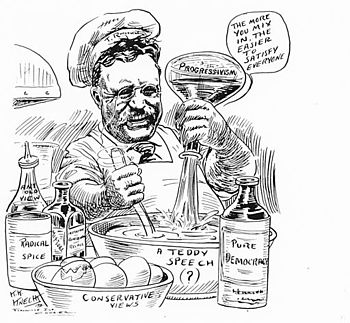
The political paths of men such as Miles Poindexter, Walter Chandler, Henry Temple, and most notably of all Roy Woodruff as he served during the Roosevelt and Truman Administrations, hardly speak of a radical philosophy, despite what regular Republicans tried to portray in the 1912 election. Its exterior as a party comes off as more progressive than its interior. Other figures who once identified as Progressives included Hamilton Fish III of New York (a staunch FDR critic) and most shockingly of all, Clare Hoffman of Michigan. Hoffman had run for district attorney on the Progressive Party in 1912, and his ideology during his time in Congress from 1935 to 1963 can be described as nothing short of extremely conservative. In some ways, the Progressives are in the middle between the Republicans and Democrats. They accept the protective tariff as opposed to “tariff for revenue only” but oppose how far the GOP has taken it. The protective tariff, as I previously noted, is the policy that Democrats in their platform blame for economic inequality. Indeed, it is underappreciated in modern day how much the tariff was thought of as a fundamental class issue then. And the protective tariff was as much of a cornerstone of GOP policy in that day as income tax reductions have been since 1981.
References
1912 Democratic Party Platform. The American Presidency Project.
Retrieved from
https://www.presidency.ucsb.edu/documents/1912-democratic-party-platform
1912 Progressive Party Platform. The American Presidency Project.
Retrieved from
https://www.presidency.ucsb.edu/documents/progressive-party-platform-1912
1912 Republican Party Platform. The American Presidency Project.
Retrieved from
https://www.presidency.ucsb.edu/documents/republican-party-platform-1912
CQG, 1985, pp. 77–78