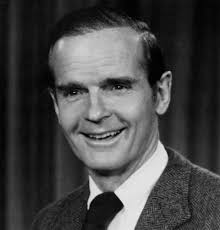
Wisconsin has produced its share of mavericks in politics. It is one of two states to have elected to Congress a member of the Socialist Party, its voters elected the legendary Robert La Follette, and they elected William Proxmire (1915-2005).
Proxmire’s political career began when Wisconsin was considered a Republican state rather than the swing state it is today. Its senators were Republicans Joseph McCarthy and Alexander Wiley, and the state had been trending towards conservatism since the 1938 midterms. Proxmire thrice ran for governor in the 1950s, but Wisconsin was still voting staunchly Republican in those years. However, the demise of one of Wisconsin’s most infamous figures provided the opportunity he needed.
On May 2, 1957, McCarthy died at Bethesda Naval Hospital as a consequence of his alcoholism and a special election was held to succeed him. In August, the voters elected him and could have scarcely picked someone further from him. Contrary to public custom of new senators giving some words of praise to their predecessors, Proxmire denounced McCarthy, calling him a “disgrace to Wisconsin, the Senate, and America” (Glass). This did not cost him at the polls, and he won a full term in 1958. At the time of his election, he was widely regarded as staunchly left-wing and initially he lived up to this reputation. Americans for Democratic Action gave him 100% scores in his first three years of Congress. Americans for Constitutional Action, which covered his record from 1958 to 1959 in its 1960 release of its first index, gave him a 10%. Proxmire was loyal to numerous bread and butter Democratic causes, such as food stamps and strengthening organized labor. However, Proxmire came to have a bit of a skeptical eye on spending, and this resulted in his dissents with Democratic amendments and legislation increasing overtime. He was an enemy of pork barrel amendments and joined Wayne Morse of Oregon as a liberal dissenter on foreign aid spending. This didn’t make him some crusty conservative non-interventionist or particularly anti-communist in foreign policy; he supported the Partial Nuclear Test Ban Treaty in 1963 and from 1967 until the Senate voted to ratify in 1986, he spoke every day the Senate was in session for the Treaty on the Prevention of Genocide. Proxmire also backed numerous Northern Democratic domestic policy fundamentals such as the Economic Opportunity Act of 1964, Medicare, civil rights legislation, and federal aid to education. He dissented from the Johnson Administration on tax reduction as he believed spending restrictions should be in place for such a cut, a stance in conflict with the Keynesian philosophy of the White House and a majority of lawmakers of the day.
Attendance Record and Fitness
Proxmire was legendary for, among other things, his almost perfect attendance record. Quite a healthy man who was into fitness, he from April 20, 1966, to October 18, 1988, did not miss a single vote in the Senate. This is a record that has yet to be broken by any senator, and it was another indicator to Wisconsin voters that they had a special senator. The New York Times reported in 1978 that the 62-year-old Proxmire’s morning consisted of “100 push-ups and 200 sit-ups, 50 at a time” and that he ran 4.9 miles to his office (Tolchin).
Proxmire vs. The Vietnam War
Although Proxmire had voted for the Gulf of Tonkin Resolution, he would join Wayne Morse as one of the foremost critics of the Vietnam War and criticize both the Johnson and Nixon Administrations. In 1970, he voted for the Cooper-Church Amendment to end the US military presence in Cambodia and for the McGovern-Hatfield “End the War” Amendment providing for a timetable for withdrawal from Vietnam. His record of staunch opposition to the Vietnam War as well as his deep-seated skepticism to funding the B-1 Bomber and the MX Missile contributed to his shockingly low DW-Nominate score of -0.598, which is, if you take DW-Nominate at face value, lower than Bernie Sanders.
Proxmire the Incorruptible and Frugal
William Proxmire not only was not corrupt, but he also did much to avoid any such impression. He refused to accept reimbursements for travel expenses. Not all senators appreciated such gestures, possibly because they made them look bad by comparison, but many also regarded him as a grandstander (Severo). Some Wisconsinites were critical of him for his tightfistedness as it contributed to Wisconsin getting less federal money than perhaps it otherwise would and thought him ineffective, but these folks were in the minority. Proxmire only went on one junket (a taxpayer funded trip) in his entire career and was similarly notorious for his personal frugality.
When it came to New York City’s bailout, although Proxmire voted for it, he became known for his oversight of the city in the process as chairman of the Senate Banking and Finance Committee, with The New York Times describing him as “the de facto viceroy of New York City, a potentate imposed by an alien power, in this case the Federal Government” (Tolchin). New York City was reliant upon him to approve of continuing the federal loan program to the city, and thus his opinions became of paramount importance. The New York Times wrote, “On those occasions when officials persist in policies that he opposes, they invariably reverse themselves. His criticism led City Council officials to relinquish a 50 percent pay raise they had voted for themselves. How, he had asked, could they expect city employees to hold the line in negotiations? He was instrumental, too, in persuading City University to end free tuition” (Tolchin).
Proxmire vs. Scientists (Govt. Funded Ones, Anyway)
In his quest to curb wasteful spending in government, William Proxmire became the bane of scientists who sought government research grants. From 1975 to 1988 he monthly sponsored his “Golden Fleece Awards”. The first study he awarded was one by the National Science Foundation for $84,000 on why people fall in love. Proxmire explained his opposition to funding, “not only because no one – not even the National Science Foundation – can argue that falling in love is a science; not only because I’m sure that even if they spend $84 million or $84 billion they wouldn’t get an answer that anyone would believe. I’m also against it because I don’t want the answer” (Glass). Other Golden Fleece Awards per Richard Severo (2005) and Martin Tolchin (1976), both of The New York Times, went to:
. A $97,000 study that included covering what happened in a Peruvian brothel, with researchers making multiple visits for what they claimed was for accuracy.
. A $57,800 study by the Federal Aviation Administration to study measurements of airline stewardesses, including the “length of the buttocks” and how their knees were arranged when seated.
. A $27,000 Justice Department study on why prisoners want to escape.
. A $3,000 Pentagon study to ascertain if soldiers should carry umbrellas in the rain.
. A $10,900 study by the National Institute of Alcohol Abuse to determine whether intoxication makes fish more aggressive.
Proxmire also crossed the scientific community in his skepticism over NASA funding. Indeed, NASA has been a target for cuts from both figures on the left and right, and Proxmire was between camps. This resulted in what was called the “Proxmire Effect”, in which government scientists were increasingly reluctant to pursue less conventional research lest it attract Proxmire’s critical eye and potentially “win” a Golden Fleece Award (Kress). Proxmire’s commitment to trimming waste, even if it meant crossing the scientific community, added to his reputation as a legislator with great integrity.
Proxmire and the Supreme Court
Proxmire generally supported nominating liberal justices to the Supreme Court and opposed conservative ones. He voted against both Clement Haynsworth and G. Harrold Carswell for the court, but he crossed liberals when he voted for William Rehnquist both for associate justice in 1971 and for chief justice in 1986. Proxmire did, however, vote against the confirmation of Robert Bork in 1987.
A Most Unconventional Reelection Strategy
In 1976, Proxmire told his secretary-treasurer John D. Finerty to his shock that he would not accept any campaign contributions for his reelection and proceeded to announce this to the public. For a normal politician especially today, this is probably suicide, but Proxmire was not a normal politician and was by this time quite popular. He figured that if he’s for reductions in government spending, he should be trimming campaign spending too. Proxmire won reelection with 73% of the vote by simply campaigning around the state out of his own pocket, and he only paid $177.73 to run for reelection (Tolchin). He was a vigorous campaigner and shook the hands of so many voters on one occasion that his hand needed to be bandaged due to blisters (Kelly). This didn’t slow him down much though as he got right back to it! Proxmire said regarding his approach, “I think fully two-thirds of the senators could get re-elected without spending a penny” (Severo). He again did not accept any campaign contributions for 1982 and won with 65% of the vote.
Proxmire and Reagan
Proxmire proved surprisingly friendly to the Reagan Administration in many respects. For 1981, the first year of the Reagan Administration, ACA scored him a 71% while ADA scored him a 55%. He supported tax reduction and reductions of domestic expenditures, very much contrary to what his party wanted. Like Reagan, Proxmire was pro-life. However, he retained his skepticism to military spending and opposed Reagan’s spending buildup as well as his military aid to Central American nations such as El Salvador.
On August 27, 1987, Proxmire announced his retirement without giving any indicators beforehand to his family or staff, citing his age of 71, not wanting to be approaching 80 while in the Senate. I have just one thing to say about that: how quaint! Proxmire continued to work in his law office until he started showing symptoms of Alzheimer’s disease, being officially diagnosed in 1998. He died on December 15, 2005, in a Sykesville, Maryland nursing home at the age of 90. Wisconsin hasn’t had another senator like Proxmire and they probably never will again, for there was one and only Bill Proxmire. Although my viewpoint is conservative, I have a tremendous admiration for this man’s sense of discipline,
References
Glass, A. (2015, April 20). Sen. William Proxmire starts vote streak, April 20, 1966. Politico.
Retrieved from
https://www.politico.com/story/2015/04/this-day-in-politics-april-20-1966-117125
Kelly, J. (2022, September 28). Before money ruled politics, how William Proxmire sold himself to Wisconsin. The Cap Times.
Retrieved from
https://captimes.com/news/government/before-money-ruled-politics-how-william-proxmire-sold-himself-to-wisconsin/article_742dd3ec-48c9-5a32-9e87-002db30ecc36.html
Kress, K.A. (1978) Parapsychology in Intelligence: A Personal Review and Conclusions. Central Intelligence Agency.
Retrieved from
https://www.cia.gov/readingroom/docs/NSA-RDP96X00790R000100010031-3.pdf
Proxmire, William. Voteview.
Retrieved from
https://voteview.com/person/7638/william-proxmire
Severo, R. (2005, December 16). William Proxmire, Maverick Democratic Senator From Wisconsin, Is Dead a 90. The New York Times.
Retrieved from
https://www.nytimes.com/2005/12/16/us/william-proxmire-maverick-democratic-senator-from-wisconsin-is-dead-at.html
Tolchin, M. (1978, May 28). The Perplexing Mr. Proxmire. The New York Times.
Retrieved from
https://www.nytimes.com/1978/05/28/archives/the-perplexing-mr-proxmire-with-new-york-facing-bankruptcy-by-hands.html

