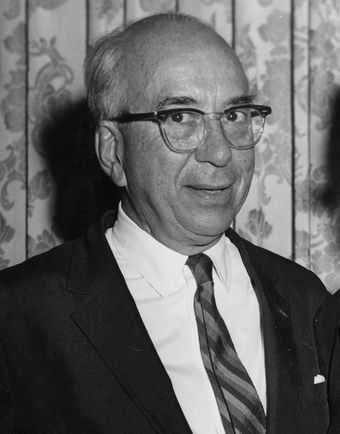
One of the more controversial figures to have worked in the federal government was Lewis Strauss. Strauss’s career in government began as a young man when he volunteered his services to Herbert Hoover in 1917 for the Belgian Relief Commission and then participated in Hoover’s efforts to feed Europe after World War I. His work under Hoover got him into working on Wall Street, where he made his fortune in the 1920s. Strauss was wedded on both a partisan and ideological basis to the Republican Party, and had been a strong opponent of the New Deal. During World War II, Strauss served in the U.S. Navy but in a desk position due to his poor eyesight, but his work was of enough merit to get him the rank of rear admiral the Distinguished Service Medal, Legion of Merit. During the Truman Administration, he was tapped to serve on the Atomic Energy Commission, where he was a frequent dissenter to the others, who were Democrats. One success that Time Magazine (1959) credits him with was pulling out all the stops to get the government to set up an atomic test detection system when other AEC commissioners would not support it, which resulted in us knowing that the Soviets had detonated an atomic bomb in 1949. He also successfully pushed, over the objections of physicist J. Robert Oppenheimer, the development of the H-Bomb, although he was far from the only person to push this. The U.S. did beat the Soviets by nine months in testing the H-Bomb (Time Magazine). However, his way of going about things got him a reputation for competence and intelligence but also arrogance and ruthlessness. Time Magazine (1959) described the contrast in perspectives between supporters and opponents, “In the eyes of friends, he is brilliant, devoted, courageous and, in his more relaxed moments, exceedingly charming. His enemies regard him as arrogant, evasive, suspicious-minded, pride-ridden, and an excessively rough battler.” Indeed, Oppenheimer would be on the receiving end of Strauss’s rough battling due to personal differences, political differences, and national security concerns with him being denied renewal of his security clearance in 1954 due to his ties to communists, which included Strauss successfully lobbying FBI director J. Edgar Hoover to conduct surveillance on him, which included illegal wiretapping. However, he was far from alone in the push against Oppenheimer. The Defense Department as well as President Eisenhower himself were working against him. Strauss also crossed western senators in his successful effort to block the Atomic Energy Commission from constructing nuclear power plants (leaving this to the private sector) and his efforts at pushing private over public power, but again this was not all Strauss; Eisenhower and his Budget Bureau were behind this push (Time Magazine). Strauss served as Eisenhower’s chairman of the Atomic Energy Commission and was initially going to bow out of public service in 1958. However…
In October 1958, Strauss was tapped to serve as acting Secretary of Commerce by President Eisenhower, after the resignation of Sinclair Weeks, and was sworn in on November 13th. He did have to be confirmed to serve as the actual Secretary of Commerce, and he had made enemies on Capitol Hill. One figure he had repeatedly crossed on policy was Senator Clinton Anderson (D-N.M.) on policy and had really done it when he implied in a speech that the senator and other critics of him not releasing research information on atomic energy research projects to them did not understand the relationship between atomic energy and national security. Anderson came up with a strategy on defeating his nomination to hold weeks of hearings, reasoning, “I thought if the committee members saw enough of him, he would begin to irritate them, just as he has me” (Time Magazine).
The source of Strauss’s defeat, although most commonly publicized based on the film Oppenheimer as his role in denying the renewal of his security clearance, there were more factors at play in his defeat. One was his pushing of private over public power, which displeased Democratic senators in the west as previously mentioned, but another was his highly defensive and condescending attitude. Indeed, it was a bad sign for him when his nomination was only narrowly favorably reported out of committee on a 9-8 vote. President Eisenhower was resolute in supporting Strauss’s nomination and would not back down even if Strauss offered to back out (Time Magazine). In the face of opposition led by Anderson and freshman Senator Gale W. McGee (D-Wyo.), Strauss refused to admit any errors on his part. Time Magazine (1959) observed that had he given even a little ground, he would likely have been confirmed. Another factor was that the Democrats, who had won a blowout victory in 1958, were repeatedly facing Eisenhower’s veto pen for their proposals, thus one way they could assert some authority was by denying his nomination.
Supporters of Strauss’s nomination spoke out:
Andrew Schoeppel (R-Kan.) said of him that he is “personifying a philosophy of government which some feel impelled to combat and destroy. Mr. Strauss quite simply is a conservative…He has always stubbornly resisted anything which seemed to him to be an undue encroachment by the Legislative Branch” (CQ Press).
Prescott Bush (R-Conn.) criticized the efforts against his nomination as “The campaign of character assassination” (CQ Press).
Hugh Scott (R-Penn.) condemned the campaign against him, stating, “In all my career I have never before witnessed such a well-planned attempt at legislative lynching….(Yet) in 16 days of hearings I saw no evidence to justify an adverse recommendation on this nomination. Lewis Strauss’ competence, patriotism and excellent background were never challenged” (CQ Press).
Some supporters, such as Rep. Steven Derounian (R-N.Y.) and Sen. Scott (R-Penn.), alleged anti-Semitism in the opposition to Strauss (Time Magazine).
Opponents of Strauss
Opponents of Strauss, who wrote the minority report on his confirmation, charged Strauss with “deception,” telling “unqualified falsehoods” and creating “myths” about his own achievements (Time Magazine). As noted before, Anderson and McGee were the chief foes, and they were helped by certain pro-Strauss industrialists who lobbied heavily for him and in a way that was seen as unseemly. Also a boon for opponents of his nomination was that Strauss insisted on cross-examining hostile witnesses and senators which fueled more opposition to him (U.S. Senate).
When the nomination looked like it was going to be close, Republican senators were desperately flown in to cast votes. However, it was to no avail; on June 19, 1959, Strauss was rejected 46-49. The Democratic vote on his nomination was 15-47 and the Republican vote was 31-2. His nomination President Eisenhower was deeply disappointed, calling his rejection the “second most shameful day in Senate history” (the first was the Andrew Johnson impeachment trial) (Drury). The two Republican dissenters were Maine’s highly independent-minded Margaret Chase Smith and aging populist maverick William Langer of North Dakota. The Democratic supporters of his nomination were Arkansas’ John McClellan, Connecticut’s Thomas Dodd, Florida’s Spessard Holland, Georgia’s Richard Russell, Louisiana’s Allen Ellender, Mississippi’s James Eastland and John C. Stennis, New Mexico’s Dennis Chavez, Ohio’s Frank Lausche, Oklahoma’s Robert S. Kerr, Rhode Island’s John O. Pastore, South Carolina’s Strom Thurmond, Tennessee’s Albert Gore, and Virginia’s Harry F. Byrd and Willis Robertson. To emphasize how rare confirmation rejections of cabinet nominees are, the last one to have been rejected was Charles B. Warren for Attorney General in 1925 and the next to be rejected would be John Tower for Defense Secretary in 1989. Strauss never served in another position in government and published his autobiography, Men and Decisions, in 1962. Strauss died on January 21, 1974, of cancer at the age of 77.
References
Drury, A. (1959, June 19). Senate Rejects Strauss, 49-46, at Night Session. The New York Times.
Retrieved from
Senate Rejects Lewis Strauss Confirmation. U.S. Senate.
Retrieved from
https://www.senate.gov/about/powers-procedures/nominations/strauss-nomination-rejected.htm
Strauss Nomination. CQ Almanac 1959. CQ Press.
Retrieved from
https://library.cqpress.com/cqalmanac/document.php?id=cqal59-1334314#_
The Administration: The Strauss Affair. (1959, June 14). Time Magazine.
Retrieved from
https://time.com/archive/6827665/the-administration-the-strauss-affair

