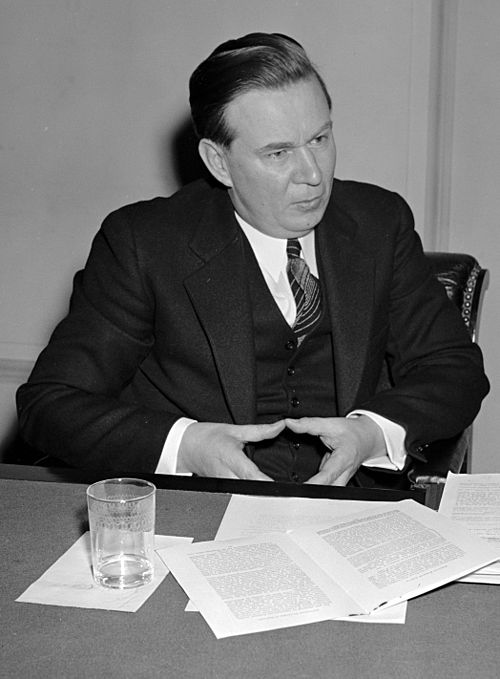
Thomas Amlie
I’d already written a post earlier about UDA-New Republic ratings from 1943, but I have found through a search of newspapers.com more information on the organization, the first vote guide they put out.
In 1942, Union for Democratic Action published through the left-wing The New Republic a pamphlet for voters led in crafting by former Representative Thomas Amlie of Wisconsin, who I already covered as a major example of a genuine RINO (Republican in Name Only), which he was during his first term. In the House and Senate he and his team tabulated 20 votes, 10 domestic, and 10 foreign by which to judge them. On its back, the upcoming 1942 election was proclaimed to be the most important in the nation’s history. Gee, how many have times have we heard that one before?
The House criterion for votes presents an issue as one of the twenty is not a roll call vote, rather a teller vote on whether to adopt FDR’s proposed $875 million WPA bill, which the House rejected 137-226 on January 13, 1939. They count the vote based on a reconstruction based on witness accounts as well as how legislators said they voted. This reconstruction was done by labor leader John L. Lewis’s Labor’s Non-Partisan League, but most troubling for my analysis, however, is that because they are so focused on making this relevant for 1942, they don’t tabulate the vote for representatives who left office in 1940. Thus, in order to reconstruct the vote myself I must find more sources…if I do reconstruct it I’ll update this post. It is rather compelling that there’s a vote so relevant but only done by voice vote that a labor group reconstructed it. There was, incidentally, a recorded Senate vote in which the $875 million bill was rejected by one vote. This, as well as reporting on the House vote indicates House GOP opposition to the $875 million bill to be overwhelming and one of the earliest victories of the Conservative Coalition.
The House roll call votes they count are, and I am going to put these in chronological order:
1. Fortification of Guam
Delete $5 million for fortification of Guam.
Adopted 205-168 (D 64-152; R 138-15; P 2-0; FL 1-0; AL 01), 2/39.
A “nay” is the liberal position.
2. Cut Military Plane Spending
Reducing funds for airplane construction by the military by $37 million.
Rejected 150-217 (D 3-207; R 145-8; P 2-0; FL 0-1; AL 0-1), 6/22/39.
A “nay” is the liberal position.
3. RFC Bond Authority
Motion to consider the bill providing the Reconstruction Finance Corporation authority to issue bonds.
Rejected 167-193: D 164-47; R 0-146; P 2-0; AL 1-0, 8/1/39.
A “yea” is the liberal position.
4. Continue Arms Embargo
Rep. James Shanley (D-Conn.) amendment to the Neutrality Act amendments, retaining the arms embargo.
Defeated 181-243, 11/2/39.
A “nay” is the liberal position.
5. Neutrality Revision
Passage of the bill repealing the arms embargo, a weakening of the Neutrality Acts.
Passed 244-171, 11/3/39.
A “yea” is the liberal position.
6. National Youth Administration
Amendment to the Department of Labor, Federal Security Administration, and related agencies, increasing funds for the National Youth Administration.
Adopted 218-159 (D 183-42; R 31-117; P 2-0; FL 1-0; AL 1-0), 3/28/40.
A “yea” is the liberal position.
7. Food Stamp Plan
Reduce funds for the food stamp plan, providing surplus food to the needy, from $85 million to $72.7 million.
Rejected 173-191 (D R 17-105), 5/9/40.
A “yea” is the liberal position.
8. Wagner Act Amendments
Passage of the Smith (D-Va.) amendments to the Wagner Act, which sought to limit the power of organized labor.
Passed 258-129 (D 116-112; R 142-14; P 0-1; FL 0-1; AL 0-1), 6/7/40.
A “nay” is the liberal position.
9. Conscription Bill
Passage of the bill instituting a peacetime draft for military preparedness.
Passed 263-149 (D 211-33; R 52-112; P 0-2; FL 0-1; AL 0-1), 9/7/40.
A “yea” is the liberal position.
10. Lend-Lease
Passage of the bill authorizing the U.S. to lend ships to Britain.
Passed 260-165 (D 236-25; R 24-135; P 0-3; FL 0-1; AL 0-1), 2/6/41.
A “yea” is the liberal position.
11. First Lend-Lease Appropriation
Passed 336-55 (D 231-6; R 104-45; P 0-3; FL 1-0; AL 0-1), 3/19/41.
A “yea” is the liberal position.
12. Property Seizure Bill
Passage of the bill authorizing the President to acquire property, with compensation, as needed for the national defense.
Passed 240-133 (D 215-11; R 25-122; P 0-3; AL 1-0), 08/05/41.
A “yea” is the liberal position.
13. Draft Extension
Passage of the bill extending the draft for an additional 18 months, the closest major vote of the session.
Passed 203-202 (D 182-65; R 21-133; P 0-3; AL 0-1), 8/12/41.
A “yea” is the liberal position.
14. Ban on Arming Ships Repeal
Adopted 259-138 (D 219-21; R 39-113; P 0-3; FL 0-1; AL 1-0), 10/17/41.
A “yea” is the liberal position.
15. Lifting Belligerent Port and Combat Zone Ban
Passed 212-194 (D 189-53; R 22-137; P 0-3; FL 0-1; AL 1-0) , 11/13/41.
A “yea” is the liberal position.
16. Vinson Anti-Strike Bill
Passage of the Vinson (D-Ga.) Anti-Strike bill, which includes the Smith (D-Va.) amendments placing numerous restrictions on organized labor activities.
Passed 252-136 (D 129-108; R 123-24; P 0-3; AL 0-1), 12/3/41.
A “nay”’ is the liberal position.
17. Price Control Limitation
Rep. Jesse Wolcott (R-Mich.) amendment, strike authorization for creation of the Office of Price Administration to issue and revoke licenses and provide for a board of review.
Rejected 189-210 (D 36-204; R 149-6; P 3-0; FL 1-0; , 1/6/42.
A “nay” is the liberal position.
18. Continue the Dies Committee
Adoption of the resolution extending the life of the investigative Dies Committee, which investigates communist and fascist, among other “un-American” activities.
Passed 331-46 (D 183-41; R 145-3; P 3-0; FL 0-1; AL 0-1), 3/11/42.
A “nay” is the liberal position.
19. Increase Funds for Public Power Projects
Adoption of the amendment providing $24 million in funds for the Table Rock and Bull Shoals public power projects.
Defeated 117-202 (D 110-76; R 3-126; P 3-0; AL 1-0), 3/27/42.
A “yea” is the liberal position.
Senate
Unlike the House, in which the votes go back to 1939, the Senate goes back to 1937 to account for a full term of senators up for reelection in 1942. This is the same thing that the conservative Americans for Constitutional Action did for their first set of ratings, which like UDA’s, were designed to influence voters for an upcoming election. Rather peculiarly, only foreign policy issues are counted for the 1941 Senate and the same goes for all but one of the House votes.
The following 29 legislators were singled out by Union for Democratic Action as obstructionists for defeat in the 1942 election, among them 18 Republicans and 11 Democrats.
1. Gilbertsville Dam
Adoption of the amendment appropriating funds for the Gilbertsville Dam as part of the Tennessee Valley Authority.
Adopted 46-29 (D 40-20; R 3-9; FL 1-0; P 1-0; I 1-0), 5/12/37.
A “yea” is the liberal position.
2. Recommit (Defeat) Court Packing Plan
Passed 70-20 (D 53-18; R 16-0; FL 1-1; I 0-1; P 0-1), 7/22/37.
A “nay” is the liberal position.
3. Housing Act Restriction
Sen. Harry Byrd (D-Va.) amendment limiting the housing bill’s costs to $4000 a unit.
Adopted 40-39 (D 26-37; R 13-0; FL 1-1; P 0-1), 8/4/37.
A “nay” is the liberal position.
4. Reorganization Plan
Adoption of FDR’s reorganization plan, which centralized more power in the executive. Although it passed here, it was defeated in the House.
Passed 49-42 (D 47-26; R 0-14; FL 0-2; P 1-0; I 1-0), 3/28/38.
A “yea” is the liberal position.
5. Roosevelt Administration WPA Measure
Sen. Kenneth McKellar (D-Tenn.) proposed to adopt the Roosevelt Administration figure of $875,000 for the Works Progress Administration.
Defeated 46-47 (D 41-26; R 2-20; FL 1-1; P 1-0; I 1-0), 1/27/39.
A “yea” is the liberal position.
6. Surtax on Incomes Starting at $3000 Instead of $4000
Sen. Robert La Follette Jr. (P-Wis.) amendment, providing for a more proportional tax system.
Defeated 38-38 (D 23-32; R 11-6; FL 2-0; P 1-0; I 1-0), 6/22/39.
A “yea” is the liberal position.
7. Delete RFC Loan for Railroads
Sen. Burton Wheeler (D-Mont.) amendment to the Public Works bill, deleting a Reconstruction Finance Corporation loan to railroads.
Adopted 45-32 (D 23-31; R 19-0; FL 2-0; P 0-1; I 1-0), 7/28/39.
A “nay” is the liberal position.
8. Resume Mandatory Arms Embargo
Rejected 33-60 (D 14-52; R 17-7; FL 2-0;P 1-0; I 0-1), 10/27/39.
A “nay” is the liberal position.
9. Passage of the Arms Embargo Repeal
Passed 63-30 (D 54-12; R 8-16; FL -1; P 0-1; I 1-0), 10/27/39.
A “yea” is the liberal position.
10. Cut Civilian Conservation Corps
Reduce funds for Civilian Conservation Corps camps by $25 million.
Defeated 14-43 (D 11-33; R 3-8; FL 0-1; P 0-1), 4/25/40.
A “nay” is the liberal position.
11. Labor Anti-Spy Bill
Passage of the bill stopping certain oppressive labor practices, such as employing spies within unions.
Passed 47-20 (D 37-14; R 7-6; FL 1-0; P 1-0; I-0), 5/27/40.
A “yea” is the liberal position.
12. Conscription Bill
Passage of the bill instituting a peacetime draft for military preparedness.
Passed 58-31 (D 50-17; R 8-10; FL 0-2;P 0-1; I 0-1), 8/28/40.
A “yea” is the liberal position.
13. Tax-Exempt Securities
Sen. Prentiss Brown (D-Mich.) amendment, stopping further issuing of tax-exempt securities.
Defeated 30-44 (D 19-34; R 8-10; FL 1-0; P 1-0; I 1-0), 9/19/40.
A “yea” is the liberal position.
14. Restrict Armed Forces to Western Hemisphere
Amendment to the Lend-Lease bill, restricting deployment of US forces to the Western Hemisphere.
Rejected 38-51 (D 12-48; R 25-2; P 1-0; I 0-1, 3/7/41.
A “nay” is the liberal position.
15. Substitute Loan for Lend-Lease
Amendment substituting Lend-Lease with a $2 billion loan to Britain.
Rejected 33-56 (D 13-48; R 19-7; P 1-0; I 0-1), 3/8/41.
A “nay” is the liberal position.
16. Lend-Lease Bill
Passed 60-31 (D 49-13; R 10-17; P 0-1; I 1-0), 3/8/41.
A “yea” is the liberal position.
17. No Transfer of Axis Ships to Great Britain
Amendment barring transfer of Axis ships to Great Britain.
Rejected 38-43 (D 15-39; R 22-3; P 1-0; I 0-1), 5/15/41.
A “nay” is the liberal position.
18. Extend Military Draft for 18 Months
Passed 45-30 (D 38-16; R 7-13; P 0-1), 8/7/41.
A “yea” is the liberal position.
19. Retain Belligerent Port and Combat Zone Bans
Defeated 38-49 (D 15-43; R 22-5; P 1-0; I 0-1), 11/7/41.
A “nay” is the liberal position.
20. Neutrality Act Revision
Passage of the bill repealing sections 3 and 6 of the Neutrality Act of 1939.
Passed 50-37 (D 43-15; R 6-21; P 0-1; I 1-0), 11/7/41.
A “yea” is the liberal position.
Not only was this offered as a guide for the voters, but UDA also highlighted three senators and twenty-six representatives who were up for reelection as key obstructionists of President Roosevelt’s agenda. These were:
Senate
C. Wayland “Curly” Brooks, R-Ill. – Staunch non-interventionist and domestic conservative.
Arthur Capper, R-Kan. – Longtime advocate for agriculture, his record was once supportive of the New Deal but had since moved to the right.
W. Lee “Pappy” O’Daniel, D-Tex.
House
Joe Starnes, D-Ala. – For his role on the House Committee on Un-American Activities.
Leland M. Ford, R-Calif. – Although Ford was an interventionist, he was one of the staunchest opponents of FDR on domestic issues.
Eugene Cox, D-Ga. – Cox was a prominent member of the House Rules Committee and a key figure in the Conservative Coalition.
Everett Dirksen, R-Ill. – Although considered an effective figure, that’s part of why he makes the list as a foe of FDR’s domestic and foreign policies. From 1959 to 1969 he would lead the Senate Republicans.
Stephen A. Day, R-Ill. – Prominent non-interventionist who published speeches through Flanders Hall, which was run by the Nazis’ top paid agent in the US, George Sylvester Viereck.
William P. Lambertson, R-Kan. – A rural progressive turned staunch conservative.
Thomas Winter, R-Kan. – A a strong opponent of the president on domestic and foreign policy.
Paul Shafer, R-Mich. – A representative taking after Clare Hoffman in his sheer opposition to the Roosevelt Administration.
Clare Hoffman, R-Mich. – A man whose record is described as almost 100% bad by UDA.
Harold Knutson, R-Minn. – Minnesota’s staunchest foe of President Roosevelt’s agenda.
John Rankin, D-Miss. – A staunch bigot who shifted right on numerous issues, but still was a strong supporter of public power.
Dewey Short, R-Mo., a staunch conservative known for his strong oratory against he Roosevelt Administration, in particular on the draft.
James F. O’Connor, D-Mont., for his allegiance to Senator Burton K. Wheeler and his non-interventionism.
Harry B. Coffee, D-Neb., who had been voting like a Republican.
J. Parnell Thomas, R-N.J., a prominent member of the House Committee on Un-American Activities.
William B. Barry, D-N.Y., for his status as a non-interventionist Democrat who spoke at America First events.
Hamilton Fish, R-N.Y., for his leading role in opposition to the Roosevelt Administration who had been careless in his connections.
Frederick C. Smith, R-Ohio, a conservative traditionalist in the mold of McKinley.
Martin Sweeney, D-Ohio, for his non-interventionism and having been the House’s leading supporter of Father Charles Coughlin.
James Van Zandt, backed by railroad interests and a consistent pusher of America First.
Charles Faddis, D-Penn. -For his increasingly rightist stances on domestic issues.
Karl Mundt, R-S.D., prominent non-interventionist.
Martin Dies, D-Tex. – For his leading the House Committee on Un-American Activities.
Howard W. Smith, D-Va. – Another Southern Democrat on the Rules Committee who pushed legislation to limit the power of organized labor.
Frank Keefe, R-Wis. – A staunch foe of the Roosevelt Administration on domestic and foreign policy.
Joshua L. Johns, R-Wis. – Another staunch Midwestern non-interventionist first elected by the splitting of the Democratic and Progressive votes.
Most of these people, including all of the senators, were returned to office in 1942. The successor organization, Americans for Democratic Action, would be a lot more successful in advancing liberal causes.
The approach of balancing out domestic and foreign votes met with criticism from another liberal, Morris H. Rubin of The Progressive magazine. He critiqued that Democrats with opposition records to the New Deal and organized labor were faring better than certain progressives because of foreign policy and that the release of this serves to divide real progressives. Although he opposes inclusion of foreign policy votes, which I don’t agree with, I largely concur with his criticism. I think UDA’s selection is over-weighted to the inclusion of foreign policy issues by making matters 50-50. Although a UDA representative in response held that the foreign policy records of a number of progressives served to cause division and denied that these scorecards were meant to be averaged out, I think the presentation of pluses and minuses gives ammo to this interpretation. This overall constitutes an early, flawed, and largely unsuccessful effort to bolster President Roosevelt. Yet, it is an interesting look at the issues the staunchly left among FDR’s backers found to be most important. There is more to say about UDA, but I will leave that for later.
References
A Congress to Win The War. (1942, May 18). The New Republic.
Retrieved from
https://archive.org/details/cainmnh_000157/mode/2up
Rubin, M.H. (1942, May 24). Progressive Editor Attacks New Republic-UDA Roll Call. The Capital Times (Madison, Wis.), 40.

