Recently Representative Adam Schiff (D-Calif.) was censured by the House entirely on party lines over his pushing of the Trump/Russia collusion narrative. Critics of the House majority either seem to think that the Trump/Russia collusion was true or that Schiff was being censured as petty retaliation for action against Paul Gosar (R-Ariz.) and Marjorie Taylor Greene (R-Ga.). I’ve got news for those folks for the latter. People have been censured for smaller things than this. One of them was Rep. William Bynum (D-Ind.).
The Reed Congress
The results of the 1888 election gave Republicans unified government for the first time since the Grant Administration, and Speaker Thomas Brackett Reed (R-Me.) aimed to make the most of it. He dramatically increased the power of the speaker and did so primarily by eliminating the disappearing quorum, in which members who were physically present would literally not answer their names as a way of denying the House the ability to conduct business. This would result in a ridiculous number of roll calls in which names were called out. Thus, with a small majority, Reed needed all the Republicans he could get, and this was proving a difficult task. Thus, one day he just counted people as present whether they answered their names or not. This resulted in a cacophony of protest from Democrats, Democrats trying to hide behind desks, and one kicking a door down to escape. Reed’s power consolidation led to his critics calling him “Czar Reed”. One representative was particularly heated in his condemnation of Reed’s rule. Minority Whip William D. Bynum (D-Ind.) angrily weighed in against “the arbitrary, the outrageous, the damnable rulings of the Chair” (Tuchman). However, although Bynum’s anger at the Speaker is cited as the cause of his censure, on further investigation I discovered this isn’t actually true. The issue actually related to a prominent Pittsburg resident.
Bynum spoke on the House floor against James Campbell, who had been accused of forgery, calling him a “liar and a perjurer” (The Sunday Herald). Republican Thomas Bayne read into the Congressional Record Campbell’s letter defending himself and called for Bynum’s remarks to be removed. Bynum, in response, called Bayne “the sewer through which this attack of Campbell made its way into the record” and upon objection changed it to “conduit pipe” and went on to say regarding Bayne that “I want to say now that I accept and am willing to believe that I have as great confidence in the character of Mr. Campbell as I have in the character of the gentleman who makes this attack upon me” (The Sunday Herald).
For this insult to another member, the Republican majority voted to censure Bynum for “unparliamentary language” on May 17, 1890, on a party line vote. The Democrats would win the House in 1890, but Bynum would lose reelection in the Republican sweep of 1894. Ironically, he would himself dissent from the Democratic Party come 1896 when they nominated William Jennings Bryan, instead running the party organization of the “National Democratic Party”, which supported the Gold Standard. President McKinley would in 1900 appoint him to the commission codifying U.S. criminal laws, where he would serve until 1906.
References
To Adopt the Last Part of the Resolution Regarding the Censure of William D. Bynum. (P. 4864). Govtrack.
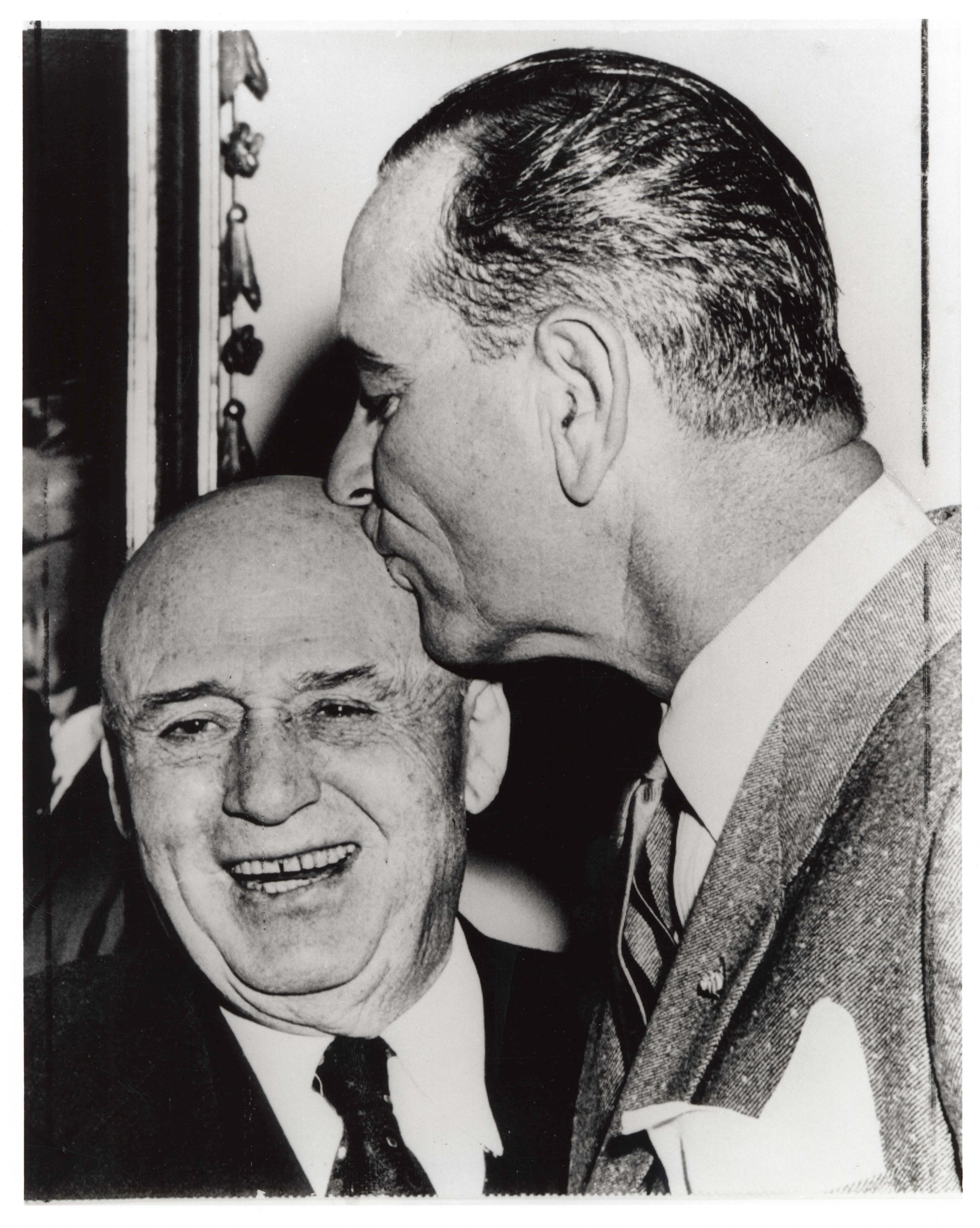
The victorious Democratic leaders: Speaker Sam Rayburn & Majority Leader LBJ.
The 1958 midterms don’t usually get a whole lot of attention, but they were in truth quite a turning point for conservatism vs. liberalism. The 1950s have been seen as a politically conservative period, which had at least been true in Congress. Conservatives had considerable strength for the past two decades, with it being particularly strong in the 78th, the 80th, and the 82nd and 83rd Congresses. In the Senate, the Democrats had only a 49-47 majority before this election, and after they had a commanding 62-34 lead, only to turn into a 65-35 lead after the addition of Alaska and Hawaii to the Union. This was the most severe blow the Conservative Coalition had experienced since its rise in the 1938 midterms and would set the stage for the liberal politics of the 1960s.
The following Senate seats either had Republicans defeated or retiring Republicans were succeeded by Democrats:
California – William Knowland (R) (MCI: 71%) retired to run for governor, succeeded by Rep. Clair Engle (D) (MCI: 22%).
Connecticut – William Purtell (R) (MCI: 61%) was defeated for reelection by former Rep. Thomas Dodd (D) (MCI: 19%).
Indiana – William Jenner (R) (MCI: 96%) retired, Vance Hartke (D) (MCI: 10%) defeated Harold W. Handley (R) to succeed him.
Maine – Frederick Payne (R) (MCI: 52%) was defeated for reelection by Governor Edmund Muskie (D) (MCI: 5%).
Michigan – Charles Potter (R) (MCI: 75%) was defeated for reelection by Phil Hart (D) (MCI: 1%).
Minnesota – Eugene Thye (R) (MCI: 57%) was defeated for reelection by Rep. Eugene McCarthy (D) (MCI: 2%).
Nevada – George Malone (R) (MCI: 84%) was defeated for reelection by Howard Cannon (D) (MCI: 37%).
New Jersey – H. Alexander Smith (R) (MCI: 63%) retired, former Rep. Harrison Williams (D) (MCI: 6%) defeated Rep. Robert Kean (R) to succeed him.
Ohio – John W. Bricker (R) (MCI: 98%) was defeated for reelection by former Rep. Stephen Young (D) (MCI: 18%).
Utah – Arthur Watkins (R) (MCI: 86%) was defeated for reelection by Frank Moss (D) (MCI: 10%), who benefited from the entry of Republican J. Bracken Lee, who ran as an Independent to Watkins’ right and won 26.4% of the vote.
West Virginia – W. Chapman Revercomb (R) (MCI: 84%) was defeated for reelection by Rep. Robert Byrd (D) (MCI: 28%), John Hoblitzell (R) (MCI: 76%) was defeated for election to a full term by former Rep. Jennings Randolph (D) (MCI: 25%).
Wyoming – Frank Barrett (R) (MCI: 87%) was defeated for reelection by Gale W. McGee (D) (MCI: 17%).
The following Senate seats had retiring Republicans succeeded by more liberal Republicans:
Pennsylvania – Edward Martin (R) (MCI: 90%) for Rep. Hugh Scott (R) (MCI: 53%), who defeated George M. Leader (D).
Vermont – Ralph Flanders (R) (MCI: 62%) for Rep. Winston Prouty (R) (MCI: 56%), who defeated Frederick J. Fayette (D).
Additionally, with the two states of Alaska and Hawaii being added to the union, the following senators were elected:
Alaska
Bob Bartlett (D) (MCI: 14%) Ernest Gruening (D) (MCI: 16%)
Hawaii
Oren Long (D) (MCI: 5%) Hiram Fong (R) (MCI: 52%)
Among the defeated or retired who were solid or ultra-conservatives were Jenner, Malone, Bricker, Martin, Watkins, Revercomb, and Barrett. Moderate conservatives defeated or retired were Knowland, Potter, and Hoblitzell. The moderates defeated or retired were Purtell, Payne, Thye, Smith, Ives, and Flanders. Every senator who defeated or succeeded another senator, with the exception of replacing Irving Ives (MCI: 47%) with Kenneth Keating (MCI: 54%), was more liberal and often considerably more liberal than his predecessor. Every single one of the new senators would support the Economic Opportunity Act of 1964 and Medicare and all won reelection in 1964 save for Kenneth Keating, who lost reelection to RFK, and Clair Engle, who died of a brain tumor. Democrats adding 15 seats provided a solid liberal base in the Senate for over two decades. Particularly notable was the defeat of Payne in a state that had previously had a registration ratio of 3 to 1 Republican…his opponent Edmund Muskie had as governor made massive inroads with voters for the Democratic Party (U.S. Senate).
The House: A Triumph for Liberalism
The Democrats increased their lead in the House from 234-201 to 283-153 lost 48 seats, which solidified their position in the majority until 1994. Democrats won a lot in the Midwest, gaining three seats in Illinois, six in Indiana, three in Iowa, two in Kansas, one in Michigan, two in Nebraska, one in North Dakota, three in Ohio, and two in Wisconsin. In New England, they defeated all six Republican representatives in Connecticut, won a seat in Maine, won a seat in Massachusetts, and won a seat in Vermont. The latter result was particularly jarring as William Meyer was the first Democrat to win an election to Congress from the state since before the Republican Party’s founding in 1854. This would be a temporary victory for them, as Rockefeller Republican Robert Stafford would defeat him in 1960, but it would prove a portend of the future. In Massachusetts, Republican Richard Wigglesworth was succeeded by Democrat Jimmy Burke, a hilariously shameless figure on spending and taxes who I’ve written about before (but from an electoral standpoint, was he wrong?). The seat would never again be held by a Republican. Also, the two Republicans (Silvio Conte and Hastings Keith) who kept seats being departed by retiring Republicans (John Heselton and Donald Nicholson) were more liberal than their predecessors. This election also hit home for President Eisenhower, as his district’s representative, Pennsylvania Republican S. Walter Stauffer, lost reelection to Democrat James M. Quigley (Time Magazine).
Another interesting tidbit was that moderate conservative Republican John J. Allen of California narrowly lost reelection to ultra-liberal Democrat Jeffery Cohelan. The district he lost covered Berkley and Oakland. To this day, Allen is the last Republican to represent these cities in Congress and today they are represented by Barbara Lee, one of the most liberal members of Congress.
Gubernatorial Elections
In these elections, Democrats gained a net of six governorships.
Democratic Gains
Alaska – William A. Egan (D) defeated John Butrovich (R) in the state’s first gubernatorial election.
California – Pat Brown (D) defeated Senator William Knowland (R) to succeed Goodwin Knight (R).
Maryland – J. Millard Tawes (D) defeated Congressman James Devereux (R) to succeed Theodore McKeldin (R).
Nebraska – Victor Andersen (R) was defeated for reelection by Ralph Brooks (D).
Nevada – Charles Russell (R) was defeated for reelection by Grant Sawyer (D).
New Mexico – Edwin Mechem (R) was defeated for reelection by John Burroughs (D).
Ohio – C. William O’Neill (R) was defeated for reelection by Michael DiSalle (D).
South Dakota – Ralph Herseth (D) defeated Phil Saunders (R) to succeed retiring Joe Foss (R).
Wisconsin – Vernon Thomson (R) was defeated for reelection by Gaylord Nelson (D).
Wyoming – Milward Simpson (R) was defeated for reelection by John J. Hickey (D).
Republican Gains
Arizona – Paul Fannin (R) defeated Robert Morrison (D) to succeed Ernest McFarland (D).
New York – Averell Harriman (D) was defeated for reelection by Nelson Rockefeller (R).
Oregon – Robert D. Holmes (D) was defeated for reelection by Mark Hatfield (R).
Rhode Island – Dennis J. Roberts (D) was defeated for reelection by Christopher Del Sesto (R).
Causes & Consequences:
For causes, the economy was in a recession in 1958, and this led to many Republicans being turned out of office, with President Eisenhower not being popular at the time. Although the primarily worked against Republicans, in New York it worked against Democratic Governor Averill Harriman, who was defeated by Nelson Rockefeller, providing a major boost to the latter’s profile. Another factor was simply the good looks of candidates themselves, as the more attractive candidates were consistently winning (Time Magazine). There was also the perception that the US was behind in the Cold War because of the launch of Sputnik. Also, organized labor was heavily mobilized to turn out for this election, and they did in droves to fight “right to work” proposals in certain states as well as the Eisenhower Administration’s support of such proposals. Such a proposal on the ballot in Ohio was widely believed to be the deciding factor in the defeat of Bricker, who had a history as a popular governor and VP nominee, was previously believed to be unbeatable (Hill).
After this election there were leadership changes in both chambers. In the House, the Republicans voted their leader Joe Martin of Massachusetts out in favor of Charles Halleck of Indiana. In the Senate, William Knowland of California had been their leader, and the Republicans elected whip Everett Dirksen of Illinois in his place although Rockefeller Republican John Sherman Cooper of Kentucky made a spirited run for the post.
The South
Before this time, Northern and Southern Democrats were fairly evenly divided, but with Northern Democrats now outnumbering Southerners by almost two to one, this would distinctly disadvantage them on the direction of the party (U.S. Senate). Most notably, the party would become bolder on civil rights. Among the senators newly elected in 1958, only Robert Byrd of West Virginia would vote against the Civil Rights Act of 1964 and the Voting Rights Act of 1965.
References
Hill, R. John W. Bricker of Ohio. The Knoxville Focus.
Maryland’s 6th district has been one of the less liberal and Democratic districts in the state, even with the redistricting from the 2010 census that made the area lean Democratic. From 1943 to 1959 it was represented by Republicans J. Glenn Beall Sr. and DeWitt Hyde, who were both moderate conservatives. However, 1958 was a pretty bad midterm for the GOP and they lost all three of the Maryland House seats they held. The only one they won back in 1960 was the 6th, and Charles McCurdy “Mac” Mathias (1922-2010) was their champion.
Moving to the Rockefeller Wing Early
Although Mathias criticized incumbent John Foley for voting with Americans for Democratic Action (ADA) (he had done so 8 out of 9 times in 1959 and 9 out of 9 times in 1960), it took him but a year for his record to move from that similar to his Republican predecessors to being in the liberal camp. While in 1961 he had scored a 30 by the ADA and 67 by Americans for Constitutional Action, he scored an 88 from the former and a 27 from the latter the next year. A portend for this development was that his third vote in Congress was to increase the House Rules Committee from 12 to 15, adding two Democrats and one Republican to counter the power of Chairman Howard W. Smith (D-Va.) and the conservatives on the committee who were blocking liberal legislation.
Mathias was a vote for the Economic Opportunity Act of 1964, Medicare, and other Great Society programs. However, he did dissent from the liberal position on food stamps and Urban Mass Transit. Mathias was also a strong supporter of civil rights and played a significant role in the passage of the Civil Rights Act of 1964. In 1966, he attempted to broker a compromise on fair housing legislation through his amendment, which would impose no limitations on discrimination from the homeowner or for owner-occupied rental establishments but would impose discrimination prohibition on the real estate broker. The bill was defeated in the Senate, but fair housing would be the core of the Civil Rights Act of 1968.
Boot Brewster!
In 1968, Mathias decided to run for the Senate against incumbent Daniel J. Brewster. Brewster had been Mathias’ college friend and was at the time for Democrats a rising star, the “Golden Boy” of Maryland’s politics. He was, unfortunately, suffering from alcoholism and he would later face corruption charges at least mostly on account of the acts of a corrupt aide. Brewster ultimately would plead no contest to a charge after a new trial was going to be held after his first trial resulted in an acquittal. Mathias would win by a plurality in a three-way race, with Brewster in second and perennial candidate George P. Mahoney running in third.
Aggravating Nixon
Not since ideological turncoat Charles Goodell of New York had a Republican senator gotten the goat of the Nixon Administration. Mathias voted against both Clement Haynsworth of South Carolina and G. Harrold Carswell of Florida for the Supreme Court. He was a Vietnam War dove and his record only had gotten more liberal from his House years. As Maryland Senate President Thomas Mike V. Miller Jr., put it, “He was an enemy to the Nixon White House…He didn’t like the Vietnam War and thought the Nixon Administration wasn’t progressive enough on civil rights” (Borda). On the latter, this was over President Nixon’s opposition to busing as well as his effort to cater to the South by nationalizing coverage of the Voting Rights Act of 1965. Rowland Evans and Robert Novak (1971) also observed this development, writing that he was “the new supervillain…in President Nixon’s doghouse…not since [Charles Goodell] was defeated with White House connivance has any Republican so outraged Mr. Nixon and his senior staff as Mathias. The senator’s liberalism and tendency to bolt party lines have bred animosity in the inner sanctum”.
In 1973, he was one of the earliest Republican supporters of an investigation into Watergate. Mathias would during his next election quote Edmund Burke, “Your representative owes you, not his industry only, but his judgment, and he betrays instead of serving you if he sacrifices it to your opinion”, to which he added, “I would point out that Edmund Burke was defeated at the next election”, but which he rejoined with, “But it was still the right answer” (Clymer). This time was also perhaps the height of his liberalism, but he disputed the degree of it. Although Americans for Democratic Action had only scored him wrong on one issue in 1973 (confirming Gerald Ford VP), the following year he said, “I’m not all that liberal. In fact, in some respects I’m conservative. A while ago I introduced a bill preserving the guarantees of the Bill of Rights by prohibiting warrantless wiretaps. I suppose they’ll say it’s another liberal effort, but it’s as conservative as you can get. It’s conserving the Constitution” (Clymer). This argument would certainly get the agreement of such people as Rand Paul, Mike Lee, and Thomas Massie today.
Thanks to his conflicted relations with the Nixon Administration, he was spared from the Watergate backlash in 1974. Mathias won reelection by about 15 points against future Senator Barbara Mikulski in a state in which Democrats outnumbered Republicans three to one in registration. Her vote overwhelmingly came from Baltimore, indeed the only county she won was Baltimore, but did so with only 51%.
Conservation
Mathias was a strong supporter of environmental legislation, and his most notable work involved preserving the Chesapeake Bay. His advocacy finally in 1984 resulted in the creation of the Chesapeake Bay Program to clean up and protect the bay under the Clean Water Act. He also successfully pushed for the passage of the Chesapeake and Ohio Canal National Historical Park.
Conflict with Reagan and Retirement
Mathias disapproved of the rising conservative influence in the party, and in 1976 outright considered running as an independent. This didn’t come to pass and in 1980 he made no such move despite his numerous reservations about Reagan. Although Mathias often voted with the Reagan Administration on taxes, he often was at loggerheads with him, and in 1986 he voted against elevating William Rehnquist to chief justice. Mathias also continued to back socially liberal positions and was opposed to much of Reagan’s foreign policy. He also continued his civil rights advocacy and played a significant role in the passage of the extension of the Voting Rights Act of 1965 in 1982.
Although it initially looked like Mathias might run for reelection in 1986, he chose to retire, and Barbara Mikulski won the election to succeed him. His lifetime MC-Index score was a 23%. Although he remained a Republican until his dying day, in 2008, he endorsed Democrat Barack Obama in the presidential election. Two years later, Mathias died of Parkinson’s Disease. To this day, Mac Mathias is the last Republican to represent Maryland in the Senate.
References
1966 Civil Rights Act Dies in the Senate.CQ Almanac 1966. CQ Press.
On June 8, 2023, televangelist and political influencer Pat Robertson died at the age of 93. I am not covering his legacy today, but that of his father, Absalom Willis Robertson (1887-1971), a political actor in his own right.
Robertson, an attorney, started his political career in Virginia young, in 1915 being elected to the Virginia State Senate, getting elected at the same time as a major player in Byrd. There he would author the Robertson Road Act, providing $14 million to assist localities for road construction, and was okay with using some bonds to fund road construction (Heinemann). He was a man of deep religious faith, after all he was named after the third son of King David, Absalom (Hill). Robertson, who would go by A. Willis, would pass on this faith to his children, most notable of course being Marion Gordon “Pat” Robertson. Although Pat’s central figure of instruction was his mother, Gladys, who was even more Biblically focused than her husband (Epps). Robertson would move out of the legislature in 1924 to serve as Commonwealth Attorney for Rockbridge County and would serve until 1928.
Robertson Goes to Congress
In 1932, Willis Robertson is elected to Congress At-Large from Virginia in the Roosevelt landslide. His territorial district is the 7th, and this would be restored with the 1934 midterms. The 7th was not the most secure territory for Democrats, as Republican John Paul had briefly served in the 67th Congress and the 1928 landslide by Herbert Hoover brought into office Republican Jacob Garber for a single term. Robertson was initially a supporter of FDR’s New Deal, backing the Agricultural Adjustment Act, the Tennessee Valley Authority, and the National Industrial Recovery Act, but he would soon have major disagreements with Roosevelt, and in 1935 he voted against work relief and Social Security. Although Robertson often quoted the Bible, he was in truth foremost devoted to the Constitution according to his friend Senator John C. Stennis (D-Miss.), stating, “He almost worshiped the Constitution — and had a fine knowledge of it, too” (Epps).
Robertson in the Senate
Robertson, like most Virginia politicians, was part of the Byrd Organization, and after Carter Glass’ death in 1946, he competed against Congressman Howard W. Smith and former Congressman Colgate Darden for the seat. These men all being friends of Byrd, he maintained neutrality in the contest. The primary was challenging, but Robertson pulled ahead after Darden withdrew and his supporters went to him. Winning the primary in Virginia at the time was tantamount to election.
Although a conservative, Robertson is considerably more moderate than Byrd himself. Unlike the hyper cost-conscious Byrd, he joins most Democrats in voting for Greek-Turkish Aid and the Marshall Plan. He was, like Byrd, an opponent of the Fair Deal. Also, unlike him, Robertson maintains loyalty in backing the Democratic Party’s candidates nationally. He backed Truman in 1948 and while Byrd found himself unable to endorse Adlai Stevenson in 1952 and 1956 on account of his liberalism, Robertson considered him a quality nominee and backed him whatever ideological differences existed. He also was far more devoted to his Senate duties than Byrd (he had a near perfect attendance record) and regularly studied legislation (Hill).
By the 1960s, Robertson is roughly equal to Harry Byrd in his conservatism but is independent of the Byrd Organization and is the chairman of the Banking and Currency Committee due to seniority. Although he publicly backs Byrd’s “Massive Resistance” policy to desegregation, he does so lukewarmly and has private reservations about its wisdom. This doesn’t mean that he slacks in his opposition to civil rights legislation nationally; on one occasion he dislocated his shoulder while gesticulating against a civil rights bill. Robertson also votes against the New Frontier and Great Society programs including LBJ’s “War on Poverty” and voted against its flagship legislation, the Economic Opportunity Act of 1964. He stated on the law, “Jesus said, ‘The poor ye shall always have with you'” (Epps). It is also no surprise given Robertson’s vote against Social Security that he voted against Medicare and Medicaid the following year. Robertson, among the many ways he crossed liberals, was in his opposition to financial disclosure statements from senators. But this was not out of fear that it would expose how wealthy he was, rather “He didn’t want anybody to know how poor he was because then they might run against him” (Epps).
The Lady Bird Whistle Stop – The End of a Career
Although Robertson is getting increasingly out of the times on his civil rights stances, it is a personal affront that most directly brings about his defeat. In 1965, Robertson was one of four Southern senators to snub Lady Bird Johnson in her traveling by train to Southern states to encourage support for civil rights legislation. This ticks off President Johnson, who sees an opportunity to end Robertson’s career. This wouldn’t have been possible in the last election as the Byrd Organization was a solid force, but in 1965 Byrd resigns due to his terminal brain cancer and the Voting Rights Act of 1965 dramatically increased voter participation of blacks and poor whites. Thus, Johnson recruits State Senator William B. Spong, a moderate, to run against Robertson in 1966. Spong criticizes a number of his conservative votes and him as being a man of the past. Robertson’s age doesn’t help as a few days before the primary election, Byrd, who was two weeks younger than him, slipped into a coma (Epps). Spong prevails in the primary by only 611 votes (Heinemann). His MC-Index score, which covers his entire career, is a 73% and his adjusted* ADA average score, covering 1947 to 1966, is a 14%. Robertson subsequently engaged in consulting work for the International Bank for Reconstruction and Development. He maintained an active lifestyle and good health until his sudden death on November 1, 1971. Robertson’s legacy partially lived on in his son, who one friend would state, “spent 50 years as a professional politician, with an alert bright son who just absorbed piles of this stuff — and then the very strange, remote, religious mother. The result is almost what you’d get if you wrote that novel” (Epps).
* – Not counting unopinionated absences towards ideology.
References
Epps, G. (1986, October 19). Pat Robertson’s a Pastor, But his Father Was a Pol. The Washington Post.
If anyone remembers Senator Roman Lee Hruska (1904-1999), it is probably for an unflattering argument he made for Supreme Court nominee G. Harrold Carswell in 1970. Leading the advocacy for Carswell in the Senate, he held that he was being opposed for being a Southerner and went on to say, “Even if he were mediocre, there are a lot of mediocre judges and people and lawyers. They are entitled to a little representation, aren’t they? We can’t have all Brandeises and Frankfurters and Cardozos” (Pearson). This was lampooned and there were even questions about whether there was an anti-Semitic tinge to it as all the justices he mentioned were Jewish. Hruska would not be the only senator to make an unfortunate argument for the allegedly mediocre Carswell, but his words stuck the most, both to Carswell and himself. This is unfortunate, as Hruska was a productive and accomplished legislator.
The 1952 Election: Congress
Hruska’s ascension to the national political scene coincided with Dwight Eisenhower’s, with him representing the 2nd district of Nebraska. However, he wouldn’t be there for long; in 1954, Senator Hugh Butler died of a stroke less than three months after Nebraska’s other senator, Dwight Griswold, had died of a heart attack. Although Samuel Reynolds was appointed to fill the Butler vacancy that year, he was merely a placeholder and it was Hruska who ran to complete the term. He was seated just in time to vote on Joseph McCarthy’s censure, which he voted against. Contrary to what Voteview and Govtrack report due to a data error, it was his colleague, placeholder Hazel Abel, who voted to censure McCarthy (UPI).
Hruska in the Senate
Hruska quickly established himself as a staunch conservative, but also a productive legislator and this got the positive attention of Everett Dirksen (R-Ill.). Hruska would become his best friend in the Senate and the main conservative he would turn to for advice and assistance in passing and opposing legislation. It also helped Hruska that he was a highly effective speaker and campaigner. He was even at one point considered as a possible leading public face for a conservative resurgence in the late 1950s, but Barry Goldwater was chosen by leading conservatives for this role as he was thought to be more telegenic (Hagel).
In 1957, he voted against the striking of 14th Amendment implementation from the Civil Rights Act of 1957 and the jury trial amendment. Although Hruska was often opposed to Democratic proposals on foreign policy including repeatedly voting against foreign aid, Dirksen got him to vote for the Partial Nuclear Test Ban Treaty in 1963.
In 1964, he served as one of the floor managers for the Civil Rights Act of 1964. Although he voted to strike Title VII (employment discrimination) from the legislation, Hruska voted to keep Title II (public accommodations) and he voted to end debate. His, along with Norris Cotton’s (R-N.H.) and Karl Mundt’s (R-S.D.) votes were won by an agreement that some Republican amendments would get a vote. The votes were held and rejected and Hruska voted for the bill.
In 1965, Hruska sponsored the constitutional amendment providing for a constitutional procedure for succession to the president. He also co-sponsored the Constitutional amendment giving citizens the vote at 18, and was a driving force behind legislation giving D.C. a delegate in Congress and establishing a federal criminal code. Hruska stood as a foe of what he regarded as excessive violence and pornography in media, and sponsored legislation to limit them (Honan).
When Everett Dirksen was elected minority leader in 1959, one of the key senators he turned to was Hruska. He helped get some conservatives on board with the Partial Nuclear Test Ban Treaty, which Dirksen was pushing for. When Thomas Kuchel lost renomination in 1968, Dirksen wanted Hruska to be his whip, but Republican senators voted for the moderate Hugh Scott of Pennsylvania instead. An unhappy Dirksen sidelined Scott as much as he could, but Dirksen died on September 7, 1969 of complications from lung cancer. Hruska became a candidate for minority leader, but dropped out to unify the conservative vote behind Dirksen’s son-in-law Howard Baker Jr. of Tennessee, who had won the support of Barry Goldwater of Arizona. However, Scott won the post with moderate conservative Robert P. Griffin of Michigan getting the whip post.
Hruska was, although to the right of Nixon, a loyal supporter of him and supported President Ford’s pardon of him, thinking it necessary for the nation to move on. In 1976, now a man of 72, he decided to retire from the Senate. Hruska’s record and reputation were staunchly conservative, averaging an adjusted (unopinionated absences don’t count against) 5% ADA score. Hruska also scored a 96% on the MC-Index. After the Senate, he practiced law, never fully retiring.
Hruska lived long enough to see Republicans gain the majority in Congress in 1994. He reflected that his favorite president to serve under was Nixon, stating, “I think he had a better understanding of domestic and foreign affairs than any other president when he entered the office” and credited him with transferring significant powers from the federal government to the states (Horning). Hruska died from complications of a fall on April 25, 1999 at the ripe old age of 94.
P.S.: Update on the MC-Index
I have altered the MC-Index slightly, now if there is a tie among the top ideologically extreme legislators per DW-Nominate on one pole, it will be the next one who decides the direction rather than the vote being excluded.
References
Censured McCarthy plans new investigation. (1954, December 2). UPI.
As of writing, the latest polls have President Joe Biden and former President Donald Trump leading among primary voters for the 2024 election. The primary voters, at least as of this moment, seem intent on having a rematch of 2020, which I’m sure will go off without a hitch. However, I, like many Americans, despair at the idea of us doing this again, so I think to the history of polling. I will not count incumbent presidents running again for recent history.
2000: Bush vs. McCain & Gore vs. Bradley
Neither Senator John McCain (R-Ariz.) nor Bill Bradley (D-N.J.) really represented serious threats to Bush and Gore. Bradley was consistently behind in polling and didn’t win a single primary, although he came close in New Hampshire. McCain was a greater threat as he actually did win a few primaries, including a key one in New Hampshire, but he was consistently the underdog and he was done after the South Carolina primary. On a side note, this was the last Republican primary in which perennial candidate Harold Stassen, who had been governor of Minnesota in the 1940s and was now 93 years old, was even a thought. Two most conventional party primaries, it turns out, resulted in a most controversial election.
2004 – Kerry Rises Late
At around this time, Senator John Kerry of Massachusetts was not the leading contender for the Democratic nomination. In August 2003, it was Connecticut Senator Joe Lieberman leading for the nomination, with Kerry being in fourth. In September 2003, General Wesley Clark entered the race, causing a brief amount of enthusiasm for him with Kerry tied for third. After this enthusiasm, Governor Howard Dean of Vermont led for some time in the race, as late as January 2004 he was polling ahead of the others. However, after Kerry won the Iowa caucuses, his numbers surged and the primary race was over.
2008: The Insurgents Prevail
In June 2007, the leading Republican for the presidential nomination was Rudy Giuliani and the leading Democrat was Hillary Clinton. My, how times have changed! The first time a poll showed Obama tied with Clinton was in January 2008 (Whitesides). Not a single poll showed Obama in the lead against Clinton until Cook Political Strategies Poll in late January to early February 2008. Clinton regularly was posting double-digit leads against Obama in June of 2007. Giuliani was the favorite until December 2007, when Mike Huckabee began leading in polls and John McCain did not post a lead in a single poll until Pew Research’s conducted in December 19-30th 2007.
2012: Conventionality Prevails
In June 2011, Mitt Romney led in most polls and he did win the nomination. However, Newt Gingrich led in the majority of polling from October to December 2011 and Rick Santorum in February 2012 led in a minority of polls, but Romney was the favorite throughout. Again, my how times have changed!
2016: The Trump Train and the Independent Challenge for the Democrats
On June 16, 2015, Donald Trump announced his run for the Republican nomination for president, and in less than a month he came to consistently post leads in Republican polling, taking the lead in the fractured clown-car Republican primary from Jeb Bush. This was even before the first debate! Hillary Clinton was the all-around favorite, although Bernie Sanders gave a spirited run and posted leads in a few polls between February and June 2016. Perhaps if he had switched from Independent to Democrat he could have done better.
2020: Again, Conventionality Prevails
Joe Biden was leading in June 2019, so no change there. He was frequently ahead in national polling and for the Republicans, former Congressman Joe Walsh and former Governor Bill Weld were unconvincing competition against Trump for renomination on the Republican side.
The 2024 Republican Primary: A Challenge for Insurgents, But Not Insurmountable
Looking at the polling history provides some hope for people who wish for the Republican Party to move on from Trump, but the weight of recent polling history does find that in more cases than not, the candidate who leads in polling at this point wins the primary. In June 2015, Trump had yet to lead the field, and the Democratic nominations of 2004 and the Republican and Democratic nominations of 2008 present precedents for a turnaround. There are, however, some different circumstances than usual. Trump is a challenge and the reason he is is because there hasn’t been a candidate to have as much of a sway over certain voters. Reagan was always more popular among the general public, and his base support was strong, but there is a part of the GOP base for which supporting Trump is a matter of religious zeal. He is for such people a flawed man “chosen by God”, you see, like monarchs of old were claimed to have been. However, there are a number of fundamentals that work strongly against his viability in a general election. He is aging, he has a complete lack of discipline (which contributes to his appeal among some), he is a slave to his own personal animosities, the indictments/investigations, and his political and to a bit of a lesser degree moral responsibility for January 6th. The only reason I thought Trump even had a chance in 2020 was that his base enthusiasm was higher than Biden’s.
The challenge for other Republican candidates is to convince the base that Trump’s time as an effective leader for their causes has passed, and for that Governor Ron DeSantis appears best positioned among the announced candidates at this time. I think the other Republicans must tread carefully regarding criticism of policies under Trump, especially ones in which the Republican Congress clearly voted for, and should portray themselves as the future while Trump is too focused on the past and on his personal animosities. Frankly, there is a mountain of evidence to present for the case against him running again, but will other candidates be able to present it effectively? And what’s more, will the base voters view issues as the endgame or Trump himself as the endgame? If its the former, insurgents stand a real chance of winning. If the latter, the primary is as good as Trump’s. Other Republicans cannot let Trump frame the debate, for if they do, the primary is, again, as good as his. Hillary Clinton made that mistake when dealing with Trump as instead of trying to make the case as to why her record as an insider produced results for the nation, she tried to hold that being a woman was in itself being an outsider, which I doubt was convincing to anyone who didn’t already support her. Again, I think DeSantis is best positioned at this time to pull this off.
As for the Democrats, the only person to present a challenge for Biden in any way so far has been Robert F. Kennedy Jr., a man who represents the conspiracist perspective from the left who would have absolutely zero consideration in this race if it were not for his father’s name.
References
2000 Democratic Party presidential primaries. Wikipedia.
On March 28, 1928, 75-year-old Senator Woodbridge Ferris of Michigan lost his battle with pneumonia. Although Ferris had been a Democrat, Michigan’s governor was Republican Fred Green, and thus he appointed Republican journalist Arthur Vandenberg (1884-1951) to succeed him.
Vandenberg was a hard worker, having worked since he was a child. He stated on his past, “I had no youth. I went to work when I was nine, and I never got a chance to enjoy myself” (Simkin). He became a journalist and had a reformist mindset as editor and publisher of the Grand Rapids Herald, being a strong supporter of Theodore Roosevelt and his form of progressive Republicanism during his presidency. However, when push came to shove and Roosevelt was running against Taft in 1912, Vandenberg chose party loyalty with Taft. His historical hero was Founding Father Alexander Hamilton, and in 1921 published The Greatest American: Alexander Hamilton as well as 1923’s If Hamilton Were Here Today: American Fundamentals Applied to Modern Problems. Vandenberg may have been the originator of “return to normalcy” which was picked up by Warren G. Harding’s campaign, but Vandenberg himself wasn’t sure he had written that.
Vandenberg proved conservative albeit independent-minded. This was most notable in his 1930 vote against the confirmation of John J. Parker to the Supreme Court over his negative comments on black voting participation, stating that the Republican Party “has no right to shut its eyes to the outraged sensibilities of 18 million colored persons. Our party was practically born with the 14th and 15th amendments” (Lauck). This vote would be a portend of the Republican-Southern Democrat alliance on many issues in the future and would put a dent in reelection efforts of Republican senators in states with high levels of black voting.
Vandenberg and the New Deal
Republicans differed a bit on how they reacted to the first New Deal. Some were die-hard opposed to it, others were quite supportive. Vandenberg leaned to the former position but was not uncompromising. He supported the Securities and Exchange Act in 1934 and supported increased taxation in 1934 to fund New Deal programs as well as Social Security in 1935. However, Vandenberg also voted against the meat of the First New Deal in the Agricultural Adjustment Act, the Tennessee Valley Authority, and the National Industrial Recovery Act. In 1936, Vandenberg proposed to turn the administration of work relief over to the states, which on the surface looks like a contradiction to his staunch support of Alexander Hamilton, known for his support of centralized authority. However, Vandenberg saw the New Deal overall as standing opposed to business, and Hamilton was a supporter of business interests. Interestingly, Vandenberg’s proposal was universally opposed by Southern legislators as federal control saved the Southern states money while it imposed higher costs on other sectors of the nation, including New England (The New York Times). He also voted against the National Labor Relations Act in 1935 and sided with Roosevelt in his veto of the Patman Bonus Bill.
Vandenberg’s journalistic experience was useful in the employing of rhetoric against the New Deal, calling it the “New Ordeal” and FDR became “Dr. Jekyll and Mr. Hyde Park” (FDR’s New York home was in Hyde Park) (Nordlinger). Although he was thrice speculated as a possibility for running for president, in 1936, 1940, and 1948, he was never even a top contender for the Republican nomination.
Building the Conservative Coalition
In 1937, a bipartisan group of senators drafted a ten-point document to try to push FDR to pull back on the New Deal. This was called the Conservative Manifesto, and ultimately it was seen as, and not unfairly, a critique of the New Deal. Many senators were hesitant to speak up about their contributions to it, so Democrat Josiah Bailey of North Carolina, who had been a principal author with Vandenberg, admitted to it. Bailey had been sure to win reelection in 1936 before making his increasing opposition to Roosevelt’s domestic policies clear. Vandenberg was a key figure on the Republican side of the aisle to New Deal opposition, and the Conservative Coalition would become an effective force with the 1938 midterms.
Personal Life
Senator Vandenberg had an interesting personal life to say the least. His first wife had died young, and he cheated on his second wife with Mitzi Sims, the wife of a British diplomat, who may or may not have been a British agent influencing his views on foreign policy. Vandenberg’s son, Vandenberg Jr., who worked on his campaigns as an administrative assistant and would play significant roles in the Eisenhower campaign in 1952, was a homosexual and this would preclude him from a position in the Eisenhower Administration as he couldn’t pass a security clearance.
Vandenberg and Foreign Policy
Although Vandenberg had at one time been a Theodore Roosevelt war hawk, his view on the conflict had changed by the 1930s to the belief that the United States had been misled into war by the greed of big banks and arms merchants, condemning “a war system that has crucified this world for a thousand years” (Kirchick). Such was also the view of North Dakota’s Republican Senator Gerald Nye, who chaired the Nye Committee from 1934 to 1936, investigating the causes of World War I. Vandenberg sat on this committee and would become one of the leading opponents of FDR’s foreign policy, voting against repealing the arms embargo in 1939, against the peacetime draft, and against Lend-Lease. He would speak before the America First Committee. Vandenberg did, however, support aid to Finland to repel the USSR’s invasion. His goals were to stop “international emotionalism” and “appetites which love commerce in spite of casualties” from holding sway over U.S. foreign policy (Kirchick).
The Speech Heard Around the World and Building Post-War Foreign Policy Consensus
Although Senator Vandenberg had in truth changed his mind about the direction of foreign policy after the attack on Pearl Harbor and had demonstrated this as he had voted against Chapman Revercomb’s (R-W.V.) 1943 proposal to require treaties for membership in international organizations and had voted for American participation in the UN Relief and Rehabilitation Administration, Vandenberg made history with his speech on January 10, 1945 in which he made his switch from non-interventionist to internationalist official. He held that “I have always been frankly one of those who has believed in our own self-reliance” but went on to say, “I do not believe that any nation hereafter can immunize itself by its own exclusive action…Our oceans have ceased to be moats which automatically protect our ramparts” (Kirchick). He expressed strong support for the creation of the United Nations as a means to prevent World War III. Vandenberg stated, “If World War III ever unhappily arrives; it will open new laboratories of death too horrible to contemplate. I propose to do everything within my power to keep those laboratories closed for keeps. I want maximum American cooperation, consistent with legitimate American self-interest, with constitutional process and with collateral events which warrant it, to make the basic idea of Dumbarton Oaks succeed. I want a new dignity and a new authority for international law” (Vandenberg, 603). U.S. membership in the United Nations would later pass on a vote of 89-2.
Vandenberg’s foreign policy was now dedicated to upholding collective security internationally through the United Nations. He famously declared that “we must stop partisan politics at the water’s edge” (Kirchick). As chairman of the Foreign Relations Committee during the 80th Congress, Vandenberg succeeded in winning a majority of Republicans to support the Greek-Turkish Act, the Marshall Plan, and the Vandenberg Resolution (which led to the North Atlantic Treaty Organization to counter the USSR). In that Republican Congress, he led the way on foreign policy while Robert Taft of Ohio led on domestic policy, with Majority Leader Wallace White of Maine being a figurehead. In the following Congress, he led the way to ratifying the North Atlantic Treaty Organization. However, Vandenberg’s declaration was, if not in the short-term, in the long-term an unrealistic prescription. This would be demonstrated as early as 1950 when only eight of Vandenberg’s fellow internationalist Senate Republicans voted for Point IV foreign aid to developing nations, a proposal supported by him and only passed by one vote. He had also been critical in convincing a significant minority of Republicans to overcome opposition to former Tennessee Valley Authority director David Lilienthal led by the powerful Kenneth McKellar (D-Tenn.), who had repeatedly clashed with him on patronage.
Vandenberg and Civil Rights
Senator Vandenberg was a supporter of civil rights legislation, supporting banning the poll tax and a voluntary Fair Employment Practices Committee. He saw himself as someone to uphold the tradition of Lincoln. His concern for the matter he expressed in his belief against factionalism, writing, “Faction takes the law into its own hands and lynches negroes” (Nordlinger).
The End
Although Vandenberg was riding high from his crafting of a bipartisan foreign policy, not all was well with his health. He was a frequent smoker of cigars to the point that a cigar hanging out of his mouth became a trademark look and this caught up with him when in 1949, he was diagnosed with lung cancer. Vandenberg had an operation for it in October, but the cancer ultimately spread to his spine. His presence in the Senate was increasingly limited and he died on April 18, 1951. The liberal lobbying group Americans for Democratic Action, which evaluated his record from 1947 to 1950, scored him an adjusted (meaning unopinionated absences don’t count for or against the legislator) 40, 40, 8, and 50 respectively. Although Vandenberg was gone, a protege had already been elected to Congress who would make it to the presidency: Gerald Ford in 1948 had defeated incumbent Congressman Bartel Jonkman in the Republican primary on an internationalist platform. In 2000, Vandenberg was granted an honor that only six other senators have: his portrait was hung up in the Senate Reception Room as among the greatest senators.
References
A Report Card for 80th Congress. (1947). Americans for Democratic Action.
Least Relief Costs Paid By the South; Federal Contributions Were 98.1 of Total in South Carolina, Large in Other Cities. Ratio in New York 54.2%, New England Paid About Half, Delaware More Than Half – Vandenberg Asks for Formula. (1936, January 31). The New York Times.
Retrieved from
Nordlinger, J. (2017, December 7). A Senator’s Journey – Notes on Arthur Vandenberg, Part II. National Review.
While we have positive images of President Roosevelt’s wartime leadership and national unity, US victory in World War II was far from considered a certainty in 1942. Dissatisfaction with the progress of the war effort gained the Republicans 47 seats in the House as well as 9 seats in the Senate. Republicans now held all House seats from Connecticut, Iowa, Kansas, Nebraska, and Oregon. Every Illinois House seat outside of Chicago was now held by a Republican, Republicans gained five seats from Democrats in Missouri, and for the first time since the Hoover Administration Republicans won House seats in Maryland and Washington. While Republicans were still far behind in the latter chamber, the Democrats had a mere 13 seat majority in the House after.
The situation wouldn’t have been such an issue for the domestic situation of the Roosevelt Administration had the parties operated the way they do now. They did not, as many Southern Democrats had shifted to the right and were now part of the Conservative Coalition, with House Minority Leader Joe Martin (R-Mass.) and Rules Committee’s second ranking Gene Cox (D-Ga.) at the helm. Although the chairman was liberal Adolph Sabath (D-Ill.), the committee had such supporters of Cox as Howard Smith of Virginia and William Colmer of Mississippi, who aligned with the committee’s Republicans, all conservatives. Indeed, this Congress saw a significant rise in conservatism among Southern Democrats.
This Congress revoked the wage freeze by President Roosevelt, fought consumer subsidies, passed the Smith-Connally Act permitting the seizure of plants of critical industries for defense if there is a strike or a threat of one over President Roosevelt’s veto, passed a soldier voting bill that fell far short of the comprehensive measure the Roosevelt Administration wanted, fought to limit price control, and passed tax relief over President Roosevelt’s veto. The latter would be the first time in American history that Congress passed a revenue measure over a presidential veto. He also reluctantly signed a bill freezing the payroll taxes under the Social Security Act to 1% for 1945. This was also, however, the Congress that paved the way to US participation in the UN as it passed the bill providing for American participation in the UN Relief and Rehabilitation Administration. Despite being in the midst of World War II, it was Roosevelt’s least favorable Congress. The situation would improve for FDR as Democrats would gain seats in the 1944 election. He was undoubtedly deeply satisfied to see bitter foes Rep. Hamilton Fish (R-N.Y.) and Sen. Gerald Nye (R-N.D.) lose reelection. Roosevelt, however, wouldn’t enjoy the new Congress or his new term for long, as he died on April 12, 1945 of a cerebral hemorrhage.
In the House and Senate, 34 votes for each chamber have been counted to create these ratings, and the following legislators represent the extremes of this Congress:
Republicans are in italics. Democrats are in plain text.
+ – Vote for the conservative position + – Pair or announcement for the conservative position. – – Vote against the conservative position. – – Pair or announcement against the conservative position. ? – No vote, pair, or announcement.
78th Congress MC-Index House, Senate, & Vote Descriptions:
Vito Marcantonio, ALP-N.Y., the sponsor of the 1943 poll tax ban.
On May 25, 1943, the House overwhelmingly passed the Marcantonio Anti-Poll Tax Bill on a vote of 265-110 (D 92-93, R 169-17, Prog. 2-0, ALP 1-0, FL 1-0). This isn’t the first anti-poll tax bill. That was the 1942 Geyer (D-Calif.)-Pepper (D-Fla.) Anti-Poll Tax bill, which only prohibited poll taxes in general elections. The trouble with Geyer-Pepper’s scope was that most of the time the Democratic primary was the real election in states with poll taxes. The Marcantonio bill covers primaries as well, which attracts more opposition to the measure than Geyer-Pepper, including a cadre of conservative Republicans. Marcantonio himself attracted controversy as he was a member of the American Labor Party and openly pro-communist, so Southern Democrats could tar the bill as “communistic” by his leadership on the matter. I have included the vote in the bottom link, as well as MC-Index scores for that session of Congress.
President Obama’s presidency was haunted by his foil, the Tea Party, which helped gin up enthusiasm for the GOP’s blockbuster results in the House. JFK’s and to a lesser extent LBJ’s presidency was haunted by the John Birch Society, which proved an uncomfortable group for the Republicans to navigate given the support of many base conservatives for it in the early 1960s and the propensity of its leader, Robert W. Welch, to indulge in conspiracy theories. There were a number of groups that formed to oppose FDR and his New Deal, and one of the earliest and best funded was the American Liberty League.
This organization was established in 1934 as unions became bolder with strikes. This was a combination of Democrats and Republicans dissatisfied with the New Deal, with its president being Jouett Shouse, who had served in Congress as a Democrat from Kansas from 1915 to 1919. The organization got a lot of funding from the Du Pont family (30% of its funding) and a number of corporate figures. Perhaps the most compelling fact about the organization was that FDR’s two Democratic predecessor nominees for president were on its National Executive Committee: John W. Davis and Al Smith. Also on the committee were Senator David A. Reed (R-Penn.) and Congressmen Robert Luce (R-Mass.) and James W. Wadsworth (R-N.Y.). They crafted a ten-point philosophy, much of which was directly counter to the New Deal. Some of the figures (such as Shouse) had previous records as progressives but found the New Deal to be going too far. The platform read,
“1. To preserve American institutions which safeguard, to citizens in all walks of life, the right to liberty and the pursuit of happiness. Therefore to uphold American principles which oppose the tendency shown in many countries to restrict freedom of speech, freedom of the press, religious liberty, the right to peaceable assembly and the right to petition the government; and to combat the growth of bureaucracy, the spread of monopoly, the socialization of industry and the regimentation of American life.
To maintain the right of an equal opportunity for all to work, earn, save and acquire property in order that every man may enjoy the fruit of his own ability and labor, and thus have, in his declining years, the peace of mind that comes from a sense of security for himself and for his wife and children who may survive him.
To uphold the principle that the levying of taxes, the appropriation of public funds and the designation of the purposes for which they are to be expended are exclusively the functions of the Congress and should not be exercised by administrative officials.
To advocate economy in government by abolishing useless commissions and offices, consolidating departments and bureaus and eliminating extravagance; to advocate a sound fiscal policy and the maintenance of a sound and stable currency to be preserved at all hazards.
To further the restoration of employment and the rehabilitation of agriculture, business and industry, and to oppose all unnecessary interference and competition by government with legitimate industry.
To oppose all measures that may threaten the security of the invested savings of the millions of savings bank depositors, holders of insurance policies and other investors. Also to support governmental policies that will protect invested funds that go to the maintenance of churches, colleges, hospitals and all institutions that care for the aged, the poor, the orphans and the afflicted.
To support government in the obligation to provide for those who, because of involuntary unemployment or disability, cannot provide for themselves.
To uphold the American principle that laws to be made only by the direct representatives of the people in the Congress, and that the laws be interpreted only by the Courts, and to oppose the delegation of either of these functions to executive departments, commissions or bureau heads.
To provide for the rank and file of the American people, who are unorganized and too often have no voice in legislation that affects their welfare, an opportunity, through united effort and a service of public information, to offset the influence of any and all groups working for selfish purposes.
Finally, to preserve for the succeeding generations the principles of the Declaration of Independence, the safeguards of personal liberty and the opportunity for initiative and enterprise provided under the Constitution. These are the foundation stones upon which America has built the most successful governmental structure thus far devised.” (American Liberty League)
There are some curious figures who served on the National Advisory Council, perhaps the oddest being Chase G. Woodhouse. The reason is that Woodhouse would be elected to Congress as a Democrat from Connecticut in 1944 and 1948, and both her terms she was a staunch liberal. It appears that her politics changed considerably during the 1930s, as she won her first statewide election as a Democrat in 1940. Part of the National Executive Committee was Pauline Sabin, who had been a key figure in bringing about the end of Prohibition. Indeed, a number of figures who had pushed for the end of Prohibition were in this organization. Yet another was Hal Roach, the Hollywood director-producer of Laurel and Hardy shorts and films and Our Gang (“Little Rascals”) shorts. Even a Roosevelt was on the committee, George E. Roosevelt, a first cousin once-removed of President Theodore Roosevelt. Along with Woodhouse, future members of Congress Rene F. Coudert (R-N.Y.) and Thurmond Chatham (D-N.C.) were members. Past legislators included Senator Elihu Root (R-N.Y.) (who had also served as a Secretary of War and Secretary of State) and Representatives Richmond P. Hobson (D-Ala.) (also a naval hero) and Thomas W. Phillips Jr. (R-Penn.). There were also two former governors in Joseph B. Ely (D-Mass.) and Nathan Miller (R-N.Y.). Yet another figure of interest was William Howard Taft’s Attorney General George W. Wickersham, who was known as a staunch trust buster. One figure on the National Advisory Council was Rep. James M. Beck (R-Penn.), who would fight the New Deal in court until his death in 1936.
The League’s Positions and Criticisms
The American Liberty League opposed the Agricultural Adjustment Act, the Tennessee Valley Authority, the Bankhead Cotton Control Act, opposed the National Industrial Recovery Act in the form it was passed, the “death sentence clause” of the Public Utilities Holding Company Act, Social Security, the Townsend Plan, and the Patman Bonus Bill. On the latter two, they were in agreement with the Roosevelt Administration. They also defended the Supreme Court for its rulings against the Administration. Perhaps the most effective activity the group engaged in was publishing 135 educational pamphlets from August 1934 to September 1936, in which their conservative philosophy on numerous topics was effectively described and their cases made (Pietrusza).
Also of interest was the presence of numerous industrialists on the committee and the council, including J. Howard Pew of Sun Oil, John J. Raskob of Du Pont and General Motors (also chair of the DNC from 1928 to 1932), Alfred P. Sloan of General Motors, and Irenee du Pont of the Du Pont company, who had previously been a Republican but supported Al Smith in 1928 and FDR in 1932. The presence of these industrialists as well as a number of other wealthy figures was effectively capitalized (in a manner of speaking) by FDR and his supporters. Roosevelt and his campaign were highly effective in campaigning against the American Liberty League as representing the interests of the wealthy only, and he asserted that they were founded “to uphold two of the Ten Commandments” on property, that they dismissed “Love they neighbor as thyself”, that they were an “ally of the Republican National Committee”, and that they would “squeeze the worker dry in his old age and cast him like an orange rind into the refuse pail” (PotusGeeks). One of his allies, who would later get a retroactive reputation as a conservative due to some of his domestic stances from 1937 to 1941, Senator Pat Harrison of Mississippi, also had his criticisms. He said of them that they were “a group of griping and disgruntled politicians…masquerading as patriots but who are in reality apostles of greed” (Pietrusza). Such criticisms had their effect on those who during the Great Depression were facing hard times.
Link to the “Business Plot”
In 1933, retired General Smedley Butler was approached by Gerald C. MacGuire, a Wall Street bond salesman, who initially offered him a good deal more money than he thought veterans’ organizations could raise to go to Chicago and deliver a speech in support of “sound money” and thus against Roosevelt’s policies on gold. Then MacGuire offered to bankroll him running to be the National Commander of the American Legion, after which Butler was to use the 500,000 veterans of the American Legion to stage a fascist coup. The veterans were to march on Washington in a show of support for Butler with FDR ultimately relegated to the role of the King as he stood in Italy (a figurehead) while Butler would be Mussolini.
MacGuire’s connection to the American Liberty League is that he told Butler that an organization would be forming to oppose Roosevelt in the coming months that would push liberty, and he could have known about talks of something like that as he worked for Grayson M.P. Murphy’s company. Murphy was a Wall Street banker who had had military service and was made Treasurer of the American Liberty League. The degree of connection between MacGuire, this plot, and those who were in the ALL is unclear as there has been a lack of documented evidence. Indeed, Butler never did meet with anyone from the American Liberty League and was only told about the connection by MacGuire. What does appear to be the case is that MacGuire had some contact with fellow veterans on Wall Street, including businessman Robert Sterling Clark and his employer Liberty Leaguer Murphy. This matter alone in truth is a separate topic, and I plan on covering it in much greater depth in a future post.
The Results
The American Liberty League itself proved ineffective at changing the course of the United States, with Roosevelt winning every state except Maine and Vermont. One publicized event that had highlighted their incongruence with the times was in 1936 when the organization had Al Smith deliver an anti-New Deal speech which was broadcast over the radio at the Mayflower Hotel with an audience that consisted mostly of conservative Republicans…at a fancy dinner party. Although the RNC kept a distance from the American Liberty League during the 1936 election, many individual members made sizeable donations to the Landon campaign, and RNC chairman John D.M. Hamilton later admitted, “Without Liberty League money, we wouldn’t have had a national headquarters” (Pietrusza). The American Liberty League both kept the Republican Party alive as a force with money but was also an unpopular partner. The Roosevelt campaign and his allies had ultimately successfully pursued a strategy that was described by George Wolfskill and John A. Hudson in All But the People: Franklin D. Roosevelt and His Critics, 1933-1939 as, “Make the Liberty League synonymous with social and economic privilege, associate it closely with the Republican Party, then attack the Republicans by attacking the League. Once synonymity between the Liberty League and predatory wealth was established, the League could be attacked both directly by name and indirectly by attacking ‘economic royalists'” (Pietrusza).
Although the American Liberty League was effectively attacked by Roosevelt in the 1936 election and their activities were substantially lessened after until its final demise in September 1940 as it was seen as an anchor for the opposition to the New Deal, it constituted the start of the pushback from the right against FDR and New Deal. In 1937, a bipartisan group of senators led by Josiah Bailey (D-N.C.) and Arthur Vandenberg (R-Mich.) would craft the Conservative Manifesto, which had similar themes to the American Liberty League. What’s more, after the 1938 midterms the goal would be realized for a bipartisan Conservative Coalition to exist on domestic issues. This was in good part thanks to the adept leadership of House Republican leader Joe Martin of Massachusetts and Democrat Gene Cox of Georgia, and they successfully stopped further New Deal measures and limited and even repealed some in place. The Conservative Coalition would last as an informal entity until the 1994 midterms. The American Liberty League, to make a bit of an unflattering comparison, reminds me of the Lincoln Project in this sense: it had a number of figures in the Democratic Party who were has-beens to oppose the agenda of the present Democratic Party, much like the Lincoln Project has a collection of Republican has-beens (although not nearly as impressive as two past party nominees) out to oppose the current Republican Party. The Lincoln Project likely swayed few if any Republicans given its messaging oriented to attracting left-wing donors and the American Liberty League likewise proved a failure at persuasion, especially in a time in which the American public was by and large not particularly interested in hearing what major business interests had to say on the politics of the day.





 Mad Politics: The Bizarre, Fascinating, and Unknown of American Political History