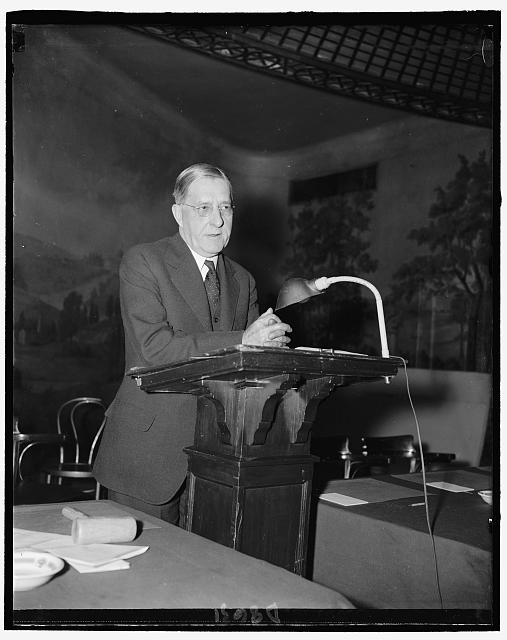
By 1930, Senator Furnifold M. Simmons had long been a powerful presence in North Carolina. He had been a senator since 1901 and had led the “white supremacy” campaign of 1898 that resulted in the Democrats coming back to power in the long run which also came with it the insurrection that overthrew the multiracial government of Wilmington, which had been the largest city in the state at the time. Although ideologically he could be thought of as a Wilsonian progressive, Simmons resolutely supported Prohibition. Thus, a problem arose for him when the Democratic Party nominated New York Governor Al Smith. Smith was against Prohibition and he had also risen in politics through New York City’s notorious Tammany Hall machine. Both were reason enough for Simmons to endorse Herbert Hoover over Smith. Simmons’ endorsement carried a lot of weight in the state and Hoover won both election and North Carolina. The last time a Republican had won North Carolina was in 1872. However, by 1930 the Great Depression had started and Hoover was very unpopular. This and that Simmons had not cultivated younger politicians made him vulnerable, and stepping in to challenge him was Josiah William Bailey (1873-1946).
Bailey had strong religious convictions as a Baptist, and after his father’s death in 1895 served as the editor of the North Carolina Baptist Convention’s newspaper the Biblical Recorder, and from 1903 to 1907, he headed the state’s Anti-Saloon League, but resigned when the organization started pushing for prohibition rather than temperance, not believing that the former would work (Moore). In 1913, President Woodrow Wilson tapped Bailey to be collector of revenue for the eastern district of North Carolina, and it was there that he gained practical experience on government efficiency, and managed to reduce the cost of collections by 65% (Moore). He served in this role until 1921 In 1914, Bailey pushed with Clarence Poe of the Progressive Farmer a platform for the Democratic Party Convention which included among its planks state primaries, increased assistance to public health and education, stronger regulation of freight and insurance rates, and strengthening child labor laws (Moore). This platform was not adopted, but it established Bailey’s reputation at the time as a progressive. By the early 1920s, Bailey became independent of the Simmons political machine and in 1924 he ran a reformist campaign in the Democratic primary for governor. Although he lost, he was now a known and credible political quantity in the state.
Bailey, who as editor of the Biblical Recorder had backed Simmons’ white supremacy campaign of 1898, hammered him for party disloyalty and this approach worked, with Bailey winning the nomination. Simmons gracefully accepted defeat and had no regrets about his decision to oppose Smith. Although Bailey had campaigned against Simmons on party disloyalty, he would ironically prove far more at odds with his party’s philosophy than Simmons had ever been. Indeed, Bailey had very distinct ideas about right and wrong. As the left-wing publication The Nation noted about him, he was a “diligent scholar whose devotion to abstract principles of right and wrong, and specifically to righteousness in civil and political affairs, borders on fanaticism…He is a brilliant but painstaking student whose mind quickly cuts through to the heart of a thing, with a logic that is irrefutable, and a command of language probably unequalled by any other living North Carolinian” (Tucker). While he campaigned for FDR in 1932, during the first 100 days of the New Deal, Bailey voted against the Agricultural Adjustment Act, being the only North Carolinian to do so. His stance was in contrast to his history of having been a progressive reformer in the 1910s and 1920s. Bailey did support some measures such as the National Industrial Recovery Act, the Tennessee Valley Authority, FDR’s gold measures, and Social Security. In FDR’s first term, Bailey served as a sometimes supporter and sometimes opponent of the New Deal. In 1935, Bailey was one of five Democratic senators to oppose the Wagner Act, commonly regarded as the Magna Carta of labor rights. He would consistently oppose legislation to increase the power of organized labor and support legislation to reduce it. Although Bailey was not blind to social problems and wasn’t necessarily opposing every measure to address them, he had his limitations which he saw as consistent with Jeffersonianism, stating, “Being a Baptist, I am liberal, and believe in liberty. Being a Democrat, I am a liberal and believe in liberty. Once we abandon the voluntary principles, we run squarely into Communism. . . . There can be no half-way control” (Tucker). Bailey was not willing, however, to go strong in opposition until after the 1936 election, but the next year he really went after the philosophy of the New Deal. In 1937, Bailey joined Burton K. Wheeler (D-Mont.) and Vice President John Nance Garner in leading the opposition to FDR’s “court packing plan” and delivered a powerful speech against on the Senate floor. In 1937, he and a group of conservative Democrats and Republicans crafted the “Conservative Manifesto”, with he and Arthur Vandenberg (R-Mich.) being the primary authors. This was a ten point document that outlined conservative alternatives to New Deal programs. This document, however, was prematurely leaked to The New York Times and when inquiries were made about who authored it, Bailey stepped up and admitted it while other Democrats were silent. Vandenberg and Warren Austin (R-Vt.) also stepped up and admitted themselves as participating in the drafting. The reason others were shying away from their involvement was because the ten point plan bore resemblance to what the American Liberty League had been calling for, and President Roosevelt had successfully painted the organization to the public as simply a vehicle for economic privilege. Indeed, Senate Minority Leader Charles McNary (R-Ore.), who had leaked the Manifesto, did so as he was concerned that this would overshadow a planned Republican platform and stated, “Anyone who signs that thing is going to have a Liberty League tag put on him” (Moore, 31-32). Bailey’s record on domestic issues after Roosevelt’s reelection was considerably more conservative on domestic issues, and he sought a program that involved lower spending, more emphasis on state’s rights, and more emphasis on free enterprise to help recovery. He stated, stated, “We do not have a Government at Washington. It is a gift enterprise and the gifts are at the expense of those who work and earn and save. Our President is not actuated by principle, but by fears. He will try to head off anything in order that he may stay at the head. I expect him to run for a third term, and if I am living, I expect to fight a good and last fight” (Moore, 26). Bailey’s leading role in the Conservative Manifesto presaged an overall shift in the state’s politics to the right, and one could consider him as an agent of change in the state who served the role that Republican George Aiken served for his state. Both men believed that in their views they were upholding their party’s traditional values but were often differing with their own parties. Bailey led the shift of North Carolina away from the national party, while Aiken led the shift of Vermont’s Republican party away from the Coolidge-style conservatism that characterized it during the 1930s. The collaboration of Bailey and Republican Vandenberg as central authors also could be marked as the start of the bipartisan Conservative Coalition which started to have pull after the 1938 midterms.
While Bailey was at odds with President Roosevelt on domestic policy, he was strongly supportive on foreign policy, backing all his major initiatives. Indeed, he contrasted considerably with his colleague, Robert Rice Reynolds, who had been much more supportive of New Deal programs but had voted against all of the president’s prewar initiatives save for the peacetime draft. Bailey was again back to the status of moderate opposition to President Roosevelt’s agenda. He was also an internationalist, and opposed the unsuccessful Revercomb (R-W.V.) amendment to require participation in international organizations be by treaty only. Although he had supported much of the president’s war policies, he was against a postwar direction of more government spending and emphasis on the public sector. However, Bailey’s role in the postwar world would be limited; in 1945, his health began to decline and on December 15, 1946, he died in office of a cerebral hemorrhage. Bailey’s DW-Nominate score is a -0.118, which although seems rather low given his domestic conservatism, party-line and procedural votes also get counted. By Democratic standards, he does fit on the party’s conservative wing. Indeed, as noted before, Bailey was the start of North Carolina’s shift to the right and away from the national Democratic Party politics. Although he is largely a forgotten figure, he got some recognition as one of the people profiled in Garland S. Tucker III’s 2015 book, Conservative Heroes: Fourteen Leaders Who Shaped America, From Jefferson to Reagan.
References
Bailey, Josiah William. Voteview.
Retrieved from
https://voteview.com/person/349/josiah-william-bailey
Moore, J.R. (1979). Bailey, Josiah William. NCpedia.
Retrieved from
https://www.ncpedia.org/biography/bailey-josiah-william
Moore, J.R. (1965). Senator Josiah W. Bailey and the “Conservative Manifesto” of 1937. The Journal of Southern History, 31(1), 21-39.
Retrieved from
Tucker, G.S. Obscure no more: N.C. Senator Josiah Bailey. Walter Magazine.
Retrieved from
Woods, T.E. (2015, August 28). A Missing History of Conservatism. The American Conservative.
Retrieved from
 Mad Politics: The Bizarre, Fascinating, and Unknown of American Political History