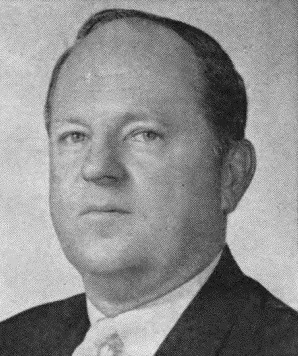
A general assumption exists that with politicians they ideologically come and go from Washington as the same people on ideological matters. Although more true today than it used to be, it is never a full guarantee. One example from the Deep South was Democrat William Jennings Bryan Dorn (1916-2005). Dorn was named after the politician William Jennings Bryan as his father wished for him to have a life in politics. He came on to the scene early, being elected to the State House in 1938 and the State Senate in 1940. His political career was interrupted by him serving in the US Army during World War II. On Dorn’s return, he sought to win election to Congress. He challenged incumbent Butler B. Hare of the 3rd district, who had served in Congress 16 years, and defeated him. Dorn proved to be to Hare’s right in his first term, and often disagreed with his party on certain key issues. Notably, he voted for Republican tax reduction bills, voted for Taft-Hartley, and even was one of the few Southern Democrats to vote against the Marshall Plan. Although only a man of 32 by the 1948 election, Dorn was highly ambitious and decided to challenge incumbent Senator Burnet R. Maybank. However, Maybank was sufficiently popular to survive Dorn’s challenge from his right. Although out of office, he wasn’t for long, and sought his old seat in 1950, now held by Hare’s son, James. This election proved to be a boon to the political right, and Dorn won renomination, tantamount to election in the at-the-time one party state of South Carolina.
Although of the right, Dorn stood out among the South Carolina House delegation in his support for public housing. However, he was opposed to price and rent controls and consistently backed foreign aid cuts. During the Eisenhower Administration, Dorn continued his opposition to foreign aid, supported releasing the regulation of natural gas prices from the Federal Power Commission, and started voting against public housing measures. He did, however, express a preference for public control over power generation and transmission, one of the ways in which many Southern Democrats remained New Dealers.
From 1961 to 1964, Dorn proved South Carolina’s foremost foe of New Frontier and Great Society measures in the House, even though his district had voted for Kennedy in 1960. This included opposing highly popular measures such as the Manpower Development and Training Act of 1962 for vocational training of the unemployed and the Educational Television Facilities Act of 1962 for the construction of public television stations for educational broadcasting. He voted against the Economic Opportunity Act of 1964, the Food Stamp Act of 1964, as well as the Elementary and Secondary Education Act and Medicare in 1965. Notably, this is contrary to South Carolina Encyclopedia’s biography on him, which depicts him as a supporter of LBJ’s anti-poverty program, which simply wasn’t so during Johnson’s time as president (Moore). Like other South Carolinian officeholders, Dorn was a segregationist and opposed every civil rights measure during the Eisenhower, Kennedy, and Johnson Administrations. Given this record quite hostile to social welfare measures and high spending, how Dorn would legislatively behave during the Nixon Administration would prove surprising if not shocking.
The Nixon Administration: Some Surprises
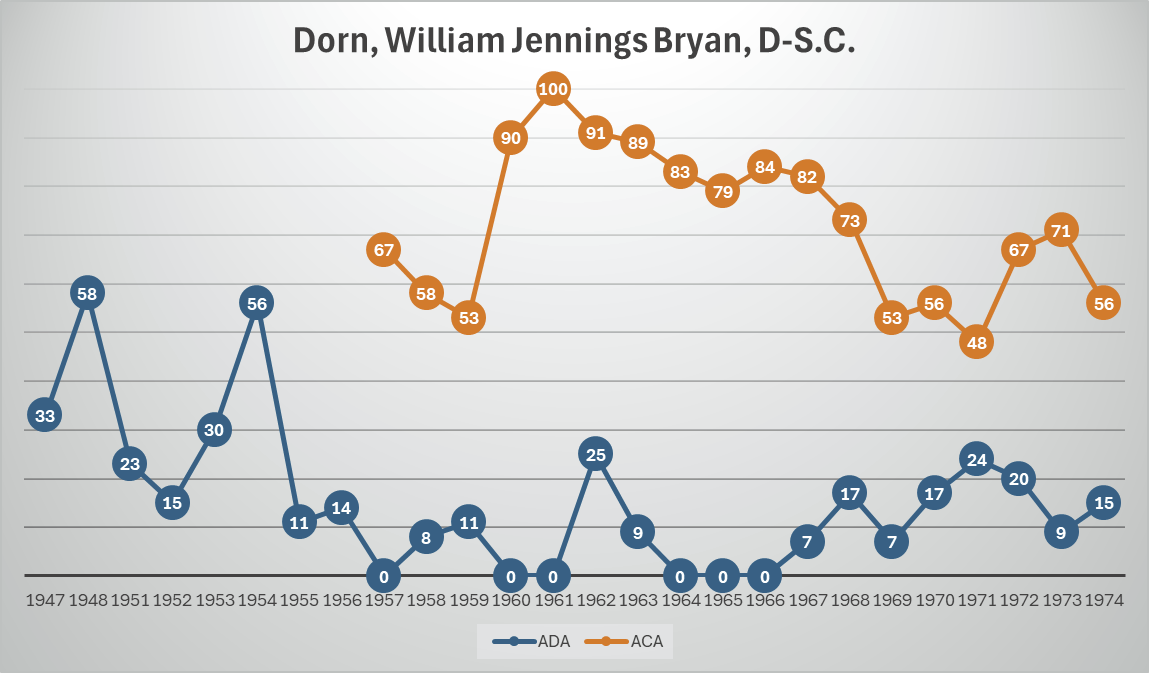
Agreement rates, ADA and ACA.
A preview of Congressman Dorn’s changes came in 1968, when he supported an open-ended appropriation for food stamps. Although this change is not nearly as represented in Americans for Democratic Action’s (ADA) ratings as opposed to Americans for Constitutional Action’s (ACA) ratings, these came in the form of how he addressed social programs and even civil rights. In 1969, Dorn opposed a conservative substitute to extending the Federal Elementary and Secondary Education Act, which he had opposed only four years before. In 1970, Dorn was the only South Carolina representative to vote for a bill for federal aid for desegregation. This absolutely floored his colleagues, especially when one considers that in other ways Dorn’s record remained in his old ways. For instance, he opposed extending the Voting Rights Act in 1970 and continued to oppose funding for the Civil Rights Commission. Dorn was also the only South Carolina representative to vote against the Equal Rights Amendment in 1971. However, he also voted against another amendment that proved even more surprising; he was also the only South Carolina representative to vote against a school prayer amendment that same year. Dorn also voted against several legislative efforts to curb busing as a means for desegregation, including Rep. Broomfield’s (R-Mich.) and Rep. Ashbrook’s (R-Ohio) 1971 proposals. Although in 1969 Dorn had supported transferring anti-poverty functions to the states, he supported extending such programs despite President Nixon’s opposition to the bill for the level of spending and for containing a provision for government daycare. He also opposed a Republican substitute to anti-poverty legislation which had a simple extension with no funding increases or government daycare program or legal services corporation the following year. The reason, however, that ADA found him still pretty conservative while ACA found him considerably less so was due to his staunchly pro-military voting record. Dorn constantly opposed defense cuts and was always supportive of President Nixon on the Vietnam War. He also voted against the War Powers Act of 1973, which was passed over President Nixon’s veto. ADA placed considerably more weight on military issues than ACA, which although far from neglectful of military spending and Vietnam, placed more weight on issues of spending and government expansion. Dorn was furthermore an advocate for veterans, and thus was well suited for his time as chairman of the Veterans’ Affairs Committee from 1973 to 1974. In 1974, Dorn opted against another term in Congress to run for governor. This certainly seemed like a good idea, after all Republicans were being dragged down by Watergate. However, South Carolina defied this trend with the election of Republican Governor James Edwards. Dorn had sided with ADA 15% of the time during his time in Congress, ACA 72% of the time, and his DW-Nominate score is -0.017. None of these criterion really reflect the notion that Dorn was a “progressive populist” as South Carolina Encyclopedia’s profile depicts him in his later career (Moore). Sure, he became a bit more liberal, but his ACA agreement never fell below 48% and he never agreed with ADA more than 58% of the time in a given year. Although DW-Nominate’s score does not look conservative at all, bear in mind that party-line procedural votes get counted and that his score is higher than any Democrat serving nationally. Dorn tried again for governor in 1978, but lost the Democratic primary. From 1980 to 1984, he did one last service for his party by serving as the chairman of the state’s Democratic Party. Perhaps aside from the shifts in his record, the most interesting thing about Dorn is that his portrayal seems a bit different from reality.
References
ADA Voting Records. Americans for Democratic Action.
Retrieved from
Dorn, William Jennings Bryan. Voteview.
Retrieved from
https://voteview.com/person/2672/william-jennings-bryan-dorn
Moore, W.V. (2016, May 17). Dorn, William Jennings Bryan. South Carolina Encyclopedia.
Retrieved from
https://www.scencyclopedia.org/sce/entries/dorn-william-jennings-bryan/
 Mad Politics: The Bizarre, Fascinating, and Unknown of American Political History