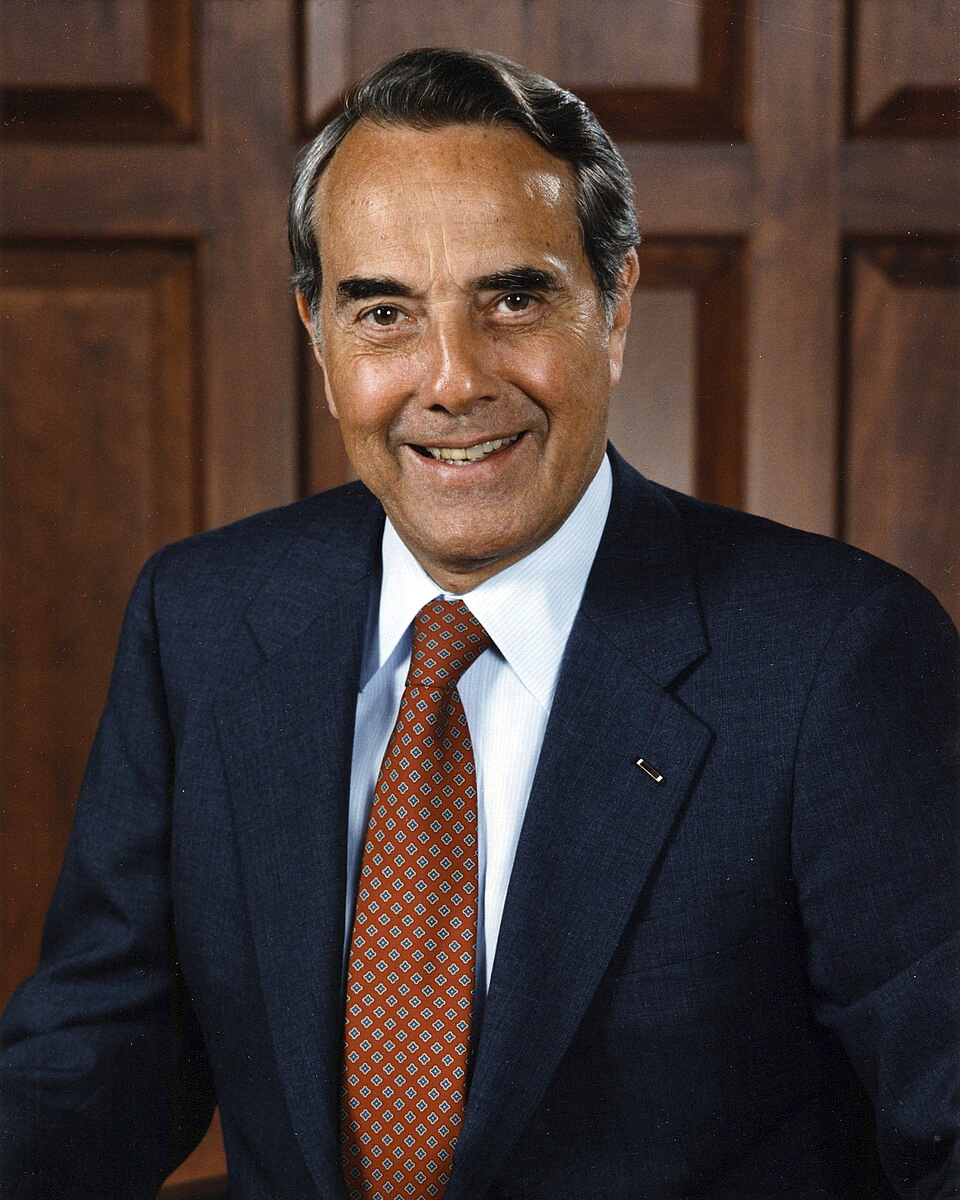
Bob Dole (R-Kan.), Senate Majority Leader
Back in 1986, Ronald Reagan is on his second term as president, having won a 49-state landslide and only narrowly losing Minnesota, the home state of his opponent, Walter Mondale. Like Trump, Reagan had the benefit of a Republican Senate although unlike Trump he never had the benefit of a Republican House. The composition of the Senate during this time presents a fascinating contrast to today. For one thing, although by this point the South is on presidents in the Republican column, it has yet to move there in its Senate composition. Today, the South’s senators are Republican save for Georgia and Virginia. In the 99th Congress, Democrats held one seat in Alabama, both of Arkansas’ seats, one of Florida’s, one of Georgia’s, both of Louisiana’s, one of Mississippi’s, one of North Carolina’s, one of South Carolina’s, both of Tennessee’s, and one of Texas’s. That’s right, in 1984 Tennessee overwhelmingly elected Al Gore to the Senate. Republicans actually hold both of Virginia’s Senate seats as back then it was a conservative state. Virginia and West Virginia have switched places since then, as both of their senators are Democrats. Another bizarre feature of this time was that Democrats held both of Nebraska’s seats! For reference, Nebraska has not voted for a Democrat for president since 1964 and its senators were among the conservative wing of the Democratic Party. Some of the social stances they held would have gotten them a quick cancellation among the base.
New England was different too, as Republicans held a seat in Connecticut, one of Maine’s, both of New Hampshire’s, one of Rhode Island’s, and one of Vermont’s. The West Coast is downright bizarre; although Democrats have held all of the West Coast states’ Senate seats since 2009, in 1985-1986 they only have California’s Alan Cranston. However, the Republicans who hold these seats would, save for Pete Wilson and perhaps Slade Gorton, be although to the right of Democrats holding these seats today, far from tolerable for the modern Republican base. In truth, 48 Senate seats are different in party affiliation between this time and now. Kentucky at that time has freshman Senator Mitch McConnell, now in his last year of service, and the last Democrat to represent the state in the Senate in Wendell Ford. In Delaware, Joe Biden is there as a Democrat, but his colleague is Republican William Roth, who played a significant role in the crafting and passage of the Reagan tax cuts and is the Roth in the Roth IRA savings account. As hard as it may be to believe, both of Minnesota’s senators are Republican! One of them, Rudy Boschwitz, had a double-digit reelection in the same year Mondale won the state. How voters viewed the president and his party varied considerably and voters were far more willing to split their tickets than now. The states that remain the same partisan composition then as they are now are Alaska, Hawaii, Idaho, Illinois, Indiana, Kansas, Massachusetts, Michigan, New Jersey, North Carolina, South Dakota, Utah, Wisconsin, and Wyoming. However, a look at the agreement rates I have put up with the senators should indicate to you that the parties were far more ideologically diverse. For instance, many of the Southern senators would not pass muster in today’s Democratic Party. One of them, John C. Stennis of Mississippi, had first been elected to the Senate in 1947! Many of the New England Republicans would not be in today’s Republican Party; Lowell Weicker of Connecticut was a bane of Reagan Republicans and later identified as an Independent and supported Democratic candidates and even Gordon Humphrey of New Hampshire, the staunch Reagan conservative of the group, has been strongly anti-Trump in recent years. Neither John Chafee of Rhode Island or Robert Stafford of Vermont would be palatable to modern Republicans. I have below senators who served in both years of the 99th Congress and included are agreement rates from the liberal Americans for Democratic Action and the conservative American Conservative Union. These are a little bit different from their official ratings; I do not count absences either way unlike ADA, I count documented legislative pairs and opinions for, and I do not double-count votes unlike ACA. Each vote is weighted equally for position agreement.
References
ADA Today, 41(1). Americans for Democratic Action.
Retrieved from
ADA Today, 42(1). Americans for Democratic Action.
Retrieved from
Federal Ratings. American Conservative Union.
Retrieved from
 Mad Politics: The Bizarre, Fascinating, and Unknown of American Political History