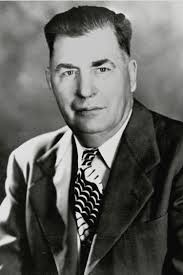
As a state, Colorado seems to be of two worlds: that of the granola-munchers and the gun-toters. For now, the granola-munchers have the edge; Colorado has not elected a Republican governor since 2002, the last time its voters chose a Republican for president was George W. Bush in 2004, and the last time its voters chose a Republican senator was in 2014. Colorado Democrats have by and large been quite far from a conservative group in recent history and the current crop is going full-bore into social liberalism in this author’s opinion. However, this was not always true of Colorado Democrats, and one figure who was a prime example was Edwin “Big Ed” Johnson (1884-1970).
Johnson grew up in Kansas and went to Nebraska for work, but in 1909, he was diagnosed with tuberculosis and advised to move to Colorado. In an age before antibiotics people were often advised to move to warmer and drier climates in an effort to cure tuberculosis, and this worked for him. He proceeded to start a political career, which started with a loss when he tried for superintendent of Moffat County schools in 1914. This would be the only race he would lose. In 1922, Johnson ran for the Colorado House and won. At the time, the Ku Klux Klan was a powerful force in the state’s politics, and he stood as an opponent. By 1930, the Klan had fallen in influence, and he was elected lieutenant governor. In 1932, Johnson ran for governor and won, serving two terms. As governor, his approach differed a bit from the New Deal, as he pushed his own programs, which included tax reduction, highway construction, balanced budgets, and civil service reform (Colorado State Archives). In 1936, Johnson easily won election to the Senate over Republican Raymond Sauter by 28 points.
As a senator, Johnson was independent of the Roosevelt Administration, and in 1940 he condemned President Roosevelt’s decision to seek a third term. He was a supporter of organized labor but also opposed his foreign policy, voting against repealing the arms embargo in 1939, the peacetime draft in 1940, Lend-Lease in 1941, and permitting both the arming of merchant ships and permitting them to enter belligerent ports just a month before Pearl Harbor. While today, such stances against a president of your party would have put him at great risk for a primary defeat, the truth is that Colorado was moving against the president; in 1940 and 1944 the state’s voters voted for Wendell Willkie and Thomas E. Dewey respectively over Roosevelt. Johnson himself was almost defeated for reelection in 1942 by Republican Governor Ralph Carr, but he had not courted popularity by standing up for the rights of Japanese-Americans, and he won another term by a point. Although often thought of as a conservative Democrat, Johnson went to bat for labor unions in his vote against the Taft-Hartley Act in 1947 and would also do so when he refused to vote to use the Taft-Hartley injunction during steel strikes in 1952. On foreign policy, Johnson’s postwar record was very mixed indeed. He voted against aid to Greece and Turkey in 1947 and only voted for the Marshall Plan the following year after supporting cutting funds. However, he would also support Point Four aid to poor nations in 1950 and at times voted for and against cuts to foreign aid. The 1948 election went much better for him, with Johnson winning almost 67% of the vote.
On March 14, 1950, Johnson denounced the affair of Roberto Rossellini and Ingrid Bergman on the floor of the Senate, and the negative publicity that followed Bergman resulted in her living in Europe for the next few years. He charged that Bergman, who had been his favorite actress, “had perpetrated an assault upon the institution of marriage” and that she was “a powerful influence for evil” and condemned Rossellini as “vile and unspeakable” and a “common love thief” (Hill). Johnson’s fiery condemnations of the two seemed to reflect a personal feeling of betrayal in the image he had of Bergman as a person. He even went as far as to propose legislation to license film performers based on personal morality (Colorado State Archives). Senator Charles Percy (R-Ill.) would apologize on behalf of the Senate for this incident in 1972. In 1952, Johnson endorsed Senator Richard Russell’s (D-Ga.) candidacy for the Democratic nomination for president and headed up his campaign, but Russell got no success outside of the South. On civil rights, he had something of a mixed record. Although he voted against Russell’s effort to undermine army desegregation in 1950, that same year he voted against ending debate on a Fair Employment Practices bill.
In 1953, Johnson was one of only two Democrats to vote against confirming Charles Bohlen as ambassador to the USSR, the push against him being spearheaded by Senator Joseph McCarthy (R-Wis.). Interestingly, he was also among a minority of senators to oppose Eisenhower’s nomination of former Congressman and public housing opponent Albert Cole (R-Kan.) as Housing Administrator. In 1954, Johnson decided against another term in the Senate as his wife, Fern, desired to return to Colorado, but surprised observers when he chose to run for governor again, which he won. In his final address, Johnson warned against committing troops to Vietnam (Colorado State Archives). His last vote as a senator had been to vote to censure Joseph McCarthy. Johnson had sided with the liberal Americans for Democratic Action from 1947 to 1954 40% of the time, and his DW-Nominate score stands as a 0.01, or more conservative than any Democrat serving in Congress today. However, his stint as governor would be limited to one term as a heart attack shortly after winning convinced him that he needed to take it easy. Despite his heart attack, Johnson did well after and persisted as a public figure after his final stint, including campaigning for the reelection of Democratic Congressman Wayne Aspinall in 1964. On May 7, 1970, Johnson was admitted to the hospital for a hernia, and underwent an operation four days later, but his condition deteriorated throughout the month, and he died on May 30th (Hill). Johnson to this day has a unique distinction in Colorado history; being the only person to serve three terms as governor and as senator. He is remembered in Colorado through the Eisenhower-Johnson Memorial Tunnel, a marvel of engineering that runs through Loveland Pass.
References
ADA Voting Records. Americans for Democratic Action.
Retrieved from
Edwin Johnson. Colorado State Archives.
Retrieved from
Hill, R. (2025, September 28). ‘Big Ed’ Johnson of Colorado. The Knoxville Focus.
Retrieved from
Johnson, Edwin Carl. Voteview.
Retrieved from
 Mad Politics: The Bizarre, Fascinating, and Unknown of American Political History