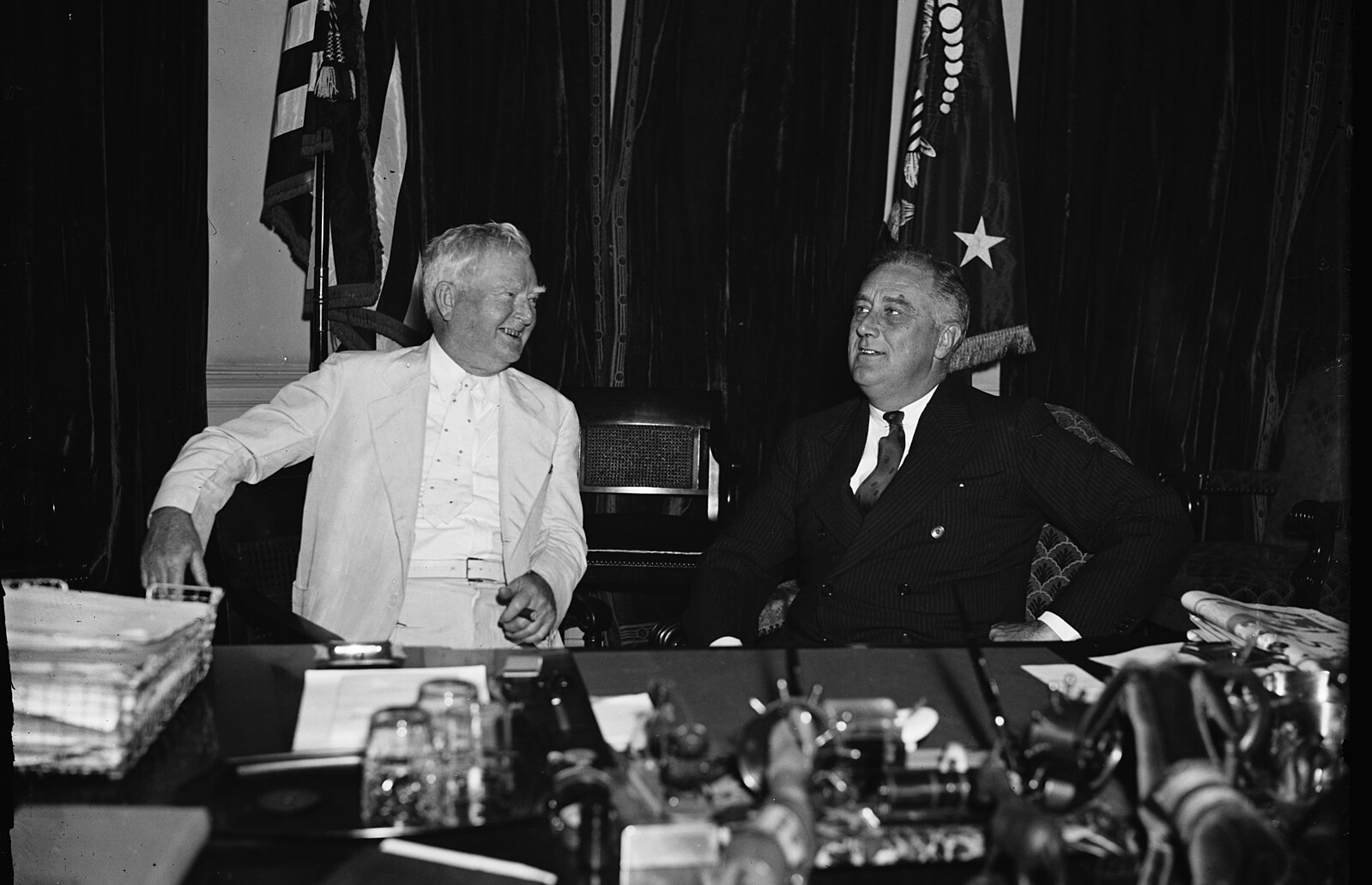
Vice President John Nance Garner and President Franklin Delano Roosevelt, the winners.
Every once in a while if things go badly for the GOP, some columnist will predict the end of the party. It turns out that Republicans are highly resilient, a lesson that should have been learned by the 1936 election, in which after they were at their lowest level of power since their foundation. The most obvious demolishing was FDR over Alf Landon. Landon, who ran on the slogan of “Life, Liberty, and Landon” and really had no issues to campaign on to effect save for critiquing government inefficiency and calling for less spending. FDR and his New Deal were so popular that he won over 60% of the vote and even defeated him in his home state of Kansas, winning every state except Maine and Vermont. Vermont at the time was the most Republican state in the nation and Maine had been strongly Republican save for a brief Democratic surge in the early 1910s. Many people had bad memories of the Hoover presidency and the Republicans were just not presenting an alternative that appealed to many at the time. As Virginia Senator Carter Glass quipped after the result, “It is well nigh impossible to beat a five billion dollar campaign fund”, referencing work relief spending (Hill). What’s more, money was short. What they could achieve was largely thanks to money provided from wealthy American Liberty League members. RNC chairman John D.M. Hamilton attested to this when after the election he said, “Without Liberty League money, we wouldn’t have had a national headquarters” (Pietrusza).
Democratic Gains:
In California, Republicans lost three seats. The 4th district’s (San Francisco) Florence Kahn was defeated by Progressive Franck Havenner, Sam Collins of the 19th district was defeated by Democrat Harry Sheppard, and the Democrats gained the open 20th district with Edouard Izac.
In Connecticut, down went both of the state’s House Republicans, William Higgins of the 2nd district to Democrat William Fitzgerald and Republican Schuyler Merritt of the 4th district to Democrat Alfred Phillips. However, the octogenarian Merritt had chosen not to campaign as he wasn’t that interested in reelection.
In Delaware, Republican Senator Daniel Hastings, definitely the most staunchly anti-New Deal of the senators, lost reelection to Democrat James Hughes. Republican freshman John G. Stewart also lost reelection to Democrat William F. Allen. Delaware’s sole seat would swing between the parties throughout the Roosevelt presidency.
In Michigan, Democrats picked up a seat, as Republican James Couzens, who had endorsed FDR for his reelection, had lost renomination in 1936 and then died. Democratic Congressman Prentiss Brown was elected. Republicans also incurred losses in the 6th and 13th districts, with Republicans William W. Blackney and Clarence G. McLeod losing reelection to Democrats Andrew Transue and George O’Brien. Blackney and McLeod would return in 1938.
In Minnesota, the Farmer-Labor Party’s Dewey Johnson picked up the open 5th district from the GOP, and Republican William Pittenger lost reelection in the 8th district to the Farmer-Labor Party’s John Bernard. Pittenger would return in 1938.
In New Hampshire, Democrat Alphonse Roy lost an election to the 1st district, which was open, to Republican Arthur B. Jenks, but this election was contested and the Democratic majority House voted to seat Roy towards the end of the 75th Congress. Jenks would win in 1938.
In New Jersey, Republican Senator William Barbour would lose reelection to Democrat William Smathers. However, Barbour would return in the 1938 election. House Republicans Isaac Bacharach of the 2nd district, Peter Cavicchia of the 11th district, and Frederick Lehlbach of the 12th district lost reelection to Democrats Elmer H. Wene, Edward O’Neill, and Frank Towey respectively.
In New York, Vito Marcantonio of the 20th district lost reelection to Democrat James Lanzetta. However, Marcantonio would make a comeback in 1938 as a member of the American Labor Party.
In Ohio, Republican representation in the House was reduced to two, as Republicans John Hollister of the 1st district, William Hess of the 2nd district, Leroy Marshall of the 7th district, John Cooper of the 19th district, and Chester Bolton of the 22nd district lost reelection to Democrats Joseph Dixon, Herbert Bigelow, Arthur Aleshire, Michael Kirwan, and Anthony Fleger respectively. Hess and Bolton would return in the 1938 election.
In Oregon, Portland’s Republican Congressman William Ekwall of the 3rd district would lose reelection to Democrat Nan Honeyman.
In Pennsylvania, a significant development occurred in Philadelphia: with the loss of all its Republican representatives, the city of brotherly love became represented entirely by Democrats! Republicans Harry Ransley of the 1st, William H. Wilson of the 2nd district, Clare G. Fenerty of the 3rd district, and George Darrow of the 7th district lost reelection to Democrats Leon Sacks, James McGranery, Michael Bradley, and Ira W. Drew respectively. Only Darrow would return in the 1938 election. Also losing in Pennsylvania were Charles Turpin of the 12th district and Isaac Doutrich of the 19th district to Democrats J. Harold Flannery and Guy J. Swope respectively.
In Rhode Island, Republican Senator Jesse Metcalf lost reelection to Democrat Theodore Green as did the 1st district’s Republican Charles Risk to Democrat Aime J. Forand. Risk would return in the 1938 election, but after 1940 no Republican would win a Senate seat from Rhode Island until 1976, and no Republican would get a House seat until 1980.
In Wyoming, Republican Senator Robert Carey lost reelection to Democrat Harry Schwartz. It was just as well, as he died only two months later.
Republican Gains
Not all was bad for Republicans in this election, although the wins they had far from made up for their big losses.
In Iowa, Republican Cassius C. Dowell, who had lost reelection in 1934, came back in winning the open 6th district.
In Kansas, Republican Edward H. Rees won the open 4th district.
In Maine, Republican James C. Oliver defeated Democrat Simon Hamlin for reelection in the 1st district, while Republican Clyde H. Smith won the open 2nd district. Yep, the Republicans did well in Maine!
In Massachusetts, Republicans scored their only Senate seat pickup: Republican Henry Cabot Lodge Jr. defeated Democrat James M. Curley. Roosevelt had come to despise Curley and his corrupt machine ways and refused to lift a finger for him. Republicans also picked up the open 2nd district with Charles R. Clason and Republican Robert Luce came back in the 9th district after his defeat by Democrat Richard Russell in 1934.
In New York, Democrat Fred Sisson of the 33rd district lost reelection to Republican Fred Douglas.
In Ohio, Democrat William Fiesinger of the 13th district lost renomination, and Republican Dudley White won the seat.
In Pennsylvania, Democrats Charles Dietrich of the 15th district and Denis J. Driscoll of the 20th district lost reelection to Republicans Albert Rutherford and Benjamin Jarrett respectively.
In South Dakota, Democrat Theodore Werner of the 2nd district was defeated for reelection by Republican Francis Case.
Renomination Losses
In Alabama’s 9th district, George Huddleston, who had served since 1915 and had become a critic of the New Deal, lost renomination to staunch New Deal liberal Luther Patrick. Since Alabama was a one-party state at the time, this was tantamount to election victory.
Multiple Democrats in Louisiana lost renomination, including Numa Montet in the 3rd district to Robert Mouton, Riley Wilson of the 5th district to Newt Mills, and Jared Y. Sanders Jr. in the 6th district to John K. Griffith.
In Michigan, Republican Verner Main of the 3rd district lost renomination to Paul Shafer, who won the seat.
In Missouri, Democrat James Claiborne of the 12th district, one of the least loyal Democrats, lost renomination to Charles Anderson, who won the seat.
In New York, Democrat Richard Tonry of the 8th district lost renomination to Donald O’Toole, who won the seat.
In Ohio, Democrat Warren Duffey of the 9th district lost renomination to John F. Hunter, who won the seat.
In Oklahoma, Democrat Percy Gassaway of the 4th district lost renomination to Lyle Boren, who won the seat.
In Pennsylvania, multiple Democrats lost renomination. Democrat William Richardson of the 14th district went down to Guy Moser, who won the seat. William Berlin of the 28th district also lost renomination to Robert G. Allen as did J. Twing Brooks of the 30th district to Peter De Muth. In Pennsylvania’s 32nd district, Theodore L. Moritz opted to run for reelection as a Progressive after losing renomination, but lost to Democratic nominee Herman P. Eberharter. In the prior two cases, the winners would turn out to be considerably more conservative than their predecessors.
In Texas, the voters of the 17th district finally had enough of Democrat Thomas Blanton being a lightning rod of controversy and dumped him for Clyde Garrett, who won the election.
In Virginia, Democrat Colgate Darden of the 2nd district, who had voted against Social Security, lost renomination to Norman Hamilton, but he would return in the 1938 election.
This election had significance not only as a public endorsement of the New Deal overall, but also as a signal to the Supreme Court that the laws they were striking down were part of what the public supported. After this election, Roosevelt would be able to replace retiring justices, changing the ideological landscape of the court in the direction of broad interpretation of the Commerce Clause. The New Deal programs would continue and the federal minimum wage under the Fair Labor Standards Act among other measures would be enacted.
References
1936 United States House of Representatives elections. Wikipedia.
Retrieved from
https://en.wikipedia.org/wiki/1936_United_States_House_of_Representatives_elections
1936 United States presidential election. Wikipedia.
Retrieved from
https://en.wikipedia.org/wiki/1936_United_States_presidential_election
1936 United States Senate elections. Wikipedia.
Retrieved from
https://en.wikipedia.org/wiki/1936_United_States_Senate_elections
Adler, B.S. (1951, February 25). Then and Now; Alf Landon, the G.O.P.’s hope (deferred) in 1936, is today a busy, contented man. The New York Times.
Retrieved from
Hill, R. (2013, January 27). Carter Glass of Virginia. The Knoxville Focus.
Retrieved from
http://knoxfocus.com/archives/carter-glass-of-virginia/
Pietrusza, D. (1978, January 1). New Deal Nemesis. Reason Magazine.
Retrieved from
 Mad Politics: The Bizarre, Fascinating, and Unknown of American Political History