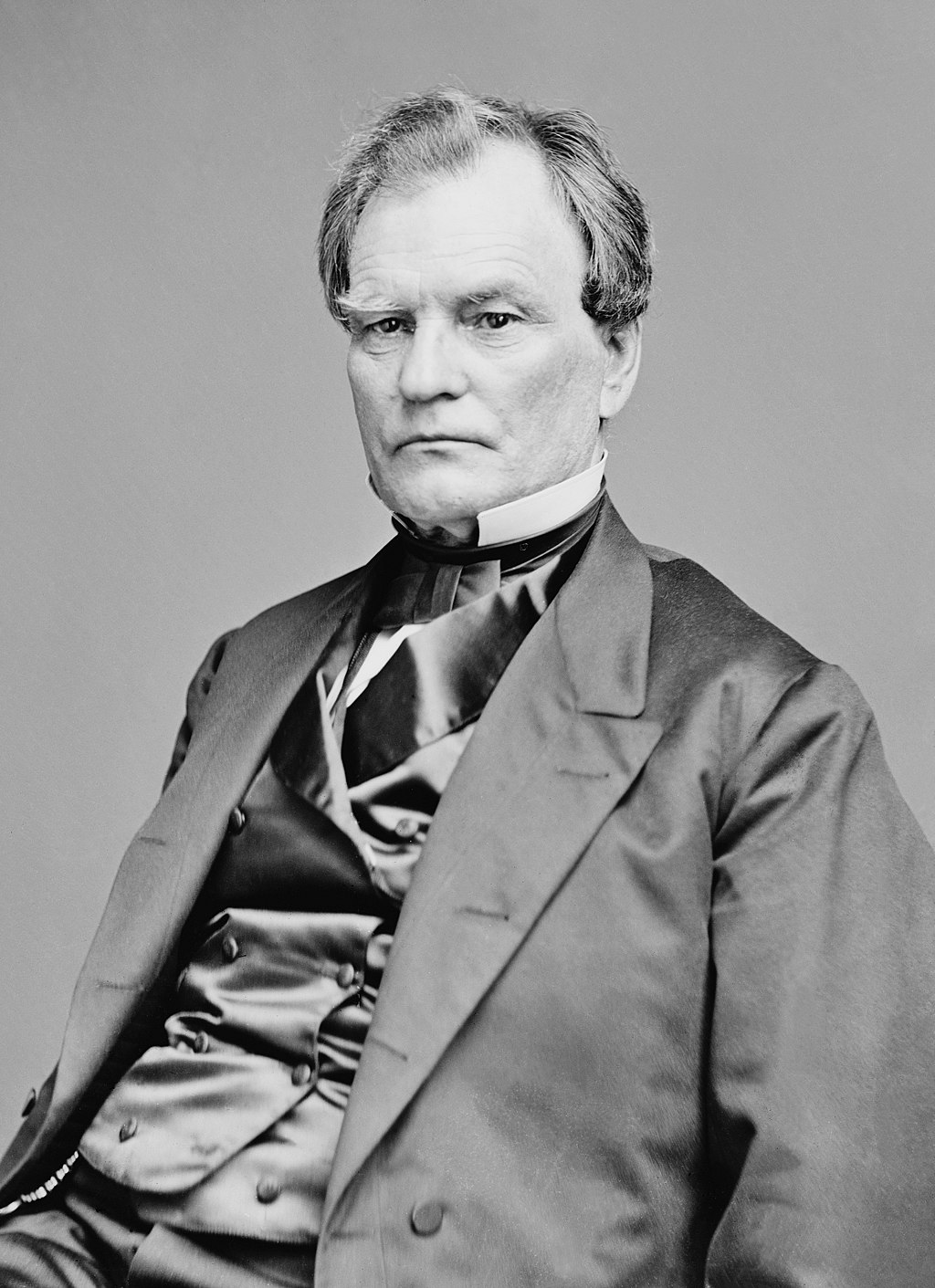
One of the most controversial figures of the old Republican Party of Lincoln, if not the most controversial, was Ohio Senator Benjamin “Bluff” Franklin Wade (1800-1878), famous for his reputation as a Radical Republican. This was due to his image as a punitive figure for Reconstruction, his uncompromising attitudes on the rights of freedmen, and a perception that he was but a tool of Northern capitalists.
An attorney by profession, Wade’s career in politics began in 1831 when he formed a legal partnership with Joshua Giddings, a fierce opponent of slavery. From there he was elected prosecutor of Ashtabula County in 1836 and in 1837, he won election to the Ohio State Senate. Although a member of the Whig Party, a party known for its staunch support of business, Wade was a bit too independent of the interests of business for the liking of the Whigs and it cost him a third term. He was out of office, but not for good, as in 1847 he was elected presiding judge of Ohio’s 3rd judicial district, serving until 1851, when he was elected to the Senate as a Whig. Although he had long been fiercely anti-slavery, he had a sense of strategy in how he voted for president, which was displayed when he voted for Whig Zachary Taylor in 1848 rather than Martin Van Buren of the anti-slavery Free Soil Party. Wade figured that a vote for Taylor, a slaveowner on a party platform that said nothing of slavery, would be preferable to Van Buren because the Free Soil Party had no chance of victory, and he correctly figured that Taylor would not bow to pro-slavery interests. Wade strongly opposed the Compromise of 1850 for its provisions benefiting slavery and in 1854, he voted against the Kansas-Nebraska Act.
In the 1850s with the party system changing given the demise of the Whig Party and the temporary rise of the American (“Know Nothing”) Party, Wade could have capitalized on the issue of nativism to help his 1857 reelection, but being a man of outspoken convictions he rather condemned nativism, and his condemnation was such that he almost got into a brawl with American Party Senator John M. Clayton of Delaware, one of the leading promoters of nativism (Trefousse, 65). Indeed, he was strongly opinionated and often crossed swords rhetorically with his colleagues. Historian Allan G. Bogue wrote of him, “Wade was no orator, and his contributions to debate were usually short and, on occasion, intemperate: he once called [Edgar] Cowan a dog and attacked the President in debate on more than one occasion” (Mr. Lincoln’s White House). He also sometimes publicly had harsh words for President Lincoln, who he believed was blowing the war effort and not going far enough against slavery. In one instance, Wade and a delegation were seeking the removal of Ulysses S. Grant as head of the Union Army at Vicksburg and upon Lincoln’s response which was to start to tell a story, he responded, “Bother your stories, Mr. President. That is the way it is with you, sir. It is all story – story. You are the father of every military blunder that has been made during the war. You are on the road to hell, sir, with this Government, and you are not a mile off this minute” to which Lincoln responded, “Wade, that is about the distance from here to the Capitol” (Mr. Lincoln’s White House). Lincoln, razor sharp and quick-witted, often got the better of Wade in their verbal exchanges. Wade never particularly liked Lincoln even though he would support him and said that his views on slavery “could only come of one born of poor white trash and educated in a slave state” (American Battlefield Trust). However, Wade was also known for making his disagreements strong on politics, but in truth he wasn’t big on making things personal. Indeed, in 1855 he had said of Judah P. Benjamin of Louisiana, who would later join the Confederacy, “I will call him a friend. I have no reason to call him anything else, for I have received nothing but kindness and respect at his hands. He being a southern man, I am the last one to assail him for defending his institutions. I have no doubt that if my habits and education had been like his, our positions would have been reversed to-day. I can understand that very well, and make allowances for it” (Trefousse, 68).
During the War of the Rebellion, Wade chaired the Joint Committee on the Conduct of the War, which covered issues of the war as well as Indian conflicts. In 1864, he coauthored and cosponsored the Wade-Davis bill setting the policy for readmission of Southern states, which required newly admitted states to abolish slavery, hold conventions for new state constitutions, required a majority of white males to pledge the ironclad oath swearing allegiance to the United States and that they had not supported the Confederacy, and barring from public office Confederate officials and veterans. This measure was pocket-vetoed by President Lincoln, who wanted to implement his own more lenient plan for Reconstruction. This, however, did not come to pass with Lincoln’s assassination. The conflict between President Johnson, who wanted lenient Reconstruction while Congressional Republicans sought Reconstruction on harsher terms as well as on terms that protected the rights of freedmen in the newly admitted states, characterized the rest of his time in office.
In 1867, Wade was elected President Pro Tempore, placing him next in line for the presidency as President Johnson had no vice president. However, his stature in Ohio was deteriorating. Wade bet his political career on a ballot measure in Ohio for universal black male suffrage, which failed. That election also saw a Democratic majority in the Ohio State Legislature, and reelection for Wade was coming up in 1869. This meant that if the Democratic majority stayed, he was going to lose reelection. This could be avoided if Andrew Johnson was convicted on his impeachment charges, thus he was strongly in support. If convicted, Senate Pro Tem Wade would have become president until the end of the term. Indeed, one newspaper wrote of Andrew Johnson’s acquittal, “Andrew Johnson is innocent because Ben Wade is guilty of being his successor” (Bomboy). This was certainly known to be the motive of Maine’s William Pitt Fessenden, the first Republican to vote to acquit Johnson, who was among the moderates who despised Wade. All Wade needed was one more vote to have been president. Worse yet for him, although he had been favored to be selected vice president, instead Speaker of the House Schuyler Colfax of Indiana won the nomination. Wade’s defeat for reelection was certainly a source of jubilation for Democrats, who elected Allen G. Thurman, who was opposed to civil rights, keen on curbing the power and influence of railroads, and opposed to high tariffs. Wade would not run for public office again, but would hold several positions in the private and public sector, including serving on a commission to study the proposed annexation of what is today known as the Dominican Republic, and was an elector for Rutherford B. Hayes in 1876. Wade would die on March 2, 1878 at the age of 77. Senator Carl Schurz praised him as “one of the oldest, most courageous, and most highly respected of the antislavery champions” (Trefousse, 73-74).
What Was Wade Ideologically?
There are some things that suggest to modern readers that Wade was left-wing. These include his belief in racial equality (unusual at the time, although liberalism as we know it hadn’t taken up the mantle of racial equality yet), his early support for women’s suffrage, his concern for the betterment of wealth of the working man, and his support for trade unions. Furthermore, Wade’s position for soft currency after the War of the Rebellion also sparked the ire of the business establishment of his day. However, there are significant issues with considering him left-wing.
These issues include that Wade was in his economic beliefs Hamiltonian, got his start in the business-friendly Whig Party, was a strong supporter of the protective tariff, supported the National Bank Act of 1863 for a uniform national currency well in keeping with the views of the Federalist and Whig parties as opposed to chaotic state banks with their own currencies, repeatedly supported legislation that favored railroads including substantial public land grants, and consistent with his stance on railroads sponsored a bill that granted public land to a mining company in the Montana territory. This indicates a willingness to hand over public land to private businesses, which I would think left-wingers would consider an abomination. Furthermore, after his time in the Senate, Wade would serve as a lobbyist for the Northern Pacific Railroad. Although he was undoubtedly sincere in his commitment to Reconstruction and penalizing the Confederates among the Southerners for rebellion, he was also a supporter of many core policies that spurred the Gilded Age and would thus produce the reaction of progressivism. Biographer Hans Trefousse writes of this mix in his stances, “The final charge against Wade was that he was a mere catspaw for powerful capitalists. While it is true that he always supported tariff protection, and while it is equally true that he pushed through the senate a bill to give a group of capitalists control of mining properties in the Far West, he was by no means beholden to industrial interests. Henry Cooke, the banker, thoroughly distrusted Wade’s radicalism, and although his brother Jay later gave the ex-senator a retainer to represent the Northern Pacific Railroad, conservative spokesmen for business had grave misgivings about the Ohioan’s financial orthodoxy” (71). Something also to consider is that Wade himself had been born into a family of modest means and had been a laborer before he started practicing law. For the issues of slavery and Reconstruction, these are strongly based on partisanship and regionalism as opposed to basic liberal/conservative philosophy as we know them today. In 1867, Wade delivered a speech advocating tariffs, stating, “Labor commands no higher reward than I am glad to see it. I hope to God it never will be any lower than it is; for now the real manual laborer gets but a scanty portion of that which he earns. I hope the time will never be when he will be less rewarded than he is now” (Trefousse, 71). He even spoke out of concern for how little the laboring man had as opposed to the wealthy in 1868, and indeed this was the time in which he was voting for the direction of post-war financial policy to be towards soft currency, perhaps suggesting he was moving a little leftward on economics later in his career. Yet, on the scale of liberalism and conservatism from DW-Nominate, he scores a 0.564, which by this measurement makes him the second most conservative senator in his day, in the sense of his backing Hamiltonian and Whig prescriptions which as I noted, were favorable to business. It is also possible for someone to score high on DW-Nominate but nonetheless show a more liberal side to labor issues, such as a figure I wrote about not too long ago in Runt Bishop of Illinois, who scored a 0.609 despite his consistent opposition to measures that curbed the power of organized labor; he voted extremely conservative on many other issues such as foreign policy. Wade stands, by looking at his voting record, as a conservative on fundamental issues that defined the Federalist and Whig parties as “conservative”, but he was indeed a complicated figure and in some ways far ahead of his time.
References
Benjamin Wade. American Battlefield Trust.
Retrieved from
https://www.battlefields.org/learn/biographies/benjamin-wade
Benjamin Wade: A Featured Biography. U.S. Senate.
Retrieved from
https://www.senate.gov/senators/FeaturedBios/Featured_Bio_Wade.htm
Bishop, Cecil William (Runt). Voteview.
Retrieved from
https://voteview.com/person/731/cecil-william-runt-bishop
Bomboy, S. (2024, August 11). Five little-known men who almost became president. National Constitution Center.
Retrieved from
https://constitutioncenter.org/blog/five-little-known-men-who-almost-became-president
Trefousse, H.L. The Motivation of a Radical Republican. Ohio History Journal.
Retrieved from
Visitors from Congress: Benjamin F. Wade. Mr. Lincoln’s White House.
Retrieved from
Wade, Benjamin Franklin. Voteview.
Retrieved from
 Mad Politics: The Bizarre, Fascinating, and Unknown of American Political History