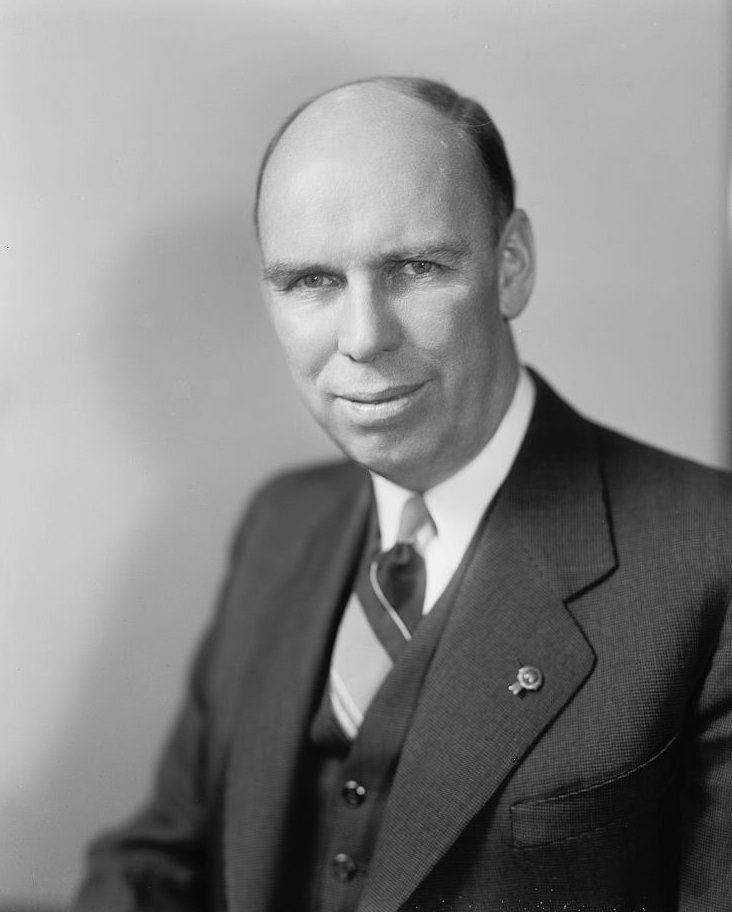
Among the states, I wouldn’t say that Maine was particularly known for making waves with the politicians its voters have sent to the Senate in the 20th century…that is, save for Ralph Owen Brewster (1888-1961). Brewster was, to put it bluntly, considered ugly, one of the ugliest men to have made it big in American politics and perhaps the ugliest since Benjamin Butler. Time Magazine (1935) would describe him as “toothy, slack-jawed” and journalist Jack Anderson in 1979 described him as “billiard-bald on top, cheerless-eyed, meaty-lipped, an appearance dark and gloomy” (Simkin). However, what he lacked in looks he made up for in hard work, diligence, and intelligence. Brewster’s success helped him get married to the daughter of one of Maine’s most prominent citizens. Although in his obituary Brewster would be most noted for his conservatism and opposition to FDR, in his earlier career he was more open to reform and change. He backed both Prohibition and women’s suffrage and initially even endorsed public ownership of water power generation in Maine. Brewster would after call for reform and would battle with holding company magnate Samuel Insull.
The 1924 Gubernatorial Election
In 1924, a rising force in American politics that had factions in both parties was the Ku Klux Klan. This was the second incarnation of the “invisible empire” and this one was the most popular. This Klan was in truth many things; it was of course racist, but it was also anti-Catholic, anti-Semitic, nativist, Prohibitionist, and Protestant group that engaged in numerous activities. These included multi-level marketing, summer camps, charity, political lobbying, and most notably in the South, exacting their brand of vigilante justice (usually night whippings) against those they regarded as violating their moral tenets. Unlike the first KKK which was seen only in the South, this Klan was nationwide, and even reached up to Maine, in which their primary prejudice was against French Canadian Catholics. Against what the Republican establishment of the state wanted, a 36-year-old Owen Brewster ran for governor with Klan support. Brewster played a bit of a game on this one; he would maintain a golden silence on the subject of the Klan unless it was to deny he was a member. Indeed, it has never been proven that Brewster was a member. He was supported by the Klan for two reasons: 1. He never condemned them when the press prompted him to do so, and 2. He supported cutting all government aid to parochial schools (which were primarily Catholic). The latter stance Brewster came to independent of the Klan, believing that this was too much government involvement in religion. He had introduced such a measure in the State Senate but it failed as its president, Frank Farrington, was opposed and convinced the Senate to vote it down (Syrett, 218). The GOP establishment of the state, represented most prominently by Governor Percival Baxter, Farrington, Senator Frederick Hale, and Representative Wallace White, were strongly against the Klan for its racial and religious bigotry. However, many white Protestant Americans at the time saw the Klan as a means for social advancement as well as a patriotic and Protestant organization. Although some state Klans had had ugly incidents of vigilantism (particularly in the South), Maine’s was not one of them. Brewster managed to win the nomination narrowly after Governor Baxter found that voter fraud had occurred in an Irish-American ward in Portland (The New York Times). At the time, winning the Republican nomination for a statewide office was tantamount to election in the strongly Republican Maine.
Brewster’s means of rising to power was something of a scarlet letter that could always be used against him. In 1925, he was the second governor to climb Mt. Katahdin (the first was his predecessor). In 1926, ever ambitious, Brewster attempted to win the special election to the Senate after the death of Bert Fernald but lost to the anti-Klan Arthur Gould. In 1928, he again attempted to win a Senate seat by trying to defeat the anti-Klan incumbent Frederick Hale in the primary, but Hale was retained with 63% of the vote. This marked the end of Klan influence in Maine, which had already been declining since the rape and murder conviction of Indiana Klan Grand Dragon D.C. Stephenson. Maine’s Klan leader, DeForest Perkins, resigned in the aftermath of the election. However, the Great Depression, although quite bad for Republican prospects, brought opportunity for Brewster.
Brewster and the Great Depression
In 1932, Brewster defeated Congressman Donald F. Snow for renomination, and this was for the best in truth as Snow would later be sent to the penitentiary for embezzlement. However, he narrowly lost the election to Democrat John Utterback. Brewster would try again in 1934, running on a platform of supporting the Townsend Plan for old age insurance, and this time he would win despite the midterm resulting in net Democratic gains. As a representative, despite his later reputation he would be far from the most conservative of Republicans, and he would support more popular measures such as Social Security and the Fair Labor Standards Act. A few of his diversions from conservatism could be seen as him looking out for his district. For instance, in 1935, he was one of five House Republicans to vote to add potatoes to the crops covered under the Agricultural Adjustment Act. One of the counties in his district, Aroostook, was one of the leading potato growers in the nation, and Brewster called them the “forgotten crop” especially since 36 million pounds of potatoes were in storage and their market value had declined from $1.37 a bushel in 1930 to $0.37 a bushel in 1935, which depressed the county (Hill). Brewster did sustain the party line on certain other subjects, such as housing policy. He also made his displeasure known about Roosevelt’s reciprocal trade policy, which most Republicans opposed, denouncing it as “Alice in Wonderland” economics (Standard-Speaker). In Brewster’s first term, he quickly stirred up controversy when in the aftermath of his conflict with the Roosevelt Administration the Passamaquoddy Tidal Power Project was canceled. He alleged that Maine representatives were pressured by brain truster Thomas Corcoran to support the “Death Sentence” clause of the Public Utilities Holding Company Act in exchange for the Roosevelt Administration’s support of the project; Brewster voted to strike the clause. This was a vote that surprised people given his efforts against holding company baron Samuel Insull as Maine’s governor. Brewster claimed his vote against was a protest against “unethical lobbying” (Hill). However, Corcoran had a witness. His side of the story, in which the “threat” was him telling Brewster that if the administration can’t count on him for the “death sentence” clause of the public utilities bill that they can’t count on him for the Passamaquoddy Tidal Power Project, was backed almost to the exact detail by witness Dr. Ernest Gruening, which made it most likely that Corcoran’s story was the accurate version of events (Time Magazine). Some constituents in Lubec were angry as they regarded Brewster as imperiling funds for the project and hung him in effigy with a sign reading, “our double-crossing Congressman” (Kansas City Journal). Nonetheless, he proved popular in his area of Maine and he was reelected in 1936. Joining him in Congress were Republicans James C. Oliver of the 1st district and Clyde Smith of the 2nd, both supporters of the Townsend Plan. Maine was one of the few places in which the 1936 election was good for Republicans.
On to the Senate
In 1940, Senator Frederick Hale opted to retire, and this time Brewster won the nomination and succeeded him. Although generally known as a conservative, in truth, as previously noted, his career was a bit more complicated than that, as demonstrated by his support of the Townsend Plan and his interventionist record on foreign policy. Brewster largely supported FDR’s foreign policy before World War II, voting to end the arms embargo in 1939, voting for the peacetime draft in 1940, and Lend-Lease in 1941, but stopped short of supporting permitting merchant ships to enter belligerent ports. While an observer may look at his support from the KKK as evidence of bigotry, there are aspects of his record that defy this characterization; in 1950 he voted to end debate on the Fair Employment Practices bill and voted to kill a Southern effort to undermine army desegregation. Furthermore, Brewster backed increasing the number of refugees admitted to the United States, and this would include a fair number of Jews. During World War II, he was one of the senators selected by Senator Truman to serve on his committee to investigate wartime expenditures. The committee was non-partisan and won great acclaim for its successes in saving taxpayer money and uncovering corrupt practices, thus elevating Truman’s profile enough for him to be nominated vice president in 1944. In 1943, at the age of 55, Brewster decided that he would change the name he would be known by from “Ralph O. Brewster” to “Owen Brewster”. There were two possible reasons for this change; first, to honor his son who had died ten years earlier of the flu at the age of 15, and second, so that people would no longer think of “R.O.B.” when they thought of him. In 1946, Brewster sat on a joint House-Senate committee investigating the attack on Pearl Harbor. The committee concluded that the Roosevelt Administration had not failed to prepare and rather placed the blame on Admiral Husband E. Kimmel and General Walter Short. Brewster along with Michigan’s Homer Ferguson dissented, with the former writing that the late president “was responsible for the failure to enforce continuous, efficient, and appropriate co-operation” in Washington “in evaluating information and dispatching clear and positive orders to the Hawaiian commanders” (The Journal Herald, 1). Both Brewster and Ferguson believed that the inquiry was incomplete. In 1946, the Senate flipped from Democrat to Republican and Brewster was now chairing this committee.
Brewster vs. Howard Hughes
Owen Brewster has not fared well in the court of historical opinion; he was portrayed by Alan Alda in the Leonardo DiCaprio film The Aviator as a villain. As chairman of the committee, he was investigating Hughes and TWA for alleged misspending in government contracts. Hughes proved a tough opponent for Brewster and although journalist Drew Pearson, a staunch New Deal liberal, was not typically inclined to back businessmen like Hughes, he did back him against Brewster, who along with Wisconsin’s Joseph McCarthy and Tennessee’s hot-tempered Kenneth McKellar ranked among his favorite political targets in the Senate. The mood of the committee on Hughes was that he was going to be easy to deal with as he had not too long ago recovered from a major plane accident that nearly killed him (Watt, 40). However, Hughes effectively played against Brewster by making Brewster himself the issue by accusing him of using this probe to try to pressure him into merging his company with Pan Am, which would be convenient for his community airline bill. Thus, the narrative became that Brewster was corruptly carrying water for Pan Am CEO Juan Trippe rather than him conducting a good government investigation on whether a big businessman had schmoozed his way into securing government contracts during wartime only to waste taxpayer money. Brewster waived his senatorial immunity to testify, and it was a bold move and one to try to convey the message that he was being honest. In the course he did admit that the subject of a potential merger with Pan Am had come up but denied that it was being used as leverage against Hughes. However, if he was the villain in this situation and this was a bluff, it didn’t pay off as he came off worse in the court of public opinion. Both men had testified under oath and thus this was yet another incident of Brewster’s word against another’s. Furthermore, the subcommittee chairman who took Brewster’s place in continuing the Hughes matter, Senator Homer Ferguson of Michigan, was not in the best state to regulate the situation as he had poison ivy all over his feet (Watt, 41). There was also another possible motive to target Hughes…as a means of targeting the Roosevelts. The Republican 80th Congress was very keen on uncovering anything that possibly went wrong during the Roosevelt Administration and Hughes had a connection to Elliott Roosevelt, thus this was used to attack the old Roosevelt Administration (Watt, 42-43).
Campaign Financing Controversy
Republicans still thought of Brewster highly enough after the Hughes controversy to place him as head of the Republican Senatorial Campaign Committee for the 1950 election. The results were good for the GOP, but there was a controversy regarding his neutrality in Republican primaries. Brewster was supposed to be neutral in primaries, and this meant that campaign money could not be used to fund anyone in the primaries. However, Brewster found a way to violate not the letter of the rule but the spirit of the rule by securing a $10,000 loan from the Liberty National bank in Washington and used shadowy middleman Henry Gruenwald to give $5000 each to candidates Richard Nixon of California and Milton Young of North Dakota (Quad-City Times). To his credit, it was Brewster who admitted this so this would not impact Gruenwald. Nixon did not have a contender in the primary who was actually a Republican as California at the time (and now) had an open primary, thus Democratic candidates Helen Gahagan Douglas and Manchester Boddy were also contenders. Young did have a Republican challenger in Thorstein H. Thoresen, formerly North Dakota’s lieutenant governor.
1952 Election
In 1952, Hughes bankrolled Governor Frederick G. Payne’s primary challenge to Brewster. Payne and Brewster represented two different factions of the party. While Brewster was a strong supporter of Senator Joseph McCarthy’s anti-communist crusade and supported nominating Ohio’s conservative standard-bearer Robert Taft in 1952, Payne backed picking the more moderate and internationalist General Dwight Eisenhower. Like Eisenhower defeated Taft, Payne narrowly won the primary. The significance of Payne’s win is that this is the only time in Maine’s history that a Republican incumbent senator was defeated for renomination, further underscoring Brewster’s controversial reputation. Not only did the feud with Hughes harm him but also Drew Pearson’s charge of unseemly lobbying by Francoist Spain’s lobbyist Charles Patrick Clark to convince him as well as Rep. Eugene Keogh (D-N.Y.) to sponsor aid to Spain (Hill). Clark would beat up Pearson in retaliation. However, Brewster may have managed to deal a blow to Payne that would hang over his head as a wine bottler claimed that he paid $12,000 to a political influencer to give to Payne for his product to be placed on the shelves of government liquor stores (Hill). Brewster was alleged to be behind these accusations, but he denied it. Although as noted before, he was considered a staunch conservative, the metrics I use indicate that he had voted with the liberal Americans for Democratic Action from 1947 to 1952 20% of the time while his DW-Nominate score was a 0.271. This indicates overall moderate conservatism in his career with his later career being a bit more conservative. Brewster attempted to secure another position both in the Senate and in the White House, but neither effort was successful. In the former case this was particularly a stinging blow as it constituted a rebuke by his former colleagues. Brewster would spend the rest of his life in semi-retirement, and for the last three years of his life he went around advocating for Americans for Constitutional Action, a newly formed conservative organization that was established as a counterpart to the liberal Americans for Democratic Action. Brewster offered himself as a candidate for the Senate in 1958 should Payne have chosen not to run for reelection (Hill). However, Payne did opt to run for reelection, and he lost by over 20 points to Edmund Muskie for reasons that were described in my post last year about the Sherman Adams controversy.
A member of the Christian Science church, Brewster died suddenly while on a Christian Science retreat in Brookline, Massachusetts, on December 25, 1961. His death was unexpected, although he had been suffering from cancer.
My Opinion on Brewster
Owen Brewster was a figure who in many ways maintained a highly clean appearance. He neither smoked nor drank, no hint of scandal existed with his personal life, and he was strongly religious. However, he also had two incidents in which the issue became his word against someone else’s, and he came out on the wrong side of it, at least in the court of public opinion. Brewster also proved willing to use cunning and tricky methods to get things done, such as his underhanded using of the KKK to win public office and his usage of a shadowy middleman to funnel money to Senate candidates against the spirit of the rules of his position. He was also quite interested in taking advantage of causes that were rising in popularity, such as his surreptitious courting of the votes of KKK members, his public support for the fiscally infeasible Townsend Plan, and his support for Joseph McCarthy. Brewster’s conservatism also strikes me as perhaps a bit overly touted when his record gets examine. In all, he was a complicated figure whose personal morality sometimes contrasted with his political methods.
References
ADA Voting Records. Americans for Democratic Action.
Retrieved from
Brewster Declared Winner in Maine. (1924, August 8). The New York Times.
Retrieved from
Brewster, Ralph Owen. Voteview.
Retrieved from
https://voteview.com/person/1021/ralph-owen-brewster
Former U.S. Senator Dies. (1961, December 26). Standard-Speaker, 1.
Retrieved from
https://www.newspapers.com/image/61225510/
Hill, R. (2024). Owen Brewster of Maine. The Knoxville Focus.
Retrieved from
https://www.knoxfocus.com/archives/this-weeks-focus/owen-brewster-of-maine/
Owen Brewster Dies; Former U.S. Senator. (1961, December 26). The Journal Herald, 1.
Retrieved from
https://www.newspapers.com/image/394350317/
Sen. Brewster Tells Trick in Using ‘Conduit’. (1952, March 21). Quad-City Times, 2.
Retrieved from
https://www.newspapers.com/image/299380913/
Simkin, J. (1997). Owen Brewster. Spartacus Educational.
Retrieved from
https://spartacus-educational.com/JFKbrewsterO.htm
Syrett, J. (2001). Principle and Expediency: The Ku Klux Klan and Ralph Owen Brewster in 1924. Maine History, 39(4).
Retrieved from
The Congress: Boomerang and Blackjack. (1935, July 22). Time Magazine.
Retrieved from
https://time.com/archive/6754199/the-congress-boomerang-blackjack/
Unpardonable Sin. (1935, August 17). Kansas City Journal, 11.
Retrieved from
https://www.newspapers.com/image/1024050087/
Watt, R.Y. (1979). Oral History Interview. Washington, D.C. United States Senate Historical Office.
Retrieved from
 Mad Politics: The Bizarre, Fascinating, and Unknown of American Political History