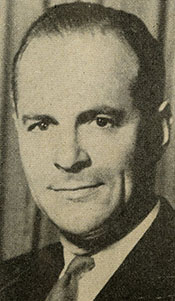
Perhaps the most famous people in the United States to have made the jump from actor to politician are Ronald Reagan and Arnold Schwarzenegger. Donald Trump is not primarily an actor, rather he was the host of The Apprentice and has had numerous film cameos and TV appearances. Rather, he is a celebrity businessman turned politician. All of them identify or identified as Republicans during their political careers. The first actor, however, to make the jump from actor to Republican politician was John Davis Lodge (1903-1985).
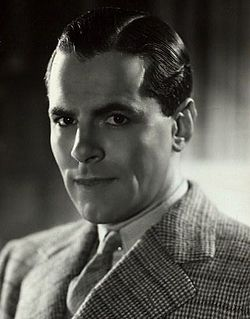
To be perfectly clear, Lodge’s family background set him up to be a politician. After all, he was descended from multiple families that produced politicians. The Lodge family, for instance, was one of the most prominent early families of Boston, and both his grandfather and older brother, Henry Cabot Lodge Sr. and Jr., were both prominent and influential politicians. Although Lodge studied law at Yale and became a lawyer, the call of Hollywood had him drop his lucrative legal practice. Naturally handsome, he would appear in numerous films from 1933 to 1940. Lodge later recalled his time in Hollywood, stating that he had known Ronald Reagan although never acted in the same film with him, explaining, “We were involved in different aspects of acting. I was leading man for Marlene Dietrich, and I acted with Katharine Hepburn in ‘Little Women,’ and I played Shirley Temple’s father in ‘The Little Colonel’” (Folkart). By the way, does this not look like a movie star to you?
During World War II, Lodge served as a lieutenant and lieutenant commander in the Navy, acting a liaison between the American and French forces. He served with distinction, being awarded the rank of Chevalier in the French Legion of Honor and the Croix de Guerre with Palm by Charles de Gaulle (National Governors Association). In 1946, a political opportunity opened up when Clare Boothe Luce of Connecticut’s 4th Congressional district decided not to run for reelection after the death of her daughter. This was an excellent year to be a Republican, and they won majorities in the House and Senate as well as had a complete sweep of the state’s House delegation.
Congressman Lodge
Lodge was without doubt a moderate Republican, as opposed to being among the conservative Old Guard. He sided with Americans for Democratic Action 40% of the time, and his DW-Nominate score was a 0.063, which indicates centrism. While in Congress, Lodge supported income tax reduction, the Taft-Hartley Act, aid to Greece and Turkey, the Marshall Plan, reducing the power of the Rules Committee to bottle up legislation, and public housing. Although the 1948 election was more difficult for Republicans, he won reelection by 12 points, easily the best performance among the state’s House Republicans. Lodge was also one of the strongest Republican internationalists, opposing foreign aid reductions and supporting Point IV aid to poor nations. Although he supported amendments weakening rent control, he supported extending it in 1950. That year, he opted not to run for reelection to run for governor against incumbent Chester Bowles, and campaigned against him as extremely left-wing (Krebs). Bowles in turn was dismissive of him, publicly regarding him as merely an actor. This was a political error as numerous retired actors lived in Connecticut (Folkart). The election was close, with Lodge winning by two points with a plurality of the vote. Had the votes for the Socialist candidate gone to Bowles, he would have won the election.
Governor Lodge
Lodge was the first governor for which the four-year term applied. Previously, Connecticut governors had served two-year terms. This gave him time to enact some measures, such as enhancing unemployment and worker’s compensation, increasing funds for education and the construction of public buildings, as well as the construction of the Lodge Turnpike (National Governors Association). However, the latter is often regarded as the reason behind his loss of reelection in 1954 to Abraham Ribicoff by just over 3,000 votes. After his loss, Republicans would have a tough time winning gubernatorial elections over the next forty years. Until 1994, the only time in which Republicans won the governorship was Congressman Thomas J. Meskill’s 1970 win.
Ambassador Lodge
Like his brother, Henry Cabot Lodge Jr., John was a friend of President Eisenhower, and he was tapped to the post of Ambassador to Spain. In this capacity, he played a role in the increasing normalization of relations between the US and Franco, serving until 1961. In 1964, Lodge attempted to revive his electoral career by running against Democratic Senator Thomas J. Dodd. Although he was far from being a Goldwater Republican, Dodd’s combination of domestic liberalism and anti-communism on foreign policy played well and Goldwater at the top of the ticket dragged down his campaign. Dodd won reelection by nearly 30 points, with Lodge only outperforming Goldwater by 3 points. Lodge did not run for political office again, but Republican presidents continued to find use for him. In 1969, President Nixon called him back into service as Ambassador to Argentina, a role he served in until 1973. Lodge’s last role would be as President Reagan’s Ambassador to Switzerland, serving from 1983 until his resignation in 1985. On October 29th, he delivered a speech at the Women’s National Republican Club in New York City but after he finished, he suffered a heart attack and was pronounced dead on arrival at St. Clare’s Hospital.
References
ADA Voting Records. Americans for Democratic Action.
Retrieved from
Folkart, B.A. (1985, November 2). Ex-Envoy John Davis Lodge Dies. Los Angeles Times.
Retrieved from
https://www.latimes.com/archives/la-xpm-1985-11-02-fi-1333-story.html
Gov. John Davis Lodge. National Governors Association.
Retrieved from
Krebs, A. (1986, May 26). Chester Bowles is Dead at 85; Served in 4 Administrations. The New York Times.
Retrieved from
Lodge, John Davis. Voteview.
Retrieved from
 Mad Politics: The Bizarre, Fascinating, and Unknown of American Political History