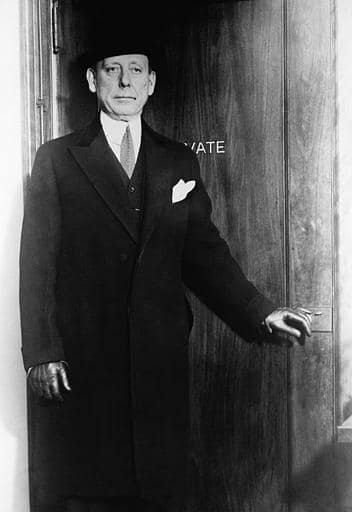
Although Hague had managed to get the lesser of the Republicans in his view, that Republican nonetheless won the gubernatorial election and indeed New Jersey had a Republican wave with Herbert Hoover winning the state by 20 points; only Hudson County voted for Democrat Al Smith. Hague had had a good run of the 1920s up to this point, having Democrats Edward I. Edwards and A. Harry Moore as governors, who could be counted on to do what Hague wanted. The same was not true for Republican Morgan F. Larson, even though Hague had collaborated with Republican Atlantic City boss Nucky Johnson to elevate him over Democrat William Dill (Murray, 26). The Republican-controlled legislature sought to take down Hague, and they focused on an area in which he was vulnerable – taxes.
Hague’s Trouble with Taxes
Frank Hague’s city government taxed quite high for the services it provided as well as for a bloated public payroll; not all “jobs” came with functions. Indeed, the cost to taxpayers for Jersey City’s government was over four times that of Kansas City and New Orleans, also ruled by bosses and both with about 100,000 more people (Life Magazine).
As mayor of Jersey City, Frank Hague’s annual salary did not exceed $8500 annually. Yet, Hague, who came from modest means, was worth millions now, and the only income he ever reported to the Treasury was his mayoral income. In addition to other sources I mentioned in my last post, he received protection money from horse gambling establishments that ran numbers rackets, and Jersey City got the reputation of being the “Horse Bourse” (Fleming). He also would receive bribes at his office. There was a desk in which the visitor would place cash on the drawer on his side, and it would come out on Hague’s side (Isherwood). Although he was compelled to answer questions about his taxes to the New Jersey legislature, he refused to answer, and they cited him for contempt. However, the Court of Errors and Appeals ruled that the legislature lacked the authority to probe an individual for felonies, only the courts did. Hague did end up having to pay $60,000 to settle with the Federal government, and his reputation as a reformer mayor was gone. In 1929, he would face his closest call as mayor against James F. Murray, a young reform Democrat, but prevailed in an election in which between 20-30% of signatures in the poll book were fraudulent and numerous people were paid to vote multiple times (Murray, 24). Throughout his career he continued to make millions while only paying the taxes on his mayoral salary. Perhaps this would have been the beginning of the end of his reign had it not been for the Great Depression, and Republicans became highly unpopular nationwide. The Great Depression also helped Hague as his machine kept on going and kept supplying public jobs, a source of relief for numerous Jersey City residents (Fleming). He might have run into more trouble with his taxes had he not gained a crucial partner in politics…Franklin Delano Roosevelt.
FDR and Hague…a Quid Pro Quo Partnership
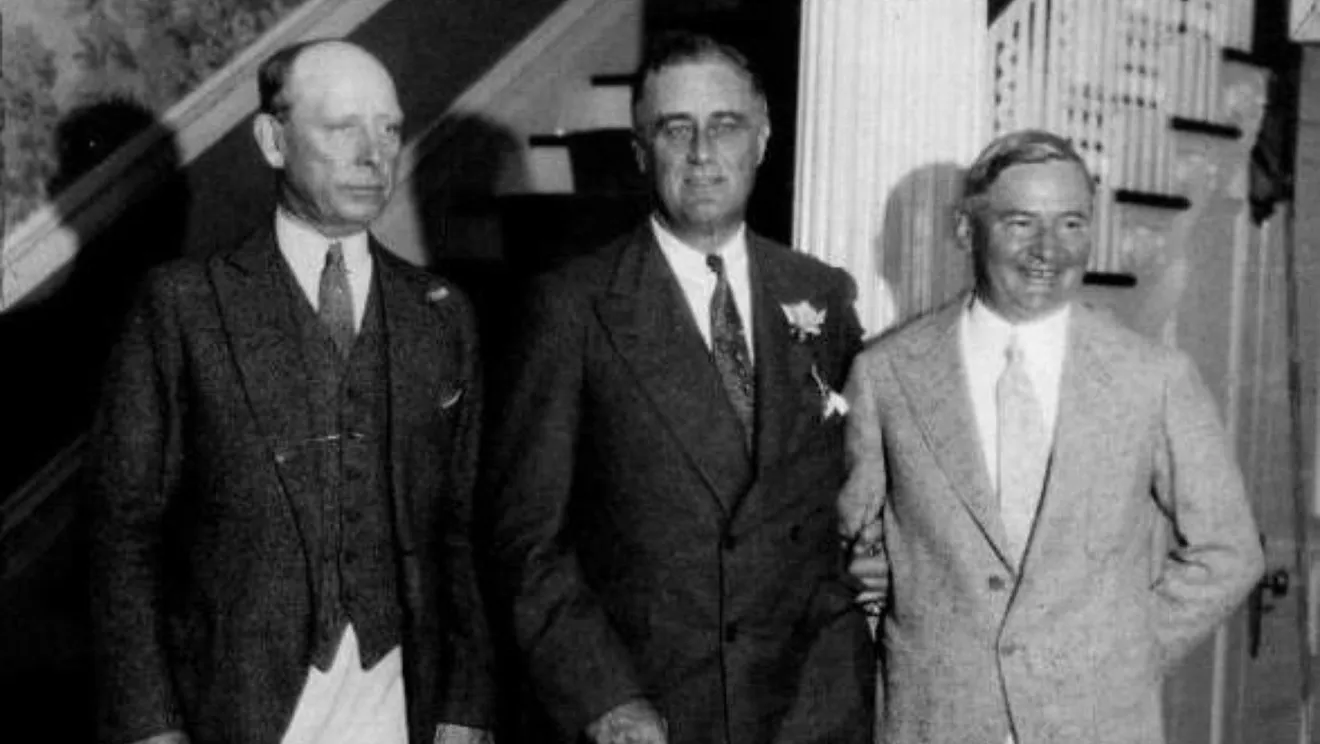
Hague, Roosevelt, and Governor A. Harry Moore, 1932
With the Great Depression in full swing, the Democrats were in the perfect position to win the next election, but who was the nominee going to be? Hague had a history of loyalty to New York’s Al Smith and indeed he initially endorsed Smith for the primary, even attacking Roosevelt by asserting that despite him being New York’s governor that he could not “carry a single state east of the Mississippi and very few in the Far West” (Fleming). However, New York City’s James A. Farley outmaneuvered him at the Democratic National Convention and FDR won the primary. Hague came around to FDR and he offered to host his first general election campaign rally. Roosevelt’s general election campaign kicked off in Sea Girt, New Jersey, on August 27, 1932, with Hague managing to get a turnout of 120,000, an incredible figure (Congressman Frank J. Guarini Library). Hague had also hosted a rally for Al Smith at Sea Girt in 1928. Although Democrats today are expected to win New Jersey in Federal elections, this was far from always the case; in 1930 Republican Dwight Morrow had won a Senate seat by nearly 20 points, and although Roosevelt’s win was a landslide in 1932, he only won New Jersey by 2 points, and that he won at all was thanks to Hudson County. Roosevelt was thankful for Hague’s help and directed Federal patronage in New Jersey to him; usually patronage went to a Democratic governor (at the start of the Roosevelt Administration it was Hague front man A. Harry Moore) or the leading Democratic senator in a state. This gave Hague all the more power, and he used the $47 million he would receive in Works Progress Administration funds for Jersey City to construct Roosevelt Stadium as well as finish the aforementioned Jersey City Medical Center. From 1936 to 1943, New Jersey would receive over $400 million in Works Progress Administration funds, one of the highest for a state (Murray, 23). Although Hague’s influence was already a bit national with his post as vice chairman of the Democratic National Committee, it was furthered now. Although Roosevelt is seen as an anti-machine politician and he denied patronage to New York City’s Tammany Hall, he let it flow to Hague’s machine. Hague also managed to get Moore elected to the Senate in 1934. In 1936, Roosevelt won reelection in New Jersey by 20 points, and Republican Senator Warren Barbour lost reelection. In 1940, Hague, along with Mayor Ed Kelly of Chicago (who ran his own corrupt machine), started up the push for Roosevelt to be nominated for a third term, which propelled him to win the primary and general election. Hague would also be of great help in the 1944 election. He was indispensable to Roosevelt, and both benefited from each other. However, this meant that sometimes Hague had to do things for Roosevelt that he’d rather not do, such as support Charles Edison for governor in 1940, but the full telling of that will be for part III.
Hague’s Other Pals
Hague managed to command many allies in New Jersey, including from both parties. Quick to court women voters once they gained suffrage, he got Mary Teresa Norton into politics, and got her elected to Congress representing Jersey City’s southern wards. Norton would be the sponsor of the Fair Labor Standards Act, also known as the law that established the Federal minimum wage. The first Democratic governor that he managed to get in, Edward I. Edwards, who served from 1920 to 1923, allowed Hague to raise taxes on corporations substantially, got him some allies on the public utility commission as well as on the Hudson County tax board and board of elections (Congressman Frank J. Guarini Library). He was allied to him until 1930, when he wanted to again be governor, but by this time Edwards’ career, finances, and general well-being were in free-fall, and after a skin cancer diagnosis the next year he took his own life. Hague’s success in electing Edwards in the 1919 election got him elected the chairman of the New Jersey Democratic Party, a position he would hold for 29 years. George Silzer was another who owed his career to Hague, serving from 1923 to 1926. He most importantly picked Hague’s choice for prosecutor of Hudson County (Frank J. Guarini Library). Hague’s greatest front man statewide, however, was A. Harry Moore, who served as governor from 1926 to 1929, 1931 to 1934, and 1937 to 1940. Hague had befriended Moore early in his career and the man had some advantages to him. First, Moore was Protestant (possibly the first Hague ever met), which made a difference in the minds of numerous voters back then as opposed to the majority Catholic population of Jersey City. Second, he had fiscally conservative tendencies (as a senator he was one of only three Democrats to oppose Social Security), which made him more palatable to Republican voters and let him get on fine with the Republican-controlled legislature. However, Moore most critically would be a party organization man up and down, meaning that he would support what Hague wanted in appointments, patronage, etc. This was especially vital when it came to getting a county prosecutor, thus Hague could direct prosecutions as he pleased. He liked Moore so much that he helped get him elected governor three times and tried to recruit him for a fourth time and got him a Senate seat. However, Moore’s credibility was damaged in his third term after he tapped Hague’s son, who had twice failed to get through law school yet passed the bar, to the Court of Errors and Appeals, the highest court in New Jersey at the time. When Moore exited the Senate in 1937 to serve again as governor, his temporary replacement, John Milton, was Hague’s longtime attorney. Speaking of the state’s highest court, he managed to get his crony, his corporate counsel Thomas J. Brogan, tapped by Governor Moore to be its chief justice, and he served from 1933 to 1946. Hague was able to get some Republican state senators to back him up, which helped him exert some influence over that legislative body, but he was never able to exert control over the Assembly, which was Republican and was just itching to find a way to get him out of office. As for his Republican friends…
“Hague Republicans”
Frank Hague not only managed to become the leading figure of the Democratic Party in Hudson County and New Jersey, he came to dominate the Hudson County Republican Party and command some statewide influence through some of his followers registering Republican in Hudson County. As I wrote in part one, 20,000 people who registered Republican in Hudson County were able to tip the results of the 1928 Republican gubernatorial primary. The Hudson County Board of Elections also had Hague Republicans at the helm, and he managed to turn Republican T. James Tumulty to supporting him (and switching parties) after offering him a job, but the most prominent Hague Republican was Harold G. Hoffman.
In 1934, Democrat William Dill was running for governor again, and although officially backed by Hague, he lost the election to Hoffman, a personally popular figure. Hague turned out to be pretty fine with Hoffman as governor as he likely knew that Hoffman had sticky fingers; per Hoffman’s confession letter revealed after his death he had throughout his political career embezzled over $300,000 from the government positions he had held (Murray, 2024, 58-60). Thus, he made deals with Hague and provided considerable patronage for his machine and came to him for support after Republicans soured on him for his backing of a sales tax. Hoffman also supported certifying the election before an investigation was done, did not support any investigations into Hudson County voting practices, and refused to back the recount of the 1937 election in which A. Harry Moore was once again elected governor (Murray, 2024, 58). Speaking of the 1937 election…
The Stolen Gubernatorial Election
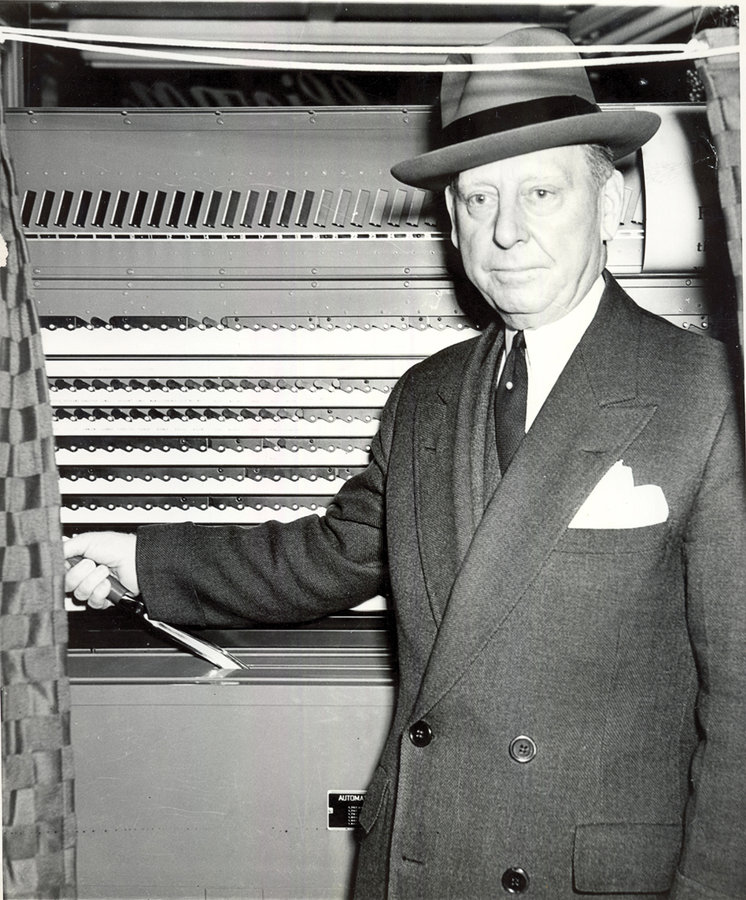
In 1937, Hague faced yet another figure in the GOP he didn’t want to contend with in Lester H. Clee, who he hadn’t been able to prevent from winning the nomination. Clee was a strong opponent of the Hague machine and was eager to act against him. Hague had a lot to potentially lose, and on Election Night 1937 Clee was leading by 80,000 votes…at least until the results of Hudson County were tabulated, and Moore came out over 45,000 votes ahead statewide. The official tally had Moore leading Clee by 129,137 votes in Hudson County while Democrat William Dill had led Harold Hoffman by 89,127 votes in 1934 (Murray, 33).
The Hague machine went all out to prevent the election of Lester Clee, and the Republican legislature sought a recount. There was undoubtedly fraud that came out of the election results of Hudson County, as the number of people who were recorded as having voted exceeded the number of eligible people. Some examples of fraud included a rabbi who had moved to Massachusetts three years earlier was recorded as having voted in Hudson County, an institutionalized man was recorded as voting, and people who were confirmed dead were recorded as having voted (Johnson). The recount was performed, but Clee didn’t gain much. The case went up to the Court of Errors and Appeals, and Hague’s man, Brogan, was invaluable in defending the machine from judicial consequences, only permitting a retabulating of cast ballots, not an investigation into the integrity of the election itself (Murray, 38). The high court declined to investigate the election, thus the Assembly pursued the investigation. What the legislature needed was access to the registration list and poll books, and that was something the Hague forces blocked with numerous tactics, including a claim that Board of Elections Commissioner Charles Stoebling, a Republican tied to Harold Hoffman and had custody over the records, was desperately ill at home. Ultimately, the New Jersey legislature was unable to procure the books, as Jersey City police blocked access to the records (Murray, 53). Furthermore, the Hudson County Board of Elections stuck behind Hague (as they were wont to do) and outgoing Republican Governor Harold Hoffman, as mentioned earlier, was outspoken in his support of the election outcome, and his appointees, including the superintendent of the New Jersey State Police, were not inclined to help with the investigation. Democratic Attorney General David Wilentz, another Hague man, went against the investigation. Hoffman’s allegiance with Hague permanently damaged his standing with New Jersey Republicans, and when he sought the nomination for governor in 1940, which was publicly supported by Hague, he was defeated, the nomination going to anti-Hague Republican and future Senator Robert Hendrickson. The investigation came to a screeching halt when the Court of Errors and Appeals ruled 12-3 that it was unconstitutional (Murray, 59). In 1940, the Senate decided to investigate the 1937 gubernatorial election, but they found that when they asked for the voting books of that election that they had been burned. No, this was not customary; other voting books had not been burned.
Hague’s Quirks
Mayor Hague was eager to counter stereotypes about the Irish and drunkenness, thus he was a resolute teetotaler throughout his life. Although his political career had started out with a loan from a saloon owner, he didn’t come there to drink alcoholic beverages, rather because he had realized this was where local political discussions occurred and where the local political power was. This didn’t just apply to him, if you were seated at a table with Hague, you were not to order an alcoholic beverage, and it was known that at dinners in which Hague was in attendance that people could not start ordering alcoholic beverages until he left, which he would before everyone else (Fleming). He also did not smoke and was a hypochondriac. Although there was much vice in his political behavior, there was no evidence of him straying from his marriage. This is similar to fellow Irish Catholic boss Jim Curley of Boston, who was highly politically corrupt but faithful to his wife.
Hague vs. the CIO and Communists
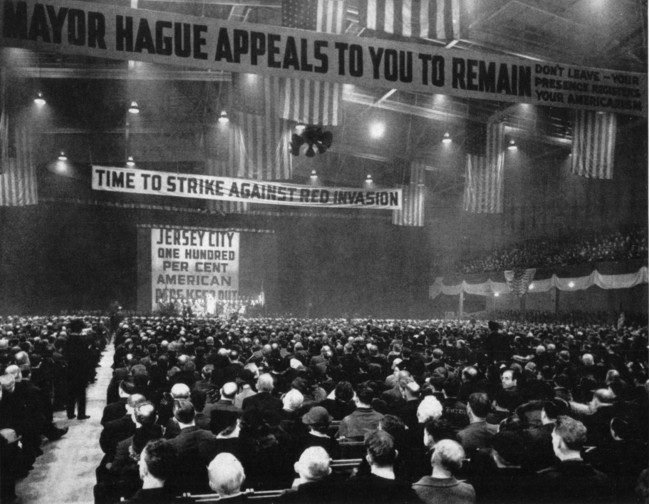
An anti-communist rally held by Mayor Hague
Frank Hague was initially a supporter of unions and could get along fine with the American Federation of Labor (AFL), which represented skilled craft laborers. However, in the 1930s a new union arose in the Congress of Industrial Organizations (CIO). This union was more radical than the AFL and represented unskilled laborers, and when they tried to get into Jersey City, Hague was hostile. He already taxed high for his government, and he was eager to attract business to the city. One way he could do that was to block the CIO. Union organizers were arrested for handing out leaflets on the streets. Hague was once alleged to have said “I am the law”, and although the truth has a little more context to it than that, it is undoubtedly true that this was the reality in Jersey City. He also banned the CIO from conducting meetings and no establishment would risk hosting them lest a city inspector come along and inevitably find code “violations” (Fleming). Hague justified his actions on the grounds that he believed that the CIO organizers were communists. His understanding of communism, however, seemed a bit limited. He said in one speech to the Jersey City Chamber of Commerce, “We hear about constitutional rights, free speech and free press. Every time I hear these words I say to myself, “That man is a Red, that man is a Communist” (Vernon, 96). Despite Hague’s stated opposition to communism, he had some similarities to them. His hospital and maternity were mostly funded with public money and his approach has even been called “municipal socialism” (Congressman Frank J. Guarini Library). During this time it was discovered that Mayor Hague was tapping phones, a part of the police state he ran. Hague used a Jersey City ordinance requiring permits from the chief of police for the leasing of any hall, which invariably would not be granted to the CIO thus preventing meetings of any substantive size, to justify his repression of the CIO. However, the case was brought to the Supreme Court, which struck down Jersey City’s ordinance as unconstitutional 5-2 in Hague v. Committee for Industrial Organization (1939). This whole affair presented a terrible difficulty for the Roosevelt Administration, which counted both Hague and the CIO as major supporters, and the Roosevelt Administration did not intervene despite calls from the CIO to do so. Hague was ultimately forced to let the CIO in. Although his understanding of communism was not impressive, it is nonetheless true that there was a significant communist presence in the CIO and some chapters were outright dominated by communists. Although Hague was brought to heel on this one by the Supreme Court, he was still in the heyday of his power. This would start to change in 1940, when Hague would have to contend with one of Thomas Edison’s sons, Charles Edison.
References
Fleming, T. (1969, June). The Political Machine II: A Case History “I Am The Law”. American Heritage, 20(4).
Retrieved from
https://www.americanheritage.com/political-machine-ii-case-history-i-am-law
Frank Hague. Congressman Frank J. Guarini Library.
Retrieved from
https://njcu.libguides.com/hague
Isherwood, D. (2013, December 2). More information surfaces on Jersey City “mystery safes”. NJ.com.
Retrieved from
https://www.nj.com/politics/2013/12/more_information_surfaces_on_jersey_city_mystery_safes.html
Jersey City’s Mayor Hague: Last of the Bosses, Not First Of The Dictators. (1938, February 7). Life Magazine.
Retrieved from
https://www.cityofjerseycity.org/hague/life/haguespeople.shtml
Murray, J.M. (2023). The Real “Stolen Election”: Frank Hague and New Jersey’s 1937 Race for Governor. NJS: An Interdisciplinary Journal, 20-67.
Retrieved from
Murray, J.M. (2024). Research Notes: The Real “Stolen Election”: Frank Hague and New Jersey’s 1937 Race for Governor. NJS: An Interdisciplinary Journal, 57-60.
Retrieved from
Vernon, L.F. (2011). The life and times of Jersey City mayor Frank Hague: I am the law. Mount Pleasant, SC: Arcadia Publishing.
 Mad Politics: The Bizarre, Fascinating, and Unknown of American Political History