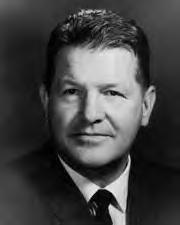
The New Mexico territory began as a conservative Republican stronghold and this was reflected in the first senators the state elected in Thomas B. Catron and Albert B. Fall. However, over time the state’s politics were increasingly inclined towards the Democrats, with the only Republican elected to Congress after the onset of the Great Depression being the progressive Senator Bronson Cutting, who would die in an airplane crash in 1935. From then on it was Democrats all the way, including in gubernatorial races. That was, until the election of Edwin Leard Mechem (1912-2002) as governor.
New Mexico in 1950 was considered quite Democratic, and at that point Republicans often had trouble recruiting candidates for major public offices. However, “Big Ed” (he was a large man) Mechem, a 38-year-old Las Cruces lawyer, stepped up to the plate against Democratic Congressman John E. Miles. Miles, who had had a long career in New Mexico politics, had good reason to think that he was going to win this one, and it didn’t hurt that he was politically moderate, potentially offsetting him being tied closely with the increasingly unpopular Truman Administration. However, Mechem delivered a powerful message against corruption in New Mexico politics and proposed reforms to the structure of the state’s government. New Mexico had had a long history of corruption in state politics, with money often having a strong influence on elections and charges of voter fraud were frequent; Senator Dennis Chavez may have won reelection in 1946 due to voter fraud (Hill). The climate of 1950 was decidedly conservative, and although New Mexico Democrats defeated Republican challengers for Congress (the two Democratic candidates were far from liberal stalwarts), Mechem won the 1950 election with 54% of the vote in an upset. Despite Mechem being quite conservative and the state of New Mexico being Democratic, he proved the state’s biggest vote-getter for the Republicans. He was not the first member of his family to serve as the state’s governor, as his uncle Merritt had done so from 1921 to 1923, also as a Republican.
As governor, Mechem proved a reformer, restructuring New Mexico government and standing independent of political machines. He also was quite politically savvy, and journalist James B. Barber of the Carlsbad Current-Argus noted that he was “a politician who can stumble into a vat of limburger cheese and come up reeking of [Chanel] No. 5. Some of it is luck, maybe, but there’s a lot of political savvy, too, in this big stubborn Las Cruces lawyer, who seldom takes advice from anyone” (28). He won reelection in 1952, running only two points behind Dwight Eisenhower. Mechem had a rather amusing tendency, as Barber noted, to issue forth a deep laugh from his chest that came out “ho ho ho” when he was dodging an inconvenient question (24). However, Mechem was term-limited, and instead of running for governor again, he tried to win a seat in the Senate. His opponent was Senator Clinton Anderson, a shrewd politician who was considered the foremost figure of the state’s Democratic Party. This would produce for him the worst defeat of his career, as the 1954 midterms resulted in the loss of control of Congress for the Republicans, and he would only net 43% of the vote. Mechem was not out of the game for long, and in 1956 he was again elected governor, defeating incumbent John F. Simms with 52% of the vote.
The 1958 election was particularly bad for Republicans, with Mechem losing by only a point to Democrat John Burroughs, but in a rematch in 1960 he campaigned against Burroughs’ forming his own political machine and came out ahead by less than a point. The Gallup Daily Independent had endorsed his bid for a comeback, citing his record as an efficient governor without ties to political machines (4). Although a victory, voters were less enthused about Mechem than in the past, and in 1962 Democrats managed to get New Mexico Representative Jack Campbell, a man known for being free of the control and influence of machines, to run against him. Campbell defeated him by 6 points. However, fate granted him an opportunity. On November 18th, the long-ailing Senator Chavez died, and Mechem pulled a maneuver that seldom works out in the long-run for politicians: resigning the governorship and having his successor appoint him to the Senate. This move was highly controversial in New Mexico as the voters had just rejected him for another term in public office only for him to move into the Senate.
Senator Mechem aligned himself closely with the staunchly conservative Barry Goldwater and his record proved among the most conservative in the Senate, opposing all major New Frontier and Great Society measures considered in his time in office as well as the Partial Nuclear Test Ban Treaty. The liberal Americans for Democratic Action rated him zeroes in both 1963 and 1964, not an easy feat to accomplish. He sided with Americans for Constitutional Action (Mechem would later serve on its Board of Trustees) 98% of the time by contrast, with the only position he had taken they considered liberal being voting against Senator Proxmire’s (D-Wis.) proposal to cut to Labor-HEW Appropriations in 1963. This meant, rather controversially for his state in which there were many Latinos, that he was one of six Republican senators to vote against the Civil Rights Act of 1964. Mechem also opposed most sections of the bill and was the only Republican to vote in favor of Senator Gore’s (D-Tenn.) motion to recommit the bill to ease the provision cutting off aid to segregated schools. Mechem’s DW-Nominate score was a 0.585, placing him as the fourth most conservative senator in the 88th Congress. Although he had voted his conscience as his voting was far from tailored to win reelection in New Mexico at the time, this was politically tough as he was up for election to a full term in 1964, and that year was worse for the average Republican candidate than 1962 had been.
The 1964 Election: “Big Ed” vs. “Little Joe”
The 1964 election was one of great contrasts, both in the presidential election and in the New Mexico Senate election. “Big Ed” was facing a challenge from Joseph “Little Joe” Montoya, who represented one of New Mexico’s two At-Large districts. Little Joe supported JFK’s New Frontier legislation and LBJ’s Great Society, Big Ed did not. Little Joe supported the Civil Rights Act of 1964, Big Ed did not. A lot of support for Mechem’s campaign likely came from people remembering him as a good and effective governor of the state, but the candidacy of Barry Goldwater was tough for him to work with, especially since he voted with him on almost all key issues.
Although Mechem tried his best, he was defeated by nine points in 1964, with Montoya getting excellent results in Spanish-American areas. Mechem’s move to the Senate had only temporarily stayed the execution of his political career, and he demonstrated that he was the rule and not the exception when it came to governors getting themselves appointed to the Senate. As a side note, West Virginia’s Joe Manchin is an example of how to do it right; after Senator Robert Byrd died in 2009, he appointed an interim successor and ran in a proper election to finish the late Byrd’s term in 2010 and won despite West Virginia no longer being competitive for Democrats in presidential elections and the 2010 midterms being what President Obama called a “shellacking” for the Democrats. Journalist Will Harrison (1964) wrote of the outcome for Mechem, “The Nov. 3 election was very likely the end of Ed Mechem’s political career. It is possible that he might have beaten Montoya in a head-to-head run without the presidential influence, but the writing was on the wall for Mechem in 1962 when Jack Campbell demonstrated that a clean, aggressive Democrat could beat him without outside influence. Mechem’s 1962 loss of Albuquerque and his home county of Dona Ana, and the loss of such formerly reliable areas as San Juan and Santa Fe were signals that he had reached the end of his string” (4). Harrison was right; the New Mexico voters had tired of “Big Ed” Mechem, and he would never again be elected to public office. However, one important person had not tired of “Big Ed”, and that was Richard Nixon.
Judge Mechem
In 1970, President Nixon nominated Mechem, who he dubbed “Mr. Republican” as a Federal court judge for the district of New Mexico, and he was confirmed. While a judge, Mechem’s judicial record was not influenced by his political leanings; he ruled that age discrimination was occurring at Sandia National Labs, that sex discrimination was occurring in the Albuquerque police department, that the Socorro County jail had been indifferent to the medical needs of a prisoner who died, and made several rulings favorable to American Indians (Hill). Mechem assumed senior status (a state of semi-retirement for judges) in 1982 but would continue to work as much as he could for the last twenty years of his life. He died on November 27, 2002, at the age of 90 from his longtime heart condition.
Future of New Mexico Politics
Interestingly, not too long after Mechem’s 1964 defeat, the politics of New Mexico improved considerably for Republicans and conservatives, with Richard Nixon winning the state in 1968, two Republicans being elected to Congress that year, and the 1972 election resulting in the election of Republican Pete Domenici to the Senate, who represented the state for 36 years. New Mexico today is now politically what it was during the time of FDR, Democratic all around for major offices, and the last Republican the state voted for in a presidential election was George W. Bush in 2004. Is a comeback in store for the Republicans in New Mexico? Undoubtedly at some point, but when that’s going to be is anyone’s guess.
Correction, 3/4/25: I had originally written of Joe Manchin’s election in 2010 to the Senate as for a full term, but it was actually to complete the late Senator Byrd’s term. Manchin ran for a full term in 2012. My thanks to Daniel Fox for spotting this.
References
ADA Voting Records. Americans for Democratic Action.
Retrieved from
Barber, J.B. (1953, May 10). If It’s Politics, Big Ed’s Coming Out Ahead. Carlsbad Current-Argus, 28.
Retrieved from
https://www.newspapers.com/image/504660962/
Barber, J.B. (1953, March 29). Will Mechem Try For Senate Seat? Ho Ho Ho. Carlsbad Current-Argus, 24.
Retrieved from
https://www.newspapers.com/image/504706110/
Harrison, W. (1964, November 8). Perfect Drive For Little Joe. Carlsbad Current-Argus, 4.
Retrieved from
https://www.newspapers.com/image/504842775/
Hill, R. E.L. Mechem of New Mexico: BIG ED. The Knoxville Focus.
Retrieved fromhttps://www.knoxfocus.com/archives/this-weeks-focus/e-l-mechem-new-mexico-big-ed/
Mechem, Edwin Leard. Voteview.
Retrieved from
 Mad Politics: The Bizarre, Fascinating, and Unknown of American Political History
Minor correction: Gov. Manchin didn’t run for “a full term” in 2010. That was a special election for the final two years of Byrd’s term.
Corrected, thanks!