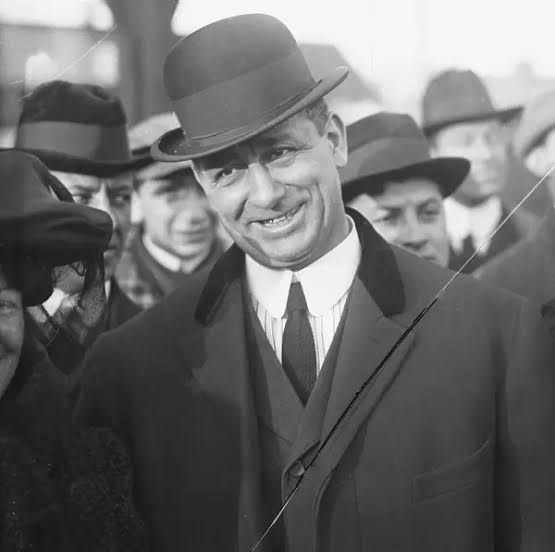
Recently, a major case in which guilt or innocence hinges on a person’s state of mind is the Lindsay Clancy case. Given this and the upcoming election, it brings to mind the story of the man who won a Congressional seat in San Francisco in 1902, Edward Livernash (1866-1938). He had defeated incumbent Republican Julius Kahn, the one and only time Kahn would lose a Congressional election. Not only would you not read a sentence like this today, you also would not have expected Livernash to reach Congress, especially when you consider his story.
Brilliant…But Peculiar
Livernash was an interesting combination, in that he possessed both brilliance and touches of madness. At 16, he established a successful newspaper and at 21 he passed the bar exam. By the time of his marriage at 24 to Jessie Overton, daughter of Judge A.P. Overton, he was the editor of the Healdsburg Enterprise. Livernash was also an active Democrat which would help his career later on.
In June 1891, Livernash purchased the Livermore Herald from W.P. Bartlett, but only three months later his troubles began when its office burned to the ground, a serious financial blow to him. However, he was able to continue publishing the paper by entering a contract with a printer in Oakland (Santa Rosa History, 2022). He also had been getting help from Dr. John W. Robertson, owner of the Livermore Sanitarium, for insomnia. On the day of the fire, he was spotted by a police sergeant in San Francisco waiting to board a ferry, dressed as a black woman with a veil. Said the sergeant, “You are a man, sir, masquerading in female attire” and after Livernash responded in an unconvincing feminine impression, “How dare you attempt to insult me, Mr. Officer? I am a lady, if I am black”, the sergeant again said “You are a man…it is against the law for one of your sex to appear in public in petticoats. I shall have to take you in” and upon grabbing the veil, Livernash was revealed with black grease paint (Santa Rosa History, 2022).
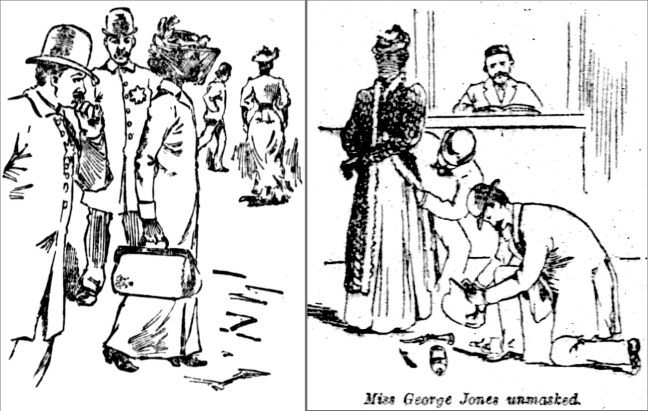
San Francisco Examiner and San Francisco Chronicle illustrations of the incident.
When asked his name, Livernash gave the alias “George Jones”. Once the police searched his satchel, they found some highly suspicious items. Recounted the San Francisco Chronicle, “Nothing of any importance was found about the prisoner’s person but the opening of the satchel created a sensation. First was fished out a pound bottle of chloroform which had not been opened. Next were produced two one-pound bottles labeled prussic acid, likewise unopened…By this time the police were genuinely interested, and pressed Jones for explanations. But he had nothing to say” (Santa Rosa History, 2022). Livernash did indeed later have things to say about what he had on him. He claimed the chloroform was for his insomnia and that his disguise was to play a prank, although he would not divulge on who he was going to play the prank. Livernash later said it was to be a prank on his wife. After having Dr. Robertson back up his defense that he was under hypnosis (caused by himself) at the time, he was convicted of a misdemeanor and fined.
Criminal Escalation
Just one month later, he made contact with Darius Ethridge, a wealthy 71-year-old bachelor with no known heirs, and visited him at his property in Cloverdale under the pretense that he was staying in town for the night and wanted to conduct a business deal, namely, the selling of his livery stable. Livernash brought a gift of a bottle of wine and told him that his father-in-law and others would be coming around later to buy his livery stable and then went to his hotel. However, Livernash returned to the property at 2 AM. After waking him, he saw pictures of other family members who Etheridge identified as his niece and nephew, with him commenting, “I thought you had no relatives” (Elliott). This revelation seemed to upset his plans. After putting $150 on the table for an initial payment for the livery stable and removing it, he pointed two revolvers at him, and demanded, “Make out your will in my favor or I will kill you, God damn you!” (Elliott). After Ethridge refused, He shot at him seven times, with four bullets hitting his face. Amazingly, the man survived with minor injuries and was able to flee to his physician neighbor’s house, where he got treated. The wine, it turns out, had been poisoned with prussic acid, but Ethridge had not opened the bottle.
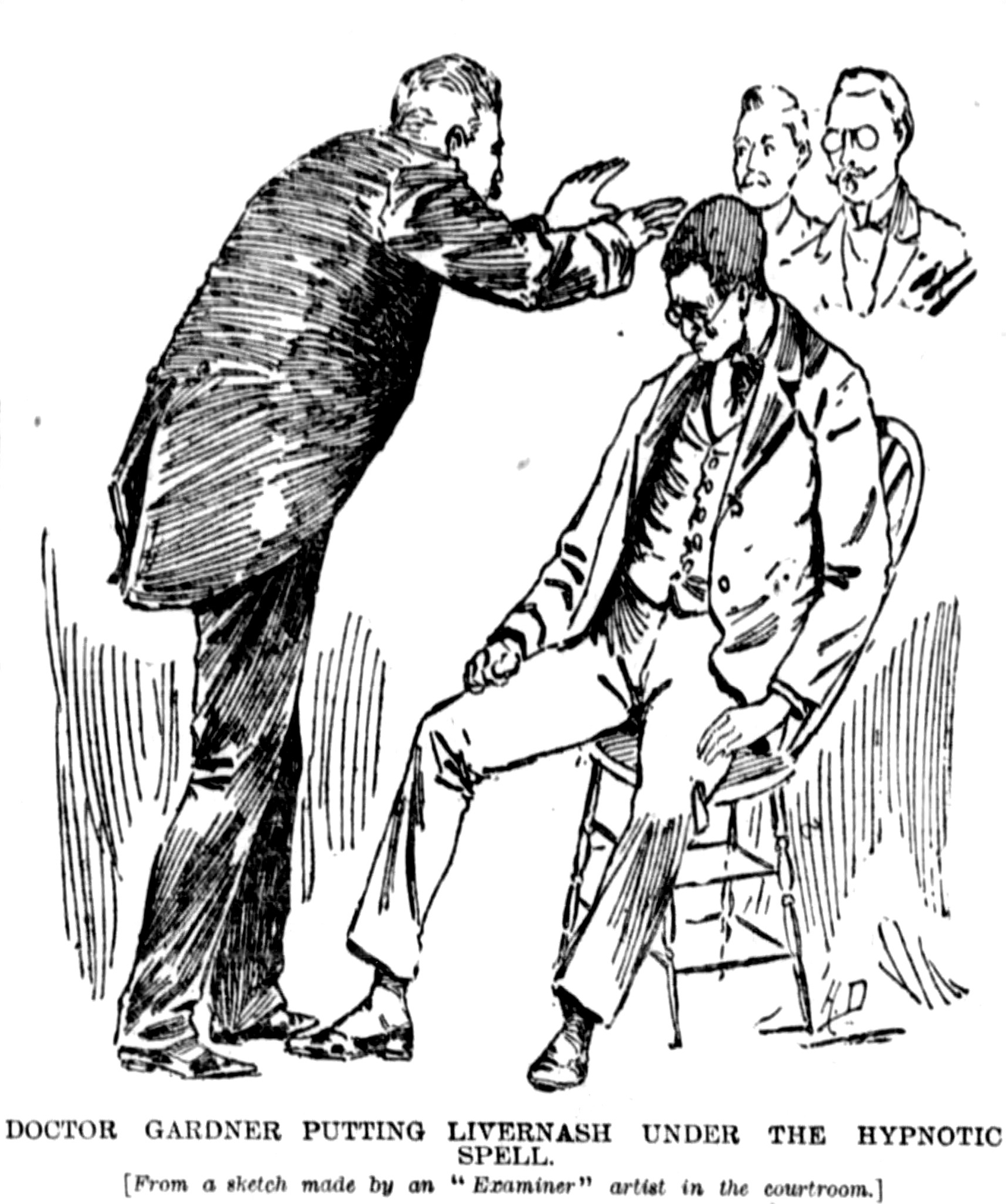
On his arrest by a marshal, Livernash proclaimed, “I am the king of Siam” and claimed to have murdered several people, including shooting a judge 43 times (Elliott). After being taken to court for a sanity hearing, he was committed to the Napa asylum. However, given his connections, the local Santa Rosa newspaper, a Democratic paper, gave the case incredibly gentle coverage (Elliott). In his first trial, Livernash claimed in his defense that he was a somnambulist and thus had no idea what he was doing while attempting murder. The case resulted in a hung jury, with eight voting to convict and four voting to acquit. In his second trial, Livernash dropped the somnambulist defense and instead cited a history of insanity in his family and that he had been in a state of insanity while attempting murder. He managed to get Congressman Thomas J. Geary as a character witness, and the jury acquitted him! Author Jeff Elliott (2021), examining the case, concluded that Livernash was a strange and brilliant man, but a rational man who faked somnambulism and insanity to get out of trouble for his criminal activities. Indeed, before the trial Livernash attempted to bribe a constable to let him sneak back to the scene of the crime (Elliott).
The Rest of the Story
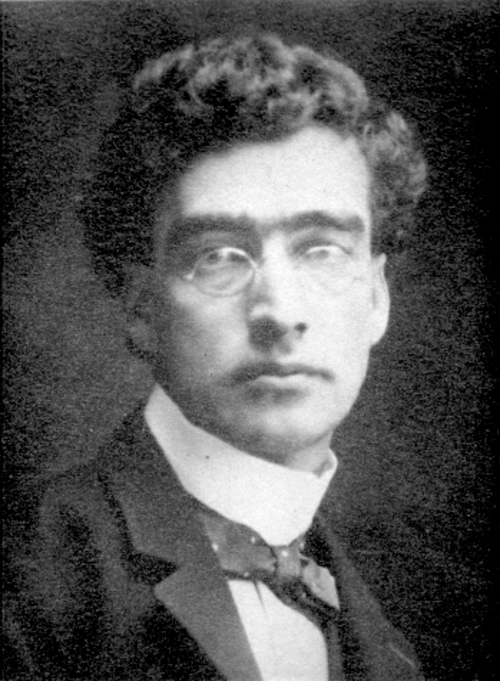
Livernash resumed his journalistic and political activities after the trial, being hired by the San Francisco Examiner and in 1897 he was sent by the paper to the Klondike region of Canada to report on the gold rush with poet Joaquin Miller. There, he befriended and allied himself with the laborers, who appointed him as their representative to petition the government to modify labor laws.
In 1902, Livernash ran for Congress to represent San Francisco, running on both the Democratic and Union Labor tickets with strong support from labor unions and in support of continuing Chinese exclusion. That year, both Republicans representing the San Francisco area, Kahn and Eugene Loud, lost reelection. The Republicans would not be out long, with Kahn defeating Livernash by 26 points in 1904 and Everis Hayes winning back the other seat. Per DW-Nominate, Livernash was one of the least liberal Democrats in the House, his score being a -0.044. One example of him being less liberal than other Democrats was being one of five Democratic votes against an amendment on February 9, 1905, strengthening the railroad rate setting powers of the Interstate Commission. Livernash also was one of eight Democrats to vote for the Republican appropriations bill passed on April 26, 1904, under the reign of famously conservative Speaker Joe Cannon (R-Ill.). After his time in Congress, Livernash continued his career in journalism, divorced his wife, and resided in France from 1909 to 1912. While in France, he discovered that he was descended from nobility and that he was legitimately a Count. He then changed his name to Edward James de Nivernais, the French spelling of his last name. For the remainder of his life he engaged in study and literary pursuits, dying in Agnew (now part of Santa Clara), California, on June 1, 1938.
References
Elliott, J. (2021, January 10). The Murderous Somnambulist. Santa Rosa History.
Retrieved from
http://santarosahistory.com/wordpress/2021/01/the-murderous-somnambulist/
Livernash, Edward James. Voteview.
Retrieved from
https://voteview.com/person/5714/edward-james-livernash
Such a Very Strange Man. (2022, January 20). Santa Rosa History.
Retrieved from
http://santarosahistory.com/wordpress/category/livernash/
The Career of Edward Livernash, Livermore Herald Editor. (2009, May/June). Livermore Heritage Guild.
Retrieved from
https://www.lhg.org/Documents/Newsletters/News2006-2009/2009May.pdf