Although in 2026, there was no turnover of major political offices in Oklahoma, the state has had quite a history of political tumult and turmoil, including one of the most powerful, out of control violent state Ku Klux Klans in the 1920s, the worst race riot in American history (Tulsa in 1921), the impeachment and removal of two governors, and the conviction of its most powerful House Speaker in its history, J.D. McCarty, of income tax evasion. The judiciary was not exempt from these troubles. As it existed, the judicial system of Oklahoma enabled appointments to the court that were based more in politics than qualifications as justices were elected in partisan elections. From its 1907 statehood the Democratic Party dominated Oklahoma politics until the 1980s (the first Republican governor wasn’t elected until 1962) and thus there was a good deal of partisan power entrenched in the state’s judiciary. This entrenched partisan power proved a breeding ground for corruption.
The Scandal
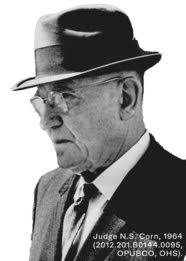
Justice N.S. Corn had a long career in Oklahoma politics, having sat on the Supreme Court since 1935 and had a benefactor in O.A. Cargill, who had been the Democratic mayor of Oklahoma City from 1923 to 1927 and would regularly contribute to his reelection campaigns. He would also serve as the body’s chief justice from 1943 to 1945. However, Corn had a dirty secret, and one that would be revealed only after his assumption of senior status in 1959. In 1964, he and sitting Justice Samuel Earl Welch were indicted for tax evasion, and the revelations of this case would change the face of government in Oklahoma.
Justice Corn pleaded no contest to the charge of income tax evasion of $11,063 from 1957 to 1959 and was sentenced to 18 months imprisonment and a fine of $11,250. He subsequently produced a sworn affidavit that detonated a political atom bomb, as he was admitted to having accepted bribes in every single year of his time as justice from Cargill in exchange for his vote and implicated two other justices, Welch and Napoleon Bonaparte Johnson, in accepting these bribes in exchange for immunity. Welch had also been convicted of income tax evasion for evading $13,364 in income taxes from 1957 to 1961 and sentenced to three years imprisonment. A specific case Corn cited was Selected Investments Corp. v. Oklahoma Tax Commission (1957), in which he admitted to having accepted $150,000 in exchange for his vote to reverse a state tax claim against a sketchy investment company and had paid $7500 to Justices Welch and Johnson for their votes. The decision in this case was 6-2. Corn also admitted to paying them $2500 each for an oil lease case in 1959.
Consequences
In January 1965, U.S. District Judge Stephen S. Chandler had been given a copy of the sworn statement gave a copy of this confession to Oklahoma Justice William A. Berry. Berry was sickened by the revelation and believed the public had the right to know of this affidavit, but should he make public statements about it he risked a lawsuit from the parties implicated, but members of the legislature were immune from slander suits for statements made during a legislative session (Oklahoma Bar Association). Berry met with Republican State House Minority Leader G.T. Blankenship, who wrote down excerpts of the affidavit and on January 21, 1965, he read the affidavit before the legislature. The state bar association, alarmed, conducted an investigation of the state Supreme Court and cleared the rest of the sitting justices.
On March 18th, impeachment charges were filed against Welch and Johnson. Justice Welch, already facing a prison sentence and reading the writing on the wall, subsequently resigned, but Justice Johnson decided to stick it out. Former Justice Corn testified in the impeachment hearings and when questioned by state senators, Justice Johnson answered “I don’t recall” 56 times, and tried to cast the case against him as anti-Indian prejudice as he was Cherokee. On a side note, Justice Welch was also an Indian, being a Chickasaw. When asked about the $20,000 he had received in addition to his income, he could not explain it (Burke). The state Senate impeached him 32-15. Johnson to this day is the only justice of the Oklahoma Supreme Court to be impeached. Although numerous parties would apply to have decisions vacated, only a few cases were vacated (Burke). On March 27th, Welch, Johnson, and Cargill were indicted for bribery. Cargill was convicted of three counts of perjury for lying about his role in the bribery conspiracy under oath, however, two of the three were thrown out on appeal.
Although changes were proposed to reform the court system, Speaker J.D. McCarty blocked them. However, the 1966 election tilted against the status quo in Oklahoma; Republican Dewey Bartlett, who ran in part on court reform, was elected governor, Blankenship was the first Republican elected attorney general, and McCarty was upset for reelection. The following year, McCarty himself was convicted of income tax evasion. This scandal resulted in the creation of the Court on the Judiciary to address ethics complaints against judges rather than merely the ballot holding justices accountable, and the voters approved two constitutional amendments; the first consolidated lower courts into district courts, and the second abolishing partisan elections for judges, instead having a 15-member Judicial Nominating Commission to select proper justices and sends finalists to the governor to appointment, with voters deciding on whether to keep them. Retention elections have no opponents, rather if a justice is not retained the Judicial Nominating Commission selects new finalists. These reforms without doubt transformed the judiciary into a more professional, accountable body to the public.
References
2 Judges Indicted on Bribe Charge. (1965, March 28). The New York Times.
Retrieved from
Burke, B. From the Ashes of Scandal Came Court Reform. Oklahoma Bar Association.
Retrieved from
Judges: Oklahoma Impeachment. (1965, May 20). Time Magazine.
Retrieved from
https://time.com/archive/6637796/judges-oklahoma-impeachment
Scandal Shakes Oklahoma Court. (1964, July 19). The New York Times.
Retrieved from
The Law: Oklahoma’s Shocking Scandal. (1965, April 15). Time Magazine.
Retrieved from
https://time.com/archive/6635937/the-law-oklahomas-shocking-scandal

