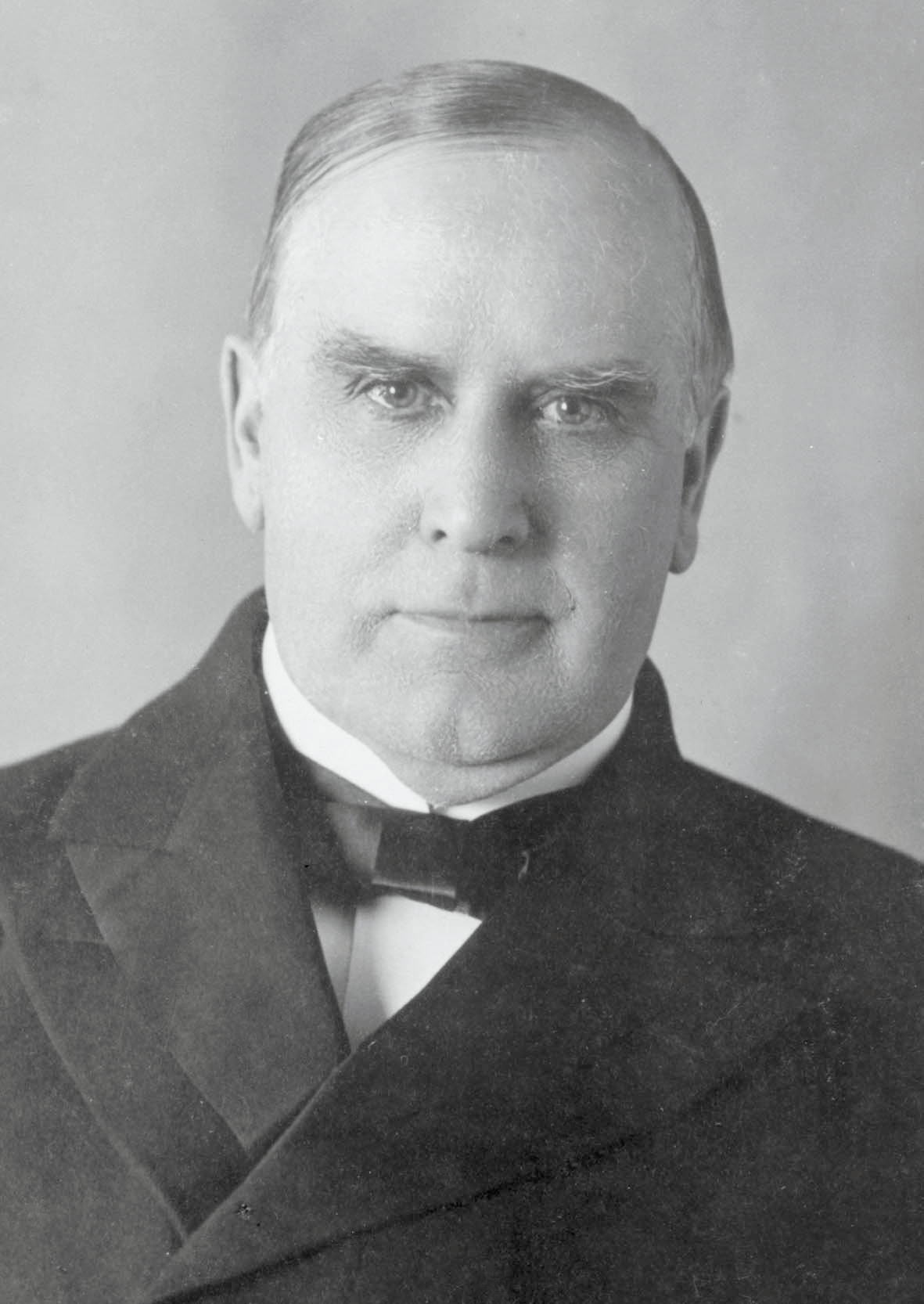
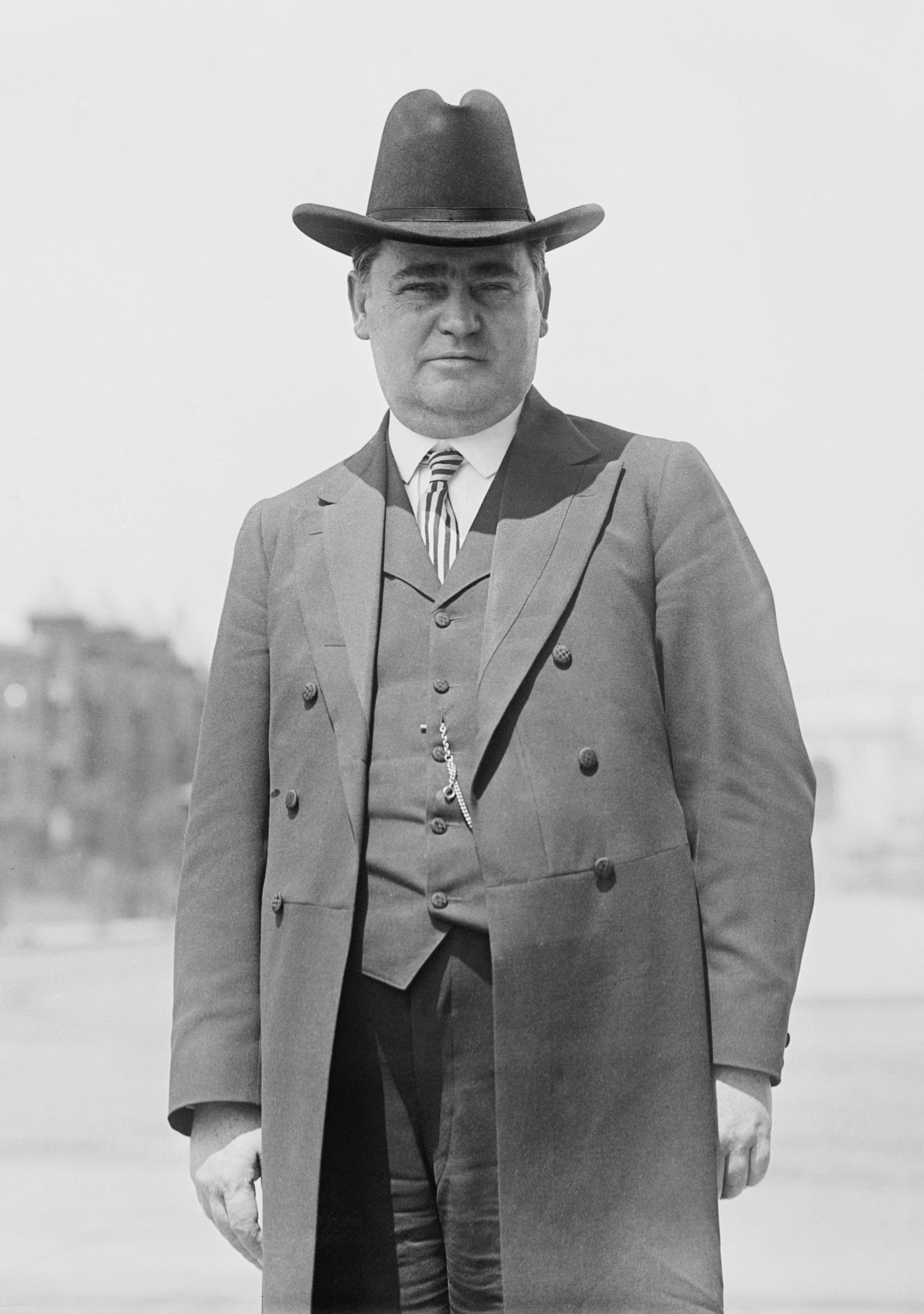
Abe Murdock: The Beehive State’s Bastion of New Deal Liberalism

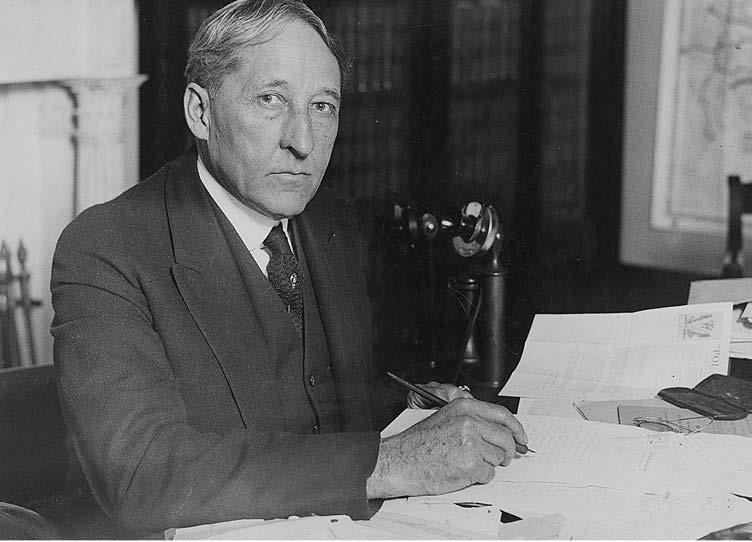
There is a notion, one that I have tried my best to combat as a writer, that states have a set philosophy for all time and thus we can look back at how they voted and say that such people would vote a certain way today. This ignores important factors such as demographic shifts and economic changes. As hard as it is for some to believe, the state of Utah at one time was a bulwark for FDR and the New Deal. In 1932, Utah voters gave their longtime Republican senator, Reed Smoot (as in Smoot-Hawley Tariff), the boot. They did likewise for their two Republican representatives, and the beneficiary in the state’s first district was Orrice Abram “Abe” Murdock Jr. (1893-1979).

Murdock made his way up in state politics during the Republican 1920s, including serving on the Beaver city council from 1920 to 1921, multiple terms as county attorney, and serving as city attorney from 1926 to 1933. In 1928, Murdock ran for district attorney in the 5th Utah district but lost. In 1932, he got his big break when he ran for Congress, defeating Republican Don B. Colton by 3 points.

Murdock was a staunch proponent of the New Deal, although he did oppose Roosevelt’s push to fund the New Deal by cutting veterans’ benefits. This was a fairly minor objection in the grand scheme of things, and he supported all of the major New Deal laws. The voters were with him, and he won reelection in 1934 by 30 points. Murdock was also supportive of water projects to help grow the west. However, he was perhaps best known for his staunch support of labor unions, and fought against the efforts of Howard W. Smith (D-Va.), chairman of the special committee to investigate the National Labor Relations Board (NLRB). Smith was an opponent of the Congress of Industrial Organizations (CIO) and believed that the NLRB favored the CIO. There was, however, one issue that contemporary liberals would not consider Murdock one of their own, and that was that in 1937 and 1940 he voted against anti-lynching legislation.

Although Utah was strongly for the New Deal, one of its senators, William H. King, had turned against it by 1936. Congressman Murdock challenged King for renomination on a platform of 100% support for the New Deal, and the contrast between Murdock and King was strong not only based on domestic policy, but also by age: Murdock was 47 while King was 77. Although the latter was for Roosevelt’s foreign policy, this wasn’t enough as Murdock was supportive too and he won the primary by a 2-1 margin, a resounding rebuke of King. The state’s voters were simpatico with the Democratic primary voters, resoundingly reelecting Roosevelt and electing Murdock by over 25 points.

Senator Murdock

Murdock proved one of the friendliest of all the senators to New Deal policy as well as to organized labor. Contrary to his votes against anti-lynching legislation in the House, he supported the retention of the Fair Employment Practices Committee as well as banning the poll tax in federal elections. His staunch pro-Administration stance included his votes against overriding President Roosevelt’s veto of the Smith-Connally Act in 1943 and the Revenue Act in 1944. Murdock also co-authored the G.I. Bill (The Ogden Standard Examiner). However, politics have a way of changing over the years, and Utah was no exception. 1946 was a far different year than 1940, as President Truman was deeply unpopular and Republicans were keen on rebounding from their losses, which they did. Murdock campaigned on his record of advocacy for agriculture, labor, and veterans, as well as the successful fight to retain the Geneva steel plant (The Ogden Standard Examiner). However, this wasn’t enough to prevent his defeat by Republican Arthur Watkins, although his loss was by less than three points him for reelection, indicative once again of how Utah was not always this staunchly red state. Murdock’s DW-Nominate score is a -0.351. This was far from the end of Murdock’s time in Washington, and President Truman tapped him to be on the National Labor Relations Board. His appointment was opposed by pro-business conservatives, but he was confirmed and served until 1957. Murdock did have disagreements with the Eisenhower Administration during this time, as he regarded its appointees to the NLRB as voting for changes in the law to favor employers (Cook). In 1960, he briefly served on the Atomic Energy Labor-Management Relations Panel before he retired from politics. Murdock died on September 15, 1979 in Bethesda, Maryland.

References

Cook, J. (1979, September 18). Abe Murdock Dead; Former U.S. Senator. The New York Times.

Retrieved from

For Action…Accomplishment…Leadership…Vote Straight Democratic. (1946, November 3). Advertisement in The Ogden (Utah) Standard Examiner, 9.

Retrieved from

https://www.newspapers.com/image/598708429/

King Suffers Crushing Defeat. (1940, September 5). Washington Times-Herald, 3.

Retrieved from

https://www.newspapers.com/image/1037944639/

Murdock, Orrice Abram, Jr. (Abe). Voteview.

Retrieved from

https://voteview.com/person/6800/orrice-abram-murdock-jr-abe

The McKinley Tariff

Tariffs have been figuring strongly in recent politics thanks to President Trump’s repeated changes in course throughout the year on the imposition or removal of tariffs and certain decisions surrounding them that have been questionable at best. Trump’s policies on tariffs, although more erratic than Republicans of past, given his positive mention of William McKinley does make me think of the McKinley Tariff of 1890, which was at the time a crowning partisan achievement of the GOP and one that helped bring about swift political consequences.

The 1888 election was very close, but a great success for the Republican Party. For the first time since the Grant Administration, they had achieved unified government, and under the highly capable Speaker Thomas Brackett Reed of Maine, they sought to make the most of it. At the forefront of the agenda was the bread and butter of economic Republicanism of the time…protective tariffs. Leading this charge was the popular Representative William McKinley (R-Ohio), known as the “Napoleon of Protection” for his strong advocacy. The Republican Party was at the time strongly unified behind increasing tariffs while the Democratic Party was just as if not more strongly unified against.

A key concept introduced by this legislation was the reciprocal tariff or empowering the executive to raise tariffs on commodities after their addition to the free list to disincentivize other nations from raising their tariffs on these goods. Furthermore, Harrison persuaded the Senate to adopt a provision permitting the president to sign agreements opening foreign markets (U.S. House). These provisions would be upheld unanimously by the Supreme Court as a constitutionally permissible delegation of power in the 1892 decision Field v. Clark.

The initial version of the McKinley Tariff passed 164-142 on May 21st on a highly partisan vote as only three representatives defected: Republicans Hamilton Coleman of Louisiana and Oscar Gifford of South Dakota and Democrat Charles Gibson of Maryland. In the Senate, the bill was managed by Nelson Aldrich (R-R.I.), perhaps the foremost representative of industry in the Senate. On tariffs, in which 138 votes on the subject were held that covered numerous commodities from salt to sponges, the Senate passed the bill 40-29 on September 10th a completely partisan vote. However, there were differences between the House and Senate versions and thus the measure went to conference to resolve them. On September 27th, the House voted on the conference report, which was passed 151-81, with only Republicans Harrison Kelley of Kansas and again Coleman of Louisiana breaking with party. In the Senate, however, there was some more dissent among Republicans, with Senators Preston Plumb of Kansas, Algernon Paddock of Nebraska, and Richard Pettigrew of South Dakota voting against. In its’ final form, this law raised tariffs on average from 38% to 49.5%. Certain commodities were heavily focused on for protective tariffs like manufactured goods such as tin plates to appeal to factories in the East, while wool was jacked up to appeal to the sheep farmers of the rural West. Other tariffs, however, were removed, such as those on sugar, molasses, coffee, tea, and hides, but the president was authorized to raise them should other nations choose to impose on these goods for the United States.

Puck cartoon mocking McKinley.

Although quite the achievement for the Republican Congress, it went into effect on October 6th, less than a month before the 1890 election, and prices promptly rose in response to the tariffs. The Democratic newspaper skewered the bill, and since the benefits of the tariffs (increase in domestic worker wages and jobs) had little time to take effect while the negative side took effect promptly, this resulted in a surge of disapproval of the Republicans. Eleven days after the tariff took effect, The Cleveland Plain Dealer (1890) wrote, “The consumers are finding out that they are compelled to pay the tax, and that fact will grow daily more apparent. A gentleman walked into a hardware store a few days ago and asked to see some pocketknives. A number were placed upon the show case and prices were given. “Are these McKinley prices?” he inquired. “No,” said the clerk, “but we will be compelled to raise prices. We have been busy and have not made any change in our prices yet, but we shall soon do so.” This is only one of many occurrences of which one hears on the streets, and to offset it all there is nothing but prattle about imaginary tin plate factories and other McKinley air castles”. Such unpopularity contributed a great deal to the utter slaughter the Republicans faced in the 1890 midterms including McKinley himself losing his seat, although his loss was in good part due to unfavorable redistricting. Democrats won the popular vote by 8 points in the House, which produced a gain of 86 seats for them and Republicans sustained a 93 seat loss; they also lost seats to the newly formed Populist Party. The Indianapolis Journal (1890), contrary to The Cleveland Plain Dealer, wrote in defense of the tariffs after the election, attributing much of the unpopularity to “falsehoods” propounded about the McKinley Tariff by the “importers’ press”, for instance attributing a price increase in fruits and vegetables to tariffs without mentioning that there were crop failures that produced shortages. Although Republicans continued to be for higher tariffs, they sought to proceed more carefully in the future than they had in 1890, and McKinley would have an astounding comeback, being elected Ohio’s governor in 1891, be reelected in 1893, and then be elected president in 1896. Although a high tariff man, he would embrace the idea of reciprocal tariff reductions, and the Dingley Tariff Act of 1897, although it enacted the highest tariffs on average in American history, would contain a provision permitting the president to reduce duties by up to 20%. McKinley even came around to the idea of reciprocal trade treaties shortly before his assassination.

References

Gould, L.L. William McKinley: Domestic Affairs. UVA Miller Center.

Retrieved from

https://millercenter.org/president/mckinley/domestic-affairs

The McKinley Tariff of 1890. U.S. House of Representatives.

Retrieved from

https://history.house.gov/Historical-Highlights/1851-1900/The-McKinley-Tariff-of-1890/

The Victory of Misrepresentation. (1890, November 7). The Indianapolis Journal, 4.

Retrieved from

https://www.newspapers.com/image/321737007/

To Adopt the Report of Comm. on Conference on Bill H.R. 9416. Govtrack.

Retrieved from

https://www.govtrack.us/congress/votes/51-1/h414

To Agree to the Conference Report on H.R. 9416 (26 STAT. 567, 10/1/1890), a Bill Reducing the Revenue and Equalizing Duties on Imports. Govtrack.

Retrieved from

https://www.govtrack.us/congress/votes/51-1/s383

To Pass Bill H.R. 9416. Govtrack.

Retrieved from

https://www.govtrack.us/congress/votes/51-1/h184

To Pass H.R. 9416. Govtrack.

Retrieved from

https://www.govtrack.us/congress/votes/51-1/s364

Up Go the Prices. (1890, October 17). The Cleveland Plain Dealer, 8.

Retrieved from

https://www.newspapers.com/image/1075890829/

RINOs from American History #26: Millicent Fenwick

At one time there were people in the Republican Party who were considered prominent and promising who were of the party’s “Rockefeller” or “liberal” wing. One of the last who looked like she was going to go to higher places was Millicent Hammond Fenwick (1910-1992). Born Millicent Hammond, she had tragedy early in her life when her mother was among the casualties of the sinking of the Lusitania in 1915. Her father was the wealthy New York financier and politician Ogden Hammond, who served as Ambassador to Spain during the Coolidge Administration. As a young society woman, she caused some scandal when she fell in love with the older and already married businessman Hugh Fenwick. Fenwick chose her and divorced his wife. He and Millicent were married from 1932 to 1945 (although they had separated in 1938) and had two children. After the separation, she sought to provide for her children by briefly modeling for Harper’s Bazaar and then writing for Vogue magazine, and in 1948 she wrote Vogue’s Book of Etiquette, which sold over a million copies. Although she had first become politically aware in the 1930s, recalling, “Hitler started me in politics; when I became aware of what he was doing to people, I fired up” (U.S. House). By the 1950s she decided that it was time to get into public service.

A strong advocate for civil rights, Fenwick was a member of the NAACP and from 1958 to 1974 she served on the New Jersey Committee of the U.S. Commission on Civil Rights. She also served on the Bernardsville Borough Council from 1958 to 1964. In 1969, Fenwick was elected to the New Jersey Assembly, serving until 1973. While there, she solidified her reputation as a wit when a conservative member of the Assembly spoke out against the Equal Rights Amendment, stating, “I just don’t like this amendment. I’ve always thought of women as kissable, cuddly and smelling good”, which was met with Fenwick’s retort, “That’s the way I feel about men, too. I only hope for your sake that you haven’t been disappointed as often as I have” (U.S. House). Although an advocate for marriage, she had never remarried after her divorce from Hugh Fenwick. In 1973, Governor William Cahill tapped her to head up the New Jersey Division of Consumer Affairs. In 1974, with Congressman Peter Frelinghuysen retiring, Fenwick sought his seat in Congress. Running against her in the Republican primary was future governor Thomas Kean, but she defeated Kean by a mere 83 votes and went on to win the seat.

Congresswoman Fenwick

After her election to Congress, Fenwick diverged even more from party line than her moderate predecessor. She voted to override President Ford’s vetoes on strip mining regulations in 1975 and federal day care and public works in 1976. However, she voted to sustain his 1976 veto of a bill loosening Hatch Act regulations. Although Fenwick backed President Ford’s position to deregulate oil prices in 1975, she also supported Representative Neal Smith’s (D-Iowa) 1976 amendment that limited deregulation of oil prices to small producers. On social issues and foreign aid, Fenwick had a liberal voting record. Contrary to a majority of her party, she opposed the Hyde Amendment, the first successful pro-life reaction to Roe v. Wade. In 1980, Fenwick unsuccessfully tried to keep an endorsement of the Equal Rights Amendment in the Republican Party platform. She was, however, also known as fiscally conservative, although this didn’t mean she was solidly down the line on cuts. When a reporter tried to categorize her, she stated, “Everyone asks me whether I’m a liberal, a maverick, a neoconservative or whatever. I simply try to stick to what I believe in” (Malnic). However, it was her stances on ethics that frequently attracted positive attention. Indeed, Fenwick was among the favorites of the mainstream media of the day, with anchor Walter Cronkite once calling her the “conscience of Congress” (U.S. House). She certainly got points not only from her party, but also the general public, when she took on the notoriously mean and tough chairman of the House Administration Committee Wayne Hays (D-Ohio). Fenwick wanted to keep committee meetings open to the public (Malnic). Hays was not happy with this freshman whippersnapper. As Fenwick recalled, “Hays once said ‘If that woman doesn’t sit down and keep quiet, I’m not going to sign the checks for her staff’”. (Malnic). Hays would resign in 1976 after a highly publicized scandal that he hired his mistress who had no secretarial skills as his secretary. She also sat on the committee that investigated the “Koreagate” influence peddling scandal. Fenwick was also widely regarded as the inspiration for the Doonesbury character Lacey Davenport (an ideal Republican by liberal standards), but cartoonist Garry Trudeau denied this was the case. In 1981, she denounced her colleagues for placing in tax deductions for themselves through hasty legislative maneuvering and announced that she would not choose to benefit from these deductions (Malnic). Fenwick was also known for smoking her trademark pipe, which she took up after her doctor advised her to quit smoking cigarettes.

The 1982 Senate Election

Fenwick, at the age of 72, decided to run for the Senate. In the primary, she faced Jeffrey Bell, a staunch Reaganite who had been the Republican nominee for the Senate in 1978. A nomination of Bell would have been seen as an affirmation of support for Reagan’s agenda within the New Jersey Republican Party, but Fenwick prevailed. Nonetheless, she got Reagan’s endorsement. Fenwick faced Democrat Frank Lautenberg, a wealthy executive who financed his own campaign. Although she was favored to win the race, 1982 was a bad year for the Republicans as the economy was in a recession, something that Lautenberg heavily capitalized on. He also made the point that if elected, she would strengthen the Senate Republican majority and thus keep Strom Thurmond of South Carolina as chairman of the prominent Judiciary Committee. Thurmond was a former segregationist and had only that year voted favorably on voting rights legislation. Fenwick hit back against this tactic, arguing, ”Is there a black person in this state who doesn’t know where I stand? I didn’t wait until 1982 to Join the N.A.A.C.P. When I was a working woman I was a member” (Norman).  Lautenberg was also able to significantly outspend her, and on election day she fell short by three points. Ideologically, Fenwick sided with the positions of Americans for Democratic Action 66% of the time, the conservative Americans for Constitutional Action 43% of the time, and her DW-Nominate score stands at a 0.134, a bit higher than one might think given these scores. Her case also is an example that conservatives can use that even when Republicans run a candidate that liberals claim to like they still don’t win. President Reagan did not leave her high and dry, tapping her to serve as Ambassador to the United Nations Agencies for Food and Agriculture, serving until she retired in March 1987. Fenwick died of heart failure on September 16, 1992 at the age of 82.

References

ADA Voting Records. Americans for Democratic Action.

Retrieved from

Fenwick, Millicent Hammond. U.S. House of Representatives.

Retrieved from

https://history.house.gov/People/Detail/13066

Fenwick, Millicent Hammond. Voteview.

Retrieved from

https://voteview.com/person/14221/millicent-hammond-fenwick

Malnic, E. (1992, September 17). Millicent Fenwick, 82; Congress ‘Conscience’. Los Angeles Times.

Retrieved from

https://www.latimes.com/archives/la-xpm-1992-09-17-mn-798-story.html

Norman, M. (1982, October 29). Rep. Fenwick Says Lautenberg Distorts Her Record. The New York Times.

Retrieved from

The 1914 Election: The First Completely Popular Election

Speaker of the House Champ Clark (D-Mo.), who retained his majority, although considerably shrunken from what it had been at the start of the Wilson Administration.

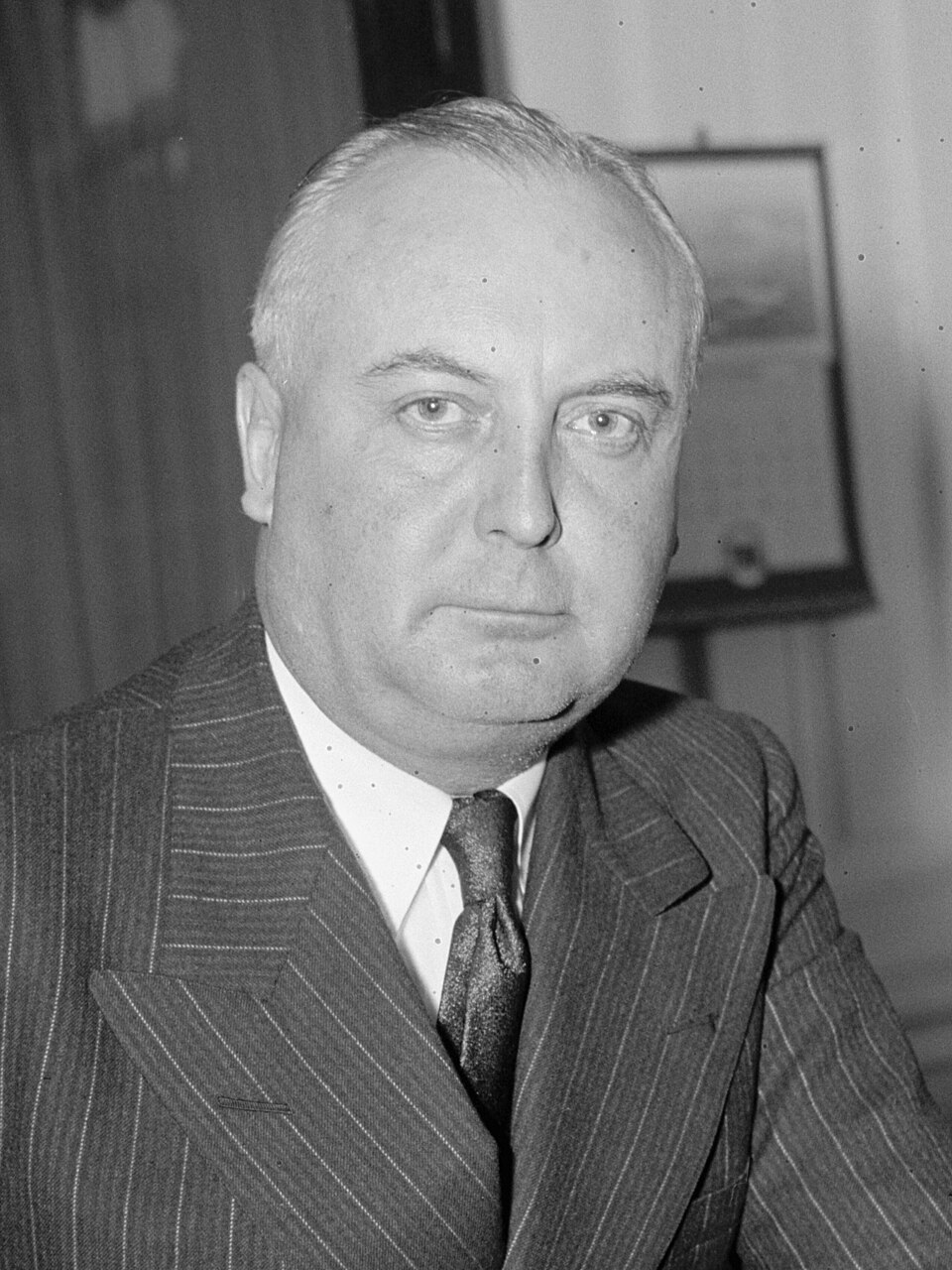
The 1914 midterms were rather peculiar. They were one of the midterms in which the president’s party lost seats in the House but gained in the Senate. Furthermore, this was the first election in which senators were popularly elected, and as I have covered before this impacted the makeup of the Senate. The Progressive Party remained a factor in a number of crucial elections which arguably resulted in Democratic wins. This election saw a future president get elected to the Senate in Warren G. Harding in Ohio, as well as the election of the first and only Prohibitionist member of Congress as well as the election of the second Socialist member of Congress. This would also be the first election won by James Wolcott Wadsworth Jr. of New York, whose career was rather unusual in that he had his national start in the Senate, and then later served in the House. He would be a consistent voice for arch-conservatism on domestic issues and his advocacy for military preparedness but would notably differ with his party in his support for FDR’s foreign policy.

Republicans ran in the 1914 election on the platform of the economic policies of the Taft Administration producing prosperity seen at the time, and this saw big gains in their traditional stronghold of New England. In the Midwest, the Republican performance was a bit spottier. They did very well in Illinois and Iowa, but were only able to regain two seats from their complete wipe-out in the 1912 election in Indiana, gained a House seat in Kansas, lost a House and a Senate seat in South Dakota, and lost a Senate seat in Wisconsin. Democrats managed to keep a number of seats or make gains in the West, where Wilson was maintaining or gaining in popularity. An interesting example was in Utah, in which the state’s second district flipped from Republican to Democrat, and this would presage Wilson’s big win there in 1916 as well as Republican Senator George Sutherland’s loss and the loss of the first district. By stark contrast, the state had been one of only two to stick with William Howard Taft in 1912. It should be noted that a significant part of why Republicans made big gains in the House was because the 1912 split in the GOP had produced major gains in the House that year, Democrats having won seats they normally would not win. In Philadelphia, at the time a Republican stronghold in part thanks to its corrupt machine, Democrats had managed to snag two of the city’s Congressional districts, which came back under Republican control in this election. Republicans overall gained 62 seats in the House, a “shellacking” but not enough to win a majority, even though they did win the popular House vote. The Progressive Party loses a net of four seats; they were but a minor contender in national politics although as noted earlier, they ate away at Republican votes in some critical places. The Progressive Party’s influence would come to an end when Theodore Roosevelt decided to back Republican Charles Evans Hughes in the 1916 presidential election.

Republican Gains, House

In Colorado’s 2nd district, Republican Charles Timberlake defeated Democrat Harry Seldomridge for reelection.

In Connecticut, Republicans had a clean sweep, with Democrats Augustine Lonergan, Bryan F. Mahan, Thomas Reilly, Jeremiah Donovan, and William Kennedy losing reelection to Republicans P. Davis Oakey, Richard Freeman, John Tilson, Ebenezer Hill, and James Glynn respectively.

In Delaware, Republican Thomas W. Miller defeated Democratic incumbent Franklin W. Brockson.

In Illinois, Republicans gained a whopping net of 11 seats. Republican Ira Copley switched to Progressive for his reelection and won. The most notable victor was former Speaker Joe Cannon regaining his seat in the 18th district over Democrat Frank O’Hair. Progressives Charles Thomson and William Hinebaugh lose reelection to George Foss and Charles Fuller in the 10th and 12th districts respectively, while Democrats Louis FitzHenry, Charles Borchers, James Graham, William Baltz, H. Robert Fowler, Robert Hill, and Lawrence Stringer lose reelection to John Sterling, William B. McKinley, Loren Wheeler, William Rodenberg, Thomas Williams, Edward Denison, and Burnett Chiperfield respectively. Republican William Wilson would win an open seat in the 3rd district.

In Indiana, Republicans Merrill Moores and William Wood defeated Democratic incumbents Charles Korbly and John Peterson in the 7th and 10th districts respectively.

In Iowa, Republicans Harry Hull, Burton Sweet, and C. William Ramseyer win in the 2nd, 3rd, and 6th districts respectively. They all win open seats.

In Maryland, Republican Sydney Mudd wins an open seat in the 5th district.

In Massachusetts, Republican George Tinkham wins an open seat in the 11th district while Republicans William H. Carter and Joseph Walsh defeat incumbents John Mitchell and Thomas Thacher in the 13th and 16th districts respectively.

In Michigan, Republicans George Loud and W. Frank James defeat Progressive incumbents Roy Woodruff and William J. MacDonald in the 10th and 12th districts respectively.

In Minnesota, Republican Franklin Ellsworth wins an open seat in Minnesota’s 2nd district.

In Nebraska, Republican C. Frank Reavis defeats Democrat John Maguire for reelection in the 1st district.

In New Hampshire, Democrat Eugene E. Reed of the 1st district loses reelection to Republican Cyrus Sulloway and Democrat Raymond B. Stevens of the 2nd district runs for the Senate (he loses) and is succeeded by Republican Edward Wason.

In New Jersey, Republicans gain five seats. At the start of the 63rd Congress, William J. Browning of the 1st district was initially the only Republican, but Dow Drukker won a special election during the Congress. Democrats J. Thompson Baker, Allan B. Walsh, William Tuttle, and Edward Townsend lost reelection to Isaac Bacharach, Elijah Hutchinson, John Capstick, and Frederick Lehlbach respectively. Republican Richard Parker wins an open seat.

In New Mexico, Republican Benigno Hernandez defeats Democrat Harvey B. Fergusson for reelection. Hernandez is the first Hispanic American in Congress.

In New York, Republicans gain eleven seats. Democratic incumbents Lathrop Brown, James O’Brien, Jacob Cantor, Benjamin Taylor, George McClellan, Peter Ten Eyck, Charles Talcott, John Clancy, and Robert Gittins lose to Frederick Hicks, Oscar Swift, Isaac Siegel, James Husted, Charles Ward, Rollin Sanford, Homer Snyder, Walter Magee, and S. Wallace Dempsey respectively.

In North Carolina, Republican James J. Britt defeats Democrat James M. Gudger Jr. for reelection in the 10th district.

In Ohio, Republicans gain ten seats. Most notably, future Speaker Nicholas Longworth regains his seat from Democrat Stanley Bowdle in the 1st district. Democrats George White, William Francis, and Elsworth Bathrick lose reelection to William Mooney in the 15th district, Roscoe McCulloch of the 16th district, and John Cooper of the 19th district respectively. Republicans Joshua Russell, Nelson Matthews, Charles Kearns, Seward Williams, David Hollingsworth, and Henry Emerson win open seats.

In Pennsylvania, Republicans gain a net of eight seats, with Democrats Michael Donohoe, J. Washington Logue, Robert E. Lee, Franklin Dershem, Andrew Brodbeck, and Wooda Carr losing reelection to Peter Costello, George Darrow, Robert Heaton, Benjamin Focht, C. William Beales, and Robert F. Hopwood. Progressives Henry Temple and Willis Hulings lose reelection to Republicans William M. Brown and Samuel H. Miller.

In Rhode Island, Republican Walter Stiness defeats Democrat Peter Gerry for reelection in the 2nd district.

Democratic Gains, House

In Iowa, Democrat Thomas Steele defeats Republican George Scott for reelection in the 11th district.

In Kansas, Republican Victor Murdock steps down to run for the Senate as a Progressive and Democrat William Ayres wins an open seat in the 8th district.

In Minnesota, Democrat Carl Van Dyke defeats Republican Frederick Stevens for reelection.

In Nebraska, Democrat Ashton Shallenberger defeats Republican Silas Barton for reelection in the 5th district.

In Oklahoma, Democrat James Davenport wins an open seat in the 1st district from retiring Republican Bird McGuire.

In Pennsylvania, Democrat Michael Liebel defeats Republican Milton Shreve for reelection. It is a three-way race in which a Progressive candidate gets 23.5% of the vote.

In South Dakota, Democrat Harry Gandy wins the open seat in the 3rd district.

In Utah, Democrat James Mays wins the open seat in the 2nd district.

In West Virginia, Democrat Adam Littlepage defeats Republican Samuel B. Avis for reelection in the 3rd district.

In Washington, Democrat Clarence Dill wins in the 5th district.

Democratic Gains, Senate

In California, Democrat James Phelan wins the election to succeed retiring Republican George Perkins.

In South Dakota, Republican Coe Crawford loses renomination to Congressman Charles Burke, but Burke loses the election to Democrat Edwin Johnson.

In Wisconsin, Democrat Paul Husting narrowly wins the election to succeed retiring Republican Isaac Stephenson.

Progressive Gains:

In California’s 6th district, Republican Joseph Knowland retires and is succeeded by John A. Elston.

In Illinois’ 11th district, Ira C. Copley switches from Republican to Progressive and wins.

In Louisiana’s 3rd district, Progressive Whitmell P. Martin wins an open seat.

In Minnesota, Progressive Thomas Schall wins an open Republican seat in the 10th district.

Other Gains:

In California, Prohibitionist Charles Randall defeats Progressive Charles W. Bell for reelection in the 9th district.

In New York, Socialist Meyer London defeats Democrat Henry Goldfogle for reelection in the 14th district.

Renomination Losses:

In Alabama’s 6th district, Democrat Richmond P. Hobson lost renomination to William B. Oliver.

In Florida’s at-Large District, Claude L’Engle, who barely voted, lost to William J. Sears.

In Louisiana, Democrat James W. Elder lost renomination to Riley J. Wilson in the 5th district.

In Maryland, Democrat Frank Smith lost renomination to Richard A. Johnson in the 5th district, who loses to Republican Sydney Mudd.

In Missouri’s 12th district, Democrat Michael Gill loses renomination, and the seat is won by Republican Leonidas C. Dyer.

In New York, Democrats Frank Wilson, Jefferson Levy, and Henry George Jr. lose renomination to Joseph Flynn in the 3rd district, Michael Farley in the 14th district, and G. Murray Hulbert in the 21st district respectively, all who win the election. Democrats Herman Metz and Edwin Underhill lose renomination in the 10th and 37th districts respectively, and the victors lose the election to Republicans. Republican Samuel Wallin loses renomination to William Charles in the 30th district, who wins his election.

In Ohio, Democrat J. Henry Goeke lost renomination in the 4th district, and the victor lost the seat.

In Oklahoma, Democrat Claude Weaver loses to Joseph B. Thompson.

In Oregon, Republican Walter Lafferty of the 3rd district ran for reelection as an Independent and lost to Republican Clifton MacArthur.

In Pennsylvania, Democrat Robert Difenderfer loses renomination to Harry E. Grim in the 8th district, who loses the election. Democrat John Rothermel loses renomination to Arthur Dewalt, who wins the election in the 13th district.

In Washington, Progressive James W. Bryan loses renomination to Austin E. Griffith, who loses the election in the 1st district.

This election resulted in a Democratic House majority of 230-196 and 7 third party members, which would place Republicans in a good position in 1916, but they fell short in enough places so that a coalition of Democrats and third party members would retain a majority in the succeeding Congress. The Senate had a 56-39 Democratic majority, which was a bit of a tougher hurdle for Republicans to come back from.

References

1914 United States House of Representatives elections. Wikipedia.

Retrieved from

https://en.wikipedia.org/wiki/1914_United_States_House_of_Representatives_elections

1914 United States Senate elections. Wikipedia.

Retrieved from

https://en.wikipedia.org/wiki/1914_United_States_Senate_elections

The Eaton Affair: A Society Drama That Put a Presidency in Peril

I hold that the era we have been living in since 2015 can be called the Trump Era. I was loath to believe this at the start of it, but the truth is that the politics of this current age have completely centered on Donald Trump, on matters both political and personal. They centered on him when he was out of office for four years as well, in part because stories about him made media companies tons of money. He has expressed great admiration for another president who so much dominated in attention of the era of his prominence that historian Arthur Schlesinger Jr. titled his 1945 book on him, The Age of Jackson. Andrew Jackson’s entry into presidential politics resulted in the demise of the old Democratic-Republican Party into factions, and Jackson ran as being closest to the original values of Thomas Jefferson. Although his first bid, 1824, was a loss, he alleged a “corrupt bargain” had occurred for him to lose, namely that John Quincy Adams had gotten Henry Clay to give him his electors in exchange for Clay being appointed Secretary of State. Such a quid pro quo was denied by Adams and Clay but the allegation stuck in the public mind. Jackson’s triumphant victory in 1828 was marred by the death of his wife Rachel shortly after. Rachel Jackson had been in fragile health, and the 1828 election had a number of nasty charges thrown around, including that Rachel had committed bigamy by marrying Jackson. The truth was that Rachel had not known that the divorce from her first husband had not been legally finalized at the time of the marriage, only discovering this two years after. Jackson blamed her death on the stress caused by such allegations of her political opponents. This added to his already existing sensitivity on personal accusations against women.

A Controversial Appointment

John H. Eaton

The trouble for Jackson began when he was picking his first cabinet, seeking to reward supporters. One of them was his close personal friend, biographer, and fellow Tennessean John H. Eaton for Secretary of War. Eaton had nine months before married a woman named Margaret “Peggy” O’Neill, who had been a bar maid at her father’s boarding house and had a reputation of being flirtatious with customers. Her first husband, a man who was 22 years her senior in Navy purser John B. Timberlake, was known for having two problems: drinking and debt. Senator John Eaton, who had befriended the couple, got Timberlake an overseas position to help him out. On April 2, 1828, he died abroad, and although an autopsy concluded that he had died of pneumonia, rumors spread throughout Washington society that he had committed suicide over an alleged affair with Eaton and it was further alleged that Eaton had gotten Timberlake the post so he could freely court Peggy. Indeed, only months after Timberlake’s death, John and Peggy were married. Based on this short grieving period and such rumors, the wives of Jackson’s cabinet officers socially ostracized Peggy Eaton, refusing to invite her to any events and would not attend any events in which she was present. Furthermore, Peggy Eaton was considered too outspoken for a woman by others. As John F. Marszalek (2000) wrote, “She did not know her place; she forthrightly spoke up about anything that came to her mind, even topics of which women were supposed to be ignorant. She thrust herself into the world in a manner inappropriate for woman…. Accept her, and society was in danger of disruption. Accept this uncouth, impure, forward, worldly woman, and the wall of virtue and morality would be breached and society would have no further defenses against the forces of frightening change. Margaret Eaton was not that important in herself; it was what she represented that constituted the threat. Proper women had no choice; they had to prevent her acceptance into society as part of their defense of that society’s morality” (56-57). This greatly upset Jackson. Jackson himself had advised Eaton to marry her as soon as possible and defended him and Peggy throughout this ordeal. The woman who was leading this ostracism was none other than his vice president’s wife, Floride Calhoun. John C. Calhoun may also have been using this as a way to boost his views within Jackson’s cabinet, as he and Eaton had significant political disagreements, including on tariffs and nullification. This whole matter became known as the Eaton Affair or the Petticoat Affair.

Peggy Eaton
A furious Jackson called a cabinet meeting to defend Peggy, and supposedly in the process commented that she was “as chaste as a virgin!” despite her having twice been married and having had three children (Hill). Although cabinet officers tried to explain to Jackson the reasoning for their wives’ ostracism of her, the subject became closed once Jackson compared her situation to that of his late wife. Only Secretary of State Martin Van Buren, a widower, and Postmaster General William Barry, who had appreciated Peggy nursing his very ill child, stood by her. This matter was a deepening sore in the administration, and John Eaton would in retaliation release accurate documentation that as Secretary of War to President Monroe Calhoun had supported censuring Jackson over his 1818 invasion of Florida. Calhoun only made matters worse when due to miscommunication he released correspondence between himself and Jackson in 1831. This major rift between Jackson and his cabinet threatened to derail his presidency, so the cunning Van Buren, who Jackson came to increasingly trust, came up with a scheme to resolve the situation.  

Van Buren would first resign his post, followed by John Eaton, thus politically permitting Jackson to ask for the resignations of all his cabinet officers with the pretense of a cabinet reorganization. Of course, Vice President John C. Calhoun could not be part of this, thus he and the ringleader in this ostracism would remain in Washington. This matter, in addition to Calhoun’s support of South Carolina’s nullification of the “Tariff of Abominations” completely alienated Jackson from Calhoun, and made him one of his two most hated rivals. When asked in 1837 if he had any regrets about his presidency, Jackson reportedly responded, “Yes, I regret I was unable to shoot Henry Clay or to hang John C. Calhoun” (U.S. Senate). With all resignations in hand, Jackson remade the cabinet, and in the process brought Van Buren back as Minister to Great Britain, but a vote to continue in his post was defeated by the influence of Calhoun. However, this came off as Van Buren being a victim of petty personal politics, and Jackson would pick him to serve as vice president in his second term. John Eaton would never attain the political heights he had reached before his marriage to Peggy; he did not succeed in a bid to return to the Senate in 1834 (he was made governor of the Florida Territory instead) and then alienated himself from Jackson by becoming a Whig and endorsing William Henry Harrison in 1840.

References

Hill, R. (2013, August 11). Peggy Eaton: The Woman Who Brought Down A Cabinet. The Knoxville Focus.

Retrieved from

https://www.knoxfocus.com/archives/peggy-eaton-the-woman-who-brought-down-a-cabinet/

John C. Calhoun. UVA Miller Center.

Retrieved from

https://millercenter.org/president/jackson/essays/calhoun-1829-john-vicepresident

Marszalek, J.F. (2017, October 8). Eaton Affair. Tennessee Encyclopedia.

Retrieved from

Marszalek, J.F. (2000). The Petticoat Affair.: manners, mutiny, and sex in Andrew Jackson’s White House. Baton Rouge, LA: Louisiana State University Press.

The Attempt to Kill “King Andrew”. U.S. Senate.

Retrieved from

https://www.senate.gov/artandhistory/history/minute/Attempt_to_kill_King_Andrew.htm

The Lodge Bill: An Early Chance at Voting Rights in the South?

Henry Cabot Lodge

The 1888 election was a close one, and one that Republican Benjamin Harrison won narrowly, and only by the electoral vote. It was in this election that Republican got for the first time since the Grant Administration unified government. The Republicans set to work on numerous bills that they did not have a chance at passing if either the House or Senate were Democratic. One of these, proposed by Congressman Henry Cabot Lodge (R-Mass.) was the Federal Elections Bill. If enacted, this measure would have, among other provisions, authorized the federal supervision of Congressional elections in cases in which 500 petitions had been made from the respective districts about voting practices to the Judge of the District Court no less than two months prior to the election (The New York Times). This bill only covered Congressional elections, and was constitutional given that Congress has the explicit authority to regulate elections for senators and representatives except for the places in which senators are chosen under Article I, Section 4, Clause 1. The primary purpose of this measure was to implement the 15th Amendment, as it was often the case that blacks were subjected to voter intimidation and fraud to keep their numbers down. There were several Congressional elections in which Congress overturned the result due to voter intimidation and fraud in the South. In 1890, for instance, Thomas E. Miller of South Carolina and John Mercer Langston of Virginia, both who identified themselves as black (Miller was mostly white), were seated after findings by Congress that a fair election had been denied. However, it was a bill that applied nationwide. Thus, the shenanigans of Northern city machines could very well be impacted too. Lodge stood steadfastly by his bill. Something to note here is that Lodge was not in keeping with radical egalitarianism, indeed in response to a letter that expressed concern over “ignorant Negro votes”, he responded, “Nothing in this bill or any other prevents a state from excluding ignorance from the suffrage. Massachusetts has an educational test. South Carolina can do the same, but will not because she wishes to exclude black ignorance and let white ignorance vote” (Gwin, 105). That sounds like a color-blind policy to me!  On July 2, 1890, the bill passed 155-149. It was on to the Senate, where the bill’s sponsor was George Frisbie Hoar (R-Mass.) and it commanded a lot of Republican support. But was it enough?

Although the House passed it, the bill did not seem terribly popular. The Weekly San Diegan (1890) noted, “It is significant that the San Francisco and Portland Councils of Federated Trades have adopted resolutions condemning the federal election bill as dangerous to the freedom of the ballot box” (2). They were not the only unions to oppose this measure. Indeed, Knights of Labor leader Terence V. Powderly (1890) opposed, arguing that the measure itself would intimidate voters and encourage fraud, and furthermore claims hypocrisy, stating, “The Democratic party does its best to intimidate the colored citizens of the South, and they give as a reason that if they did not do so they would be subject to negro rule down there, or as they put it, “ignorant rule.” In the North the employers of labor intimidate the workmen in the interest of the Republican Party, but that party cannot lay claim to so respectable an excuse as the desire to avoid “ignorant rule,” for the workmen of the North have never imposed ignorant rule where they elected their own representatives” (10).

On August 13th, it was reported that Pennsylvania boss Matthew Quay (R-Penn.) introduced a resolution to postpone consideration of the Lodge Bill so the tariff bill could be passed (Wilkes-Barre Times Leader, 1). It was said that Senator Arthur P. Gorman (D-Md.) and Quay were making an agreement behind the scenes, and it would make sense for those two to do so; both men were at the head of political machines that had engaged in corrupt practices to maintain political dominance. And indeed, the Lodge Bill was postponed, being again considered in the Senate during the lame-duck session of Congress. One of the opponents, notably, was Senator William M. Stewart (R-Nev.), who had authored the 15th Amendment. Opponents in the Senate, led by Gorman, sought to defeat the bill by delay, and they succeeded. Silver Republicans, such as Stewart, had joined the Democrats to defeat the bill given a promise from Gorman not to interfere with their silver interests (The New York Times, 1906).

Although modern liberal opinion is positive on this measure*, liberal opinion did not historically approve. Historian Richard E. Welch, Jr. (1965) noted that “The standard liberal interpretation of American history applauds recent efforts in behalf of greater political equality for the southern Negro. It continues, however, to deplore the Federal Elections Bill of 1890: its introduction, its provisions, the motives of its originators and proponents. In the lexicon of American history the defeat of the force bill of 1890 was a “good thing”” (511). This is quite reminiscent of President Kennedy’s simultaneous support for civil rights in his time and his belief that Republican Reconstruction had been a mistake.

Would the Lodge Bill have made the sort of gains on civil rights like the 1960s? I think it a mistake to believe this law would have been a panacea and would have had difficulty surviving after the next election. However, if it remained, it would have constituted a fair (in my opinion) and constitutional means of not only enforcing a race-neutral application of voting laws but also countering the fraudulent antics of big city machines. I can see this measure as both garnering historical support from contemporary liberals (now that the “little guy” isn’t just a white working man) and contemporary conservatives as a way to actually apply color-blind standards, possibly rendering more federally intrusive measures unnecessary, and countering voter fraud.

* – The pro-critical race theory The Forum Magazine’s 2022 article on the subject, which compares Republican efforts in 1890 to Democratic efforts for the For the People Act in 2022, even though the bills have many substantive differences.
 

References

A Federal Election Bill. (1890, March 15). The New York Times.

Retrieved from

Encourages Fraud. (1890, August 3). The Saint Paul Daily Globe, 10.

Retrieved from

https://www.newspapers.com/image/81068633/

Gorman Dies Suddenly; Was Seemingly Better. (1906, June 5). The New York Times.

Retrieved from

Gwin, S.P. (1968). The Partisan Rhetoric of Henry Cabot Lodge, Sr. University of Florida.

Retrieved from

Remonstrance Against the Federal Election Bill. (1890, July 24). The Weekly San Diegan, 2.

Retrieved from

https://www.newspapers.com/image/1048031780/

Senator Quay’s Move. (1890, August 13). Wilkes-Barre Times Leader, 1.

Retrieved from

https://www.newspapers.com/image/394966835/

The Federal Elections Bill of 1890. Library of America.

Retrieved from

https://storyoftheweek.loa.org/2024/10/the-federal-elections-bill-of-1890.html

Welch, R. (1965, December). The Federal Elections Bill of 1890: Postscripts and Prelude. The Journal of American History, 52 (3), 511-526.

Retrieved from

https://www.jstor.org/stable/1890845

The Ratification of the Partial Nuclear Test Ban Treaty

President Donald Trump recently caused a stir (which is pretty much a daily occurrence now) when he announced the resumption of nuclear weapons testing. Such an announcement made people think at minimum of underground testing or even more dramatic, above-ground testing, the latter which the US hasn’t done since Operation Dominic Tightrope on November 4, 1962. His energy secretary has since stated that these tests would be non-explosive, rather testing to make sure our weapons remain effective, and indeed what “nuclear testing” could mean does vary. This little controversy reminds me of our first ever nuclear arms limitation treaty with the Soviets, which was championed by President Kennedy. This treaty banned testing in the atmosphere, outer space, and underwater. Today’s post is about the process of getting this historic treaty enacted.

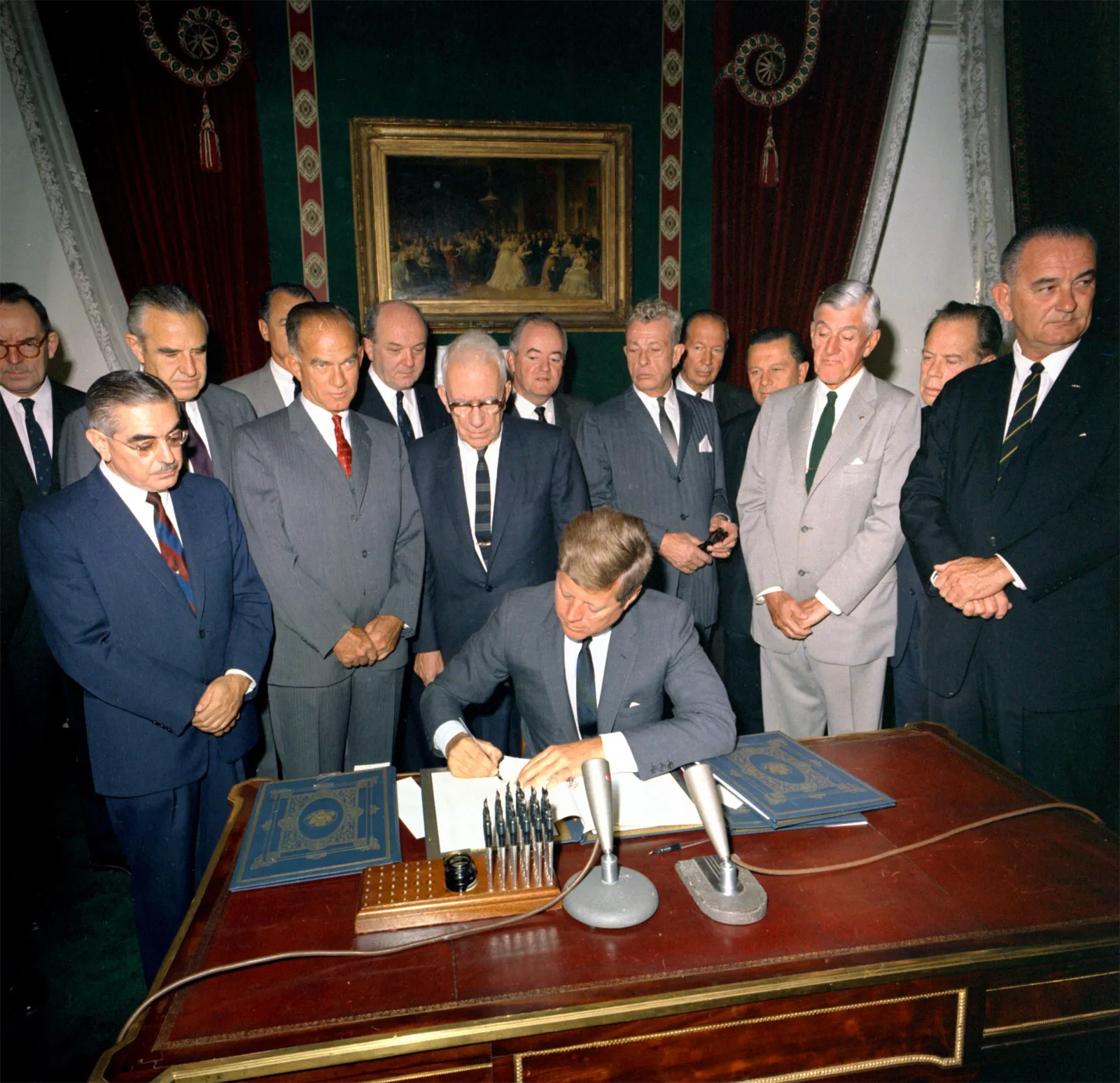
In 1961, President Kennedy proposed and Congress enacted the Arms Control and Disarmament Act of 1961, which created the Arms Control and Disarmament Agency. This was the first agency dedicated to limiting the proliferation of nuclear weapons. Although President Kennedy had started on the legislative of slowing down the arms race, it was President Eisenhower who had first sought to open a discussion on a test ban in 1958, which was followed by a Soviet announcement that they were stopping tests. The push for this effort was bolstered by an expert finding that nuclear weapons tests could be detected, thus making a treaty easily enforceable, and discussions began between the US, USSR, and Great Britain. On August 5, 1963, the US, USSR, and Great Britain signed the Partial Nuclear Test Ban Treaty. Although the Democrats had 68 senators to ratify thus by modern understanding of politics no Republican support was needed, the reality of the politics of the 1960s was that Democrats had a considerable moderate to conservative wing, most of them from this time being in the South. On the plus side for the Democrats, Republicans also had a moderate to liberal wing and this wing was stronger in the Senate than in the House. To ensure that 2/3’s vote was secured, Republican support was necessary, and what’s more, it was good for sustaining the idea of bipartisan postwar foreign policy.

Winning Over Dirksen

Although Republicans never held a majority in either legislative chamber of Congress during the 1960s, Minority Leader Everett Dirksen (R-Ill.) punched a bit above his weight in power, as he could not only sway the votes of Republicans but also conservative Democrats. Thus, winning his support for measures that required 2/3’s of the vote was rather crucial, and Dirksen relished in this role. Dirksen initially expressed skepticism, but the Joint Chiefs of Staff persuaded him to support the treaty (CQ Almanac). It also didn’t hurt in persuading him and other Republicans that both former President Eisenhower and former Vice President Richard Nixon publicly announced their support. Dirksen endorsed the treaty and corralled other Republicans in favor because to not do so would “place us in an awkward and difficult position” and that to do so would counter Soviet propaganda about a warlike US, adding that it would  “divest the unremitting effort to paint us as warmongers before the nations of the world and would lose much of its force” (CQ Almanac).

Support

The Democratic Senate leadership as well as the previously mentioned Republican leadership favored, thus you could say the internationalist establishment favored the treaty (or as some modern-day readers might say, “globalist”). This position also had the support of some prominent scientists. Dr. Harold Brown, chief civilian scientist of the Defense Department and Dr. N.E. Bradbury, head of Los Alamos Scientific Laboratory, supported (CQ Almanac). Best yet for Kennedy was not the support of scientists or politicians, but the American public. A Gallup poll of the time revealed that Americans supported the treaty 63-17 (CQ Almanac). The Senate outcome would not be that much different, but for the sake of interest, let’s look at the opposition.

Opposition

One of the most prominent opponents was Dr. Edward Teller, the lead scientist in the development of the Hydrogen Bomb, who believed, along with other Senate opponents, that the treaty would give an edge to the Soviets. He was joined by Dr. John S. Foster who headed the Lawrence Radiation Laboratory, who shared Dr. Teller’s concerns. On the more political side, conservative Reverend Carl McIntire spoke against it as did Stanley M. Andrews, who headed Liberty Lobby’s “Americans for National Security”.

The Tower-Long Reservation

Although several amendments were proposed to the treaty, the one that got the most support was sponsored by John Tower (R-Tex.) and Russell Long (D-La.), both who would vote against the treaty, that would add an “understanding” (opponents claimed it was actually a reservation) that the treaty would not serve to bar the use of nuclear weapons in armed conflicts. Majority Leader Mike Mansfield (D-Mont.) managed to successfully table the proposal 61-33 on September 23rd. Although Democrats voted to table 46-16, the Republican vote was 15-17. The rejection of this understanding was not a dealbreaker, as on that same day the treaty was approved on a vote of 80-19, 14 votes above what was needed for treaties.

Dirksen was able to deliver all but eight of his fellow Republicans on this matter, and of the Democratic dissenters nine were from the South. 1964 presidential candidate Barry Goldwater of Arizona was among the dissenters, and this would not be the last time, nor the most famous time, he dissented from Dirksen on a major bipartisan issue. Perhaps the most unusual dissenter was Maine’s Margaret Chase Smith, who was a bona fide centrist. Another notable dissenter was West Virginia’s Robert Byrd, who would also differ from Democratic leadership on the same monumental issue Goldwater did with Republican leadership (as you might have guessed, it was the Civil Rights Act of 1964). Interestingly, Byrd was around for the debate on the Comprehensive Test Ban Treaty in 1999, in which he voted “present”. That debate was much different in that all other Democrats voted for while only four Republicans crossed the aisle. Although the USSR and Great Britain had signed on to the treaty, France and China declined to do so. President Kennedy himself acknowledged that the treaty was not a panacea for the troubles of the Cold War, stating that it was a “victory for mankind” but “not the millennium” and that “it will not resolve all conflicts, or cause the Communists to forego their ambitions, or eliminate the dangers of war” and “it will not reduce our need for arms or allies or programs of assistance to others. But it is an important first step– a step toward peace – a step toward reason – a step away from war” (CQ Almanac 1963).

References

ADA Voting Records. (1963). Americans for Democratic Action.

Retrieved from

 Nuclear Test Ban Treaty. CQ Almanac 1963.

Retrieved from

https://library.cqpress.com/cqalmanac/document.php?id=cqal63-1317011#_

Shelley, T. (2022, October 18). How a bipartisan foreign policy approach helped stave off a nuclear crisis six decades ago. WCBU.

Retrieved from

https://www.wcbu.org/local-news/2022-10-18/how-a-bipartisan-foreign-policy-approach-helped-stave-off-a-nuclear-crisis-six-decades-ago

The Limited Test Ban Treaty, 1963. Department of State Office of the Historian.

Retrieved from

https://history.state.gov/milestones/1961-1968/limited-ban

Joseph Weldon Bailey: The Lone Star State’s Staunch Jeffersonian

Democrats were largely out of power in the late 19th century and early 20th century, and one figure who became prominent in the time of Republican dominance from 1895 to 1913 was Joseph Weldon Bailey (1862-1929). Born in Crystal Springs, Mississippi, Bailey got his start in politics after earning his law degree, and he quickly waded into controversy. Indeed, his career would be one full of controversy. In January 1884, Bailey was called to testify by the Senate over an allegation that he was among the leaders of a faction of the Democratic Party that had engaged in violent intimidation of Republican voters in the 1883 local elections, but he wouldn’t show as he refused to perjure himself (Holcomb, Bailey). Nothing came of this matter, and in 1885 he married and moved to Texas, where he continued his legal and political career.

Congressman Bailey

1890 was an excellent year for Democrats, and among the Congressional freshmen was Bailey. He quickly stood out as a talented parliamentarian as well as for his powerful oratory which he employed to advocate for Jeffersonian democracy, for state’s rights, against protective tariffs, against American expansionism, for free coinage of silver, and for increased railroad regulation. Bailey became a rising star in the Democratic Party, and this as well as his strong support for the candidacy of William Jennings Bryan in 1896 got him the post of House Minority Leader in 1897, at the mere age of 34. Few in politics have had as meteoric of a rise as that of Bailey. A strong partisan Democrat, Bailey had some trouble unifying the Democratic caucus and he controversially held that it was unconstitutional for members of Congress to accept commissions to serve in the army while serving as members of Congress, a cause that he couldn’t get a majority in his own party to support. After this loss, Bailey announced that he would not be a candidate for party leader. In 1901, he was elected to the Senate, replacing the retiring Horace Chilton.

Senator Bailey

Bailey continued to stand for the causes he supported while in the House, and although he seemed promising to lead there too, his reputation suffered after he, a fairly large man, lunged at Senator Albert Beveridge (R-Ind.) on the Senate floor in response to his heckling and threatened him with serious bodily harm. Although Bailey supported numerous causes that would place him on the political left of his time, he started to have troubles with progressives when he was one of the senators who muckraker David Graham Phillips accused of carrying water for private interests in his 1906 Cosmopolitan expose, Treason of the Senate. Although Bailey’s reputation survived this expose, it was nonetheless true that he had accepted hefty fees for legal services from multiple prominent businesses and individuals, and this expose would not be the only one of his problems.

Bailey considered himself a staunch Jeffersonian Democrat, and these beliefs from time to time placed him at odds with progressive causes. For example, many progressives supported Prohibition, and indeed Bailey supported amending the Texas Constitution in 1887 to enact it, but he opposed amending the U.S. Constitution for Prohibition. Bailey also found himself strongly against initiative, referendum, and recall. His opposition to such reform measures was the reason that he and two other Democrats joined President Taft and conservative Republicans in opposition to the admission of Arizona as the state had such provisions in its constitution. President Taft would accept admission of Arizona once the most offensive of the provisions to him, the recall of judges, was removed. Bailey was so floored that all but two of his fellow Democrats supported Arizona’s strongly progressive constitution that he resigned the Senate on March 4, 1911, but he withdrew it before the day was out on the urgings of Texas’s governor as well as the state legislature (The New York Times, 1911). Bailey also, contrary to most in his party, would support the seatings of Senators William Lorimer (R-Ill.) and Isaac Stephenson (R-Wis.), who faced controversies about the natures of their elections. Lorimer, the “blonde boss of Chicago”, would be denied his seat while Stephenson kept his. Bailey also proved an immovable foe of women’s suffrage, again on Jeffersonian grounds. There was also certainly a racial element in this opposition, and many Southerners would oppose women’s suffrage because the 19th Amendment provided for women’s suffrage regardless of race. Bailey would still support some positions that aligned with progressive pushes, such as opposition to high protective tariffs, a tax on corporations, and supporting direct election of senators. Bailey, however, suffered serious reputational damage when he was alleged to have illegally represented Waters-Pierce Oil Company while they were being charged with anti-trust violations in 1900. He had managed to secure Waters-Pierce being able to do business in Texas as an independent corporation, but in 1906 a lawsuit by the state of Missouri revealed that Waters-Pierce was still a subsidiary of Standard Oil, and their permit to do business in Texas was canceled with a $1,623,000 fine which was sustained by the Supreme Court (Holcomb, Waters-Pierce). Matters got worse for Bailey as not all had been disclosed about Bailey’s relationship with Waters-Pierce. Although he had officially not received a fee for his services from Waters-Pierce, it was revealed that he had not disclosed a $13,300 loan from the company at the time (Holcomb, Waters-Pierce). Support for Bailey getting another term was deteriorating, and on January 3, 1913, he resigned, being succeeded by Congressman Morris Sheppard, who was more willing to support emerging progressive causes. Bailey’s rise had come at a young age with his election to Congress at 28, and his political career was over at 50. The Marxist theoretician Daniel De Leon (1913) wrote of him upon his exit, “…Joseph Weldon Bailey, whose voice once rang sympathetically for the underdog in society, now earns his last Judas pence by acting as a mouthpiece of and Senator for the State of Oil”.  Although Bailey had a bit of a conservative turn later in his career, his record beforehand shows in his DW-Nominate score, which was a -0.63. He became increasingly antagonistic to the prevailing Democratic politics and claimed that President Wilson was a “socialist”. As The New York Times (1929) noted in their obituary of him that he was “not tolerant of party opinion which seemed to him veering toward Republicanism or socialism”. Although Bailey attempted a comeback in 1920 by running for governor, Texas Democrats were no longer in the mood for him, preferring progressive Pat M. Neff, a strong supporter of Prohibition.   

In his final years, he would practice law in Dallas, and on April 13, 1929, Bailey delivered an argument in a case in Sherman, Texas, and sat down. He never stood back up, having suffered a fatal heart attack. Bailey’s son and namesake, Joseph Weldon Bailey, Jr., would also have a political career, serving a term in the House at the start of the Roosevelt Administration in which he would oppose some New Deal measures and would endorse Republican Wendell Willkie in 1940 (Melugin). Bailey’s change later in his career as well as his son coming out against FDR makes me consider the elder Bailey to be one of the earliest indicators of the future shift of Texas politics. I think part of it was that progressive means were increasingly differing from traditional Jeffersonianism, but Bailey did become more of a creature of the establishment. Something I must note that I find curious about Bailey is that Sam Rayburn, staunch New Dealer and the leader of the House Democrats from 1940 to 1961 as well as their longest serving House speaker, was a lifelong friend and personal hero (Holcomb, Bailey). Rayburn, who I have examined before, strikes me as more able to adjust his views on the means to attain Jeffersonian ends than Bailey was.

References

Bailey, Joseph Weldon. Voteview.

Retrieved from

https://voteview.com/person/347/joseph-weldon-bailey

Bailey Resigns, Then Reconsiders. (1911, March 5). The New York Times.

Retrieved from

De Leon, Daniel. (1913, January 10). Joseph Weldon Bailey. Daily People, 13(194).

Retrieved from

Holcomb, B.C. (1952). Joseph Weldon Bailey: A Political Biography. Texas State Historical Association.

Retrieved from

https://www.tshaonline.org/handbook/entries/bailey-joseph-weldon

Holcomb, B.C. (1952). The Waters-Pierce Case: A Landmark Antitrust Suit in Texas. Texas State Historical Association.

Retrieved from

https://www.tshaonline.org/handbook/entries/waters-pierce-case

Joseph W. Bailey. (1929, April 15). The New York Times.

Retrieved from

Melugin, R.W. (1952). Joseph Weldon Bailey Jr.: A Legacy in Texas Politics. Texas State Historical Association.

Retrieved fromhttps://www.tshaonline.org/handbook/entries/bailey-joseph-weldon-jr

Henry Myers: The Man Who Was Elected to the Senate Without Offering His Candidacy

Before the 1914 elections, as noted in a recent post, senators were constitutionally elected by state legislatures. This could produce some interesting results to say the least. In 1899 in the state of Montana, Democrat William Clark was elected and it was uncovered that bribery of state legislators was used to achieve this, including in very obvious ways such as handing legislators envelopes of cash on the floor of the legislature. The election of the man I’m going to talk about today didn’t involve such corruption, but rather the resolution of a stalemate.

The Democrats won the state legislature in the 1910 midterms, and they were set to find a replacement for Republican Thomas H. Carter. However, they had trouble finding a man who would unify the legislature. Name after name was proposed only to be deadlocked. For seven and a half hours the legislature continuously voted. A move to adjourn by Republicans, thus halting the election and leaving the Senate seat vacant, was defeated thanks to the vote against by rebel Republican Ronald Higgins of Missoula much to the joy of Democrats and the consternation of Republicans (Fergus County Democrat). Democratic Representative Woody had proposed on the 27th ballot Henry Lee Myers (1861-1943). Myers, who had been elected a judge in 1907 and had served in the state Senate from 1899 to 1903, had opposed the corrupt election of William A. Clark, despite both men being Democrats (The Great Falls Leader). The choice was met with acclaim and unified the Democrats, but it certainly surprised Myers who had not been a candidate up until this time. He accepted the legislature’s choice.

Senator Myers proved a supporter of President Woodrow Wilson and his New Freedom Agenda. He was supportive of women’s suffrage, but also voted for a Southern-backed amendment that would have restricted women’s suffrage to white women. Myers also supported Prohibition, solidly within the views of the state’s voters. On other key matters he was quite supportive of Wilson as well, backing both the Espionage Act of 1917 and the Sedition Act of 1918 as well as supporting the Versailles Treaty without reservations. However, Myers also backed the Esch-Cummins Act in 1920 returning railroads to the private sector under favorable conditions as well as its anti-strike clause, much to the distress of organized labor. That year, he announced that he would fight the left-wing Nonpartisan League, which had come to dominate the state Democratic Party that year, by supporting the entire Republican ticket in Montana for that year’s elections while still supporting the Cox-Roosevelt ticket nationally, stating, “Montana must be saved; the Democratic party of Montana must be saved. The gravest crisis that our beloved state has ever known in all of its history now confronts the people of this state. The are confronted with the prospect of ruination, disgrace, confiscation, and even with the overturning of our form of government” (The Montana Record-Herald).

During the Harding Administration, although Myers supported the 1921 Emergency Tariff for agriculture and supported higher tariffs for certain commodities of interest to Montana, he voted against the Fordney-McCumber Tariff. He also opposed the Fordney-Penrose tax reduction bill. Myers also voted against the veterans bonus bill in 1922. Myers retired that year, his DW-Nominate score having been a -0.223, indicating moderate liberalism. In 1927, he was appointed associate justice of Montana’s Supreme Court, but only served until 1929, choosing to resume practicing law. Myers died in Billings, Montana, on November 11, 1943, at the age of 82.

References

Death Takes Former Montana Senator. (1943, November 12). The Butte Daily Post, 3.

Retrieved from

https://www.newspapers.com/image/958362495/

Henry L. Myers Is Named as Senator. (1911, March 7). Fergus County Democrat, 1.

Retrieved from

https://www.newspapers.com/image/343217307/

Henry L. Myers of Hamilton, Dark Horse, Elected Senator. (1911, March 3). The Great Falls Leader, 11.

Retrieved from

https://www.newspapers.com/image/1018497741/

Myers, Henry Lee. Voteview.

Retrieved from

https://voteview.com/person/6837/henry-lee-myers

Senator Henry L. Myers Leads Regular Democrats in Organized Repudiation of Nonpartisan League Nominees. (1920, October 9). The Montana Record-Herald, 10.

Retrieved from

https://www.newspapers.com/image/954449192/

Olin Johnston: The Palmetto State’s FDR

Although South Carolina and progressivism are not two things that people commonly think of together, especially not contemporary progressivism, South Carolina did embrace the New Deal, and one of the New Deal’s foremost supporters in the state’s politics was Olin DeWitt Talmadge Johnston (1896-1965).

Born to a working class family, as a boy Johnston found himself working in a textile mill as did many working class people in the state at the time. Through his experience, he came to champion addressing the issues that befell mill workers. Johnston was an intelligent man, so he was able to work his way through college. However, before he could move into a political career, he responded to the call of service to his country and enlisted to fight in World War I in 1917. He served honorably and received a citation for bravery.

In 1922, while attending law school, Johnston won a seat in South Carolina’s House of Representatives but only served a term as he wanted to focus on practicing law. However, the call of politics came not long after and in 1926, he was again elected to the state House. Johnston championed the interests of mill workers, many who were supportive of progressive politics. Indeed, he did good work by them, most notably sponsoring and getting into law a measure that required mill owners to install sewers in their mill villages in which their workers lived. Such efforts made the young man a viable candidate for governor. In 1930, Johnston tried his hand at it and although he got the most votes on the first ballot, it wasn’t a majority, and he narrowly lost the runoff to Ibra Charles Blackwood. Governor Blackwood’s term would be troubled by a mill strike, which he responded to by calling out the National Guard. Johnston ran again in 1934, but he was up against an old hand at politics and his old hero in Coleman Blease. Blease was known for his racist demagoguery and his heavy courting of mill workers, indeed they had been central to his being elected governor and to the Senate. However, he was past his prime, and the youthful Johnston, who was with the New Deal spirit of the age, prevailed.  He also had an able partner in politics in his wife, Gladys Atkinson, who would be his closet counsel.

Governor Johnston

Many South Carolinians supported both FDR and Johnston, the latter who was lauded as “South Carolina’s Roosevelt”. He strongly supported unions, and continued to help out mill workers. Under Johnston’s administration, worker’s compensation was increased, the South Carolina Public Welfare Act was passed, the South Carolina Rural Electrification Authority was created, and employment of children under 16 in industrial work was banned (National Governors Association). However, there was a controversial incident in his administration. Johnston came to believe that the State Highway Department was acting contrary to public interests and engaging in corruption, thus he ordered the National Guard to occupy the department, but no wrong-doing was found (National Governors Association). This incident would result in opponents calling him “Machine Gun Olin”, such as Senator Ellison DuRant “Cotton Ed” Smith.

FDR in 1938: I’m Helping! I’m Helping!

Although “Cotton Ed” Smith had initially supported the New Deal, he was becoming increasingly critical. His opposition to the “Death Sentence” clause of the Public Utilities Holding Company Act in 1935 and to FDR’s “court packing plan” stung Roosevelt, who wanted someone more like him. Olin Johnston was the man for the job, and Roosevelt made it very clear that he was supporting him over Smith. Roosevelt hoped to exercise more control over the party, and his efforts at a “purge” of recalcitrant Democrats in the 1938 election would be a good demonstration. However, Smith was able to effectively capitalize on numerous voters opposing FDR’s intervening in state primaries (it was a different time back then, wasn’t it?) and furthermore sit-down strikes were not engendering sympathy with organized labor, and Smith prevailed. Cotton Ed Smith was never a particularly popular senator and was despised by his colleague, Jimmy Byrnes, who nonetheless backed him in the hope that his preferred man, Burnet Maybank, could succeed Smith in 1944. It is entirely possible that if Roosevelt had just stayed out, he could have gotten his man in the Senate. Johnston was also temporarily out of office because of this run, with Maybank succeeding him as governor.

The 1941 Senate Race

In 1941, Senator Byrnes stepped down to accept a nomination to the Supreme Court, and Johnston ran to succeed him. However, Byrnes’ ideal man, Governor Maybank, won the Democratic primary. This loss and the 1938 loss for the Senate resulted in some doubt about whether Johnston was still a viable candidate. Thus, the next election was do or die for his career: the 1942 gubernatorial election.

Going for Governor Again

In running for governor, he faced state legislator Wyndham Manning, who was a real threat to win the primary and had twice before tried for governor. However, Johnston prevailed with nearly 52% of the vote, thus putting an end to Manning’s political career. The major issue that occupied this term was the subject of the white primary. On April 3, 1944, the Supreme Court announced the decision of Smith v. Allwright, which ruled the white primary unconstitutional. In response, Johnston proceeded to hold an emergency session of the state legislature in which all references to “white primary” were scrubbed, and within days 147 bills were passed that eliminated any legal connections between state government and primaries, and a constitutional amendment was proposed and adopted by the voters that the General assembly would not regulate state primaries (Moore). However, this private approach would too be ruled unconstitutional in the federal court decision Elmore v. Rice (1947), and the Supreme Court refused to take the case. Thus, the white primary was ended for good. This push gave him the springboard he needed for his third try at the Senate. During this time, Johnston also denied clemency for a 14-year-old black boy, George Stinney, who was sentenced to death for allegedly murdering two white girls. The conclusion of an investigation many decades later was that Stinney was innocent.

1944: Cotton Ed Runs Out of Steam

By 1944, Smith is 80 years old and is clearly on the decline. Furthermore, his record is now much more conservative than it was when FDR sought to purge him. Johnston was also able to more loudly and effectively capitalize on the issue of race, focusing his ire on Smith v. Allwright. By contrast, during one campaign speech, Smith spoke for a few minutes and then simply played on a record of a 1938 speech. He was just tired out and given that FDR was not “helping” Johnston this time, Smith lost, dying only three months later.

Senator Johnston

Interestingly, Johnston as a senator was not quite as liberal as he was earlier in his career. Although he got a 100% from Americans for Democratic Action in 1947, which meant he was one of the few Southern senators to oppose the Taft-Hartley Act that gave states the option to become “right to work”, he also was one of the strongest opponents of foreign aid on the Democratic side and even voted against the Marshall Plan in 1948. Johnston’s overall record by liberal standards was moderate, as he sided with Americans for Democratic Action 44% of the time. However, by conservative standards, Johnston was a moderate liberal, siding with Americans for Constitutional Action 30% of the time. His DW-Nominate score was a -0.166, making him one of the more liberal postwar Southern senators. In 1959, Johnston sponsored with Senator Styles Bridges (R-N.H.) an amendment that prohibited foreign aid to nations that expropriated US property without proper compensation. Although he opposed efforts to curb labor unions, supported strong minimum wage increases, supported public housing, supported public generation of power rather than private, and twice voted for Medicare, he also voted against federal aid for education, voted against two Area Redevelopment bills, supported domestic anti-communist measures, often voted for anti-communist amendments to foreign aid bills, and of course was against civil rights legislation. Johnston was also one of the most noted advocates for federal employees and butted heads with Senator Joseph McCarthy. Johnston was clearly interested in continuing to support meat and potatoes New Deal issues but was not friendly on some more recent liberal issues.

1950: A Serious Challenge

The year 1950 was a decidedly conservative year in American politics; many candidates Senator Joseph McCarthy endorsed won their races, and on the Democratic side of the aisle in the South some liberal officeholders fell to more conservative ones, most notably Senator Claude Pepper’s defeat by Congressman George Smathers in Florida and Senator Frank Porter Graham’s defeat by Willis Smith in North Carolina. Johnston risked meeting the same fate when up against Governor Strom Thurmond. By running against Johnston, Thurmond was breaking a promise not to run against him if he supported his campaign for governor in 1946, which he had.  Johnston got his base of support in South Carolina’s northern, working class communities, while Thurmond got his support from the wealthier southern counties. The campaign was ugly, with accusations flying from both candidates, and both men tried to outdo each other in racist campaigning, including Thurmond claiming that Johnston was passive against President Truman’s civil rights pushes and Johnston condemning Thurmond for appointing a black doctor to the state’s medical board. Johnston won by single digits.

1962 Election and Decline

In 1962, Governor Fritz Hollings challenged Johnston for renomination, asserting that he was too liberal, but Johnston defeated him for renomination by a nearly 2 to 1 ratio. Interestingly, his bid for reelection proved more difficult, contrary to past years. He faced Republican journalist William D. Workman Jr., who campaigned against him as supporting socialist proposals, particularly on healthcare through his support of Medicare, but Johnston prevailed by nearly 15 points. By contrast, Johnston’s 1956 Republican opponent had pulled just under 18% of the vote. South Carolina wasn’t quite ready to elect a Republican senator. However, not all was well for him. After his reelection, he was diagnosed with cancer and by 1965 he was in serious decline. On April 17, 1965, his doctors announced that Johnston was suffering from viral pneumonia, was not responding to treatment, and had slipped into a coma. Johnston died the next day at the age of 68.

Columnist Ralph McGill (1965) praised Johnston as having had “a lot more intellectual courage than many of those whose names are better known. He not only had this courage, he showed it”  and noted, “One of the tragedies of the Southern senators and congressmen, especially the more able, is that in the past they have had to join with, encourage and expand racial prejudice to win primaries in states where there was no Republican opposition and where Negro voters were so few as to be meaningless” (37). Johnston was also praised by his successor, Donald Russell. Russell held that “I have never known a warmer, more patient and steadfast friend than he. He was equally warm and gracious to all, the lowly and the mighty” (Hill). Johnston’s legacy would continue through his daughter, Liz Patterson, who served in Congress as a Democrat from 1987 to 1993.

References

ADA Voting Records. Americans for Democratic Action.

Retrieved from

Gov. Olin DeWitt Talmadge Johnston. National Governors Association.

Retrieved from

Hill, R. The Friend of the Workers: Olin D. Johnston of South Carolina. The Knoxville Focus.

Retrieved from

https://www.knoxfocus.com/archives/this-weeks-focus/the-friend-of-the-workers-olin-d-johnston-of-south-carolina/

Johnston, Olin DeWitt Talmadge. Voteview.

Retrieved from

https://voteview.com/person/5009/olin-dewitt-talmadge-johnston

McGill, R. (1965, April 28). Olin Johnston had courage. The Peninsula Times Tribune, 37.

Retrieved from

https://www.newspapers.com/image/839749772/

Moore, W.V. (2016, August 1). South Carolina Plan. South Carolina Encyclopedia.

Retrieved from

https://www.scencyclopedia.org/sce/entries/south-carolina-plan/

Simon, B. (2016, June 8). Johnston, Olin DeWitt Talmadge. South Carolina Encyclopedia.

Retrieved from

https://www.scencyclopedia.org/sce/entries/johnston-olin-dewitt-talmadge/