Some dyed-in-the-wool left-wingers seem to be of the belief that if you are rich, you cannot be a leftist. One figure who proves them wrong is the late Frederick Vanderbilt Field (1905-2000).
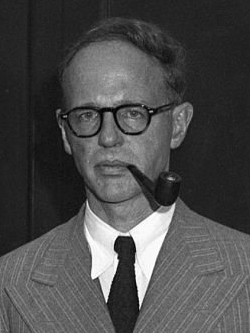
A great great grandson of the famous railroad and shipping magnate Cornelius Vanderbilt, Frederick Vanderbilt Field was born with a silver spoon in his mouth, but his worldview would fundamentally change when he went to college. His time studying at the London School of Economics convinced him that socialism was the way of the future and that the wealthy were completely out of touch with the plight of the less fortunate, but on his return to America he found that the 1920s Democratic Party lacked interest in socialism, thus he joined up with the Socialist Party and endorsed Norman Thomas’s 1928 run for president. This made him a disgrace to the family, and his great uncle and namesake, Frederick Vanderbilt, financially cut him off. The Great Depression convinced Field that the Socialist Party wasn’t enough, and moved to supporting the Communist Party.
This support was financial, with him becoming known as “the Reds’ pet blueblood” as well as him participating in communist organizations and pickets. During the Moscow Trials, Field (1983) recalled defending them by saying “because Comrade Stalin says so, we have to believe the trials are just” (22). In 1940, as executive secretary of the American Peace Mobilization (which would be identified as a communist front by Attorney General Tom C. Clark in 1947), he strongly opposed the U.S. getting involved in World War II but immediately switched to interventionism when Hitler betrayed Stalin with Operation Barbarossa, consistent with the communist line. In 1942, FDR’s administrative assistant Lauchlin Currie (now known to have been a Soviet agent) attempted to get Field a military intelligence post, this was denied as he was considered a security risk. It is not confirmed whether Field actually joined the Communist Party itself, but he in every way behaved as a member. Indeed, in 1949, he identified himself as an “American Communist”. Field also notably was a member of the Institute of Pacific Relations, which was used to advance the cause of Mao and his communists in China and with communist Philip Jaffe he founded the institute’s journal, Amerasia, which was pro-Mao.
Field was undoubtedly an agent of influence for the USSR in the United States, and may have even been an intelligence agent for them. Indeed, Whittaker Chambers, Elizabeth Bentley, and Louis F. Budenz attested to his activities in the Communist underground, with Bentley testifying that meetings of Soviet agents were hosted by Field. He served as secretary to the Civil Rights Congress, which was identified as a communist front by Attorney General Tom C. Clark, and in this position he coordinated the collection of the bail money for eight communists who jumped bail and disappeared after their convictions for violation of the Smith Act. In 1951, Field was sentenced to 90 days in prison for failure to disclose the providers of the bail money, and served two months in federal prison at Ashland, Kentucky. That year, Life Magazine (1951) quoted him as saying, ”You can get stinking drunk at the Stork Club every night and still be held in the highest esteem, but if you write or even believe anything different, then you’re a traitor to your class” (Nemy). In December 1953, finding the political climate of the US untenable, he moved to Mexico, where he was an unsuccessful businessman and an amateur archaeologist until his return to the United States in 1982. In his autobiography, Field (1983) denied having been a member of the party, but conceded that “I suppose I was what the Party called a ‘member at large” (22). He lived in Minneapolis until his death on February 1, 2000 at the age of 94. Even if Field was not a member of the Communist Party, he was in thought and deed a communist at least up into the 1950s.
References
Communists: Life of an Angel. (1950, January 8). Time Magazine.
Retrieved from
https://time.com/archive/6613971/communists-life-of-an-angel
Field, F.V. (1983). From Right to Left: An Autobiography. Brooklyn, NY: Lawrence Hill.
Nemy, E. (2000, February 7). Frederick Vanderbilt Field, Wealthy Leftist, Dies at 94. The New York Times.
Retrieved from
White, W.S. (1951, July 27). Field Says He Was Invited to Seek Air Intelligence Post. The New York Times.
Retrieved from

