
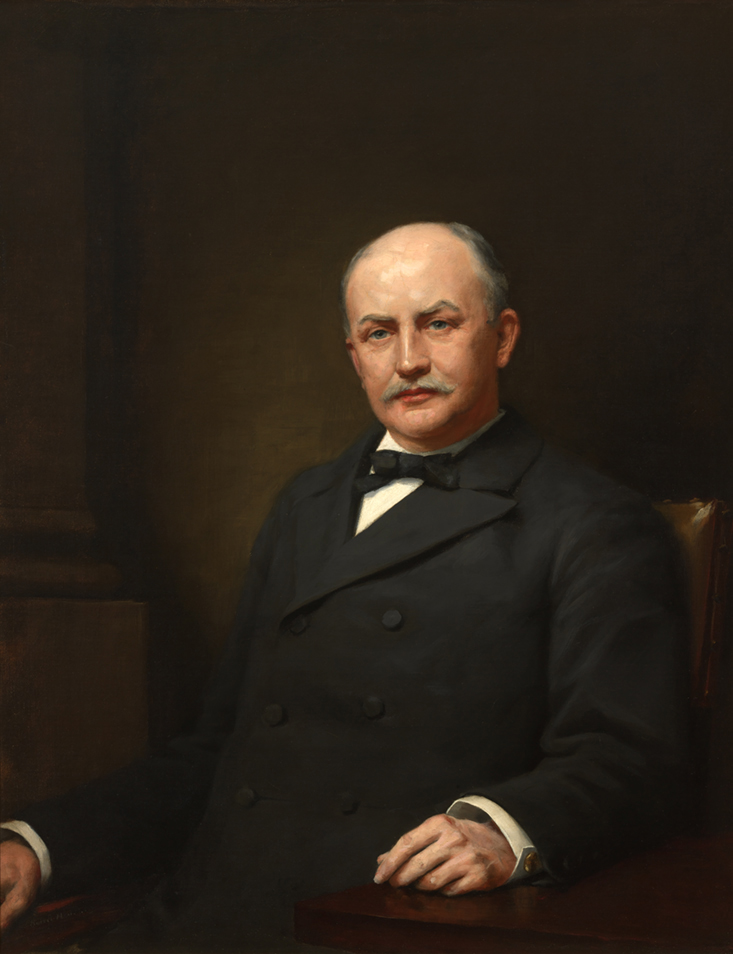
Most people do not know of senators from history, especially those who did not run for president. One senator who is very much worth remembering, however, is Roscoe Conkling of New York (1829-1888). His iron political grip on New York, a vital swing state in his time, produced divisions within the Republican Party itself.
In 1858, the Republican Party was a young organization, and elected to Congress from New York that year was Roscoe Conkling. Formerly the mayor of Utica, Conkling was such a striking figure in Washington that if he were serving today, one might call him “Congressman Chad”. By profession a successful lawyer, he was a strapping young buck who was always committed to self-improvement. This meant strength of body and mind, making him exercise a great deal including through horseback riding and boxing. Conkling was also tremendously well-read, and his memory was such that he could read books and documents and be able to recite much of them afterwards. He could deliver speeches for hours without stumbling on a single word or losing anyone’s attention. Conkling also did not smoke and seldom drank. All this, including his height of 6’3″ and his reputation as “Lord Roscoe” made him a hit with the ladies of Washington. When Republican representatives were concerned for the safety of the aging Thaddeus Stevens (R-Penn.) as his words for Southern Democrats were often harsh, considering the brutal beating inflicted on Senator Charles Sumner in 1856, Conkling served as his bodyguard. He condemned President Buchanan during the secession crisis as being “petrified by fear, or vacillating between determination and doubt, while the rebels snatched him from his nerveless grasp the ensign of the Republic, and waved before his eyes the banner of secession…” (National Park Service, Part 1). However, there were negative aspects to Conkling. He wasn’t particularly popular among his fellow legislators, as he had a well-deserved reputation for arrogance. Conkling was humorless, often disagreeable, easily offended, and was known to strut about as opposed to walk. This, combined with him having a distinctive blonde curl on his forehead as well as his loudly colored vests and bowties, made him a gold mine for political cartoonists of the era.

Conkling was on much better terms with Buchanan’s successor, Abraham Lincoln. Although his first choice had been Senator William Seward of New York, Conkling stood by Lincoln. While he often backed typical Republican positions such as high tariffs with the Morrill Tariff, he didn’t always agree with the president. For instance, he voted against the Legal Tender Act of 1862, refusing to accept fiat paper currency even as an emergency measure. That year, Conkling lost reelection to War Democrat Francis Kernan, his former law professor. Conkling in turn defeated Kernan for reelection in 1864, but both men remained good friends throughout. After the War of the Rebellion, Conkling stood as a Radical Republican. To be clear, the term “Radical Republican” means believing in a punitive approach to the South as well as strongly standing for the rights of freedmen and has no greater issue implications for the politics of the time. He clashed not only with Democrats but also with his fellow Republicans, including prominent ones in James G. Blaine and James A. Garfield. It was particularly bitter with the former, and their bad relations began in 1866, when after several exchanges on the House floor Blaine said, “The contempt of that large-minded gentleman is so wilting; his haughty disdain, his grandiloquent swell, his majestic, super-eminent, overpowering turkey-gobbler strut has been so crushing to myself and all the members of this House that I know it was an act of the greatest temerity of me to venture upon a controversy with him” (National Park Service, Part I). Conkling never forgave Blaine and would continually battle him for power and influence in the Republican Party. In 1867, Congressman Conkling became Senator Conkling.
The Senate
In the Senate, Conkling staunchly supported the impeachment of President Andrew Johnson, and the effort to convict him fell only one vote short. When it came to presidents, he would easily have his best relationship with Johnson’s successor, Ulysses S. Grant. Conkling undoubtedly found his greatest ally in his good friend Grant. He at the time was competing with Reuben Fenton, New York’s other senator, for patronage in the state, and he was quite the success on that front. Fenton thought it was a good idea to suck up to Grant, which he despised, and by contrast respected Conkling sticking to his guns respectfully (National Park Service, Part II). Grant thus heeded Conkling on many matters, including who to appoint to positions in New York, especially the customs collector of the Port of New York, the port that took in the most tariff revenue. Conkling selected Thomas Murphy for the position, but Murphy proved so antagonistic to other Republicans that he was replaced with Chester Arthur in 1871, a highly competent administrator loyal to Conkling. Chauncey Depew, a railroad executive and a senator himself, attested to his rise to power, “Conkling was a born leader, very autocratic and dictatorial…He immediately began to remove [Reuben] Fenton officials and to replace them with members of his own organization. As there was no civil service at that time and public officers were necessarily active politicians, Senator Conkling in a few years destroyed the organization which Fenton had built up as governor, and became master of the Republican party in the State” (The Lehrman Institute). Conkling’s power got to the point that anyone who wanted to have a state job had to get his seal of approval. Elihu Root, a GOP statesman, further attested to Conkling’s power, “I do not remember how many years, Mr. Conkling was the supreme ruler in this state; the Governor did not count, the legislatures did not count; comptrollers and Secretaries and what-not, did not count. It was what Mr. Conkling said” (Lamphier, 135).
In 1873, Grant nominated Conkling to succeed the late Salmon P. Chase as chief justice of the Supreme Court, a position he declined…he preferred to run his New York machine and saw himself as Grant’s successor. He also assisted Grant in numerous ways, such as when he led the push to oust Charles Sumner from his chairmanship of the Senate Foreign Relations Committee after his opposition proved key to the defeat of the annexation of Santo Domingo (now known as the Dominican Republic). The president often heeded his advice on legislation as well; for instance, both he and Secretary of the Treasury Hamilton Fish, economic conservatives, advised him to veto the popular Inflation Act of 1874, which he did. The following year, to the gratitude of black Americans, Conkling walked black Senator Blanche K. Bruce of Mississippi down the Senate aisle. This was a task usually reserved for the senator’s colleague in the state, but Mississippi Senator James Alcorn, a rival who would later support the disenfranchisement of black voters in Mississippi, wanted nothing to do with Bruce. Conkling and Bruce developed a close friendship, and numerous black parents would name their boys “Roscoe Conkling” in the following years in his honor, Bruce himself being among them.
In 1876, Conkling ran for the Republican nomination, but after his bid failed to attract much support, he managed to score a victory by pledging New York to Rutherford B. Hayes, thereby blocking former Speaker James G. Blaine’s path to the White House. After Hayes came out for civil service reform during the presidential campaign, Conkling’s efforts for Hayes slowed down, and Hayes lost New York in the presidential election. Had he won New York, there would have been no Constitutional crisis from this election. Incidentally, Conkling ended up believing that Hayes had actually lost the election and gave a propagandistic assist to Democrats by referring to him by the names they did, such as “Rutherfraud B. Hayes” and “his fraudulency”. Conkling derided civil service reform as “snivel service reform”, believing that state politicians should have free reign in their state’s affairs, a most convenient principle for him. He was not personally corrupt…no evidence has arisen that he profited from his office and although he was a target of investigation for the Credit Mobilier Scandal, documentary evidence cleared him of wrongdoing. Conkling had made his fortune legitimately; he hungered for power rather than money. However, numerous underlings were corrupt and profited off their offices.
As president, Hayes tried to appoint people to prominent positions in New York independent of Conkling’s approval. This resulted in several failed nominations, including one Theodore Roosevelt Sr. for customs collector for the Port of New York, the post formerly held by Conkling man Chester Arthur, who Hayes had fired. Ultimately Hayes managed to replace Conkling men Arthur and Alonzo Cornell with Edwin Merritt and Silas Burt in 1879. He did, however, consistent with his position favoring hard money, back Hayes’ veto of the bimetallist Bland-Allison Act in 1878.
Indiscretions in Washington
I mentioned earlier that Conkling was a hit with the ladies, but he was married. While he denied accusations that he was a womanizer, it was an open secret in Washington was that he was carrying on an affair with Kate Chase Sprague, the wife of former Senator William Sprague of Rhode Island, an insecure narcissist and abusive alcoholic. His only great virtue for the marriage seemed to be his wealth, much of the latter he had lost in the Panic of 1873. There was a rather famous incident surrounding this in 1879 in which Sprague chased Conkling out of his home with a shotgun.
Conkling Goes to Bat for Grant: 1880
Senator Roscoe Conkling, keen to have a Stalwart in office as opposed to Rutherford B. Hayes, who had through his single term crossed him in multiple ways, pushed for Grant get the nod again. There was indeed a real chance this could happen, but Grant had competition in former Senator John Sherman of Ohio as well as Conkling’s old rival Blaine. Although Grant won the first ballot, the threshold for winning the nomination wasn’t reached until the 35th ballot, by which point Sherman and Blaine had thrown their support to the dark horse candidate, Congressman James A. Garfield of Ohio. To please the Stalwarts, Conkling’s old right-hand man, Chester Arthur, was selected as the nominee for vice president.
Conkling vs. Garfield
President Garfield, like his fellow Ohioan Hayes, challenged Conkling’s authority in his nominations. He nominated a candidate for customs collector of the Port of New York in William Robertson, a former Fenton man, and in response Conkling “raged and roared like a bull for three mortal hours” and decried a violation of “senatorial courtesy” to which Garfield responded that he was the president rather than “the registering clerk of the United States Senate” (U.S. Senate). After Garfield was able to secure his nominee for customs collector of the Port of New York, Conkling and his protege, Senator Thomas C. Platt, resigned the Senate in protest on May 16, 1881, so they could be reelected by the state legislature in a show of power and support in New York. However, the men had miscalculated in trying to make loyalty to Garfield or loyalty to Conkling an issue for the state legislature, and in the meantime Garfield had been shot by Charles Guiteau, a deranged office-seeker who when he did it proclaimed, “I am a Stalwart” (Mitchell). The state legislature instead elected Republicans Elbridge Lapham and Warner Miller to the Senate. With this failed gambit, Conkling’s political career was over, and he returned to practicing law. Conkling’s DW-Nominate score stands at a 0.306, on the right side of Republican senators of his time. Platt would become a political boss in his own right but would not return to the Senate until 1897.
Although President Arthur nominated Conkling to the Supreme Court and the Senate voted to confirm him, he refused to serve. There were two reasons for Conkling to do so. First, he wanted a more active lifestyle than the Supreme Court would give him, and second, he was bitter over Chester Arthur’s embrace of a civil service, viewing it as a betrayal. Conkling to this day is one of only two men to refuse a Supreme Court nomination twice.
Conkling and the 14th Amendment as a Vehicle for Corporate Rights
In 1882, Conkling argued before the Supreme Court in San Mateo County v. Southern Pacific Railroad Company that as a member of the Joint Committee on Reconstruction, which drafted the 14th Amendment, that there was a debate about the distinction between “persons” and “citizens” and that this debate revealed that corporations were intended for coverage. Although enhanced legal protections for corporations certainly fit the ideology of the former Whigs, of which central framer John A. Bingham of Ohio and Conkling were formerly of, 14th Amendment scholar Howard Jay Graham found in the 1960s that Conkling had almost certainly deliberately misrepresented and misquoted the Globe regarding Congress’s proceedings to help his client. While the idea of corporations as persons as a legal fiction predates the adoption of the 14th Amendment, it is understandable that this episode would give people the idea that the concept was born in illegitimacy.
Conkling vs. The Great Blizzard of 1888
On March 12, 1888, New York City faced the Great Blizzard of 1888, and although Conkling could have taken a carriage to get from his office to his home, but the carriage driver was charging an exorbitant (although affordable for Conkling) rate, which he refused to pay and opted to walk the three miles home. Conkling made it to Union Square, about halfway to his destination, before collapsing from exposure. Although this episode was of some embarrassment to him, it was much worse than that; it had weakened his immune system and he contracted pneumonia. This pneumonia progressed into meningitis, which killed him on April 18th at the age of 58. Both Conkling’s end in politics and of life was brought about by his own arrogance. As Chauncey Depew said of him, “Roscoe Conkling was created by nature for a great career” and that his lost potential “was entirely his own fault. Physically he was the handsomest man of his time. His mental equipment nearly approached genius…His oratorical gifts were of the highest order, and he was a debater of rare power and resources. But his intolerable egotism deprived him of the vision necessary for supreme leadership….[H]is wonderful gifts were wholly devoted to partisan discussions and local issues” (National Park Service, Part II).
References
Both New York Senators Resign. United States Senate.
Retrieved from
Conkling, Roscoe. Voteview.
Retrieved from
https://voteview.com/person/1984/roscoe-conkling
Graham, H.J. (1968). Everyman’s Constitution. Madison, WI: State Historical Society of Wisconsin.
Retrieved from
Lamphier, P.A. (2003). Kate Chase and William Sprague: politics and gender in a Civil War marriage. Omaha, NE: University of Nebraska.
Mr. Lincoln and New York: Roscoe Conkling. The Lehrman Institute.
Retrieved from
https://www.mrlincolnandnewyork.org/new-yorkers/roscoe-conkling-1829-1888/
Mitchell, R. (2022, February 27). The senator who said no to a seat on the Supreme Court – twice. The Washington Post.
Retrieved from
https://www.washingtonpost.com/history/2022/02/27/roscoe-conkling-supreme-court/
O’Grady, J. (2015, January 27). Bad Idea: The Most Powerful Man in America Walks Home Through the Blizzard of 1888. WNYC News.
Retrieved from
https://www.wnyc.org/story/bad-idea-most-powerful-man-america-walks-home-through-blizzard-1888/
The Remarkable Roscoe: Friend and Nemesis of Presidents (Part I). National Park Service.
Retrieved from
https://www.nps.gov/articles/000/the-remarkable-roscoe-friend-and-nemesis-of-presidents-part-i.htm
The Remarkable Roscoe, Part II. National Park Service.
Retrieved from
https://www.nps.gov/articles/000/the-remarkable-roscoe-part-ii.htm




 Mad Politics: The Bizarre, Fascinating, and Unknown of American Political History