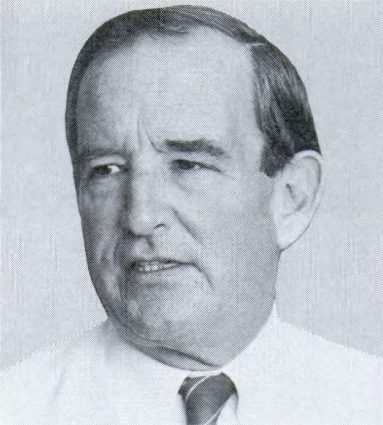
Connecticut seems to be just out of reach for Republicans. Although George Logan came close to winning a Congressional seat last year, the state hasn’t elected a Republican governor or member of Congress since 2006. Those who won office were of a distinctly moderate to liberal variety: Chris Shays was the last Republican ever elected to Congress from the state and he was often thought of as a RINO, but more so than him was his predecessor, Stewart Brett McKinney (1931-1987).
A businessman primarily focusing on cars, McKinney was well placed in the community of Fairfield, Connecticut to run for public office. Although his first effort at running in 1965 as a town selectman was unsuccessful, the following year his political career kicked off, being elected to the Connecticut State House. His chance to move up came soon, as in 1970 Congressman Lowell Weicker ran for the Senate, with McKinney going for his seat in the 4th district. Both men won their races, with the latter winning by 14 points. Indeed, the 4th district was consistently represented by a Republican from 1969 to 2009.
Congressman McKinney: A Liberal Reputation
In the House, Congressman McKinney developed a record that was supportive of social welfare measures, including government-run childcare and extending the Economic Opportunity Act in 1971. He also was supportive of organized labor, voting against amendments prohibiting food stamps for households that need assistance because the head of household is on strike. McKinney defied the Nixon Administration multiple times on Vietnam, supporting a defined pullout date. However, he also had a mixed record on busing as a means for school desegregation, supported anti-subversive legislation, and backed the B-1 Bomber. In 1973, McKinney supported the Crane (R-Ill.) proposal legalizing the private ownership of gold, but also supported raising the minimum wage over President Nixon’s veto and foreign aid. That year, he drafted the D.C. Home Rule Act, which granted D.C. residents the ability to elect their own mayor and city council. Indeed, McKinney was so passionate in his advocacy for D.C. that the district’s non-voting delegate, Democrat Walter Fauntroy, regarded him as “my vote on the House floor” (Specter & Pearson). McKinney’s modified ACA-Index scores ranged from 15% in 1977 to 54% in 1971. The American Conservative Union gave him a lifetime score of 27%.
During the 95th Congress, McKinney served on the Committee on Assassinations, and agreed with the majority conclusion that there was a fourth shot coming from the grassy knoll in the JFK assassination based on a Dictabelt recording, but this turned out not to have been a recording from Dealey Plaza (Sabato). In 1979, he led the drafting of the Chrysler bailout, and this wouldn’t be the last time he’d be involved in business bailouts. In 1984, there was a run on the Continental Illinois National Bank and Trust Co., and as Congress was conducting hearings on a bailout package, McKinney stated, “We have a new kind of bank. It is called too big to fail. TBTF, and it is a wonderful bank” (Ryssdal & Hollenhorst). His use of “too big to fail” popularized the now commonly used term.
McKinney and Reagan
Although Congressman McKinney backed a number of Reagan’s budget and tax reduction proposals, he would be one of the most visible dissenters within the GOP, including on social issues and on military spending. In 1983, he voted for the Equal Rights Amendment and against funding the MX Missile and the B-1 Bomber. It was also during this time that he would have his last achievement in the Homeless Assistance Act, which he sponsored with Representative Bruce Vento (D-Minn.). This established aid programs for the homeless and would be signed into law by President Reagan on July 22, 1987.
Personal Life and End
Although a married man with children, McKinney was bisexual and had relations with multiple men. He also struggled with his health over the years, including needing to undergo multiple-heart-bypass surgery in 1979. In 1985, McKinney was diagnosed with HIV, and on April 22, 1987, while being hospitalized for pneumonia he would be diagnosed with AIDS, dying on May 7th. McKinney’s physician Dr. Cesar Caceres stated, “I believe that Mr. McKinney contracted the disease from the many blood transfusions he received while undergoing multiple-heart-bypass surgery in 1979. This was during the period between 1978 and the spring of 1985 when no testing of blood donors for [HIV] was done” (Specter & Pearson).
References
Rep. Stewart McKinney. American Conservative Union.
I have written about this subject before, namely that I regard the narrative that Nixon of being a liberal as a myth, rather that he was moderately conservative, but there are some greater details I’d like to delve into, namely how he fared with the top two interest groups that issued ratings based on liberalism and conservatism: Americans for Democratic Action and Americans for Constitutional Action. Some takeaways: Ideologues were not pleased with Nixon’s first two years. For conservatives, the complaints included that under his administration there was the largest expansion of the federal government since 1945 (Kotlowski). However, like I’ve covered before, some of these changes such as the Endangered Species Act and the Clean Air Act amendments, received consensus support to the degree that such votes are rendered worthless for ascertaining liberalism and conservatism among legislators.
If Nixon was counted by ACA and ADA scorecards based on the positions he took on their votes, this is how it would come out:
Years
ADA (S)
ADA (H)
ACA (S)
ACA (H)
1969
13
17
22
30
1970
21
44
75
67
1971
17
8
55
91
1972
14
29
100
55
1973
11
11
100
80
1974
33
17
89
60
Average
18
21
74
64
The scores regarding Americans for Constitutional Action can be searched on this website under Americans for Constitutional Action Project: An Update. For Americans for Democratic Action, the votes counted can be looked up on Voteview’s website for Nixon’s positions. However, the vote count is incompletely presented for 1970 and 1974 on ADA’s website, so I have filled in the blanks. The 1970 ADA file available consists of interim ratings designed to influence voters for the 1970 midterms, which ADA regarded as of the utmost importance. The complete version, released later, had 25 House votes rather than 18 and 32 Senate votes rather than 20.
The missing roll call votes for 1970 in the House, with the pro-ADA position, are: 335, Yea; 382, Nay; 383, Nay; 400, Nay; 404, Yea; 410, Yea; 439. Yea.
The missing roll call votes for 1970 in the Senate, with the pro-ADA position, are: 483, Yea; 496, Yea; 501, Yea; 503, Yea; 553, Yea; 559, Nay; 571, Yea; 596, Yea; 608, Yea; 623, Yea; 642, Yea; 647, Yea.
The missing roll call votes for 1974 in the House, with the pro-ADA position, are: 699, Yea; 701, Yea; 707, Nay; 739, Yea; 776, Yea; 779, Nay; 796, Yea; 861, Yea; 862, Yea; 863, Yea; 874, Yea; 897, Nay; 933, Yea; 947, Nay; 971, Nay; 988, Nay.
The missing roll call votes for 1974 in the Senate, with the pro-ADA position, are: 671, Nay; 713, Yea; 750, Yea; 784, Yea; 799, Yea; 804, Yea; 806.
1969 provides a fascinating contrast between how liberals and conservatives saw Nixon: both groups thought he was bad news but for different reasons. Of particular note is how low he scores with Americans for Constitutional Action, which was achieved by him only siding with them on three of ten issues in the House and two of nine in the Senate. Nixon’s sins from a conservative perspective included:
Accepting too high raises of the debt ceiling.
The Family Assistance Plan.
Compromising with Republican liberals on the issue of busing as a means of desegregation.
Leading otherwise conservative Republicans into taking more liberal positions to be in line with the president.
Supporting increases in foreign aid.
Supporting extensions of anti-poverty programs without their functions being transferred to states.
Supporting farm subsidy payments.
1970 strangely has Nixon moving in a rightward direction from ACA but a leftward direction from ADA.
ADA’s problems with Nixon were many, but among some more notable ones:
His support for Supersonic Transport, which ACA didn’t regard as sufficiently indicative of conservatism to count in their ratings.
Vietnam War policy.
His support for altering the Voting Rights Act to make application nationwide as well as his opposition to a voting rights extension over the inclusion of an 18-year-old vote provision. Although it is true that Nixon signed into law an extension of the Voting Rights Act, he did that in spite of the 18-year-old vote provision, which was struck down by the Supreme Court and thus necessitated a Constitutional amendment.
Nixon does better by ACA in both Houses in 1970, and afterwards did much better. After being reelected, he looks downright princely in the Senate by ACA standards and just okay in the House. Overall, Nixon figures as a moderate by ACA standards in the House and as a moderate conservative in the Senate. By ADA standards, he figures as a conservative in the Senate and as a moderate conservative in the House. I have noticed that when looking at historic figures for liberalism, a standard that seems akin to that of radical conservatives Kent and Phoebe Courtney, whose 1961-1962 ratings I have covered, is often used. Such a standard ought to cause them to blush, were they still alive, and it doesn’t account for where conservatives and liberals were standing at the time. ACA itself was already considered very conservative, yet by their standards Nixon doesn’t do too shabbily.
References
Kotlowski, D.J. (2002, June 9). Was Richard M. Nixon a closet liberal? The Baltimore Sun.
Senator Charles Sumner (R-Mass.), most noted as an abolitionist, was also a supporter of the proposed Christian Amendment to the Constitution.
Lately, we have heard some GOP showhorses talk about the United States as a “Christian nation”. Lauren Boebert of Colorado, for instance, said last year that she was “tired of this separation of church and state junk – that’s not in the Constitution”, while adding that “The church is supposed to direct the government” and not the other way around (Dress). Non-Republicans lament of what the GOP has become over such a sentiment and others, seeming to believe that the GOP was once a more secular party. The Senate GOP’s 29-3 vote for a school prayer amendment to the Constitution in 1966, which I have covered before, says otherwise. Although the latter part of Boebert’s statement about church directing government is completely off as to the intentions of the Founding Fathers, she is on solid ground with holding that government is not supposed to direct the church as well as the first part as the phrase “separation of church and state” does not appear in the Constitution, rather Thomas Jefferson’s letter to the Danbury Baptists. Her sentiments on religion and state also have more in common with founding figures of the Republican Party than such non-Republicans think. From the adoption of the United States Constitution, there were those who saw the absence of God in it as a deficit, and during the 1860s a number of Republicans saw fit to do something about it.
Proposing the Christian Amendment
In 1861, eleven representatives from Protestant denominations met and saw the War of the Rebellion as a form of divine punishment for failure to include God in the Constitution, and proposed to alter the preamble to mention God. The following year the National Reform Association was founded to push this amendment and proposed it to President Lincoln, who was noncommittal. The proposed amendment would add, “We, the people of the United States, humbly acknowledging Almighty God as the source of all authority and power in civil government, the Lord Jesus Christ as the Ruler among the nations, His revealed will as the supreme law of the land, in order to constitute a Christian government, and in order to form a more perfect union, establish justice, insure domestic tranquility, provide for the common defense, promote the general welfare, and secure the inalienable rights and the blessings of life, liberty, and the pursuit of happiness to ourselves and our posterity, and all the people, do ordain and establish this Constitution for the United States of America” (Allison). Prominent supporters included such big names in the early Republican Party as Senators Charles Sumner of Massachusetts, Zachariah Chandler and Jacob Howard of Michigan, B. Gratz Brown of Missouri, John Sherman of Ohio, and Justin Morrill and George Edmunds of Vermont.
Despite this promising start of support, the War of the Rebellion was consuming the time of government, and the assassination of President Lincoln further disrupted any push forward this amendment might have had. There was also some growing hesitation among its supporters. Charles Sumner, for instance, grew concerned about how his Jewish constituents would respond (Allison). The proposed amendment suffered a great blow when Lyman Trumbull (R-Ill.), chairman of the Judiciary Committee, regarded the amendment as unnecessary in 1865 and cited examples of the Constitution indirectly supporting the notion of God, including public oaths for office and a right for free exercise of religion. Trumbull then asked for the Judiciary Committee to be discharged from the duty of consideration of the amendment and it was agreed to (Allison). Efforts persisted, with petitions being presented by numerous members of the House and Senate. Senator Richard Yates (R-Ill.), stated in his support,
“So far as I am concerned. I must say that this nation is too much indebted to the Christian religion for its national superiority for it to ignore Christianity. This is the religion which aroused our fathers in the old country and caused them to migrate to this continent and to lay here the foundations of religion and freedom. It crossed the ocean with our Pilgrim fathers; it has carried our institutions to the distant frontier; it has erected temples dedicated to the true God. The spirit of its philanthropy has filled our land with colleges and school. Its benevolence has established institutions for the relief of the disabled and the diseased, and for the amelioration of our race. And now, sir, nine-tenths of the people of my State demand that there shall be an amendment to the Constitution by which the supremacy of God shall be acknowledged by this great nation to that Being to whom we are indebted for all that we are — for our successes in many wars, and for the establishment of equal rights and liberty throughout the land” (Allison).
The amendment was not without its opponents, including Senators Francis P. Blair (D-Mo.) and Carl Schurz (LR-Mo.) who objected to consideration with the latter citing petitions from over 10,000 people in opposition. No action was taken over concerns that the amendment had potential to impair free exercise of religion.
The nation that existed when this amendment was proposed was an overwhelmingly Protestant one, with Protestantism being taken as a given with Catholic and other religious schools being regarded as “sectarian”. There have been periodic efforts since to amend the Constitution to make it more of a Christian document, with the most recent example being school prayer, which I have covered before. Although the school prayer amendment is on its face neutral and could potentially be neutral in application, the motivation for it comes from Protestants who want prayer in the classroom, as it existed in many American schools before the 1962 Supreme Court decision Engel v. Vitale.
References
Allison, J. (1998). The NRA (National Reform Association) and the Christian Amendment. The Constitutional Principle: Separation of Church and State.
Dress, B. (2022, June 28). Boebert says she is ‘tired’ of separation between church and state: ‘The church is supposed to direct the government’. The Hill.
The election of Ronald Reagan to the presidency in 1980 provided a real promise of conservative governance, with a conservative president, a Republican Senate, and a House that although was not Republican, promised to be majority conservative. However, what was the score for Reagan and the Congress on the issues? They counted for the 1981 and 1982 House 24 and 23 votes respectively, and for 1981 and 1982 Senate 21 votes for both years. Among the issues, they supported indexing tax brackets for inflation, retaining funds for the B-1 Bomber and MX Missile, the Solomon Amendment, overturning a Federal Trade Commission regulation requiring used car sellers to inform their customers of major known defects with automobiles, a Balanced Budget Amendment to the Constitution, and school prayer. They opposed busing, the proposed American Conservation Corps, raising the debt ceiling, bilingual ballot requirements, US participation in international development banks, and overriding President Reagan’s vetoes on spending bills. President Reagan himself gets, based on issues he made his opinion known on, an 80 and 100 in the House in 1981 and 1982, and a 70 and 73 in 1981 and 1982 in the Senate respectively. A bit lower than expected, honestly, but ACA finds him having gone wrong by supporting raising the debt limit in 1981 and 1982, supporting US involvement in international development banks in 1981, supporting the Tennessee-Tombigbee Waterway in 1981, opposing Sen. Harrison Schmitt’s (R-N.M.) amendment on disapproving federal regulations in 1982, and opposing a debt ceiling amendment to the Balanced Budget Amendment in 1982.
Some notable figures and their ACA scores, modified to count pairs for and against:
Barry Goldwater, R-Ariz. 1981 – 81 1982 – 72
John Rhodes, R-Ariz. – House Minority Leader 1981 – 74 1982 – 76
The ACA made their scores particularly tough to get all right or all wrong. In the 1981 Senate, for instance, only Chris Dodd of Connecticut scored a 0 and no senators scored a 100. In 1982, only Bill Armstrong of Colorado scored a 100 and no senators scored a 0. Jesse Helms of North Carolina missed one vote for each year. His sins by the standards of ACA? Voting to raise the debt limit in 1981 and voting to table an amendment allowing states to veto a nuclear waste storage site unless both Houses of Congress overrode the state’s veto.
Americans for Constitutional Action continued not to count abortion as an issue, a significant difference with the emerging new right It also counted the House vote for the conference report on the Tax Equity and Fiscal Responsibility Act in 1982 as a vote FOR the conservative position, as opposed to Americans for Democratic Action, which considered it a vote FOR the liberal position and American Conservative Union, which considered it a vote AGAINST the conservative position. This highlights a difference in the emphasis ACA put on deficit reduction to tax reduction. This wasn’t the only issue in which the organization sided with Americans for Democratic Action in this Congress: they shared their opposition to the Tennessee-Tombigbee Waterway, a project President Reagan favored.
Note: Errors
The data I used to ascertain the issues behind these scores comes from Voteview legacy’s website as well as the Almanac of American Politics 1984 edition. There were some errors in the process that I discovered, and this was through being unable to replicate the exact set of ratings. The 1981 Senate one given how much does fit I am 99% sure about.
The Senate has multiple instances, including:
Paula Hawkins (R-Fla.) – Improper in both 1981 and 1982, 1982 possibly a repeat of Lawton Chiles’ (D-Fla.) 57 score. Charles Mathias (R-Md.) – His 1981 score appears to be erroneously a repeat of his 1982 score of 14. Paul Tsongas (D-Mass.) – His 1981 score is listed as a 13, but appears to be a 16 instead. Claiborne Pell (D-R.I.) – His 1981 score appears to count a pair for ending debate on an anti-busing amendment as a vote for. Howard Baker (R-Tenn.) – He is counted as 67, but has an absence for the Metzenbaum amendment on oil price deregulation, which he was for.
The House’s issues:
In 1981, Bill Hefner (D-N.C.) was listed as having a score of 49. This is not mathematically possible with 24 votes, he scored a 48. In 1982, Beryl Anthony (D-Ark.) was listed as having a score of 65. This happened to be the same as neighboring Congressman John Paul Hammerschmidt (R-Ark.) and I was unable to find a proper combination of votes that would give Hammerschmidt and Anthony both a 65. I conclude this score was put in by mistake as a duplicate of Hammerschmidt’s.
Despite these, I believe I have hit upon an accurate counting of ACA’s scores, as I have found no other way to reconcile how all the other senators’ scores can be achieved at the same time. It was a truly tall order to find how ACA counted ultra-conservative Steve Symms’ (R-Idaho) score as an 81 in 1981, meaning he voted against their position four times. Same goes for ultra-liberal Ted Kennedy (D-Mass.) getting three votes right by their standards that year. What strikes me as interesting about these ratings is that they show how less ideological partisanship was in times past. Admittedly, the ACA has picked a few oddball votes for counting conservatism that contribute to this, but I can see how a case could be made for them.
In a recent post, I covered an Illinois Republican who dramatically departed from conservative orthodoxy. Today’s post is about a figure who could be said to have been a trailblazer for Reagan conservatism: Philip Miller Crane (1930-2014) of Illinois.
The son of newspaper columnist Dr. George W. Crane, who wrote the advice column “The Worry Clinic”, Crane carried his father’s conservative beliefs with him and was a Republican not only by ideology but by family legacy. Crane recounted, “My dad made sure that we shook hands with him [his great-grandfather], because he shook hands with Abraham Lincoln. In 1858, he went over to Danville in a covered wagon and sat in Lincoln’s lap. And Lincoln patted him on the head and shook his hand and said, ‘You know, you’re a fine young Republican, boy, and you stick with it.’ So we were knee-jerk Republicans because of that inheritance” (Loerzel). Dr. Crane would bring Phil to campaign for Republicans from a young age, including Alf Landon in 1936. Dr. Crane “felt Roosevelt had destroyed the republic”, and Phil himself condemned FDR for bringing “people to the nonsense belief that somehow you can get something for nothing out of Washington” (Loerzel). Crane served in the army from 1954 to 1956 and in 1961, he earned a PhD in history and subsequently became a professor at Bradley University, where he set up University Professors for Barry Goldwater. In 1964, he worked on the Goldwater campaign conducting research and published “The Democrat’s Dilemma” alleging heavy socialist influence on the Democratic Party. Crane was from that point forward active in the conservative movement, and recounted attacks against Goldwater supporters from other professors, “They charged that anyone supporting Goldwater was an incipient fascist, racist, anti-Semite. I didn’t mind the slings and arrows…I just redoubled my efforts” (Loerzel).
Crane to Congress
In 1969, Congressman Donald Rumsfeld resigned from his seat in the Chicago suburbs to head the Office of Economic Opportunity. Crane ran for the seat on a platform of never voting to raise taxes, and although he was not favored by the party establishment, he won. State Representative Bernie Pedersen said of him in 1992, “He’s a brilliant guy. He had a lot of appeal personally. He’s very articulate. In the beginning, if you asked him a question, he’d give you a 15-minute answer, like he was still a professor” (Loerzel). In Congress, he quickly established himself as an energetic advocate of conservative causes on numerous fronts. Crane was one of the founders of and served as chairman of the Republican Study Committee from 1973 to 1989, which was created to push the GOP leadership in a more conservative direction. He also helped found the Heritage Foundation in 1973 and hosted the show Conservative Viewpoint. From 1977 to 1979, he chaired the American Conservative Union, and he was quite ideologically fit to do so; In most of his years in Congress Crane received 100% scores from the organization. Indeed, his lifetime score would be a 99%. On May 26, 1972, he was one of only seven representatives to vote against authorizing the President to approve of the interim SALT Treaty with the USSR. Crane only once voted for a foreign aid bill: in 1974 the International Development Association bill included his amendment legalizing private ownership of gold, which took effect on December 31, 1974. That year, he successfully pushed for the only public and filmed audit of the U.S. Bullion Depository at Fort Knox, in which 12 members of Congress and 100 journalists participated on September 19th (Ganz). He was also involved in the successful effort to re-legalize gold clauses in contracts in 1977. Although his constituents repeatedly reelected him, Crane had critics in his district. His Democratic opponent in 1992, Sheila Smith, held that “Phil lives in an ivory tower. He entered it when he was teaching in the 1950s, and he never came out. (But) the real world doesn’t work that way” (Loerzel).
Although Crane had voted for the Equal Rights Amendment in 1971, he turned against it after Roe v. Wade and with the rise of the Stop ERA movement. Indeed, he was a staunch opponent of abortion throughout his career. During the Carter Administration, Crane was one of the leading figures against the Panama Canal treaties and the proposed SALT II Treaty. In 1978, his brother, Daniel, joined him in Congress. Dan Crane would vote almost identically to Phil, however he would lose reelection in 1984 due to him having an affair with a 17-year-old female page.
Running for President
In 1976, Crane endorsed Ronald Reagan’s challenge to Gerald Ford and chaired Illinois Citizens for Reagan. However, this didn’t stop this rising Republican star from announcing a presidential run in 1979. Unfortunately for Crane, he had made a powerful enemy who was supporting Ronald Reagan: William Loeb. Loeb’s newspaper, the Manchester Union-Leader, began publishing numerous anonymous accusations about Crane’s personal life and these dogged his already underdog campaign (Loerzel). Crane would endorse Reagan after dropping out. Rep. Mike Pence (R-Ind.) would tell in a tribute to Crane in 2004 why he ran, “I will never forget the evening sitting on the House floor when Congressman Crane told me the story of that night. He said, “We all just figured that one day Governor Reagan would look at Nancy and say, ‘I think, Mommy, we should just go and retire to the ranch.’ Ronald Reagan and history had different intentions, but as he has always been throughout his career, Phil Crane was ready to stand in the gap,” Pence said. “And when Ronald Reagan made his candidacy a reality, Phil Crane stayed in the race to honor his delegates from Illinois who had supported their favorite son, but he was one of the strongest supporters of President Reagan in 1980, enabling and assisting in his election and also being one of the great champions of the Reagan revolution from the minority here on Capitol Hill” (Sweet).
Subsequent Time in Congress
After the 1980 election, Crane, although as rigidly conservative as ever and his views becoming more in vogue, he was becoming eclipsed by other conservative advocates, such as Newt Gingrich. This was noted in the 1992 edition of “The Almanac of American Politics”, “There is an anomaly to his career. At the same time as his beliefs — in free-market economics, in a strong national defense, in traditional American ideals have been sweeping the country and the world, his own influence has been woefully meager and he continues to languish mostly unnoticed, despite 20-plus years of seniority, on back benches” (Loerzel). He remained a fighter for conservatism and if there was conservative opposition to be had to legislation, even if only a small group was opposing, he could usually be found among that minority. Although Crane had voted for the Balanced Budget Amendment in 1982 as well as repeated budget reduction proposals, he voted against the Gramm-Hollings-Rudman Balanced Budget Act in 1985. In some instances, he proved relevant, such as winning a repeal on the ban on chewing gum with the U.S.-Singapore Free Trade Agreement in 2003.
Personal Issues
In 1982, Crane was arrested for drunk driving in California but was found not guilty in June 1983. By the 1990s, his drinking had been on an upswing, which he attributed to the death of his 17-year-old daughter from cancer and his quitting of smoking cold turkey after 50 years (Sweet). In 2000, he admitted to being an alcoholic, drinking up to ten beers in a night, and successfully sought treatment. Although being senior to California’s Bill Thomas, he was passed over for the chairmanship of the House Ways and Means Committee, instead getting the vice chairmanship.
The End of the Road
In 2002, Crane faced a surprisingly strong challenge from Democrat Melissa Bean, who ran on him being out of touch with his constituents. Indeed, he had no public email address and numerous Republican voters said that they hadn’t seen him in decades. Although Crane won reelection, Bean had gotten 43% of the vote. In 2004, she tried again, and although President Bush carried the district by 12 points that year, Bean defeated him by about four points. The district, which has since been redistricted to favor Democrats considerably, has remained represented by Democrats for all except Joe Walsh’s term from 2011 to 2013. Crane died of lung cancer on November 8, 2014.
Overall
Crane was one of those conservatives who was instrumental in building up the conservative organizations that helped bring about the rise of conservatism in the United States. This, plus his stalwart record, his restoring the legality of gold ownership, and length of service, have earned him a place among the great conservatives of American history. Crane incidentally also scores a 99% on the MC-Index.
P.S.: My father has told me that my grandmother, who lived for some time in Crane’s district, had quite an argument with him. The subject of the argument is unknown to me.
References
Ganz, D.L. (2014, November 20). Right to own gold due to Phil Crane. Numismatic News.
The 88th Congress was the product of a midterm that was about as good as President Kennedy could have had. The Democrats lost only a single seat in the House and the Republicans lost three in the Senate. During this Congress, the tragedy that was the JFK assassination occurred. However, perhaps motivated to cooperate with the new administration, they passed a lot of significant measures, including mass transportation legislation, food stamp legislation, the Civil Rights Act of 1964, and the Economic Opportunity Act of 1964. However, liberals did face some setbacks, with a vote on extending the Area Redevelopment Act failing, the foreign aid bill being recommitted for further cuts, and an additional appropriation for the International Development Association being recommitted before a second version successfully passed. Notably, this was also the Congress that passed the Gulf of Tonkin Resolution.
I get the sense from reporting on the subject that 2023’s new party, No Labels, is for people who both want a break from Trump and the social justice obsessives and are roughly center to center right in orientation. Liberals and that parade of has-been Biden sycophants known as The Lincoln Project are alarmed by this development and they should be. Third parties tend to be detrimental to the party holding the White House, although the 1948 election was arguably an exception, as the perception of Truman’s distance from the nationally unpopular pro-Soviet Progressive Party and the segregationist State’s Rights (Dixiecrat) Party may have won him votes that would have otherwise gone to Dewey. This exception certainly did not apply to the 1980 election, and a contributing factor to Carter’s loss was a “tell it as it is” style independent candidate in Congressman John B. Anderson (1922-2017) of Illinois.
Anderson in 1965.
When Anderson was first elected to Congress in 1960 from a staunchly conservative rural Illinois district, succeeding longtime conservative Leo Allen, there was little thought that his record would be any different. And indeed, for a time, it wasn’t and if anything, more conservative. From 1961 to 1964, Americans for Democratic Action counted only one selected vote of his favorably: the Civil Rights Act of 1964. In the 87th Congress (1961-1962) Anderson only disagreed with John Birchers John Rousselot and Edgar Hiestand of California on one issue on Americans for Constitutional Action’s 23 selected votes. Indeed, they wrote on him, “He stands firm against the liberal pressures of Washington, the wild spending schemes, and the permissive society offered by the proponents of the Great Society” (Mason, 14). Anderson stood as an intellectual and articulate voice for conservatism in the 1960s, and if we were to look only at his record during the Kennedy and Johnson years, he stands as an easy candidate for a great conservative from American history. Indeed, his record was so impressive to the Republican leadership at the time that they made him number #3 in party leadership in the House as chairman of the House Republican Conference in 1969, the post that Elise Stefanik now occupies and figures such as Gerald Ford, Mike Pence, and Dick Cheney occupied in the past. However, by this point Anderson was already starting to turn away from conservatism.
A Turn to the Left
The classic story is that people who run for Congress pledging to change Washington become more changed by Washington than they change it. This was certainly the case for Anderson. In 1968, he flipped on a highly controversial issue: open housing. As former Congressman Don Manzullo recalls, “He was on the Rules Committee and under a lot of pressure to vote against bringing open housing to the House floor. But he was very touched by the plight of black Americans facing discrimination. At one point, he read a letter from a black husband and wife in Rockford who were teachers and had answered more than 100 advertisements for an apartment. They were turned away from all. That really moved him” (Gizzi). In 1966, Anderson had voted against that year’s civil rights bill over the open housing provisions, regarding it as a homeowner’s right to sell to who they want to sell to, whether their criterion was racially discriminatory or not. However, on April 9, 1968, only five days after MLK’s assassination, he cast the deciding vote for the bill to leave the Rules Committee and move to the floor and from that point forward his record would be consistently in support of civil rights measures. Anderson would repeatedly vote for busing and in 1978 he voted against curbing racial quotas. He also in 1968 voted for the Housing and Urban Development Act, providing extensive housing aid to low-income families along with other provisions. His turn to the left on social issues was also pronounced, as in 1971 he voted against the Wylie School Prayer Amendment; Anderson had previously sponsored multiple amendments for school prayer. Anderson proved supportive of environmental legislation as well, supporting environmental protection of Alaska lands and opposing compliance deadline for vehicle emission standards to 1977 in 1973, voting for a comprehensive land use bill in 1974, and voting to override President Ford’s veto of a strip-mining control bill in 1975. He did, however, regard the Reuss (D-Wis.) proposal in 1972 to require firms to have the latest water pollution control technology by 1980 to be excessive. By contrast, in 1961 Anderson had voted for the Cramer (R-Fla.) proposal to cut grants for water pollution facilities and in 1963 he had voted against the Clean Air Act.
Anderson also went liberal on foreign policy, opposing importing Rhodesian chrome, easing up on opposition to Export-Import Bank loans for communist nations in 1971 (he had voted multiple times against Ex-Im Bank funding for grain purchases for communist nations in 1963), and voted supportively of the Panama Canal treaties in 1976. As opposed to his early-mid 1960s record, he also voted for foreign aid measures. What’s more, he proved supportive of the creation of the Legal Services Corporation and supported a version of a proposed Consumer Protection Agency. To add to the laundry list of key issues Anderson backed that elicited hearty conservative complaints was his votes for New York City bailouts in 1975 and 1978. He bears a good deal of similarity to his Illinois colleague also elected in 1960, Paul Findley, but Anderson’s change was more dramatic.
His 1978 primary opponent, Rev. Don Lyon, came to believe that Anderson’s change was “Like a lot of ambitious Republicans, he wanted The Washington Post and The New York Times to like him. And, he wanted the money of the Rockefellers behind him. So he moved liberal” (Gizzi).
Where Anderson Kept Conservatism
Anderson hadn’t gone full to the left, of course, he voted to sustain many of President Nixon’s spending vetoes and remained a bit wary of anti-poverty and food stamp expenditures; in 1974 he proposed an amendment prohibiting food stamps for college students who were claimed as dependents by their parents. However, Anderson did vote for Nixon’s Family Assistance Plan in 1970. He supported Nixon on the subject of impoundments, a practice his critics regarded as being abused for political reasons and after Watergate Congress passed a severe curb on impoundments. Anderson also backed his 1973 veto a bill increasing the minimum wage and proved an opponent of price controls on oil, voting against the Emergency Energy Act in 1974 and voting for deregulation proposals in 1975 and 1977.
Increasing Dissatisfaction with the GOP
One source of constant support for Anderson despite his turns was the affable Gerald Ford, both as minority leader and as president, but Ford’s loss in 1976 to Carter took him out of the picture. By this point, conservatives were moving forward on primarying moderates and liberals, and they would prove successful in ousting Senators Clifford Case of New Jersey and Jacob Javits of New York in 1978 and 1980 respectively. Although Anderson bested his conservative primary challenger in 1978 by almost 10,000 votes, he was feeling done with Congress.
Anderson for President
Anderson in 1980
Anderson was getting a rather tired of the House and he had in 1979 been moved out of leadership in favor of arch-conservative Samuel Devine of Ohio. He resolved to either win the Republican nomination for president or be out of political office after 1980.
Anderson was often the odd man out in the Republican primary, bucking numerous conservative shibboleths in the primary debates. He supported raising the gas tax and supported the licensing of firearms (Neuman). Anderson also opposed lowering income taxes and supported the ratification of the Equal Rights Amendment, which at this point had become associated with abortion. And yes, Anderson did support government funding of abortions. However, Anderson, like other Republicans, focused against inflation. He hit both Carter and Reagan, for the former calling him a “mean and evasive” campaigner who was using recession to fight inflation, and he regarded Reagan as a dispenser of “slick and simplistic” campaign one-liners (Neuman). Anderson presented an alternative for the Republican Party’s weakening liberal wing. As the Washington Post noted at the time, “Anderson has built his success so far around what he calls “the Anderson Difference” — a willingness to take firm, sharp stands on such controversial questions as gasoline taxes and gun control (which he favors) and the MX missile system (which he opposes). Paradoxically, his position on the economy is not as distinct, because it consists of a complex mixture of orthodox Republican conservatism and liberal activism” (The Washington Post). After losing the primary, Anderson couldn’t back Reagan, but he wasn’t giving up yet.
Instead of backing Reagan, he runs as an Independent, focusing on his liberal positions to bleed support from Carter. However, he is no match in a debate with him. Anderson also selects a rather odd choice for running mate in Wisconsin’s former Democratic Governor Patrick Lucey. Ultimately, the Anderson-Lucey ticket only nets 6.6% of the popular vote in the general election. His ticket, does, however, have an interesting impact. It puts Reagan over the top in some states that he may not otherwise have won. In the following states Reagan’s margin of victory was less than the Anderson vote:
Arkansas
Connecticut
Delaware
Maine
Massachusetts (Reagan barely won the state while Anderson got 15% of the vote)
Michigan
Mississippi
New York
North Carolina
South Carolina
Tennessee
Vermont (Reagan won by six but Anderson got 15% of the vote)
Anderson would later sue the state of Ohio for their early filing deadline for independent candidates, and the statute was struck down by the Supreme Court in Anderson v. Celebrezze (1983) as unconstitutional. His foremost regret in Congress was his vote for the Gulf of Tonkin Resolution in 1964.
By 1984, Anderson had left the Republican Party and endorsed Democratic nominee Walter Mondale. He remained a political independent albeit a left-leaning one: in 2000, he endorsed Ralph Nader and in 2008 he supported Barack Obama for president. In 2012, Anderson played a minor role in the creation of the left-wing Justice Party, which ran former Salt Lake City Mayor Rocky Anderson for president. In 1992, he had founded Citizens for Proportional Representation, which has since changed its name to FairVote. This organization calls for instant run-off voting and proportional representation as well as universal voter registration. Anderson also voiced opposition to the Tea Party movement in 2010, stating, “I break out in a cold sweat at the thought that any of those people might prevail” (Clymer). Anderson died on December 3, 2017.
Just as a note of curiosity. The 1979 and 1980 ACA scores I have not mapped out, although information available on Voteview’s legacy website indicates Anderson’s 1979 and 1980 official ACA-Index scores.
ACA (Modified)
ADA (Modified)
Kennedy-Johnson Era
1961
100
0
1962
91
0
1963
100
0
1964
79
8
1965
91
12
1966
88
0
1967
81
13
1968
68
17
Average
87
6
Nixon-Carter Era
1969
38
36
1970
68
29
1971
63
36
1972
43
54
1973
42
38
1974
33
38
1975
58
61
1976
33
53
1977
38
47
1978
44
65
1979
37 (Official)
80
1980
0 (Official)
100
Average
42
53
References
For my citations of votes, check my posted ACA-Indexes of the years I mention.



 Mad Politics: The Bizarre, Fascinating, and Unknown of American Political History